
You don't have to go to the forest to pick mushrooms—you can successfully grow them at home. Honey mushrooms are a popular choice for this purpose—they're delicious and relatively easy to grow. They can be grown in a variety of ways, each with its own unique characteristics.
Types of honey mushrooms for growing at home
Several types of honey mushrooms grow in natural conditions, but only two of them are important for home cultivation: summer and winter (flammulina).
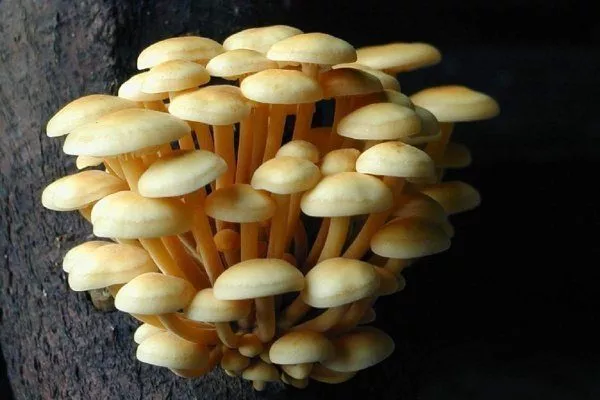
The winter variety of these mushrooms is attractive for its excellent taste. They are consumed primarily fresh or dried, with both the caps and stems being edible. The caps of winter honey mushrooms are rusty-yellow and can reach 9 cm in diameter. The flesh is yellowish and has a pleasant flavor.
Winter honey fungi naturally grow in tree hollows and stumps. They are usually found from October to December, but during thaws, they can be found even in February.
Winter honey mushrooms contain mildly toxic substances. These are present in the raw product but are completely destroyed after 20 minutes of cooking.
Comparative characteristics of honey mushroom species
| Parameter | Winter | Summer | Poplar | Marble |
|---|---|---|---|---|
| Cap diameter (cm) | Up to 9 | Up to 6 | 5-7 | 4-8 |
| Shelf life of fresh (days) | 3-5 | 2-3 | 1 | 10-12 |
| Required processing | Cook for 20 minutes | Can be eaten raw | Washing | Without soaking |
Summer mushrooms are smaller, with a cap diameter of up to 6 cm. They have watery flesh and a mild flavor. This variety of mushroom can even be eaten fresh.
In nature, summer honey mushrooms prefer rotten wood and grow in colonies. In mild climates, these mushrooms are found year-round.
One of the rare species is the poplar honey fungus. It's appealing for its crisp texture and nutty flavor, but it has a significant drawback: it has a shelf life of less than a day, and when frozen, no longer than a week. Despite its name, honey fungus can be grown not only on poplar but also on maple logs.
Another rare variety of mushroom is the marbled mushroom. These mushrooms are considered a delicacy. They have a slightly crunchy texture, a nutty flavor, and a sweet aroma. Raw mushrooms can be stored refrigerated for 1.5 weeks.
Marbled honey mushrooms are not soaked in water, as they absorb it and become brittle. This variety is prized for its complete lack of fat and high nutrient content.
Necessary conditions for growing
To grow honey mushrooms yourself, you need to provide them with certain conditions. These conditions depend on the chosen growing method.
General recommendations are as follows:
- maintain an optimal temperature within 10-15 degrees;
- ensure high humidity, which should be at least 70%;
- maintain the necessary lighting for mushrooms;
- ensure good ventilation;
- carry out disease and pest prevention.
Methods and technologies
Honey mushrooms are grown in artificial conditions using various methods. Stumps, greenhouses, and even jars are used. Each method has its own specific characteristics that must be considered to ensure a good harvest and a high-quality product.
Honey mushrooms on stumps
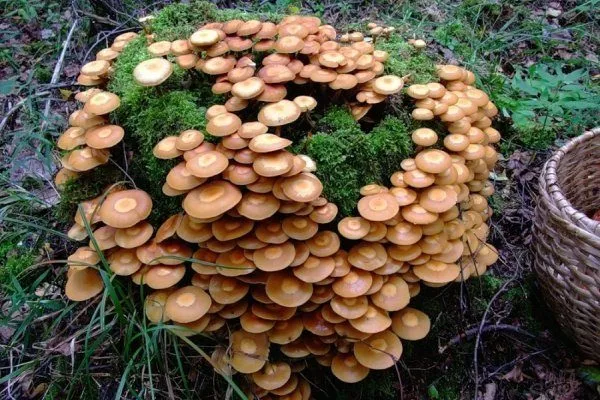
This method appeals to many people due to its minimal cost and close proximity to natural conditions. It's best to choose stumps from birch or spruce trees, but apple, pear, aspen, or poplar trees will also work. Summer mushrooms prefer deciduous trees.
Stumps must meet the following requirements:
- sufficient wood density;
- absence of rotten and bark beetle-damaged areas;
- sufficient humidity;
- diameter not less than 15 cm.
Optimal wood species for stumps
| Breed | Duration of stay (months) | Duration of fruiting (years) |
|---|---|---|
| Birch | 9-12 | 4-5 |
| Aspen | 8-10 | 5-6 |
| Apple | 10-14 | 3-4 |
The stump should be moistened not only on the outside but also inside, right down to the core. You can moisten it yourself by watering it generously for 1-2 days. Water can be applied with a bucket or in small doses from a hose.
A rich, dark color on the cut surface indicates sufficient moisture. If you cut off a small piece, liquid will ooze from it.
Growing from mushroom spores
Mushrooms can be planted from May until the end of summer. Follow these steps:
- Select overripe caps with a dark brown underside.
- Fill the selected caps with natural water. It should be chlorine-free, so don't use tap water for this purpose.
- The raw materials must be soaked in water for 24 hours.
- After the required time, the caps should be crushed by hand directly in the water.
- Pass the resulting mass several times through cheesecloth folded in several layers.
- The resulting spore mixture is poured onto the prepared stump. This can be easily done using a syringe.
- Indentations are made on the vertical parts of the stump and filled with the mixture. These should then be sealed with forest moss or damp sawdust.
For one medium-sized stump you need to use about a liter of the mixture.
Mushrooms planted this way take a long time to hatch. You'll only be able to enjoy the fruits of your labor after a year and a half.
Honey mushrooms can bear fruit on a single stump for about five years. During this time, the stump deteriorates, and the mushrooms can migrate to the ground. If there are trees nearby, they will attach themselves to large roots.
This video explains how to choose the right stumps for growing mushrooms:
Growing from mycelium
To grow honey mushrooms on a stump, you can use not only a mash but also mycelium particles. This method has the advantage of producing the first harvest more quickly.
It's best to collect mycelium from a nearly rotted stump. Choose a site with abundant light-cream threads and a strong mushroom aroma.
You need to act according to the following algorithm:
- Separate part of the mycelium and divide it into pieces 1-2 cm in size.
- Make notches in the prepared stump. You can make 5-7 notches on the vertical sides and 2 on the ends.
- Place the pieces of mycelium into the holes made, covering them with moss or sawdust.
- Cover the end of the stump with plastic wrap and weigh it down with a heavy weight. This is necessary to maintain moisture.
- Cover the stump with spruce branches for the winter. In the spring, remove snow to prevent meltwater from seeping in. Otherwise, the harvest will be delayed.
- The spruce branches need to be removed at the beginning of summer.
When growing honey mushrooms, there's a risk of infecting nearby crops: the presence of mycelium on a living tree can cause its death. To avoid this problem, dig trenches 0.3 m deep and 0.1 m wide around the stumps.
Until the mycelium germinates, infected stumps or logs can be kept in the basement. During this time, they should be covered with straw. It is recommended to wipe the basement walls and floor daily. This measure is necessary to maintain optimal humidity levels.
Honey mushrooms in the greenhouse
This cultivation method is attractive because it allows for large yields by maintaining optimal humidity levels. It uses a spore-infected slurry, which is prepared in the same way as for stump inoculation.
Further actions are carried out according to the following algorithm:
- Find a corner of the greenhouse where you'll grow mushrooms and stack some half-rotted logs there. If you don't have any, you can use log trimmings, placing them in bags.
- Pour the mixture over the prepared wood.
- Use rainwater for irrigation. This procedure is best done between 12:00 and 5:00 PM. During this period, it's best to water the logs every hour, but for only 5 minutes.
When grown in greenhouses, the harvest can be ready as early as mid-June. Harvesting typically continues until autumn.
Growing honey mushrooms in jars
If you don't have your own garden, you can grow honey mushrooms even in an ordinary apartment. For this, you can use jars placed on windowsills. This method is only suitable for winter mushrooms.
Jars should be at least 1 liter in capacity. Plastic bags can be used instead.
For growing honey mushrooms, it is better to choose windows on the north side, since they need shade, and direct sunlight is destructive.
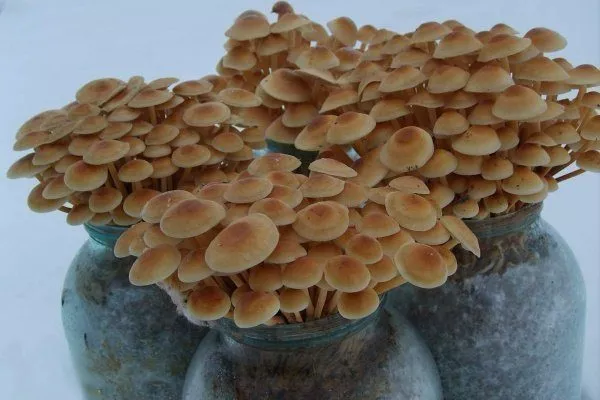
To grow honey mushrooms in jars, you need a substrate. Mix one part bran with three parts sawdust (preferably from deciduous trees). You can also use chopped corn cobs, buckwheat husks, or sunflower husks.
To grow honey mushrooms in jars, use mycelium, which can be purchased at a specialty store or from a private seller. Follow these steps:
- Fill the prepared substrate with water and let it sit for 24 hours. Then squeeze it out and place it in jars, leaving them half empty.
- Take a stick with a diameter of 15-20 mm and make holes in the substrate down to the bottom of the container.
- Pasteurize the jars. This procedure is necessary to eliminate pathogenic microflora and prevent mold. To pasteurize, place the jars in a large container of hot water and simmer for an hour over low heat. Repeat the process the next day.
- After the jars have cooled to 25 degrees Celsius, seal them with perforated plastic lids. The holes should be no more than 2 mm in diameter.
- Inject the mycelium through the holes in the lid. It's best to use a syringe. The mycelium volume should be approximately 5% of the substrate volume.
- Place the jars in a warm place for a month. The ambient temperature should be 23-24 degrees Celsius.
- Once the mushrooms begin to sprout, the jars can be moved to windowsills. In winter, they can be placed on the balcony, as long as the temperature there is at least 13 degrees Celsius.
- Over time, the mushrooms will grow to the top of the jars. In this case, remove the lids and make a cardboard funnel to keep the mushrooms from growing beyond the top.
- Mushroom caps need to be moistened periodically to maintain a humidity level of around 90%.
Mycelium application rates for different volumes
| Volume of the can (l) | Amount of mycelium (ml) | Colonization time (days) |
|---|---|---|
| 1 | 50 | 25-30 |
| 2 | 100 | 30-35 |
| 3 | 150 | 35-45 |
During the preparatory stage, the substrate can be fertilized. To do this, mix 25 g each of corn flour, oat flour, and 8 g of starch. This amount is calculated for 1 kg of substrate.
The first harvest is harvested within two weeks after the mycelium has sprouted. On average, 45 days pass from the moment the mycelium infects. If harvested correctly, one three-liter jar can yield up to 1.5 kg of mushrooms.
Instead of pasteurizing the jars containing the substrate, you can boil the prepared mixture. To do this, soak it in water for 10 minutes to allow it to swell. Then, simmer the mixture for 45 minutes over low heat, adding water periodically to prevent burning. Finally, drain off any excess water and evaporate the excess liquid. The substrate should be moist, but not wet. Then, follow the standard procedure.
The mycelium can be placed not only in the prepared holes but also mixed with the substrate. This can only be done after the mixture has cooled to 25 degrees Celsius. To mix the mycelium with the substrate, use a wooden spatula, which must be sterilized first. The resulting mixture is placed in jars.
It's essential to make holes in the lid. This is necessary to allow gases emitted by mushroom spores to escape. Fluffy cotton wool can be used instead of a perforated lid.
To obtain mushrooms regularly, it is necessary to prepare jars at intervals of 1-1.5 weeks.
See the experiment on growing honey mushrooms in a jar and its results:
Possible difficulties
One of the most common challenges when growing honey mushrooms indoors is the rapid spread of spores and their infestation of healthy wood. Outdoors, this problem can be solved by digging a trench. If grown indoors, a dedicated area for the mushrooms must be designated.
If you plan to grow honey mushrooms on a large scale, you should allocate a separate space (plot, greenhouse) for them. With the right conditions, mushroom growing can be a profitable business.
Another challenge in growing honey mushrooms is maintaining a certain temperature and humidity. Greenhouses are the easiest way to achieve these conditions. In an apartment, maintaining proper temperature and humidity can present some challenges.
Honey mushrooms are prized for their flavor. Their low maintenance makes them easy to grow at home. This can be done in a variety of ways. To ensure a good harvest, it's important to follow the proper growing guidelines.