
False honey mushrooms are very similar in appearance to edible and tasty honey mushrooms. However, some of them are poisonous and should not be eaten. It's easy to make a mistake when picking mushrooms, so it's important to know what false honey mushrooms look like to avoid picking dangerous specimens.
Description of representatives
This type of mushroom includes special mushrooms that resemble common honey mushrooms and are safe to eat. Some are officially called "false honey mushrooms," while others have their own specific names but are visually very similar to honey mushrooms.
The correct indication of a mushroom's edibility is a skirt on the stem or a membranous ring.
You can identify false honey mushrooms by the following signs:
- Aroma. Edible mushrooms have a pleasant, light aroma. False mushrooms often have a very unpleasant, moldy odor.
- Color. Inedible mushrooms have caps with a more vibrant hue. The color can range from a rich sulfur yellow to a brick red (depending on the specific species). The brighter hue is closer to the center. Edible mushrooms have a more subdued, muted color.
- Hat shape. The false mushroom has a rounded, elongated cap that gradually becomes convex and semi-prostrate. The true mushroom has dark scales on its cap.
- Color of the plates. Inedible species have yellow gills that turn olive-brown when ripe. True honey fungus gills are yellowish-white or cream-colored.
- Leg. False honey mushrooms are hollow and fairly thin, reaching a height of about 10 cm, while true honey mushrooms are no more than 6 cm tall. The edible variety has a ring on the stem, which the false species lack.
- Intergrowths. Edible honey mushrooms usually grow in fairly large clusters. False mushrooms can also grow in groups, but no more than two or three mushrooms.
What types are they divided into?
Today, quite a large number of varieties of false honey mushrooms are known. Some mushrooms are dangerous and poisonous, and are prohibited for consumption. There are also specimens that become completely safe after heat treatment. However, all false mushrooms are unpopular in Russia, and experienced mushroom pickers avoid them.
| Name | Toxicity | Fruiting season | Place of growth |
|---|---|---|---|
| Hypholoma | Poisonous | Early summer – mid-autumn | Mosses, damp and swampy areas, different types of forests |
| Sulfur Yellow | Very poisonous | Late May – late November | Decaying wood and stumps, soil near old trees, different types of forests |
| Watery | Inedible | First half of June – October | Remains of old wood, stumps, damp soil, mixed and coniferous forests |
| Leggy | Poisonous | Late spring – November | Swampy areas, damp or acidic soils, mixed or coniferous forests |
| Brick red | Inedible | Summer - Autumn | Deciduous tree species that have begun to rot |
| False honey fungus | Conditionally edible | Not specified | Coniferous forests, dead wood, dying trees, roots of healthy trees |
| Candolle's false honey fungus | Conditionally edible | May - autumn | Mixed and deciduous forests, vegetable gardens, parks, rotten stumps, occasionally living trees |
Hypholoma
This is a poisonous and dangerous species that can cause poisoning. It closely resembles the Long-legged False Honey Fungus in appearance. It is often called the Moss Honey Fungus. There are 20 subspecies of this mushroom, including the well-known Sulphur-yellow Honey Fungus.
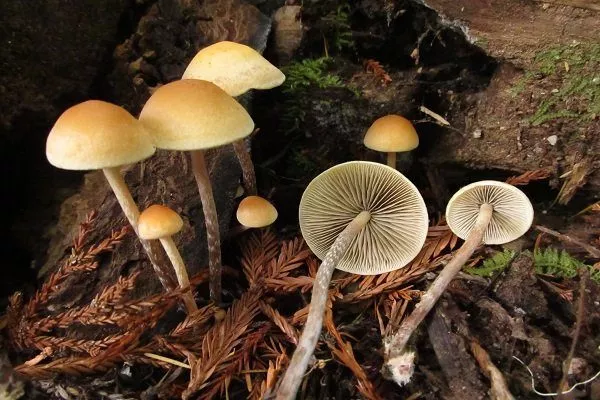
Characteristic features:
- the cap reaches 3.5 mm in diameter, initially has a hemispherical shape, gradually straightening out;
- brown cap, the edges are much lighter than the central part;
- there are traces of a veil on the cap of young specimens; if the weather is damp, mucus forms;
- lamellar hymenophore;
- the leg is no more than 12 cm long, the thickness is about 4 mm;
- the pulp is quite thin and light.
This species bears fruit in early summer and continues to grow until mid-autumn. It prefers mosses, damp, and marshy areas, and can be found in various forest types.
This species has not been well studied to date. It is classified as poisonous, but the degree of danger has not been determined.
Sulfur Yellow
This mushroom is highly poisonous and is the most dangerous of all false honey fungi. It can cause severe food poisoning if consumed.
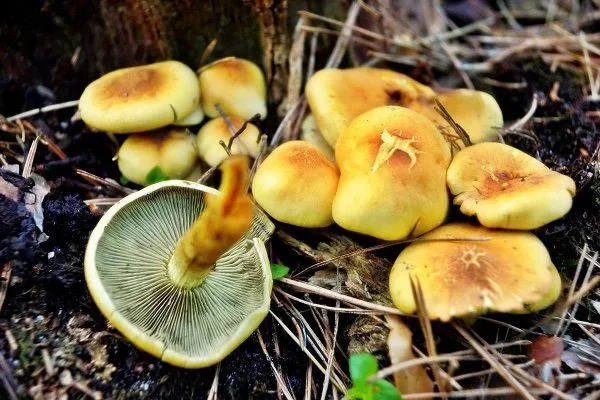
Characteristic features:
- the cap is not very large, at first it has a bell-shaped form, gradually becoming spread out;
- the cap has a grayish-yellow tint, the central part is significantly darker than the edges;
- leg height 10 cm, color – soft yellow;
- the flesh is moderately dense and light;
- unpleasant aroma, bitter and strongly pronounced taste.
This species grows in large groups; single specimens are extremely rare. Fruiting begins in late May and continues almost until the end of November.
It prefers rotting wood and stumps, but can also grow on soil, as close as possible to old trees with stumps. It also grows on green trees. It is found in various forest types.
Honey mushrooms contain a dangerous toxin that is not destroyed by cooking. It causes severe intoxication, including vomiting, diarrhea, profuse sweating, increased heart rate, and possible loss of consciousness.
To date, no fatalities have been recorded after consuming this species.
Watery
This inedible subspecies belongs to the genus Psathyrella, family Psathyrellaceae. It is also known as Psathyrella globulosa.
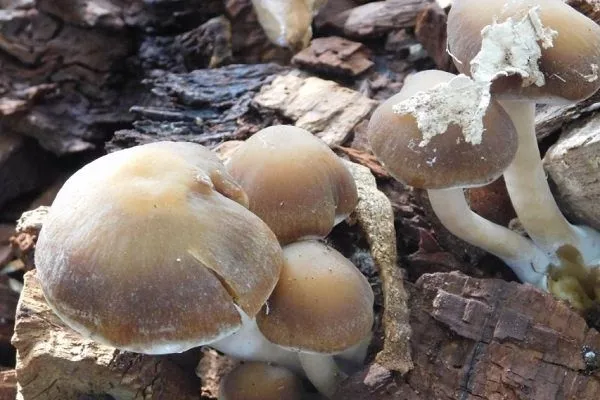
Characteristic features:
- the cap is about 6 cm in diameter, at first it is slightly convex, gradually straightening out;
- the hat comes in different colors (chocolate or cream);
- the remains of the veil are clearly visible along the edges of the hat;
- the stem is quite dense, 8 cm in height, diameter – about 7 mm;
- no distinct taste or aroma.
Fruiting begins in the first half of June and continues until October. It is found in the remains of old wood, on stumps, or in damp soil. It prefers mixed and coniferous forests. It grows in fairly large clumps and can form intergrowths.
This subspecies is inedible. However, there are cases of its consumption after prolonged boiling. Some people find it tasty.
This species is often confused with the Summer Honey Fungus, as they have similar cap coloring. The edible subspecies is larger and grows primarily in deciduous forests.
Leggy
This mushroom is highly poisonous and can cause food poisoning. Unlike its relatives, it is less dangerous because it bears virtually no resemblance to the edible varieties of honey mushrooms. It is also known as Hypholoma elongata.
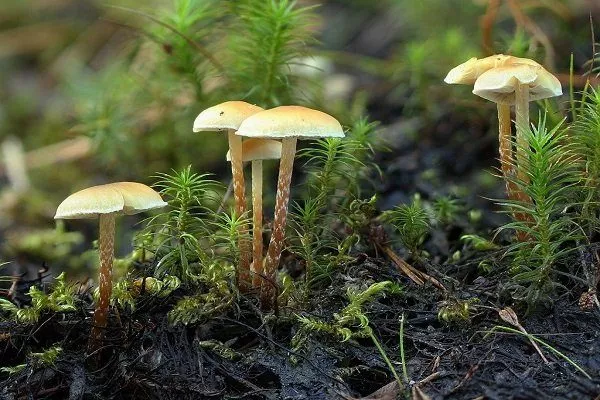
Characteristic features:
- the cap is initially hemispherical in shape, gradually becomes flat; if the weather is damp, the surface is slimy, diameter – 3 cm;
- as it ripens, the color of the cap gradually changes, starting from yellow and ending with olive;
- On the cap of young mushrooms there may be a remnant of the veil;
- slender and thin stem, fine-fibered, very fragile, length – no more than 12 cm, thickness – about 5 mm;
- the stem is slightly curved, and there are elongated scales on the surface;
- The taste is quite bitter, the aroma is unpleasant and very pronounced.
It grows in marshy areas, preferring damp or acidic soils. It is found in mixed or coniferous forests. It appears in late spring and continues fruiting until November. It can bear fruit singly or in groups.
The toxic substance contained in this mushroom species is little studied today. However, when consumed, it can cause severe poisoning.
This subspecies has no noticeable external resemblance to normal honey mushrooms.
Brick red
This species is considered inedible, but some mushroom pickers regularly collect it. It can be eaten after prolonged boiling and soaking.
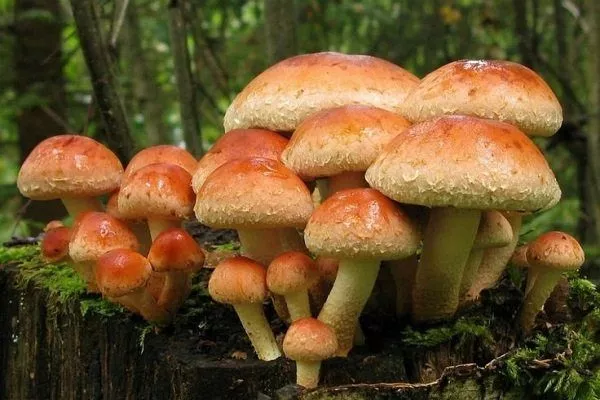
Characteristic features:
- the cap is spherical in shape, gradually opens during growth, diameter from 5 to 11 cm;
- the cap is quite fleshy and thick, and can be brown or brown;
- the plates are initially yellow, but gradually acquire a dark shade;
- dense pulp of dirty yellow color, has an unpleasant aroma, the taste is very bitter;
- a straight stem, in an adult specimen it is curved and hollow, in a young honey fungus it is solid and straight.
This species is found on deciduous trees that have already begun to rot. Fruiting begins in summer and continues until autumn. The first mushrooms appear as early as August, and fruiting continues until the first autumn frosts.
The edibility of this species continues to be debated. In Russia, it is considered inedible. The mushrooms contain dangerous toxins that can cause stomach upset. Poisoning causes abdominal pain, vomiting, headaches, and severe dizziness.
Long-term storage of brown mushrooms is prohibited, as this will increase the concentration of hazardous toxic substances.
False honey fungus
This species is considered conditionally edible. Consumption is only possible after careful preparation. It is also known as pine or poppy honey fungus. It comes from the genus Hypholoma.
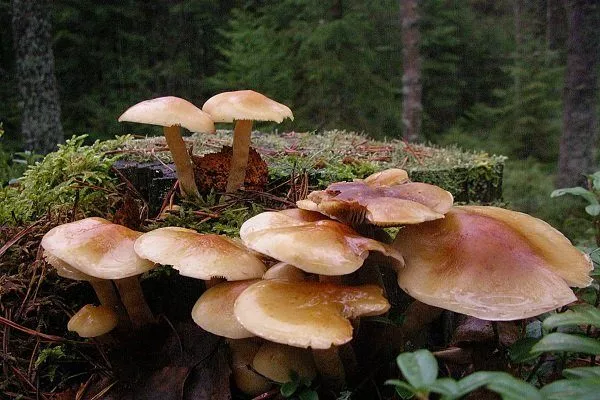
Characteristic features:
- Depending on the age and humidity of the mushroom, the color of the cap changes - in dry specimens it is a soft yellow hue, in wet specimens it is light brown;
- in young representatives the cap is convex and gradually straightens out;
- in damp and humid weather, mucus appears on the surface of the hat;
- the plates are narrow;
- stem diameter from 4 to 6 mm, cylindrical shape;
- there are almost no rings on the leg;
- The flesh is thin and there is practically no smell, but when ripe, the mushrooms develop a distinct aroma.
This species is found exclusively in coniferous forests. It prefers to grow on dead wood and dying trees. It can also be found on the roots of healthy trees. Dense groups of mushrooms are found, fused at the base of the stems.
This species is edible, but only after careful and lengthy preparation. Boil the mushrooms for at least 15 minutes, 3-4 times, draining the broth each time. This species is often pickled and dried, and used in pickles. In Russia, it is generally avoided, but in Europe, it is used in delicious dishes due to its mild mushroom aroma, which is highly prized by foreigners.
Candolle's false honey fungus
This type of mushroom does not contain toxic substances and, if prepared properly, is safe for consumption. However, unlike normal honey mushrooms, false honey mushrooms require complex and time-consuming cooking.
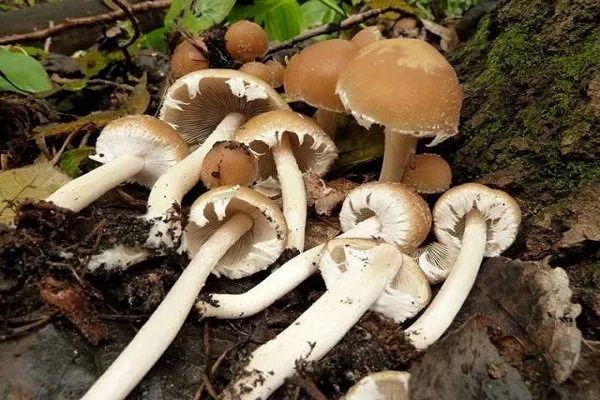
Characteristic features:
- the cap of young specimens has a bell-shaped form, gradually flattens out and becomes spread out, but a raised area is retained in the center;
- the color of the cap varies from white to yellow-brown, diameter – 3-7 cm;
- thin and tender pulp, breaks easily;
- the stem is cylindrical in shape, with a small fluff in the lower area;
- The stem is whitish-cream in color, about 7-11 cm long and 0.5-0.8 cm thick.
This species grows in mixed and deciduous forests, including vegetable gardens and parks. Fruiting begins in May and continues until autumn. The mushrooms grow in large clusters. Their favorite habitat is rotten stumps, but occasionally they can also grow on living trees.
This species belongs to the conditionally edible group. Before eating, the mushrooms are boiled for a long time – at least 3-4 times.
The mushroom is very popular abroad – in North America it is often used in cooking.
Negative impact on health
Depending on the specific type of false honey fungus, the onset of poisoning symptoms varies, ranging from 3 to 12 hours. General signs of intoxication include:
- persistent feeling of nausea;
- diarrhea;
- severe and persistent vomiting;
- heart rate increases;
- numbness of the limbs;
- headache;
- my head is spinning;
- loss of consciousness;
- cold sweat;
- difficulty breathing.
Do you need help?
False honey mushrooms are very dangerous, but with prompt treatment, negative consequences can be minimized. In case of mushroom poisoning, seek immediate medical attention.
You can provide first aid yourself:
- Rinse the stomach with large amounts of boiled water with baking soda added (1 teaspoon of baking soda per 1 liter of liquid). After drinking the solution, induce vomiting. Repeat the procedure several times.
- Give the patient an absorbent (activated charcoal will do).
- Lay down the poisoned person and cover him with a warm blanket.
- Ensure that you drink plenty of fluids after the gastric lavage procedure.
- Rinse the stomach with plenty of boiled water with the addition of soda (1 teaspoon per 1 liter of liquid).
- Give an absorbent (eg activated charcoal).
- Provide rest and warmth to the victim.
- Ensure that you drink plenty of fluids after gastric lavage.
False honey mushrooms are very similar in appearance to the real thing. They can be found on rotting wood and old stumps, but they don't have the same culinary qualities. They can also be dangerous to your health. While there are no deadly poisonous species among the false honey mushrooms, they are also completely useless.