
Summer honey mushrooms are considered edible mushrooms belonging to the Strophariaceae family of the genus Kuneromyces. They grow exclusively in groups or large colonies, making them easy to harvest. They have excellent flavor and marketability, and are used for frying, boiling, and pickling.
Summer honey mushrooms: description
They are popularly known as honey fungus, talker, linden honey fungus, and variable kuneromyces. Honey fungus got its name from the fact that it grows near tree stumps.
External indicators:
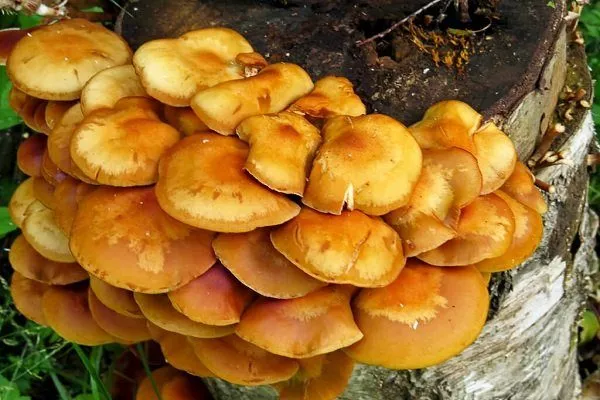
- Hat. It is distinguished by its drooping edges, brown or light brown coloration, and a light-colored tubercle in the center. The cap size varies from 2 to 8 cm (diameter), and the surface is slimy, so in high humidity, leaves, grass, and other debris stick to it.
In young mushrooms the cap has convexities, in older ones it is flattened. - Leg. 0.5 cm in diameter and 3.5 to 8 cm in length. The shape is cylindrical with a curve. The color is light near the cap, but as it descends, the stem becomes dark brown. The surface is covered with microscopic scales and has a ring.
- Hymenophore. The underside of the cap is covered with gills. When young, they are beige; when old, they become brownish. The hymenophore is covered with a web-like substance; the spore powder is dark brown.
- Pulp. The stem's interior is tough and therefore not edible, while the cap's flesh is soft. It has a woody aroma, a watery cut, and a color ranging from pale yellow to brown.
Varieties
There are a huge number of species of honey mushrooms. Each has its own characteristics, taste, and appearance. Some are edible and some are poisonous, so it's important to learn to recognize the varieties.
| Name | Cap diameter (cm) | Cap color | Leg length (cm) |
|---|---|---|---|
| Meadow honey fungus | 3-5 | Light ochre to light red | 3-10 |
| Udemansiella mucosae | 2-10 | Light gray, brownish towards the center | 5-8 |
| Thick-legged honey fungus | 2.5-10 | From pink to dark brown | Up to 8 |
Meadow honey fungus
Meadow honey fungus is found primarily in open spaces—meadows, pastures, clearings, fields, etc.—located among grass on the ground. The growing season runs from late May to late October, making it considered a summer mushroom.
Peculiarities:
- cap diameter – from 3 to 5 cm;
- shape – hemispherical convex;
- shade – from light ocher to light red;
- surface – smooth;
- plates are rare, ocher-colored in sunny weather, creamy-white during rain;
- stem – from 3 to 10 cm in length, thin, velvety, ocher;
- pulp - light and sweet;
- taste – clove;
- spore powder - light.
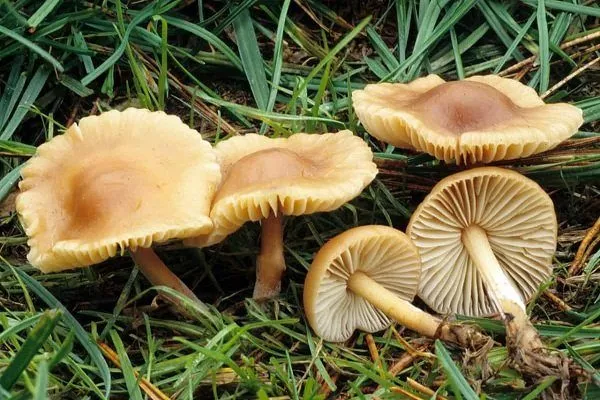
In dry weather the cap becomes droopy, but if it is placed in water, its elasticity returns.
Udemansiella mucosae
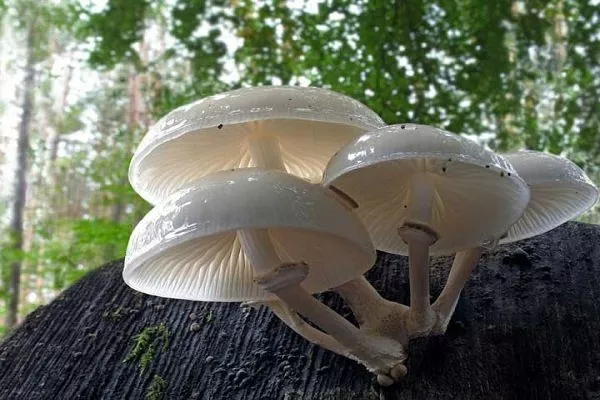
A distinctive feature of this species is that it grows not in colonies, but singly or in stalks of up to three mushrooms. It grows in woody areas of broadleaf forests. The growing season is July to November.
Brief description:
- cap diameter – from 2 to 10 cm;
- shape - first hemispherical, then flat;
- color - light gray at the edges, brownish towards the center;
- surface - mucous;
- plates - rare and white;
- stem – 5-8 cm, covered with brown-black scales;
- spore powder - whitish;
- pulp – white;
- ring - ribbed, movable.
Thick-legged honey fungus
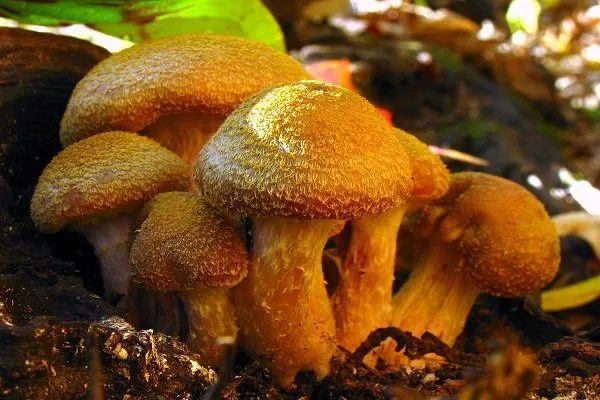
This variety grows among decaying leaves, on rotting stumps, and dying trees. The harvest is from early August to late October.
Characteristic:
- cap diameter from 2.5 to 10 cm;
- shape – broadly conical at first, flattened later;
- color – from pink to dark brown;
- surface - scaly;
- plates - frequent;
- stem – up to 8 cm in length, cylindrical in shape with club-shaped thickenings;
- The pulp and spore powder are white.
Dangerous Doubles
There are varieties of summer honey fungus that are prohibited for consumption because they are false lookalikes. Four species of these mushrooms are most commonly found in our country.
| Name | Cap diameter (cm) | Cap color | Presence of a ring |
|---|---|---|---|
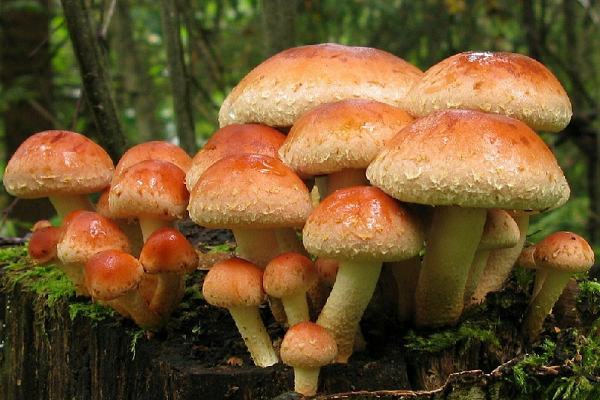
| False honey fungus, brick-red | 2-7.5 | Brick red with a light cream tint at the edge | No |
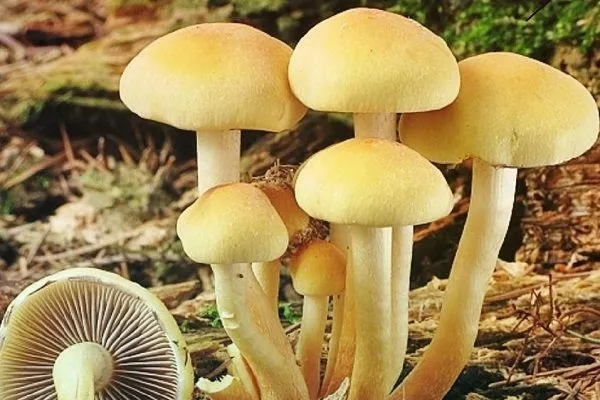
| False honey fungus, sulfur-yellow | 2-7 | From yellow-brown to sulfur-yellow | No |
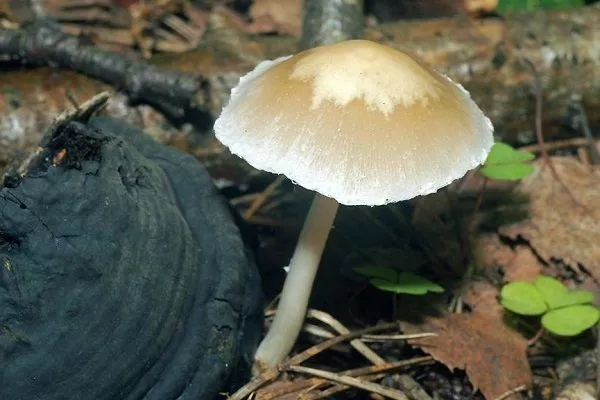
| Psatirella Candolla | 3-8 | Creamy, matte | Only in young mushrooms |
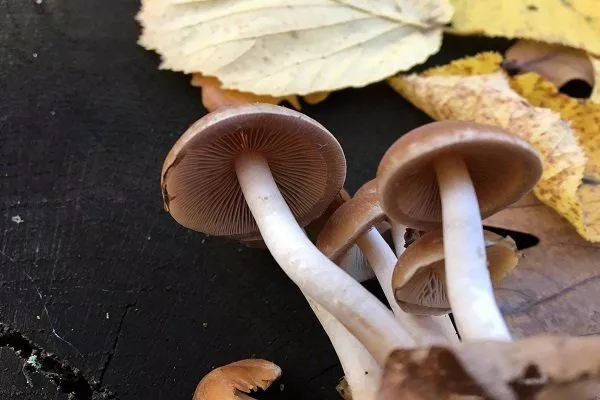
| Psathyrella aquatifolia | 4-6 | Brown-cream or chocolate | Eat |
False honey fungus, brick-red
The mushroom is considered conditionally edible, but there is no definitive scientific evidence of its toxic properties. There are reports of gastrointestinal poisoning after eating it. Many mushroom pickers collect the brick-red false honey fungus, but soak it for a long time before cooking.
How to recognize:
- Habitat: rotting deciduous trees;
- growing time – from the beginning of July to the end of October;
- cap diameter – from 2 to 7.5 cm;
- shape - initially bell-shaped, then flat-convex;
- surface – smooth with a bump in the center (but may be without it);
- ring - absent;
- color – brick red with a light cream tint at the edge;
- stem – yellow-brown, up to 10-12 cm long;
- the pulp is yellowish and fleshy;
- taste – has bitterness;
- plates - frequent, notched-fused.
False honey fungus, sulfur-yellow
The mushroom is considered poisonous, so eating it is strictly prohibited. Intoxication occurs within 1-5 hours, manifested by nausea and vomiting, increased sweating, and loss of consciousness.
External indicators:
- Habitat: rotting deciduous and coniferous trees, stumps, soil;
- growing season – from the end of May to November;
- cap – from 2 to 7 cm in diameter;
- color – from yellow-brown to sulfur-yellow;
- shape - bell-shaped at first, flat later;
- pulp - white or yellowish;
- taste - very bitter;
- smell - earthy, unpleasant;
- stem – up to 10 cm long, straight in shape, fibrous in structure;
- plates - thin and frequent, greenish, yellow or olive;
- spore powder - brown-chocolate;
- ring on the leg - absent.
Psatirella Candolla
The mushroom is considered conditionally poisonous, since literature from the last century indicates that it is poisonous, but modern publications contain information that Psathyrella candolleii is allowed to be consumed, but only after cooking.
Characteristic features:
- grows on both rotting and living trees, in the soil, on stumps;
- growing period – from the end of May to September;
- cap diameter – from 3 to 8 cm;
- color – cream, matte;
- structure – cracking;
- shape - conical initially, flat later;
- edges - wavy, sinuous;
- the surface is smooth, but small scales appear periodically and immediately fall off;
- stem – very thin (maximum 0.6 cm), up to 9 cm in length;
- plates - brown-violet, frequent;
- pulp - white, fragile;
- ring – present only in young mushrooms;
- smell and taste - mushroom;
- spore powder - brown-violet.
Psathyrella aquatifolia
It's considered a conditionally poisonous mushroom. It grows on deciduous trees and is sometimes found on pine needles. It also grows in the soil, but only around tree stumps.
How to recognize Psathyrella hydrophila:
- cap – convex, bell-shaped with a diameter of up to 4-6 cm;
- color – brown-cream or chocolate (depending on the weather – the latter option during rain);
- fruiting period: from the first days of June to mid-October;
- stem – up to 6-8 cm, hollow and curved;
- the flesh is brown and hard;
- surface – hygrophanous;
- taste – soft;
- odor – absent;
- ring – yes;
- plates - frequent, fused, color from light brown to brownish-black;
- spore powder - brown-violet.
Season and habitat
Summer honey fungi prefer deciduous and mixed forests where rotten stumps and decaying wood are abundant. They can also grow in clearings and mountainous areas. Their favorite trees are linden, birch, hazel, and oak, but they can be found on any tree species, including conifers.
It grows in all latitudes except the far north, bearing fruit from early April to late October, depending on climate and weather conditions. In the south, harvesting is possible year-round.
Collection Features
Summer mushroom pickers search for honey mushrooms in hard-to-reach places. Sometimes they even need to peer into a hollow tree trunk, but it must be rotten. There are rules for collecting these mushrooms that must be followed:
- Never damage the mycelium, otherwise the entire colony will die out, so do not pull them out, but cut them off with a sharp knife or simply twist the mushroom, turning it around its axis;
- After cutting, sprinkle the mycelium with soil and compact it lightly;
- look for mushrooms with a long stick (1-1.5 m);
- The most delicious honey mushrooms are young ones, but do not touch very small specimens;
- If you see a small cluster of mushrooms, do not leave, as you can find a whole colony very close by;
- Do not place cut honey mushrooms in a container such as a bucket - it is better to use a basket, which will allow air to reach the mushrooms;
- place the mushrooms with the caps facing up and the stems facing down - this way the mushrooms will not be damaged;
- do not put dirty specimens in the basket – brush off any dirt and stuck leaves;
- go out "hunting" after the rain has passed;
- Avoid picking mushrooms near the side of the road – these mushrooms are saturated with toxins from passing cars.
How to store it correctly?
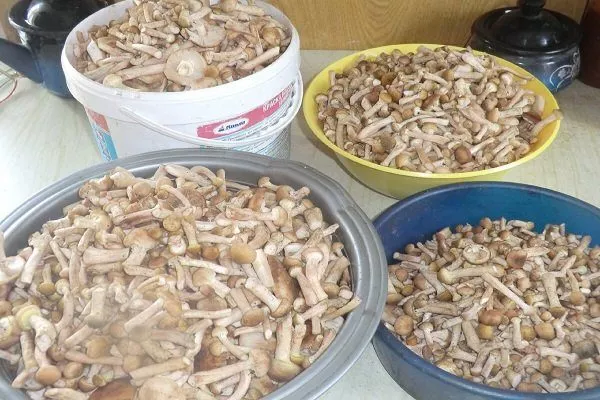
Freshly picked honey mushrooms can be stored for up to 6 hours at room temperature, or 48 hours in the refrigerator (on the vegetable shelf). If you don't have time to process them for further storage, boil them for 30 minutes in salted water and place them in the freezer.
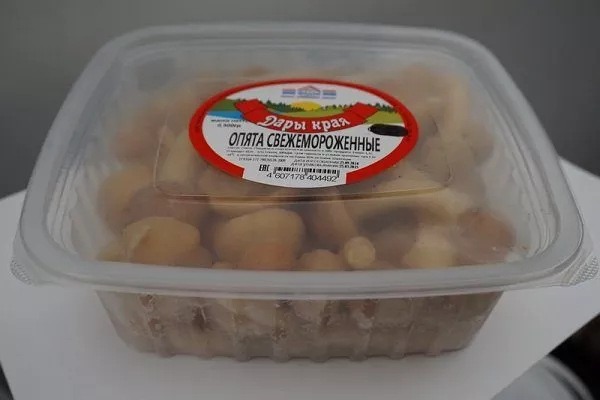
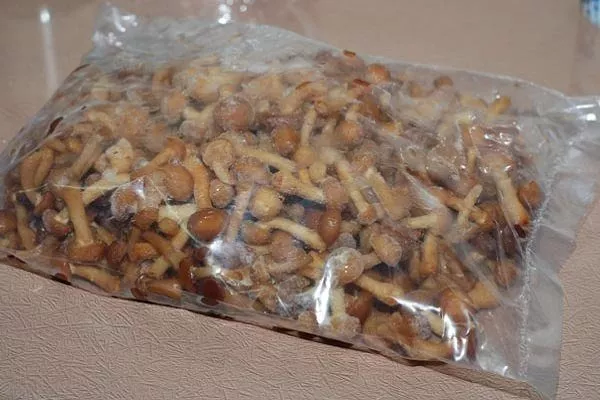
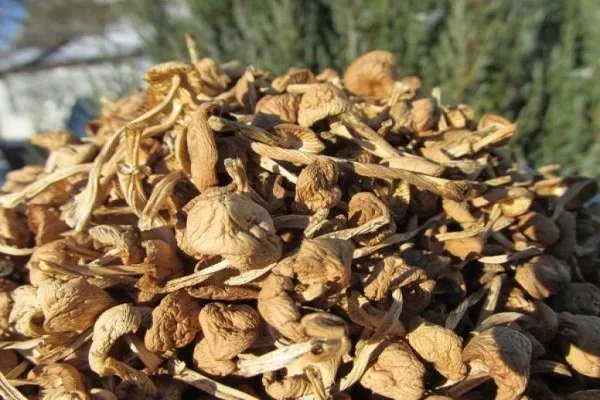
Summer honey mushrooms can be stored frozen (boiled and raw), refrigerated, dried, or canned. The shelf life and storage instructions depend on the following factors:
- Store in the refrigerator, boiled. Store for a maximum of 5-6 days. Before storing in a plastic container, be sure to drain the water and dry with a paper towel. Place a cotton cloth on the bottom and top of the container to absorb any moisture. Change the cloth once a day.

- Frozen raw. The longest shelf life is 9 months. Store in plastic bags or plastic wrap. Do not rinse beforehand—this will ensure the mushrooms stay as dry as possible.
- In the freezer, boiled. Can be used for up to 6 months. Be sure to drain and dry the mushrooms by laying them out on a cloth or paper towel.
- Dried. They have a long shelf life – 16-18 months. Dry the mushrooms sliced or whole. To do this, string the mushrooms on a string, hang them, and dry until completely hardened. Alternatively, spread them out on a baking sheet and preheat the oven to 50°C.
Place the dried mushrooms in a canvas bag or a glass jar with a tight-fitting lid. If you plan to make a creamy soup from the mushrooms, puree them in a blender until they form a powder.
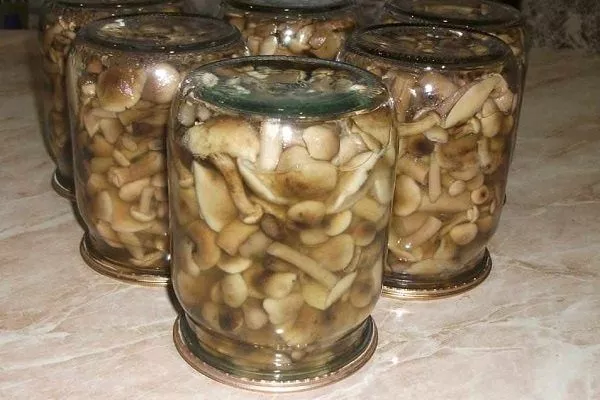
- Home-canned. The shelf life is up to 6 months. Store only in a cool place – in a cellar or refrigerator. Monitor the marinade (it should not become cloudy) and the lid (it should not be bulging).
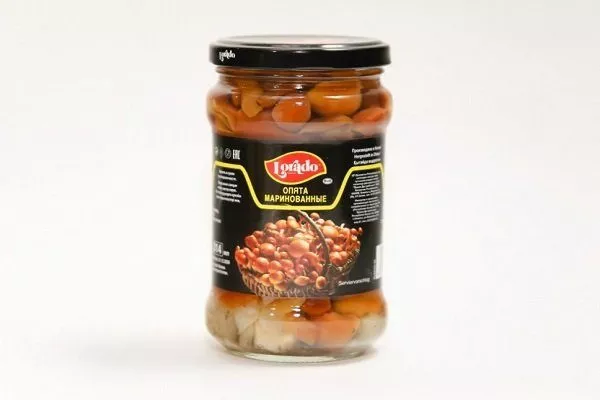
- Marinated factory. The can states "up to 12 months." The conditions are identical to the previous ones. The shelf life is longer due to the use of preservatives during production, which extend the shelf life.
Benefits and contraindications
Honey mushrooms are considered a nutritious food with beneficial effects on the cardiovascular system. The substances they contain can inhibit the growth and development of staphylococci. Other beneficial properties include:
- antibacterial action – in addition to staphylococcus, it also destroys other pathogens;
- strengthening of muscles, joints, hair, nails (due to the content of chitinous compounds);
- immunomodulatory effect, which is especially important in the development of malignant neoplasms (in dried form, honey mushrooms promote the absorption of radioactive substances);
- lowering cholesterol levels;
- fat breakdown in obesity;
- lowering blood pressure;
- acceleration of metabolism;
- improving performance;
- elimination of inflammatory processes;
- strengthening the immune system.
100 g of the product contains 22-22.3 kcal, 2.3-2.5 g of protein, 0.5-0.6 g of carbohydrates, 1.1-1.4 g of fat, and 5-5.1 g of dietary fiber. Among the nutrients in honey mushrooms are the following:
- Vitamins. Contains large amounts of vitamin C, B1, B2, PP.
- Minerals. These are phosphorus, magnesium, potassium, iron.
- Microelements. Contains chromium, zinc, nickel, and copper.
Experts also highlight contraindications:
- age up to 7 years;
- ulcer and gastritis in the acute stage;
- colitis;
- cholecystitis.
How to grow summer honey mushrooms in your garden?
Summer honey mushrooms differ from other mushrooms in that they cannot be transported for long periods of time—their appearance deteriorates, and drying out reduces their nutritional value. This forces many gardeners and vegetable growers to cultivate them artificially.
- ✓ The optimal humidity of the substrate should be 60-65% to prevent the mycelium from drying out.
- ✓ The air temperature in the room for mycelium incubation should be maintained at +20…+24°C.
For this purpose, you can purchase a special border or transplant honey mushrooms taken from the forest (be sure to include a piece of wood). Since they grow rapidly, the harvest can be harvested in 1-2 months.
There are several growing methods used by experienced mushroom pickers:
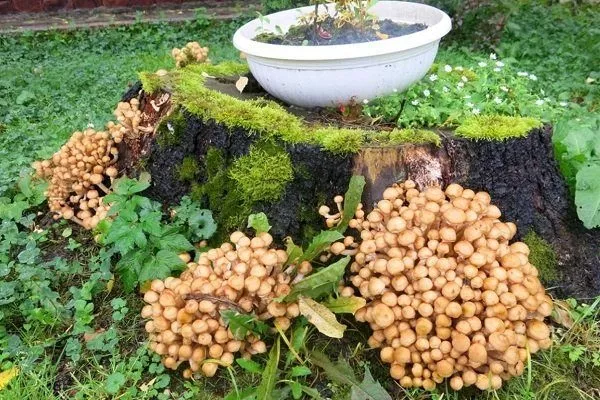
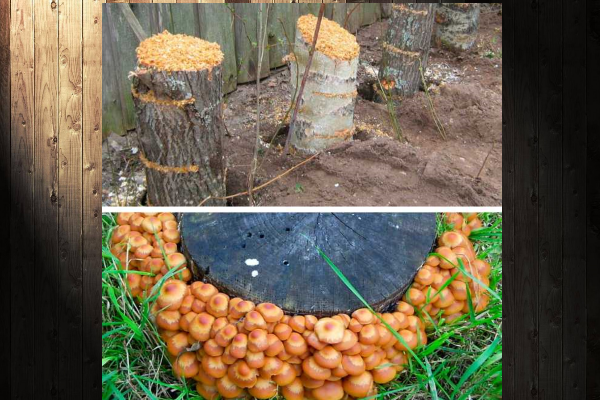
- On the stumps. They're found in all gardens, but choose wild trees over fruit trees. For inoculation (planting), use the mycelium-injection method, along with a piece of wood.
To do this, drill a hole in the stump and insert a piece of wood infected with fungal spores. Then, fill the hole with moss and cover the stump with branches. Water the soil several times a week. Expect the first harvest next year.
- On the logs. The method is identical to the previous one, but with the difference that the wood blocks are placed anywhere in the garden. The harvest is collected in 3-4 months. Instructions:
- the log must be freshly cut;
- take material from deciduous trees;
- size – 25-30 cm in length, 15-20 cm in diameter;
- Immediately after planting, move the logs to a dark place;
- The optimal air temperature is +25…+30 °C, but not higher, as the mycelium will not germinate:
- After the mushrooms have formed, transfer the log to the beds, burying them 10-15 cm into the ground;
- location - shade.
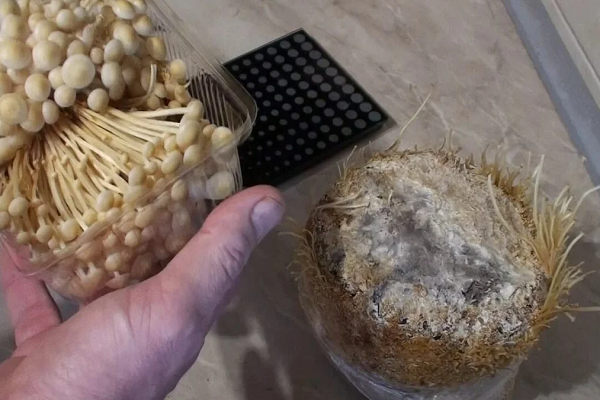
- On sawdust. This is the best option for indoor growing, especially in the southern regions, as mushrooms require cool, shaded conditions. To do this, mix sawdust with finer wood shavings (2:1 ratio), then add 75 g of starch, 250 g of oatmeal, and the same amount of corn flour per 10 kg of the mixture.
Then proceed as follows:- Pour boiling water over the sawdust and shavings, then add the remaining ingredients.
- Transfer the substrate into glass containers (you can use plastic containers, flower pots, etc.).
- Place the mycelium on top.
- Place the container in a room with a humidity level of 85-90% and a temperature of +15 to +18 °C, excluding light.
- After 2-3 months, move the containers to a room with lighting, the same thermometer readings, but humidity of only 75%.
- Replace the substrate in the fall.
How to pickle summer honey mushrooms?
There are many recipes for preserving honey mushrooms, but among them there are several universal and very tasty ones.
Recipe #1 – with vinegar:
- Prepare ingredients for 1 kg of fresh mushrooms:
- water – 2 l;
- salt and sugar - 1 tsp each;
- vinegar – 2 tbsp;
- bay leaf – 1-2 pcs.;
- black or allspice peppercorns – 3-4 pcs.;
- garlic – 2-3 cloves.
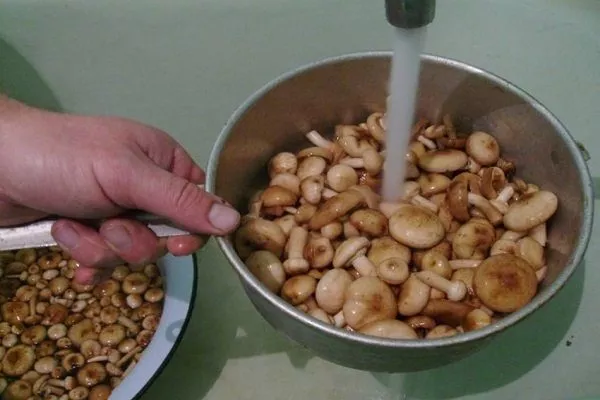
- Wash all dirt off the mushrooms under running water.
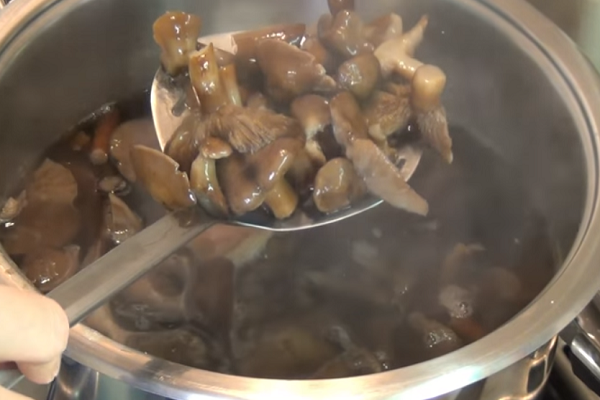
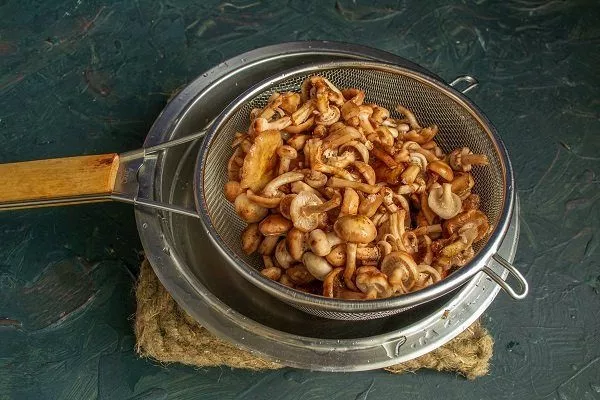
- Pour boiling water over it and cook at full boil for 5 minutes.
- Drain the water and rinse the honey mushrooms. Add new water and cook the mushrooms for 20-30 minutes, adding a light sprinkling of salt (optional).
- Throw it into a colander and let it stand.
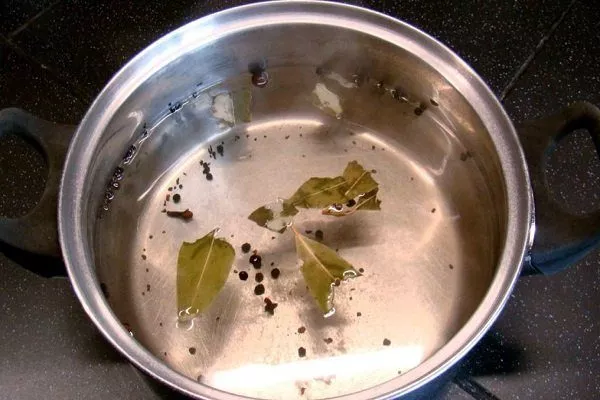
- Prepare the marinade: combine all ingredients except the vinegar and simmer for 5 minutes. Add the vinegar at the end of cooking.
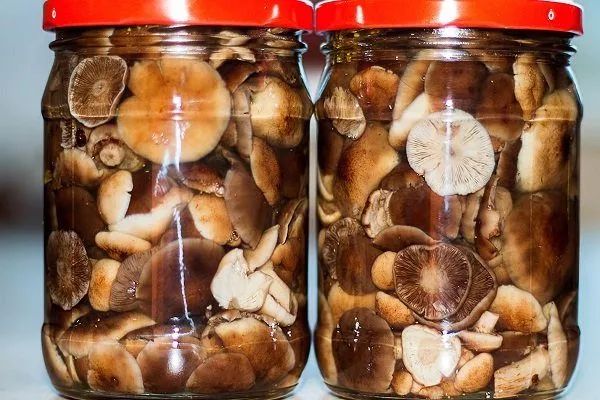
- Place the mushrooms in sterilized jars, pour in the brine and roll up.
Recipe #2 – without vinegar:
- Prepare the ingredients (for 1 kg of honey mushrooms):
- water – 100-150 ml;
- salt – 1 tbsp;
- vegetable oil – 1 tbsp;
- citric acid – 1 tsp;
- bay leaf, peppercorns – to taste.
- As in the previous case, boil the mushrooms, but not for 5 minutes, but for 15.
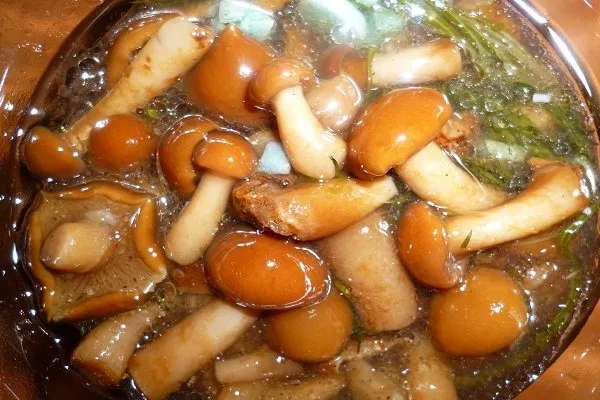
- Drain the liquid and immediately add new water (150 ml), add mushrooms and other ingredients.
- Cook for another 15-20 minutes.
- Transfer to sterilized jars and screw on the lids.
Don't forget to sterilize the lids, turn the jars upside down, and cover with a blanket until completely cool.
Summer honey mushrooms are tasty and healthy, with a fairly bountiful harvest. They're easy to grow in your garden, but you need to be careful when harvesting them—among the true honey mushrooms, there are false mushrooms, which are difficult for a novice to distinguish from the edible ones.