
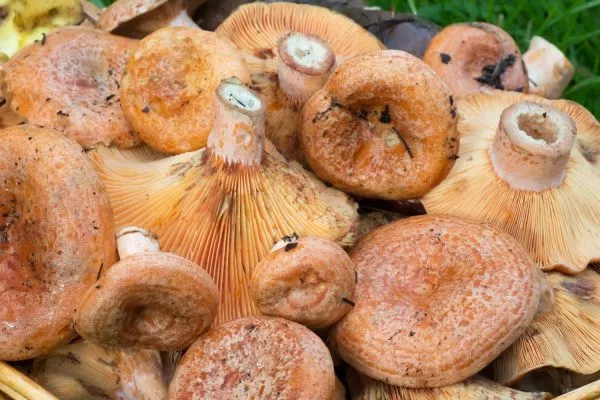
Saffron milk cap mushrooms have excellent flavor and an attractive appearance, and are considered the most popular mushrooms in the Russulaceae family. Saffron milk cap mushrooms are divided into subspecies, including both edible and inedible varieties.
Description
The mushrooms get their name from their unusual, vibrant orange color when mature. At the beginning of the growing season, saffron milk caps have a yellowish tint. However, there are also red, brown, and other varieties.
General information about the mushroom
Saffron milk caps belong to the genus Lactarius, family Russulaceae, order Russulaceae, class Agaricomycetes, division Basidiomycetes. Their main distinguishing feature from other milk caps is the bright carrot-colored milky fluid that exudes from their gills after they are broken. Other characteristics of all milk caps include:
- The cap is very fleshy. Concentric stripes appear on its surface—their color is olive-green and uneven (more like spots).
- The leg is usually spotted.
- The juice exhibits fluorescent properties when exposed to bright light. It always leaves traces when touched.
- The gills differ in their lower direction and the different lengths of their elements.
- ✓ The presence of bright carrot milk, which is released when broken.
- ✓ Change in pulp color to green after breaking.
Distribution: where and when they appear, ripening period
This species of milkweed prefers coniferous forests, especially undergrowth. The grass should be low and the terrain elevated. Despite this, mushroom pickers collect them not only in mixed forests but also in deciduous forests.
Saffron milk caps are most common in cold climate zones – Siberia, the Urals, and Central Russia, but can also be found in the South.
- ✓ The optimal temperature for harvesting is between 15 and 27 degrees Celsius. Growth stops at temperatures below 10 degrees Celsius.
- ✓ The best time for harvesting: after heavy rains, as saffron milk caps do not grow during drought.
Growing characteristics:
- Chanterelles love warmth. The optimal temperature range is 15 to 27 degrees Celsius; as soon as the thermometer drops below 10 degrees Celsius, growth and reproduction stop completely.
- Full ripening occurs between early July and late November. The timing depends on climatic conditions.
- Most mushrooms of this species appear after heavy rains, but they are not found during drought.
- To find saffron milk caps, you need to look under fallen needles or leaves, as mushrooms like to hide from the sun.
- The arrangement is colonial, which makes the harvesting process much easier. This means you'll never find a single saffron milk cap growing alone. Sometimes they form "fairy circles."
Benefits, edibility and nutritional value
Young saffron milk caps are edible even raw. However, to enjoy them raw, you need to salt them first. However, experts recommend lightly frying them—just a couple of minutes. But according to mushroom pickers, salted saffron milk caps are considered the most delicious.
These are very useful mushrooms, as they contain a huge amount of useful substances, among which the most:
- vitamins A, B, C;
- minerals – iron, phosphorus, magnesium, potassium, calcium, sodium.
Thus, saffron milk caps have the following medicinal properties:
- strengthening the immune system and bone tissue;
- increasing performance and endurance;
- reducing the risk of cholesterol production;
- resistance to various types of infections – viruses, bacteria, fungi;
- normalization of metabolic processes;
- slowing down the growth of tumor cells.
The caloric content of saffron milk caps per 100 g of product is:
- 17 kcal fresh;
- 17.5 kcal in salted and pickled;
- 22.4 kcal – boiled;
- 94 kcal – fried.
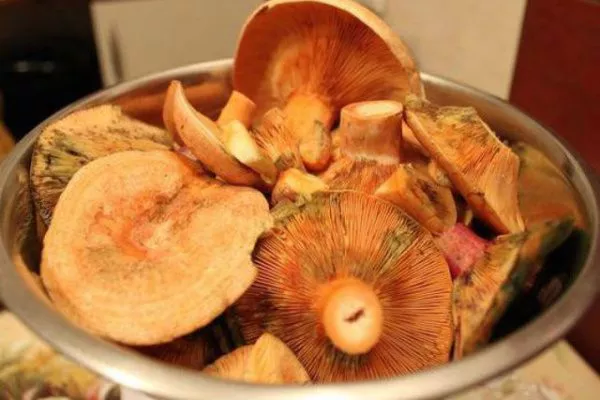
Per 100 g of mushrooms there are:
- fiber – 2.2 g;
- proteins – 1.9 g;
- fats – 0.8 g;
- carbohydrates – 0.5 g;
- water – 88.9 g.
Harm and contraindications
Avoid picking mushrooms in trash areas, near highways, industrial plants, and other polluting areas. These mushrooms, while perfectly edible, will cause harm to the body.
Mushrooms are prohibited in the following cases:
- pregnancy and lactation;
- children under 8 years of age;
- obesity;
- kidney disease;
- liver pathologies;
- inflammatory processes in the gallbladder and pancreas;
- insufficiency of bile secretion;
- allergy to mushroom products;
- gastritis with low acidity.
If you consume mushrooms uncontrollably, that is, eat them in large quantities, the following occurs:
- decreased acidity in the stomach;
- constipation;
- exacerbation of pancreatitis and cholecystitis;
- decreased tone;
- allergic reaction.
Edible species
Saffron milk caps are divided into several subspecies. Each has its own external characteristics and other features that distinguish them from one another. To avoid confusion with other mushrooms, carefully examine the characteristics of all saffron milk cap varieties.
| Name | Forest type | Cap color | Leg height (cm) |
|---|---|---|---|
| Pine | Pine forest, mixed forest | Orange-yellow | 7-9 |
| Spruce | Spruce forests | Light orange, tangerine | 4-10 |
| Red | Coniferous plantations | Orange, red-pink | 3-3.5 |
| Milky red | Pine forest | Pale orange | 2-4 |
| Japanese | Fir, mixed forest plantations | Orange | 4-8 |
| Salmon | Fir forests | Yellow-orange, bright carrot | 4 |
| Wine | Pine forest | Red wine | Up to 6 |
| Blueing | Spruce forests, forest edges | Brown with olive tint | 4-11 |
Pine
It prefers to grow in both pine forests and mixed forests. It is the most common mushroom of the genus Lactarius, with a reddish-brown fruiting body. It has a robust and stocky appearance.
More detailed description:
- Hat. It is round and orange-yellow in color. Its diameter varies from 5 to 18 cm, depending on its age. Initially, the cap is convex, but as it matures, it takes on a funnel-shaped configuration due to the raised edges.
The surface has concentric zones, is slippery in dry weather and sticky after rain, and is always smooth. If broken, the hue turns greenish. - Hymenophore and spore powder. The gills are densely dotted, narrow, and light yellow, with downward-facing gills. The hymenophore is initially whitish, then light pink with carrot-like hues, and finally dark orange.
The minimum spore size is 8x7 µm, the maximum is 11x9 µm. The combs are interconnected and reticulate. - Leg. In adulthood, it is hollow, reaching a height of 7-9 cm and a diameter of 2 cm. The shape is straight cylindrical or may taper towards the base.
- Pulp. It's dense, so a crunching sound is heard when broken. An orange-colored milky substance with a pungent taste oozes from the cut. The smell is reminiscent of resin. After breaking, the flesh turns green within a few minutes.
Spruce
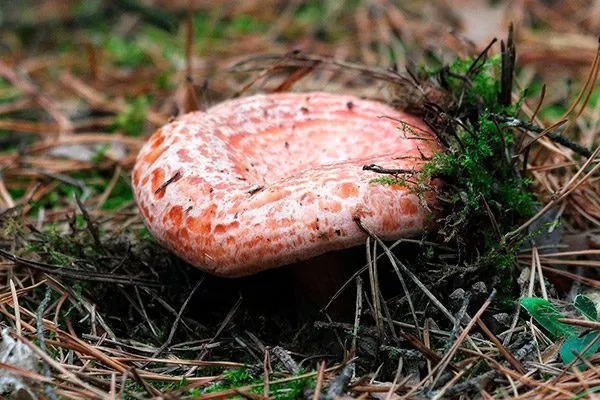
It grows in spruce forests across Russia. It is distinguished by its medium size and a distinct indentation on the cap when mature.
Characteristic:
- Hat. Its diameter varies from 2 to 7-10 cm, with specimens reaching 12 cm occasionally encountered. The surface is smooth and greasy during rainy seasons, and dry and shiny during hot weather. When young, the color is light orange, but when mature, it can turn tangerine or orange-brown.
If an old mushroom has been frozen, it turns a dirty green. If the spruce saffron milk cap grows in full sunlight, it takes on an almost white hue. - Hymenophore and spore powder. The spores are pale orange or ochre, smooth, and fragile. The gills are of varying lengths, partially branched near the stem. If the mushroom is damaged, the spores first turn dark reddish, then grayish-green.
- Leg. It is distinguished by its cylindrical shape, from 4 to 10 cm in length, with a diameter of about 1.5 cm. The base is thickened, and the interior is hollow.
- Pulp. It's very fragile, so it needs to be placed carefully in the basket when harvesting. If you break the mushroom, a milky juice will leak out. Initially, it's carrot-red, but after half an hour, it turns burgundy. The flesh is pale yellow. Various larvae often reside in it.
When cut, a sharp fruity aroma is noticeable. The taste is also variable – initially mild, then becoming bitter and spicy, with a slightly astringent feel.
Red
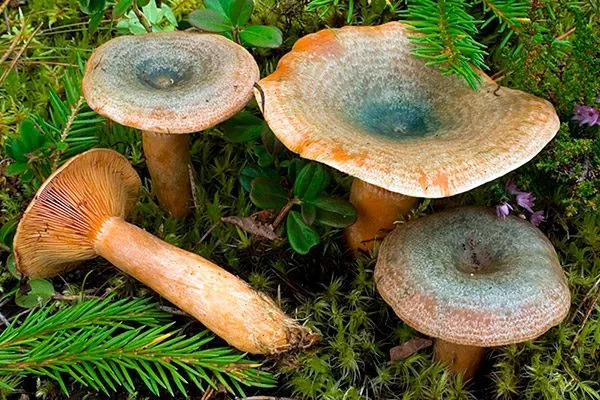
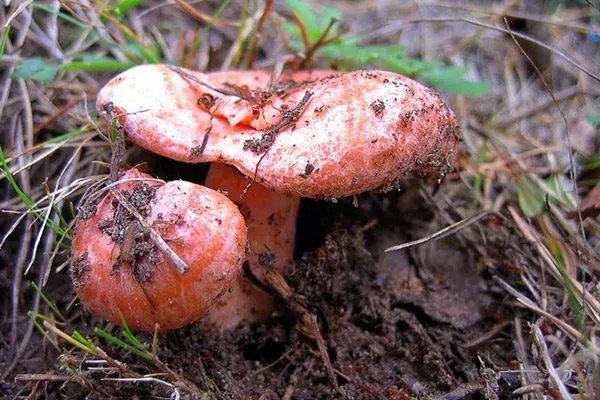
It grows exclusively in coniferous forests. Red saffron milk cap has no distinct aroma. It is characterized by the following:
- Hat. It's orange or reddish-pink, about 4-10 cm in diameter (some reach 15 cm). Occasionally, specimens with gray or gray-green speckles are found. The edges are always curved downward, and the center is notched. The surface is smooth and slightly sticky.
- Hymenophore and spore powder. The gills are fused with the stipe and arranged obliquely. They are pale burgundy in color, with pinkish edges. The spores are spherical-ellipsoidal, measuring from 7.9 x 8.0 to 9.5 x 8.8 µm. They are distinguished by their surface ornamentation, a nearly complete reticulum, and broad, rounded projections.
Spore cells have 4 spores, size 60x10 µm. - Leg. The shape is cylindrical, 3-3.5 cm long, and 1 to 2 cm thick. The surface is smooth, and the color varies from pale yellow-pink to light yellow-gray. Brown spots are occasionally observed.
- Pulp. The color is creamy with a pinkish tint and burgundy spots. The milky juice is red, which darkens significantly as the mushroom ages, eventually reaching a brown color.
Milky red
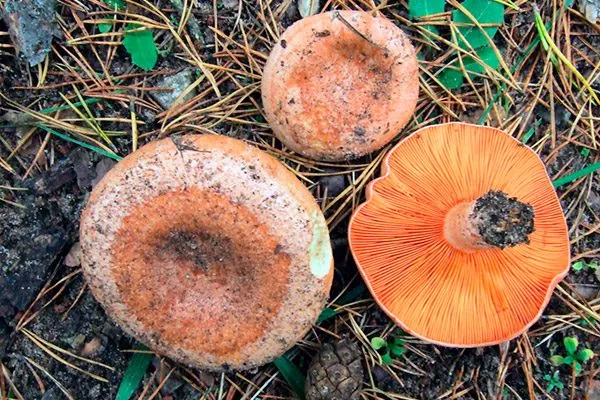
It grows mainly in pine forests and is distinguished by the following characteristics:
- Hat. The shape is initially convex with inward-curving edges, becoming flattened with maturity, with a sunken funnel-like center and open, wavy edges. The diameter ranges from 3 to 10 cm. The surface is matte, with a pale orange hue. Concentric stripes are faintly visible.
- Hymenophore and spore powder. Colour: pale orange when young, red when mature, gill type: frequent, gills bifurcated towards the stem.
- Leg. The width is from 1.2 to 2 cm, the length is from 2 to 4 cm. The color is identical to the cap, but may be slightly paler. When young, the stem is strong and firm, but when mature, it becomes hollow and loose.
- Pulp. Very fleshy and dense. When cut, it releases a rich orange milky liquid that turns wine-red after about 10 minutes. The aroma is pleasant, with hints of fruit.
Japanese
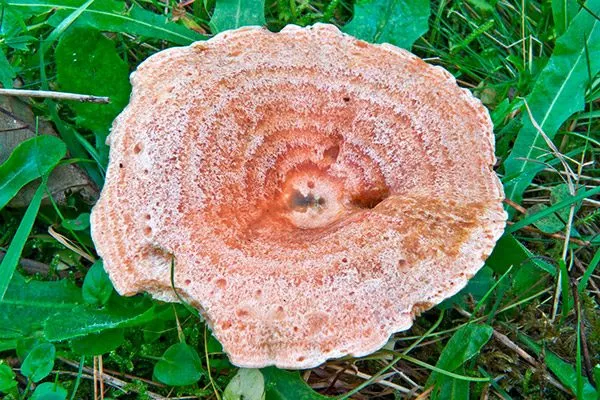
It grows primarily in Japan and southern Russia, and bears fruit only in autumn. It prefers fir and mixed forest plantations and has the following characteristic features:
- Hat. Size: 5-15 cm, flat or slightly convex. A central notch is required. The edges are always folded downward. The surface is smooth, orange, and free of sticky residue.
- Hymenophore and spore powder. The plates are very bright, orange-pink.
- Leg. It is distinguished by its rich, reddish-orange hue. Length varies from 4 to 8 cm, diameter from 1.5 to 2.0 cm.
- Pulp. Quite brittle due to its fragile structure, it's light in color and exudes a milky, reddish sap when cut. The flavor is very bland and the aroma is absent.
Salmon
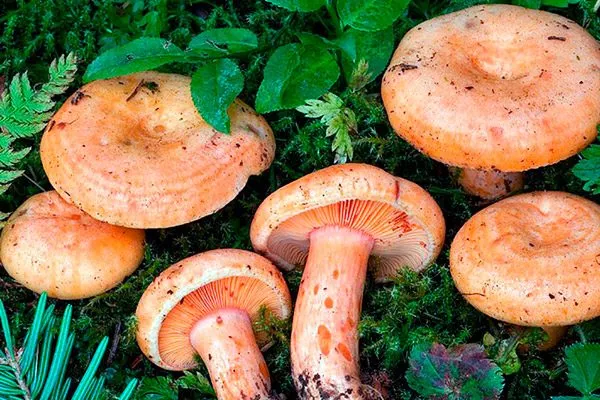
Another name is Alpine. Found only in fir forests. Characteristics:
- Hat. Very large – 10 to 20 cm in diameter. The color is yellow-orange in the center and bright carrot-red at the edges. Concentric zones can have a bright orange or salmon-pink tint.
- Hymenophore and spore powder. The plates are pinkish, but there are specimens with an orange sheen.
- Leg. It has dark indentations and a pinkish tint. It is approximately 4 cm tall and 1 to 3 cm wide.
- Pulp. Always white, after cutting an orange milky fluid appears.
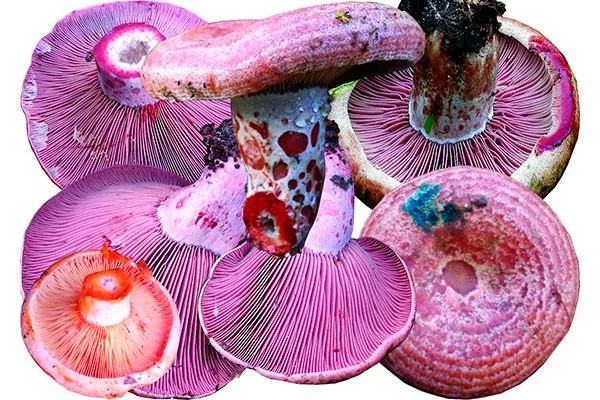
Wine
Prefers northern temperate climates and pine forests. Externally, it is similar to the red saffron milk cap. Characteristics:
- Hat. The mushroom is 10-12 cm in diameter, with a shiny, wine-red skin. Dark stripes are present. If you press the mushroom with your finger, the surface turns blue.
- Hymenophore and spore powder. The plates are narrow, the color of the hymenophore and spore powder is initially orange, later pinkish-lilac.
- Leg. Small in height (up to 6 cm) and thick (2-3 cm), it tapers toward the base and has an orange-pinkish hue. Sometimes a purple stem with bloody-wine-colored fistulas is found.
- Pulp. Exceptionally white and compacted, it turns red after breaking and, after a short time, brick-purple.
Blueing
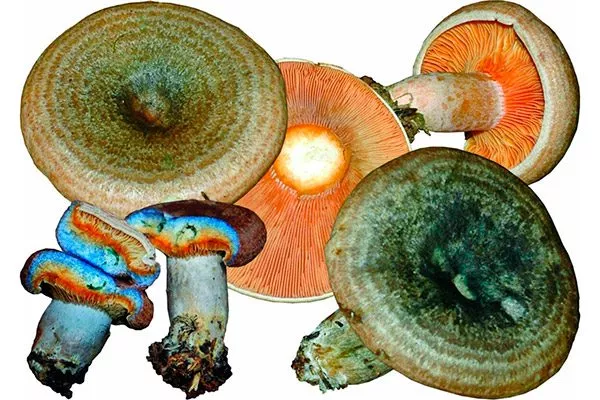
It grows in spruce forests and forest edges. In Russia, it is common in Vologda and Arkhangelsk. External characteristics:
- Hat. The diameter varies from 3 to 8 cm, the surface is sticky, and the concentric zones are clearly visible. The color resembles cinnamon with an olive tint.
- Hymenophore and spore powder. The narrow gills are closely spaced and peach-orange-yellow in color. If the spore powder is disturbed, the hymenophore turns green.
- Leg. Height from 4 to 11 cm, diameter from 1 to 3 cm, cylindrical shape, with a thickening at the base.
- Pulp. It's whitish in the center, but orange near the skin. If you cut it, it instantly turns blue.
False saffron milk caps
True saffron milk caps have a specific difference from other mushrooms: they secrete a very abundant milky juice. But there are other varieties that they confuse chanterelles, including those that are conditionally edible and those that are completely poisonous. To avoid poisoning, it's important to learn to distinguish between lookalikes.
The main ones are:
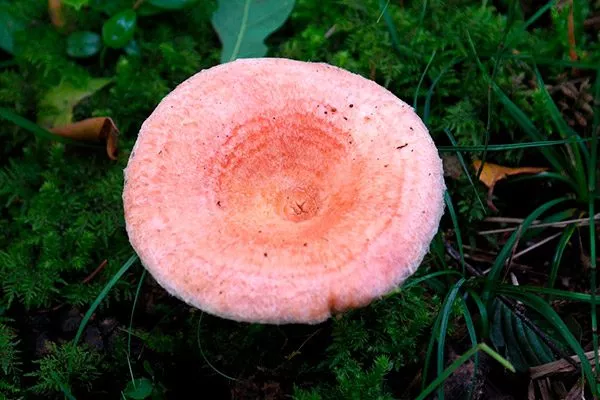
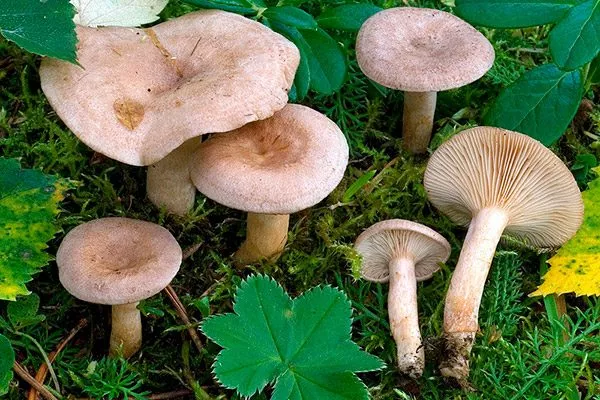
- Pink wave. It also has milky juice, but it's white (it doesn't darken when exposed to oxygen). The edges of the cap are fringed, the surface is pink, and the flesh is white. This mushroom is conditionally edible, but if improperly cooked, it can cause mild poisoning.
Its main characteristic is a very pungent peppery flavor. Biting into it raw causes mucus blisters to form on the tongue.

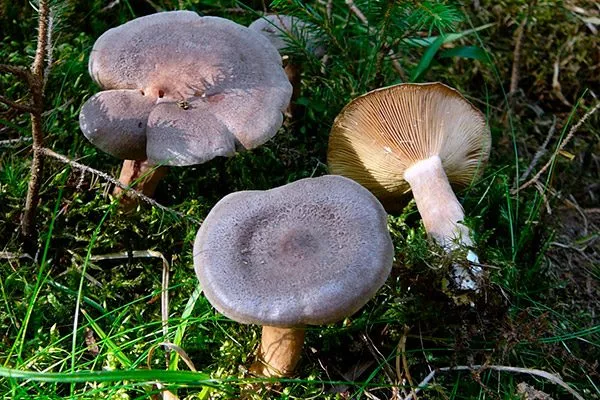
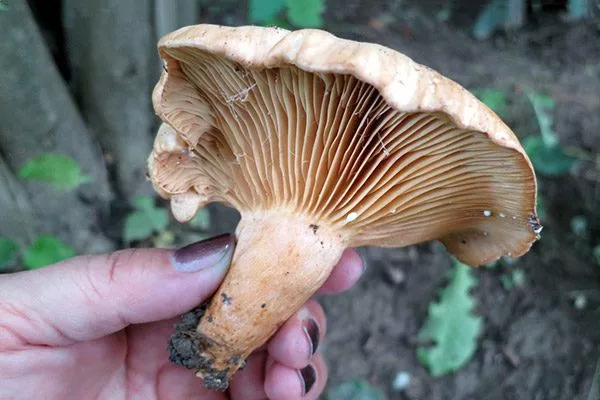
- Large milkweed. Another name is the nipple milk cap. It's also a conditionally edible species with a brownish-gray cap and white milky interior. The flesh is snow-white, with a coconut aroma when pressed. The surface is brown or brownish, turning yellowish in old age.
The taste is sharp and bitter, but toxicologically, it's not poisonous. Therefore, it will require a long soaking and salting before cooking.
- Milkweed aromatic. The cap is beige-ochre, the edges are curled, the flesh is light, and the milk is also white and does not change color when oxidized. The aroma is uniquely coconut-like, and is pronounced. Like the previous variety, it requires a special preparation technique.
- Oak saffron milk cap. Another conditionally edible mushroom, it grows only between oak and beech trees. It has a bitter taste, requiring a long soaking period. The cap is reddish or brick-red.
There are no completely poisonous look-alikes of saffron milk caps, but even conditionally edible mushrooms should be handled with caution.
How to distinguish saffron milk caps from other similar types of mushrooms?
There are only three species of conditionally edible mushrooms, most closely resembling one of the varieties of saffron milk caps. Carefully familiarize yourself with the main differences. Failure to do so increases the risk of poisoning.
Main types:
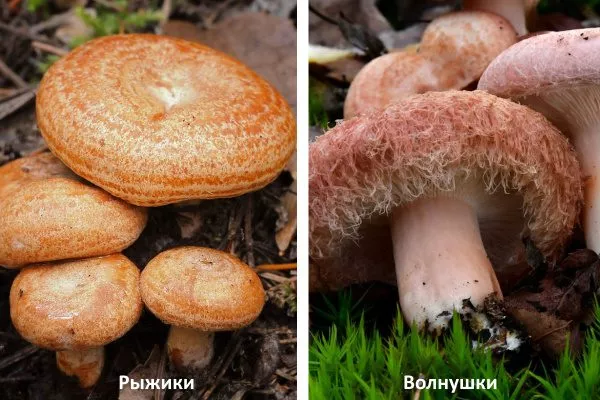
- How to distinguish saffron milk caps from volnushki (white milk caps)? These are the most commonly confused. Therefore, pay attention to the following indicators:
| Distinctive features | Chanterelles | Pink volnushki |
| Fruit body color | ocher, orange | pink |
| hat | smooth, slightly felty | pubescent |
| Milky juice | orange, changes when interacting with oxygen | white, does not darken |
| Place of growth | most often these are coniferous forests | exclusively under birch and aspen trees |
| Leg | thick | thinish |
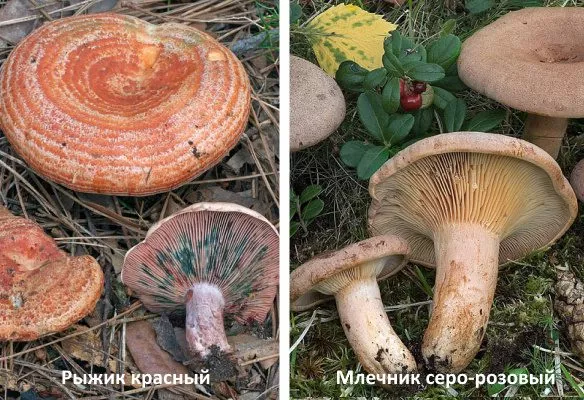
- Differences between the red milk cap and the amber milk cap (gray-pink). What is the difference:
| Distinctive features | Red saffron milk cap | Amber milkweed |
| Pulp | red-bloody under the skin, yellowish or whitish in other areas, often with red blotches, turns green after cutting | light yellow throughout the pulp, does not change after breaking |
| Milky juice | red, thick | light, very watery |
| hat | orange-red, with concentric zones | pinkish-brown, silky and graying |
| Leg | height – up to 6 cm, thickness up to 2.5 cm | height – 9-10 cm, thickness – 2 cm |
| Hymenophore | the plates are ochre at first, then wine-red | the plates are white in youth, pale pink in old age |
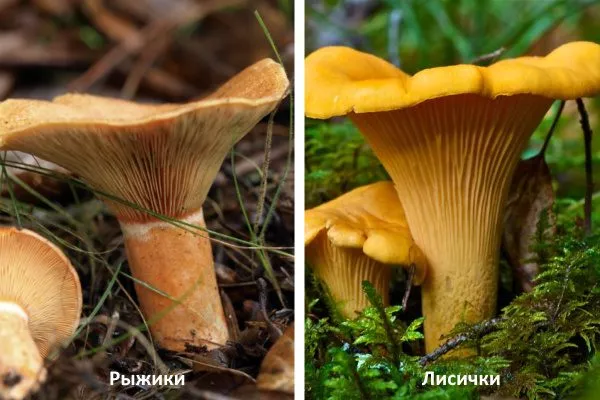
- How to distinguish them from chanterelles? These two mushrooms are sometimes confused. However, they have the following differences:
| Distinctive features | Chanterelles | Chanterelles |
| Hat shape | straight, with a notch in the central part. | funnel-shaped, very deep |
| Presence of rings | There is | No |
| Transition from cap to stem | perceptible | smooth |
Collection, preparation and storage of mushrooms
When harvesting milk caps, it's important to follow the general rules: cut or twist off the fruiting body, but don't pull it out of the soil along with the mycelium. Store carefully, as the mushrooms are fragile. Milk caps will keep for a maximum of 4 hours in a warm place, but only 24 hours in the refrigerator, provided the container is covered with a lid or plastic wrap.
Preparation rules
It's important to properly prepare saffron milk caps before storing them. To do this, follow these simple rules:
- Remove any stuck leaves and grass immediately after cutting, that is, in the forest. When you get home, start cleaning without putting it off.
- If you plan to dry the mushrooms, clean their surface and gills using a dry method – using a brush and a sponge.
- If boiling is necessary, be sure to rinse under running water, but it's better to soak the saffron milk caps in water for 15 minutes. This will facilitate the removal of dirt, especially from the gills. Additionally, remove any larvae and insects.
- Since saffron milk caps can quickly change color when exposed to air, which can make them unappealing, they should be placed in an acidic salt solution immediately after washing. To prepare, use 2 g of citric acid, 1 liter of water, and 1 teaspoon of salt. Leave the solution until ready for further processing.
Drying
True saffron milk caps are not bitter, so they can be dried. It's best to choose young specimens. Immediately after soaking in acidified water, rinse the mushrooms and dry them with a lint-free cloth. Next, spread them out in a drying area. Once completely dry, transfer them to a cloth bag or glass container.
Drying options:
- in the sun - you can lay it on a grid or hang it on a thread - drying time is about 10-15 days;
- oven - place the mushrooms on a baking sheet lined with parchment paper and dry with the door open for about 8 hours;
- Electric dryer - just arrange the mushrooms into sections and turn on the mode (each device has its own drying time).
Freezing
A great idea for those who enjoy fried saffron milk caps in the winter. You can freeze them whole or sliced, raw or cooked. The key is to let them drain thoroughly, quickly dry each mushroom with a towel, and immediately place them in the freezer.
Store in individual portions. Place saffron milk caps in vacuum-sealed bags or plastic containers.
Salting
Salted saffron milk caps are considered the most delicious. They are salted in two ways:
- Cold salting. Duration: about 30 days. How to do it right:
- Place the cleaned mushrooms in a container and cover with salt;
- put pressure on it for 2-3 days;
- Remove the weight and place the mushrooms in the refrigerator for further salting.
- Hot pickling. This is considered quick and safe, as the saffron milk caps undergo heat treatment. Instructions:
- scald the mushrooms with boiling water, but it is even better to blanch them for 2-4 minutes;
- place the mushrooms in a saucepan with their caps down in several layers;
- Sprinkle each layer with salt;
- install the weight and salt for about 5 days.
For any method, use about 50-60 g of table salt per 1 kg of saffron milk caps, and add spices such as black and allspice peppercorns and bay leaves. The mushrooms pair well with cloves.
Pickling
There are many recipes for pickled saffron milk caps—you can use one of them. But there's one universal one that has stood the test of time.
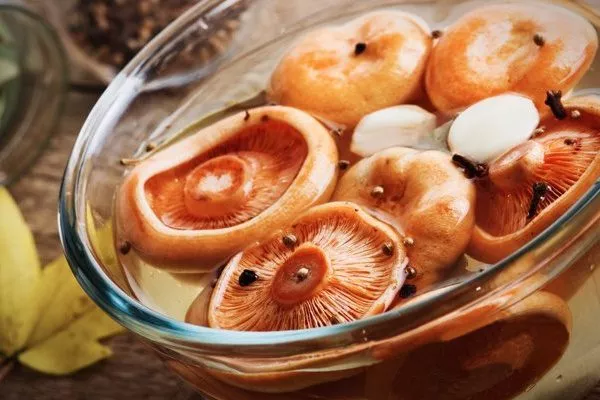
What you need for cooking:
- mushrooms – 1 kg;
- salt – 2 tbsp;
- water – 500 ml;
- vinegar essence (70%) – 1 tsp;
- dill – 10-20 g;
- cloves – 6 pcs.;
- bay leaf – 2 pcs.;
- pepper – 8 peas.
Cooking instructions:
- Prepare the mushrooms as usual. Soak them in the salty-sour mixture for exactly 60 minutes.
- Place the mushrooms in a saucepan, cover with cool water and cook for 2-3 minutes.
- Drain the water, rinse the mushrooms, and place them in an empty saucepan.
- In a separate container, prepare the brine—water, spices, etc.—and simmer for 10 minutes, skimming off any foam.
- Pour the marinade over the mushrooms, bring to a boil and cook for 15-20 minutes.
- Before turning off, pour in vinegar and cook for a couple more minutes.
- Place the saffron milk caps in sterilized jars, pour boiling marinade over them, and roll up.
Saffron milk caps in cooking
Saffron milk caps are cooked in every country, so there's an incredible number of dishes to choose from. We offer a Russian version of mushrooms in sour cream. To make it, prepare the onion, sour cream, and mushrooms (you can use any proportions you like—it all depends on your taste preferences). Then, follow these steps:
- Cut the onion into thin half rings and fry in refined vegetable oil until a light golden crust forms.
- Cut raw mushrooms into 2 halves.
- Sprinkle them with flour and fry.
- Add onion to the mushrooms, pour sour cream so that it covers the mushroom mixture to a thickness of 1-2 fingers.
- Season with salt and spices to taste. Fresh dill is also excellent.
- Simmer for about 15 minutes under a closed lid.
Interesting facts
There are many interesting facts about saffron milk caps that both seasoned mushroom pickers and novices should know. For example:
- The name "saffron milk cap" refers not only to the mushroom variety, but also to the genus of cruciferous plants and a village in the Leningrad region.
- During the Russian Empire, salted saffron milk caps were exported to other countries. The largest number of mushrooms were collected in the Kargopol district. Foreigners roughly divided them into two types: pine milk caps (red Kargopol milk caps) and spruce milk caps (blue milk caps). Meanwhile, in France, Russian saffron milk caps were valued at the same level as champagne.
- After eating saffron milk caps, human urine turns orange. This is due to the high concentration of beta-carotene.
Saffron milk caps are completely edible mushrooms with excellent flavor, but an unappealing color when cooked. They are most common in coniferous forests, growing in large colonies. There are several varieties of saffron milk caps, each with its own characteristics.