
Not all mushrooms are edible—there are some that try to disguise themselves as safe, but are actually poisonous or simply inedible. One such mushroom is the false birch bolete, also known as the bitterling, gall mushroom, or bitterling. It belongs to the genus Tylopilus.
Description of a false representative
| Name | Cap color | Hat shape | The color of the pulp when cut |
|---|---|---|---|
| False birch bolete | yellow-brown, yellow-brown | rounded, pillow-shaped | blushes slightly |
| True birch bolete | brown | hemispherical | it's getting dark |
| Aspen mushroom | orange-red | hemispherical | it's getting dark |
The false birch bolete resembles the true birch bolete Or aspen mushroom. It's impossible to confuse it with other mushrooms. How to recognize it:
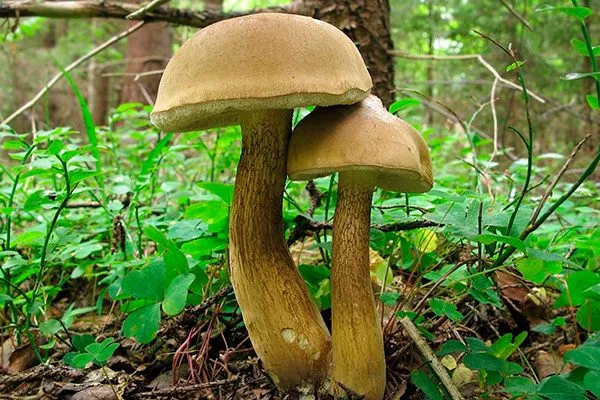
- Hat. It is distinguished by its round, cushion-like shape. Its diameter ranges from 12 to 15 cm. Its primary color is yellow-brown or yellow-brown, with additional shades of chestnut or grayish. The surface is somewhat dry in favorable or dry conditions, but wet and sticky during rainfall.
The cap structure is fibrous and the texture is velvety. - Pulp. It's distinguished by its snow-white hue, but when cut, the flesh turns slightly red, but never darkens, unlike its true counterparts. The aroma of the false birch bolete is subtle.
- Spore system. The spores are pinkish-brown or pure pink. The tubular layer is whitish when the mushroom is young, but gradually turns pink. When pressed, it turns red. The tubes are firmly attached to the stalk, so they are considered adnate.
- Leg. Identical to edible mushrooms, it is club-shaped, meaning it is thicker at the bottom and tapers toward the top. Its base color is creamy yellow or yellow-brown, but the underside is always whitish or slightly creamy. The surface is covered with a rich, reticulated pattern with a brownish, black, or rufous sheen.
- ✓ The presence of a mesh pattern on the stem, which is absent in edible analogues.
- ✓ Change in the color of the flesh when cut: it turns slightly red, unlike true birch boletes, which darken.
By what parameters can one distinguish a false birch bolete from an edible one?
It's especially difficult to distinguish bitterlings from their edible relatives when they're young, before the pores have fully developed color. However, they can be distinguished by the following characteristics:
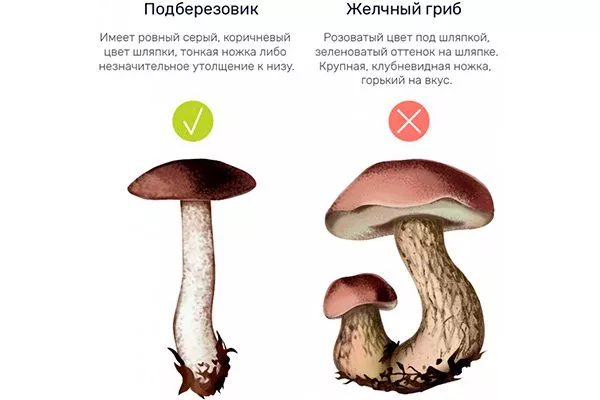
- The cap of the false mushroom is covered with a velvety surface. Edible mushrooms have a slightly shiny, completely smooth cap.
- Its color is very similar to that of the aspen mushroom, but the false birch bolete is much more intense. If it's orange, it's fiery; if it's brown, it's poisonous.
- The sizes also differ. The false mushroom is larger than the true one, and the lower thickening of the stem is more massive.
- The surface of the birch bolete or aspen bolete on its stem is always covered in scales; the inedible mushroom lacks these. Instead, it has reddish-brown veins.
- The hymenophore (the lower part of the cap) of the false mushroom is pinkish in color when young, but becomes dirty in later years.
- Bitterling is never affected by worms and other pests, as it contains bitterness that causes burning.
- The bitterling prefers maximum shade and marshy soil, while true mushrooms prefer other growing conditions.
Distribution, ecology and variability of the false birch bolete
The false birch bolete grows throughout Russia, favoring both deciduous and coniferous forest stands. It is often found on stumps that have long since rotted away. The only favorable conditions for successful propagation are fertile and acidic soil.
- ✓ Prefers acidic and fertile substrates, which is rare among edible mushrooms.
- ✓ Grows exclusively in shaded and swampy places, avoiding sunny meadows.
Bitterlings are never found in sunny forest clearings or clearings, far from water and high humidity. They thrive in the presence of decaying elements such as wood, foliage, and so on.
Edibility and taste
The false birch bolete isn't considered poisonous, like the toadstool or fly agaric, for example. Therefore, it doesn't cause death. Despite this, the bitterling is considered inedible (or conditionally edible). The mushroom's advantage is that humans can't eat it—it's excessively bitter (hence the name bitterling).
Other features:
- Because of this same bitterness, the false mushroom is not affected by insects;
- When heat treated, the bile taste only intensifies.
See also the video on this topic:
Symptoms of poisoning by false birch bolete
The flesh of the false birch bolete contains various substances, including toxic ones, which cause the bile taste. These resinous elements irritate the mucous membranes of the gastrointestinal tract.
Poisoning occurs in rare cases—only when a person deliberately eats several mushrooms (this can occur with taste bud dysfunction). Another option is to preserve the false birch bolete along with other mushrooms, vegetables, etc. The problem is that many seasonings can mask the bitterness.
If intoxication occurs, the patient's condition will be accompanied by the following symptoms:
- pain in the stomach area;
- nausea and vomiting;
- diarrhea;
- weakness;
- dizziness.
The first symptoms are observed after at least 30 minutes, at most 3 hours.
First aid
The severity of symptoms varies from person to person. Some people even experience complete dehydration, so it's important to provide prompt first aid and call an ambulance immediately.
What should be done first with the victim:
- Rinse the stomach. To do this, have the patient drink at least 600 ml of clean, still, slightly salted water. Ideally, 1-1.5 liters.
- If natural vomiting does not occur, induce it. Continue this until the condition improves.
- Give the victim any intestinal sorbent that will help remove toxic substances. For example, activated charcoal (the number of tablets depends on the person's body weight – one tablet for every 10 kg).
Even if the patient is not dehydrated, it is important to adhere to a diet for the next few days – avoid fried and spicy foods, milk, and smoked meats. Allowed foods include lean cereals, boiled lean meats (rabbit, veal), and vegetables that have been stewed (not fried) or grilled.
The prognosis for poisoning by false birch bolete is quite favorable, meaning no significant complications will occur. However, it's best to avoid this condition, so it's important to learn to recognize the bitter mushroom by its external signs.