
A convex, yellow, red, or orange cap—that's how saffron milk caps are often described. However, these characteristics also apply to other mushrooms—look-alikes of this useful product. Some species are dangerous to humans, and consuming them can cause poisoning. Others, on the contrary, are valuable, and some are considered a delicacy. It's important to learn to distinguish the false forest dweller from the real one.
False saffron milk caps and their differences from true mushrooms
Chanterelles – mushrooms popular in many countries. They are distinguished by their exquisite taste. It is very difficult to confuse them with poisonous ones, as a special juice is released when the cap is damaged. There is an exception: members of the same genus may have a similar appearance but a distinct chemical composition.
| Name | Cap color | Hat size (cm) | Pulp color | Features of juice |
|---|---|---|---|---|
| Real saffron milk cap | orange | up to 15 | orange, turns green when oxidized | red, turns green when oxidized |
| Spruce | orange with a brown tint | 2-8 | carrot, turns scarlet, then greenish | milky, does not change |
| Red | bright orange | 5-15 | reddish | scarlet |
| Red pine | green on top, orange on the bottom | 3-8 | milky with a transition to orange-red | milky, turning purple |
- ✓ The presence of milky juice, which changes color upon contact with air.
- ✓ Color and change in color of the pulp when cut.
- ✓ The smell of the pulp, which can vary from fruity to unpleasant.
Real saffron milk cap
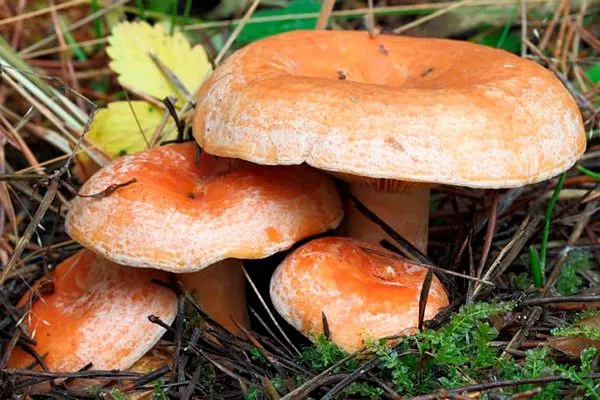
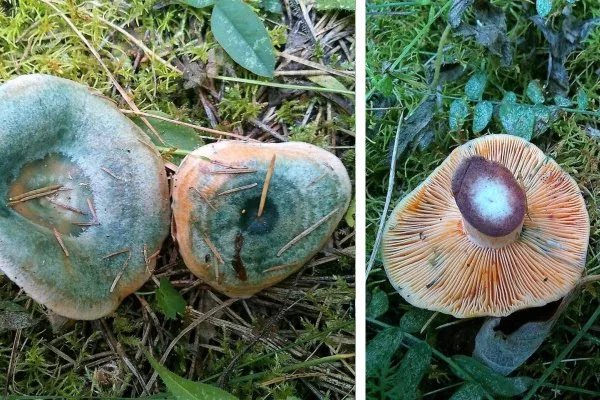
A true saffron milk cap can be identified by its cap. A mature mushroom can grow up to 15 cm in diameter. The cap's underside is always a uniform orange. If you press on the outer tissue, a red sap is released, which immediately changes color to a greenish tint.
Characteristics of a real saffron milk cap:
- The shape of the cap is flat, concave inward, the edges are slightly bent, the surface is smooth, there is an oily coating, and there are cylindrical circles.
- The flesh is orange, but oxidizes quickly. Therefore, after breaking it open, there is a greenish tinge.
- The stem is tubular and crumbles easily. It is short and may be covered with fluff. The stem is hollow, with a thickening at the point where it meets the cap.
The red pine mushroom (commonly known as the rowan mushroom) prefers to grow in close proximity to pine and spruce trees. It is particularly fond of young pine shoots. A large harvest can be obtained at forest edges and elevated areas where vegetation is sparse. Large concentrations of mycelium are found in mixed coniferous forests of the Urals and Siberia.
It's recommended to pick this delicacy in late August or early September. This is when the fruit is actively ripening, which continues until the end of October. Harvesting takes place early in the morning.
Edible varieties
The saffron milk cap has doppelgangers that pose no danger to humans and are safe to eat. However, when cooked, the flavor is altered—not as pleasant as the real saffron milk cap.
Spruce
This mushroom has several names: the spruce saffron milk cap, the spruce mushroom, and the spruce mushroom. It is also known as Lactarius deterrimus. Appearance: It has a cap 2-8 cm in circumference. It is funnel-shaped, with slightly downward-curved edges. Young specimens have a bulge in the center. The skin is smooth, but becomes slippery in humid regions.
The color is orange, with a brown tint. Juveniles have a pinkish color with dark circles.
Other characteristics:
- the plates are descending, often located next to each other, the characteristic shade is pink-orange or red (age plays a role);
- carrot pulp when cut, upon contact with air becomes scarlet, then greenish;
- the taste is sweetish, the smell is weak, fruity;
- The stem is from 3 to 8 cm in height, cylindrical, can be hollow or solid, the color is the same as the cap.
The mushroom is common in spruce forests of European Russia. It is also frequently found in the Urals, the Far East, and Siberia. It is collected under coniferous trees. Fruiting occurs in clusters. Increased germination is observed in cool summers. Peak growth occurs from July to September.
Red
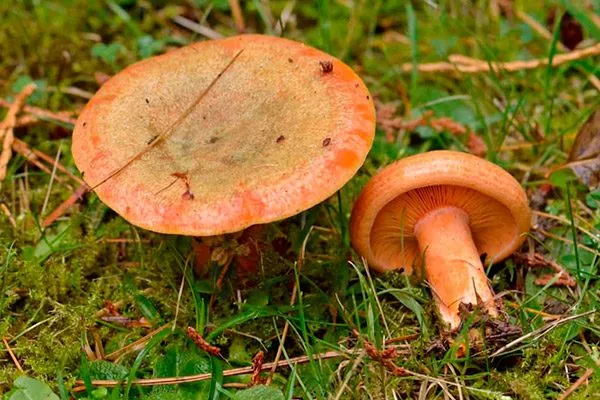
Lactarius sanguifluus, a member of the Russulaceae family, is very rare in the wild. It can only be found in coniferous forests in the highlands. It most commonly grows on the Crimean Peninsula. Fruiting begins in summer and continues until mid-autumn.
External data:
- the cap is from 5 to 15 cm in diameter, the shape is flat or slightly convex, there is always a depression in the center, the edges are bent inward;
- the skin is smooth, bright orange in color, and completely free of any coating;
- the pulp is brittle, reddish, and when cut, scarlet juice is visible;
- The stem is up to 6 cm in height, powerful, cylindrical, tapering towards the base.
Red pine (aka semi-red)
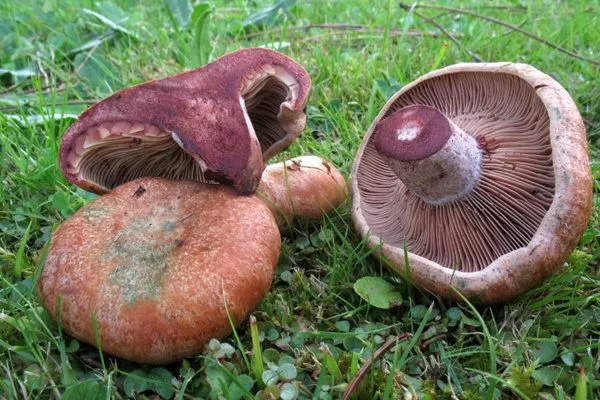
Another name is Lactarius semisanguifluus. Commonly, the mushroom is called the green-red saffron milk cap.
Characteristic:
- the cap is from 3 to 8 cm in diameter, with a concavity in the center, the edges are slightly bent inward;
- the top of the cap is green, the bottom of the cap is orange;
- the stem is up to 6 cm high, the structure is solid (in adult mushrooms there is a narrow cavity);
- when cut, the flesh is milky with a transition from the center to the periphery in orange-red color;
- the milky juice turns purple after oxidation (a fleeting phenomenon);
- The taste is sweet with a slight bitterness, the smell is mushroomy with fruity notes.
Fruiting occurs from mid-summer to late autumn. Most mushrooms are found in September. They thrive in well-lit areas and pine forests. These delicacies grow in small groups or singly.
Inedible varieties
It's important to be able to distinguish true saffron milk caps from false ones. In nature, there are species that are dangerous to humans. They don't cause death, but they can have a detrimental effect on health, digestive system function, and so on. Recognizing these mushrooms is easy; just look closely at their appearance.
Amber milkweed
Also known as the gray-pink milkcap (or Lactarius helvus), this member of the family is very similar to other milkcaps, including the saffron milkcap. The first distinguishing feature is the reddish cap with a silky sheen. Other characteristics:
- the cap is 12 cm in diameter, the shape is the same as that of a real mushroom;
- the color of the hymenophore is white, changing to pink or fawn with age;
- the flesh is light yellow, the color does not change when cut;
- the smell is unpleasant, slightly pungent, similar to chicory;
- taste with bitterness, spicy;
- The stem is cylindrical, 9 cm high, the structure is loose, in older specimens it is hollow, if you look closely you can see white fibers.
The mushroom is considered unfit for human consumption, but does not pose any danger.
Fruiting occurs throughout the summer—from June to September. It is found in temperate latitudes further north. It grows near spruce, pine, and sometimes birch trees. Most doubles are found among mosses, in blueberry patches, and on the edges of swamps.
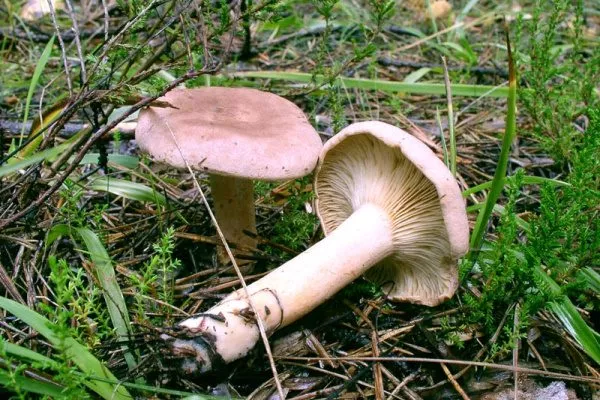
Pink wave
Also known as Lactarius torminosus, this mushroom can be considered a unique organism. There are several reasons for this, but the main one is its many synonyms. In literature, the species is called Krasnulya, Krasulya, Volzhanka, Volminka, and Otvarukha.
This is a conditionally edible product. It can be eaten safely, but it must be boiled first. Its chemical composition is meager, and the amount of beneficial microelements is minimal.
Appearance:
- the cap is 10 cm in diameter, pinkish-red in color, with dark concentric areas, flat in shape in adulthood, pubescent edges;
- the plates are white and turn yellow as they grow;
- the pulp is whitish or light cream, brittle, the juice is milky, does not change when exposed to air;
- the smell is resinous, the taste is pleasant, mushroomy;
- The stem is 6 cm high, cylindrical, solid in young plants, then hollow, pale pink in color.
The milk cap grows from July to October. It is found in deciduous and mixed forests. Large concentrations are observed near birch trees or in dense grass at the forest edge.
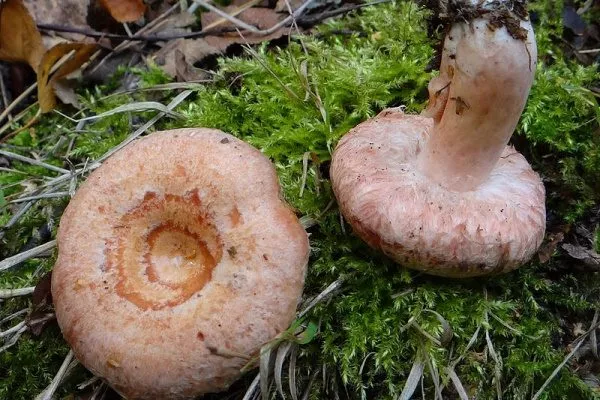
Milk cap
Another member of the Russulaceae family, it has several names: the large milkcap, the large milk cap. In Latin, it is written as Lactarius mammosus.
External data:
- the cap is flat, the circumference is up to 9 cm, there is a tubercle in the center (disappears as it matures), the color is grayish, brown or blue, but you can find specimens with purple, red skin;
- the plates are white in young animals, then red;
- the pulp is dense, milky, the shade is always the same;
- the taste is satisfactory, bitterness is almost completely absent, the smell is coconut;
- The stem is up to 7 cm in height, white in color, and in older mushrooms it merges with the cap.
This variety grows in mixed or coniferous forests. It grows in groups. It is recommended to harvest in early autumn.
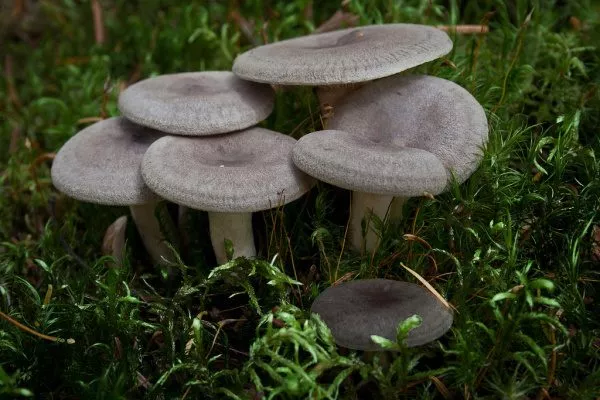
Poisoning by false mushrooms
Many saffron milk cap lookalikes are conditionally edible. If you don't process them, you can get mild poisoning. Symptoms include vomiting, diarrhea, and abdominal pain. Symptoms can appear at any time; there's no exact time frame, but malaise typically begins 30 minutes to an hour after eating.
The most dangerous thing is eating the white death cap. Even the tiniest piece can be fatal. The first warning sign is gastrointestinal upset. After 8-18 hours, loss of consciousness and impaired motor coordination occur. The toxins damage the liver, cardiovascular system, and kidneys.
First aid
If a person exhibits symptoms of mushroom poisoning and has been documented as having eaten the product, it's important to provide first aid. Here's what to do:
- Induce vomiting. Two options: give a large amount of any liquid to drink, or press two fingers on the root of the tongue.
- Rinse the stomach. Give the victim water, first dissolving 20 g of table salt (or mustard powder). After a few minutes, induce vomiting. Then offer activated charcoal – 2 tablets per 1 kg of body weight.
- Call an ambulance.
What should I do to avoid food poisoning?
It's virtually impossible to become poisoned by false, conditionally edible saffron milk caps. Only people with weakened immune systems, children under 6, and pregnant women are vulnerable. However, it's not worth the risk.
To ensure 100% safety, follow these rules:
- Go to the forest to harvest crops, do not stop near highways, roads and in places where industrial enterprises operate;
- discard suspicious specimens (with dark spots, deformed, rotten);
- Do not cook mushrooms in galvanized cookware, as zinc reacts with juice at high temperatures, resulting in the formation of zinc salts that are harmful to the human body;
- Do not change the recipe for marinating, canning, cooking, etc., everything is designed taking into account the characteristics of the product;
- Don't take what you can't define.
The saffron milk cap is a popular edible mushroom. It has many lookalikes, all members of the same family. Only three species are completely edible, but the flavor differs slightly from the "original." The others require special preparation before cooking. The white death cap is fatal.
Thanks for the interesting information. I once collected some false saffron milk caps and boiled them in a galvanized pot... luckily a neighbor stopped by and warned me... But in any case, your article is useful—it provides information on first aid and how to distinguish them from real saffron milk caps.
I lived in Berezovsky, Kemerovo Oblast, from age 6 to 18, where I picked mushrooms. I used to pickle white milk caps, black milk caps, and aspen milk caps. We probably called them that, but I don't know their real names. So, the mushrooms we ate in the Kemerovo Oblast and in some articles in Novosibirsk were false. I also watched a bunch of videos of mushrooms we thought were toadstools being picked and eaten. Many people also claim that many false mushrooms are edible, but they simply don't taste good. I've also heard that some truly poisonous or deadly mushrooms have a very distinctive taste and smell. For some reason, the article says that some mushrooms are odorless, but I've been picking and eating them for years, and they do have a smell. I also don't recommend picking rowan mushrooms and parasols. There are 10 poisonous species of two edible parasols, and rowan mushrooms have many poisonous species. I wonder how people manage to poison themselves with death cap mushrooms. They grow like fly agarics, seemingly from an egg, but have a skirt and an unusual color. I read that if you put one poor death cap mushroom in a bucket of mushrooms and then remove it, all the mushrooms become deadly poisonous. Maybe people get poisoned by death cap mushrooms not because they ate them, but simply picked them, looked at them, cut them into pieces with a knife, and then cut them into edible mushrooms. There's no antidote; heat treatment, drying, and freezing don't neutralize the poison.