
Black chanterelles belong to the genus Funnelflower, family Chanterelle, and class Agaricomycetes. They are considered edible and grow wild in various regions of Russia. They can also be grown at home. The key is to learn all the intricacies and nuances of planting and care.
A bit of history
The black chanterelle has a somber name not only because of its color, but also because it appears in forests across Europe on All Souls' Day, which is precisely November 2nd. After extensive research, biologist Tocci Augusto decided to affectionately call this variety "the poor man's truffle." The reason for this is its incredible health benefits, exquisite flavor, and dark hue.
Depending on the country, black chanterelles have other names. In Latin, they include Peziza cornucopioides L, Pezicula cornucopioides (L.), Merulius cornucopioides, Cantharellus cornucopioides, Sterbeeckia cornucopioides, and others.
Among the common people, names such as "sushka," "funnel mushroom," "gray funnel mushroom," "gray chanterelle," "horn-shaped funnel mushroom," and "craterellus corniculatus" are particularly prominent. In Europe, the following names are also used:
-
- black horn - in Finland;
- death trumpet - in France;
- trumpet of the dead - in Germany;
- cornucopia - in England.
It is the unusual shape of the fruiting body that leads people to associate the mushroom with a funnel or a horn.
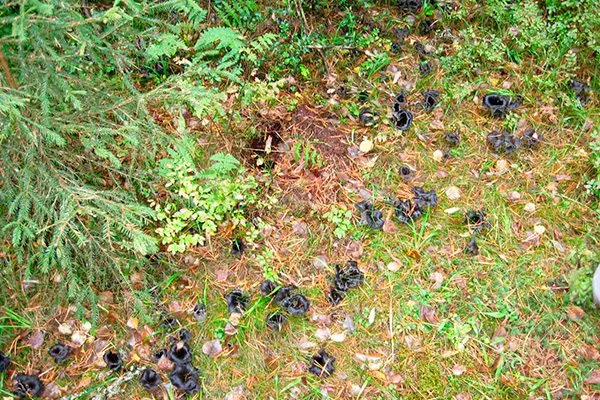
Description
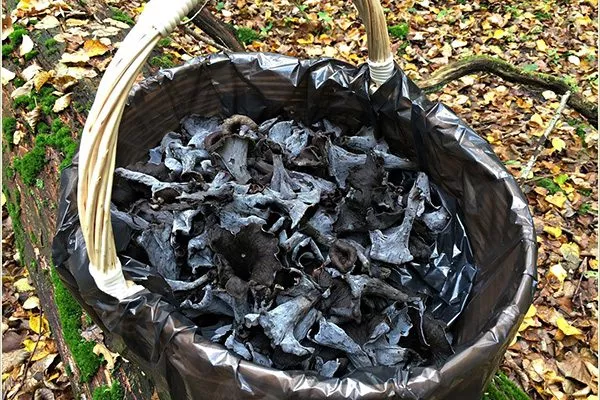
The black chanterelle's fruiting body is cup- or tubular-shaped, tapering significantly at the base. The mushroom is hollow inside, with the cap opening gradually transitioning into the stipe.
Other external indicators:
- Hat. It is considered small, as its size varies from 3 to 5 cm. If the mushroom is overgrown or grown in very favorable conditions, it can reach 7-8 cm. The cap edge is uneven and slightly inverted. The funnel has no clear boundaries.
The surface resembles a waxy coating on the outside and is rough on the inside. The mushroom's color changes depending on the weather: if it rains, the chanterelle turns black; if it's dry, it turns a dirty brown. - Pulp. The interior of the funnel-shaped arugula is very thin and fragile, easily breaking under any mechanical impact. When young, the flesh is gray, when mature, it turns dark brown, and when old, it turns black.
When any mushroom is cooked, its interior turns completely black. Fresh chanterelles are odorless and tasteless, but if they are dried or cooked, a distinctive mushroom aroma emerges. - Leg. Its height is 8-10 cm, but the most common specimens have stems ranging from 5 to 7 cm in length. The stem is thin—only 1 cm—which is why it is often confused with poisonous mushrooms. Like the cap, it is brittle, gray or brown. Its texture is somewhat dry.
- Spore-bearing layer. This species of chanterelle lacks a pseudolamellar layer entirely, but does have a spore-bearing layer on the inner surface, called the hymenium. It's quite thin, smooth when young, and rough when old.
- Spore powder. The shape is egg-shaped, the texture is transparent, the color is white or slightly yellowish.
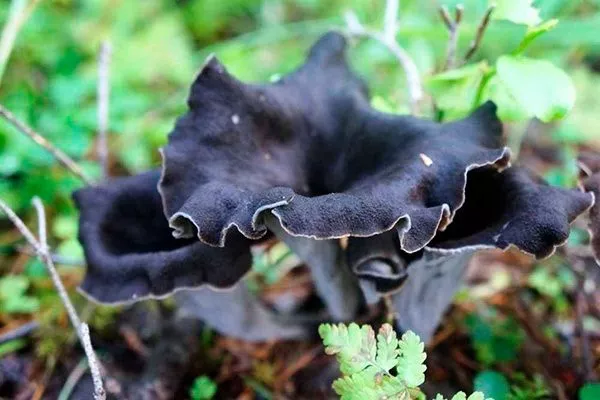
Distribution and collection
The black chanterelle mushroom prefers high humidity, so it's often found in deciduous or mixed forests. It especially loves beech and oak trees, where it hides among fallen leaves. The black chanterelle also thrives in a sunny clearing, as it requires light.
Other growing characteristics:
- the preferred soil in nature is clayey, calcareous;
- mushrooms always form in small groups or columns, so they are easy to notice, but despite this, it is problematic to determine their location under the foliage;
- The fruiting period in Russia is July-November, but the best harvest is considered to be in September, when the fruiting body gains aroma and beauty of appearance (but summer chanterelles are more nutritious);
- The largest number of black chanterelles is found in the Far East, in the Altai and West Siberian districts, and in the North Caucasus.
This variety is virtually immune to parasitic worms, so mushroom pickers collect only healthy specimens. Due to the fragility of the fruiting body, certain rules must be followed when harvesting:
- never twist the legs, but cut them off with a knife;
- the instrument must be thin and very sharp;
- Do not pull the mushroom out of the soil by the roots, otherwise the mycelium will be destroyed and there will be no further growth of chanterelles;
- should be collected in a basket made of natural wicker;
- You need to lay out the mushrooms carefully so that they don’t crumble.
Similar species
| Name | Hat size (cm) | Pulp color | Growing conditions |
|---|---|---|---|
| Black fox | 3-8 | Gray, dark brown, black | Deciduous and mixed forests, clayey, calcareous soil |
| Gray fox | 3-5 | Grayish | Deciduous forests |
| Funnelweed tortuous | 3-7 | Light | Deciduous forests |
The black horn mushroom can be confused with only two types of chanterelles:
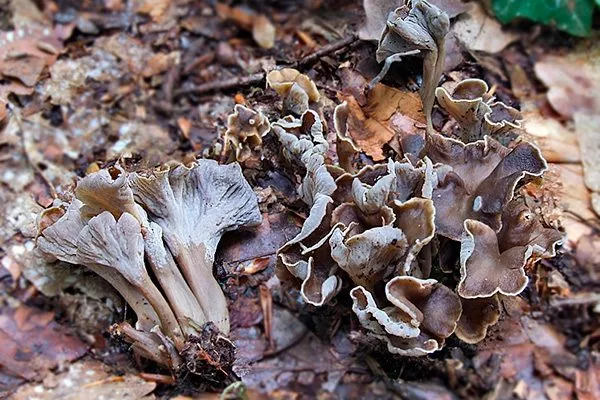
- Gray. Unlike the black chanterelle, it has pseudo-plates under the cap. The stem is more developed, and the color is always grayish.

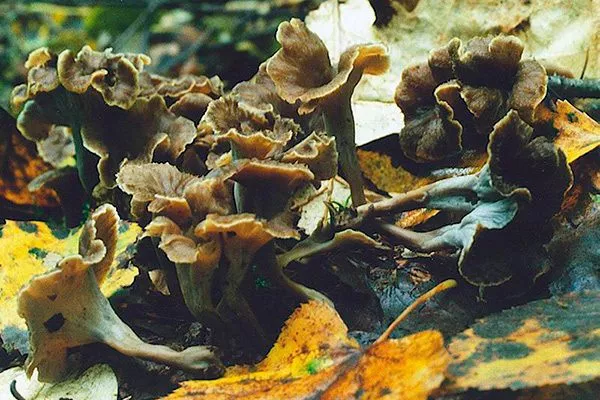
- Funnel-weed tortuous. Also in the same genus as chanterelles, it's conditionally edible, so it's important to know how to distinguish the two varieties. The twisted funnel mushroom is edible, but requires special cooking.
How is it different from the black chanterelle:- shade - lighter;
- the edges of the cap are too dissected;
- hymenophore – folded.
Characteristic
The black chanterelle is a true delicacy in many countries around the world. It's a versatile variety used in a variety of dishes, preserved for the winter, frozen, and dried. Its dark color makes it unusual in appearance. Mycologists identify several distinctive features that are important for mushroom pickers to be aware of.
This is a completely edible mushroom, the flavor and aroma of which are revealed by cooking or drying. If you cook a chanterelle, be prepared for not only the flesh at the cut end to turn black, but also the water, which is completely normal.
Medicinal properties and benefits
Black chanterelle is recommended not only for cooking, but also for treating a number of medical conditions and improving skin condition. This is possible thanks to the following beneficial properties:
- anthelmintic;
- bactericidal;
- anti-inflammatory;
- immunostimulating.
Based on this, it is actively used for the production of medicinal products for the following disorders:
- increased hemoglobin levels in the blood;
- vision restoration;
- muscle cramps;
- treatment of rheumatism;
- prevention of growth and development of cancer cells;
- normalization of blood pressure;
- relief from insomnia;
- elimination of inflammatory processes in joints;
- destruction of helminths;
- strengthening the immune system and muscle tone;
- normalization of the functioning of the digestive, cardiovascular and skeletal systems;
- removal of heavy metals and radionuclide compounds from the body;
- improving the structure of the skin.
Possible harm
Black chanterelles can cause harm in several cases. For example, if:
- there are contraindications;
- mushrooms were collected in areas with high gas pollution, near landfills, etc.;
- consume in excessively large quantities.
Several contraindications:
- pregnancy and breastfeeding;
- childhood;
- allergy to mushrooms;
- some diseases of the gastrointestinal tract.
Medicines
Traditional medicine offers many recipes, but the most popular are the following:
- Against helminthiasis, liver diseases, gastrointestinal tract. Dried mushrooms are used, which must be ground to a powder. Preparation and use instructions:
- Mix 300 ml of vodka with 3 tbsp of powder, then cover tightly with a lid and leave for 10 days (during this time, you need to periodically stir the mixture and open the lid for 15 minutes a day);
- take 20 ml once a day (before bedtime);
- course of treatment – 14 days;
- For hepatitis and pancreatitis, you need to drink 10 ml for 3 months.
- Rheumatic and joint pain, swelling, inflammation. Chop raw chanterelles, combine with porcini mushrooms and birch boletes, pour the mixture into a liter jar, and fill to the top with warm vegetable oil. Keep in a warm place for 1-2 days. Use as a compress.
- Cancer prevention. Powdered dried chanterelles are also used. How to use:
- Pour 1 tbsp of powder into 200 ml of boiling water;
- let it cool naturally;
- drink 100 ml 2 times a day;
- prepare the tincture daily;
- duration – 21 days.
Cosmetic product
To improve skin condition and rejuvenate, prepare this medicine:
- Brew green tea (2 tablespoons per 500 ml of boiling water).
- Finely chop 30 g of chanterelles and 50 g of oatmeal.
- Mix all ingredients.
- Apply to cleansed skin, leave for 30-35 minutes.
- Rinse your face.
Cooking Features
Black chanterelles can be used in a variety of ways – for cooking, preserving, pickling, drying, etc. Proper preparation of the mushrooms is crucial, as the quality of the resulting food depends on it.
Primary processing
This is a must, as the caps of chanterelles are sticky, which is why they tend to attract dirt. Here's how to do it correctly:
- First, clean the mushrooms of any dirt. To do this, pour running water into a basin and, taking out one chanterelle at a time, lower them into the water.
- Let the dirt soak for 15 minutes. Then, take a soft sponge and lightly scrub the mushroom's surface.
- Carefully inspect the chanterelle for any dark spots or other imperfections. If any are found, trim off or scrape off the affected parts.
- Now rinse under running water. Take each mushroom again and hold it under the tap. Use your fingers to thoroughly clean off any dirt. Also rinse under the cap, where the gills are.
Black chanterelles contain substances that repel insect pests. This also contributes to the formation of bitterness on the mushroom's surface. However, the bitterness disappears after the above treatments, but not always.
The reason for this is as follows:
- the mushroom is too old and has therefore accumulated an excessive amount of bitterness;
- the fox grew near the coniferous trees;
- the weather was dry.
Bitter black chanterelles are safe to eat and pose no health risks. To improve the flavor, try one of the following:
- soak for 2-3 hours;
- Boil in lightly salted water for 5-7 minutes.
Cooking
Black chanterelles can be eaten without cooking, but if you plan to preserve them for the winter, you'll need to boil them. Here's how:
- Clean the fruiting bodies.
- Cut off the stem, as it is not used for food.
- Place a pot of water on the stove.
- Add a little citric acid (0.5 teaspoon per 3 liters of water).
- Add mushrooms and bring to a boil.
- Simmer on low for 10 to 15 minutes.
- Drain the water by passing it through a colander.
Pickling
There are many ways to pickle black chanterelles, but few are particularly popular. Before pickling, chanterelles are simply boiled, then the following ingredients are prepared:
- 1.5 kg mushrooms;
- 2 tbsp. salt;
- 3 tbsp. sugar;
- 4 tbsp vinegar;
- 600 ml of water;
- 2-3 pcs. cloves and bay leaves;
- 1 teaspoon peppercorns.
Marinating process:
- Prepare the marinade. Mix all ingredients and spices except the vinegar and vegetable oil. Simmer for 2-3 minutes.
- Place the chanterelles in a saucepan and pour boiling brine over them.
- Boil for 10 minutes, pour in vinegar and keep on heat for another 4-5 minutes.
- Separately, heat vegetable oil in a frying pan.
- Place the mushrooms in glass jars.
- Pour in boiling oil and brine on top.
- Seal it.
Freezing
Frozen black chanterelles are used in sauces, soups, main courses, stuffings, and marinating. The versatility of their use is the main advantage of this method of storing mushrooms. The only requirement is not to refreeze them.
How to freeze:
- Clean and wash the mushrooms. If desired, boil them first.
- Trim the legs.
- Dry on a towel to remove any moisture from the surface.
- Place the funnel-shaped mushrooms in a thick plastic bag (preferably a vacuum bag) or in a plastic container.
- Place in the freezer.
Frying
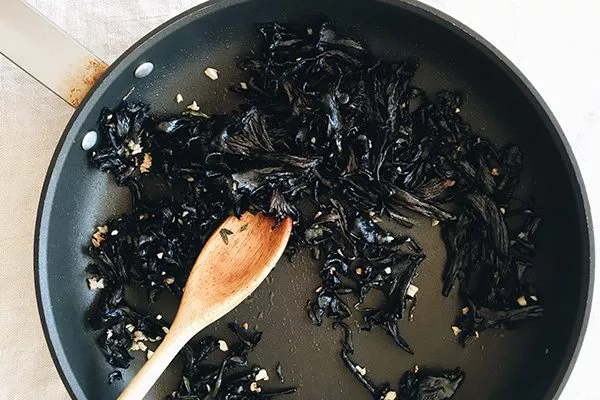
Fried chanterelles are a favorite dish for many people. They're prepared according to the classic recipe, but with the black variety, there's no need to boil them.
Chefs claim that after pre-boiling, black chanterelle becomes juicier and tastier.
What you will need:
- 600 g mushrooms;
- 1-2 cloves of garlic;
- salt, ground pepper;
- 50-60 ml vegetable oil;
- any greens.
How to fry – step-by-step instructions:
- Pour oil into a frying pan and heat it.
- Add the chopped hopper mushrooms and fry for 6 minutes. Set the stove to medium heat. If you pre-boiled them, dry them thoroughly. Otherwise, the mushrooms will be stewed rather than fried.
- Add chopped herbs and garlic. Continue frying for another 5-7 minutes.
Serve with mashed potatoes, boiled rice or vegetable salad.
Pickling
Salted black chanterelles are especially delicious because they're crispy. Ingredients:
- mushrooms – 1 kg;
- salt – 60-80 g;
- garlic – 5 cloves;
- dill – 1 bunch;
- bay leaf – 2-3 pcs.;
- peppercorns – 5 pcs.
The salting process includes the following steps:
- Boil the cleaned funnel mushrooms for 10 minutes.
- Drain the water.
- Fill with clean water and cook for another 15 minutes.
- Place in a colander again to remove excess liquid.
- Place herbs and spices, a little salt and garlic on the bottom of another container.
- Place the chanterelles in a single layer. Top with more spices, salt, and other ingredients. Then add the mushrooms again. Repeat this process until all the chanterelles are used. Remember, the top layer should consist of seasonings.
- Cover the pan with several layers of gauze, put a weight on it as a pressure and leave it to salt for several days.
- The mushrooms are ready when black juice appears on the surface. Now transfer the container to the refrigerator.
It can be consumed in about a month.
Drying
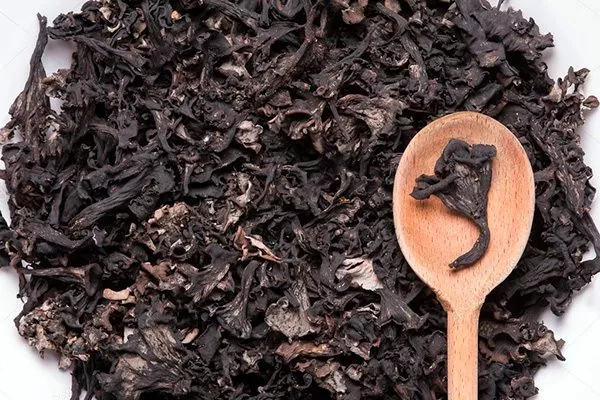
Dried black funnel mushrooms are used in the same way as frozen ones. They are also used to prepare medicinal remedies, add to prepared dishes, and as breadcrumbs.
The easiest way to dry:
- Dry clean the mushrooms. Use a brush. Washing, let alone soaking, is prohibited.
- Cut into fractions if necessary.
- Prepare a baking sheet by lining it with parchment paper.
- Arrange the mushrooms in a single layer.
- Turn the oven on to +50 degrees, but do not close the door - leave a small opening so that excess moisture will evaporate.
- Leave it like this for 2 hours, then reduce the temperature to 10 degrees Celsius. Dry for another hour.
During this time, the product should dry. You can check the quality of drying by examining its structure—the fruiting body should crumble only when pressed firmly.
Canning for the winter
Canned chanterelles are in great demand, as they are suitable for both festive tables and everyday dinners.
What you will need:
- mushrooms – 1 kg;
- onions – 150 g;
- carrots – 100 g;
- sugar – 1 tsp;
- salt – 1 tbsp;
- vinegar – 50 ml;
- vegetable oil – 100-125 ml;
- bay leaf, black peppercorns.
Step-by-step preparation:
- Boil the mushrooms for 10 minutes.
- Place in a dry frying pan and fry until all the moisture has evaporated.
- Separately fry the onion, cut into half rings, and the carrots, grated on a grater.
- Combine all ingredients in a bowl. Simmer the mixture in the oil, seasoning with salt and pepper and adding the remaining ingredients. Simmer until the moisture evaporates.
- Add vinegar and simmer for another 15 minutes.
- Place the mixture into sterilized jars and seal with lids.
Is it possible to grow it yourself and how to do it?
Black chanterelles are grown for three purposes: for sale, personal consumption, and medicinal purposes. A standard greenhouse, which requires special equipment, is used for this purpose. This allows for a year-round harvest.
- ✓ Maintaining humidity levels between 85-90% is critical for mushroom growth.
- ✓ The temperature regime must be strictly maintained at around 22 degrees for optimal mycelium development.
Conditions
If you're planting mushrooms in your backyard, you'll need a greenhouse, but if you have trees in your yard, you can sow the mushrooms under them. Oak, pine, beech, and fir are ideal. The temperature should be around 22 degrees Celsius, and the humidity level should be 85-90%.
Substrate
In the greenhouse, you need to set up a space, such as on shelves. Here, deep boxes are placed, filled with the substrate. This is made from turf soil taken from the chanterelle growing area in the forest. Sawdust from pine or oak trees is also added.
Breeding methods with step-by-step instructions
Planting is done using two methods: spores and mycelium. Each has its own subtleties that are important to understand in advance. These are spore-based and mycelium-based. In the former case, mushroom spores are used to grow seedlings; in the latter, they are planted along with the mycelium.
| Method | Time until the first harvest | Complexity |
|---|---|---|
| Disputes | 10-12 months | Average |
| Mycelium | 10-12 months | Low |
How to sow black chanterelle spores:
- First, prepare the spore material. To do this, select and wash the healthiest mushrooms, and chop the caps.
- Fill the container with settled water for 24 hours, but rainwater is best. Add 100 g of granulated sugar to 10 liters of water. Let it sit for 24 hours.
- Strain the mixture, but do not pour out the water – it will be used for watering.
- Moisten the substrate and allow the liquid to soak in.
- Prepare an infusion: pour 1 kg of crushed oak bark into 10 liters of water.
- Dig holes under a tree or in a greenhouse bed. They should be 25-30 cm deep and about 65-70 cm in diameter.
- Pour the infusion into the hole at a rate of 1 liter per hole.
- Place the spores on the bottom.
- Sprinkle with substrate, cover with covering material on top, and water with settled water.
To propagate black chanterelles using mycelium, prepare the planting material in the fall. Find a healthy, large mycelium and dig it up along with the soil. Place it in a woven bag and leave it until spring. For storage, use a cellar or simply a shed. Keep in mind that the temperature should not fall below -2°C or rise above +8°C.
The mycelium is planted as follows:
- Make planting holes about 25 cm deep and 12-15 cm in diameter.
- Place the soil from under the mycelium and pour in 1 liter of water.
- Insert the mycelium and fill the hole with leaves and moss.
During the first year of mushroom growth, be sure to moisten the soil mixture weekly. Regardless of the growing method, the first harvest can be harvested within 10-12 months.
Growing nuances
There are a number of subtleties that a mushroom picker should be aware of:
- You shouldn’t use material from different trees – if oak is chosen, then the leaves should be oak;
- It is best to grow black chanterelles under a tree - this way both plants feed each other with useful elements and moisture;
- Be sure to add soil from under the mycelium to the planting hole – if there are no fungal microorganisms in it, the germination process will take longer.
For more information on how to grow any chanterelle, watch this video:
Interesting facts
The black chanterelle variety differs from other species not only in its unusual hue. Experts and mushroom pickers note several unexpected facts:
- Due to the cavity of the stem, the mushroom is considered the lightest in weight;
- chanterelle is easily absorbed by the body and is quickly digested without causing heaviness;
- The black variety is an ideal solution for dietary nutrition, as it contains a small amount of protein;
- the usefulness of mushrooms is not lost during heat treatment;
- Novice mushroom pickers perceive the mushroom as a beautiful flower, so they avoid it;
- in chanterelles it is impossible to meet worms.
Growing black chanterelles is no more difficult than growing any other mushroom. The key is to collect the planting material carefully, maintain the required moisture level, and water the mycelium regularly. There are simply no other special growing requirements.
I never thought black chanterelles existed!!! We definitely don't have any here. I'll definitely find some reference material in stores or on websites. Thank you for such detailed information about this variety. And for the tips on how to plant and grow them.