
Professional mushroom pickers always know which mushrooms resemble milk mushrooms and will never confuse the true ones with the false. It's important for beginners to familiarize themselves with this information, too, because among the edible mushrooms, there are also poisonous and conditionally edible ones.
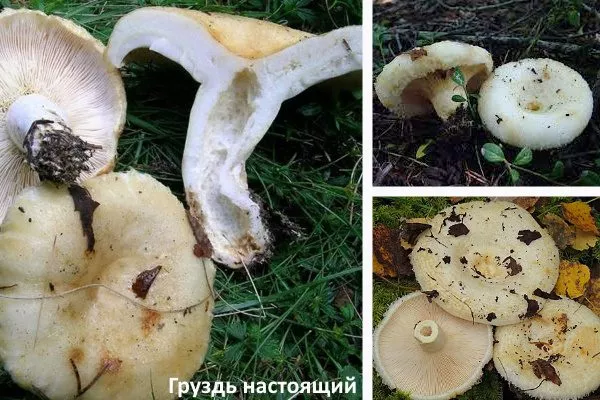
The most similar species
True milk mushrooms are divided into many varieties, among which either a dark or a light shade predominates.
- ✓ Presence of milky juice and its reaction to air (color change).
- ✓ Texture of the cap surface (velvety, slimy, dry).
- ✓ Smell of the pulp (absence or presence of a specific aroma).
The black variety is difficult to confuse with anything else, as it has a distinctive appearance, but the white milk mushroom can be. However, it does have its own distinctive features.
| Name | Hat type | Cap color | Features of the pulp |
|---|---|---|---|
| Podgruzdok | Dry | White with yellow or brownish-red areas | Dense, whitish |
| White wave | Velvet | White with reddish spots | Pink color |
| Skripun | Funnel-shaped | Whitish, may change to light yellow, brownish-red | Very dense, greenish-yellow when cut |
| Common milkcap | Flat and recessed | Pale brownish or lilac-violet | Snow-white, compacted, then loose |
| Milkweed, gray-pink | Funnel-shaped | Ochre-red, can change to purple, brown, lilac | Fleshy and yellowish |
Podgruzdok
The podgruzdok, or white russula, belongs to the same family as the milk mushroom. For this reason, the mushrooms are considered the most similar. However, the podgruzdok has specific characteristics:
- the surface is always dry;
- grows in almost all types of forests;
- the cap is distinguished by a high degree of fluffiness - small hairs are very dense;
- the size of the cap varies from 5 to 18 cm, depending on age;
- the shape is convex at first and depressed inward later;
- the surface is characterized by a poorly developed film;
- color – white with small yellow or brown-red areas;
- spore plates are dense, descending onto the stem, cream-colored, but bluish at the base;
- in drought the cap cracks;
- the stem is identical to the cap;
- the pulp is compacted, whitish;
- taste and aroma with a spicy and mushroomy note.
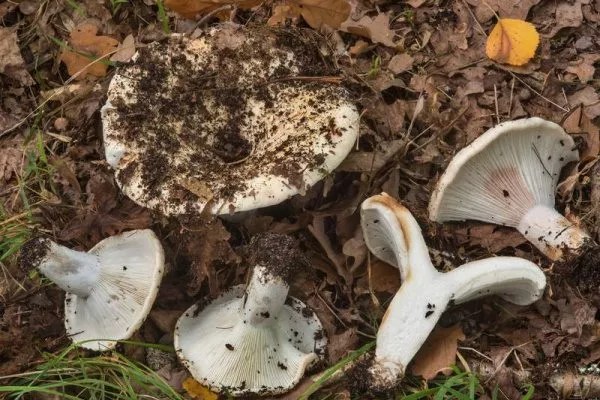
The mushroom is completely edible, so if you confuse it with a milk mushroom, nothing bad will happen.
White wave
The second most similar mushroom to the milk mushroom, the russula, the main difference lies in the appearance of the cap and flesh. The diameter reaches only 5-6 cm, the surface is velvety, and the color is white, but with reddish spots. The flesh is exclusively pink.
Other features of white volnushki:
- the edges of the cap are drooping, the shape at maturity is funnel-shaped, there is a depression in the center;
- the lamellar layer is also whitish and frequent, slightly descending;
- the stem is not high - maximum 3-4 cm, the shape is cylindrical, but narrows downwards, as it matures it becomes hollow;
- The milky juice is characterized by its increased abundance and pungent aroma, but does not change color when exposed to oxygen.
Prefers mainly birch and pine needles, growing in groups.
Skripun
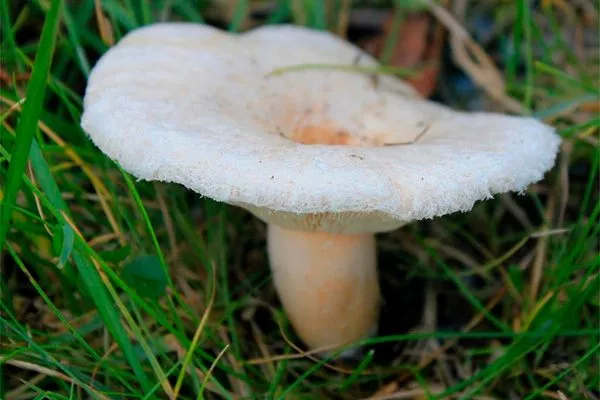
This is the only mushroom that even experienced mushroom pickers can confuse with the milk mushroom. Its second name is violinUnlike the milk mushroom, it has a cap up to 26 cm in diameter and very dense and fleshy flesh, which turns greenish-yellow when cut.
Other features of the squeaker:
- the shape of the cap is funnel-shaped, the edges are wavy and spread out, but at a young age they are bent;
- milky juice of a caustic type, whitish in color;
- the skin is covered with thick hairs;
- the plates are also light, but rare and narrow;
- The stem is medium-sized – about 8 cm, very dense and white, with a felt-like surface.
The cap is usually whitish, but often changes color to light yellow or brownish-red. Ochre spots may be present.
Common milkcap
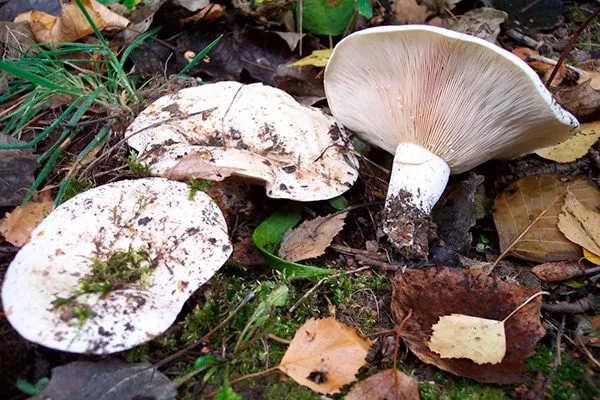
The common milk cap belongs to the same genus as the milk cap and is an edible mushroom characterized by the following external features:
- The cap diameter is from 8 to 15 cm, the shape is flat and depressed in maturity, hemispherical and with bulges in youth;
- color - in youth fawn-brownish or lilac-violet, in old age brown-pink or lilac-yellow;
- surface - mucous type;
- the plates are initially whitish, then fawn;
- the stem varies from 5 to 10 cm, is characterized by a smooth and cylindrical shape, and becomes hollow with age;
- the flesh is snow-white, initially compacted, then loose;
- milky juice is pungent.
Milkweed, gray-pink
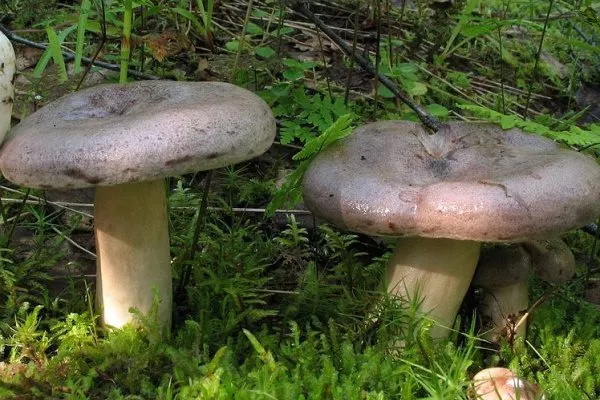
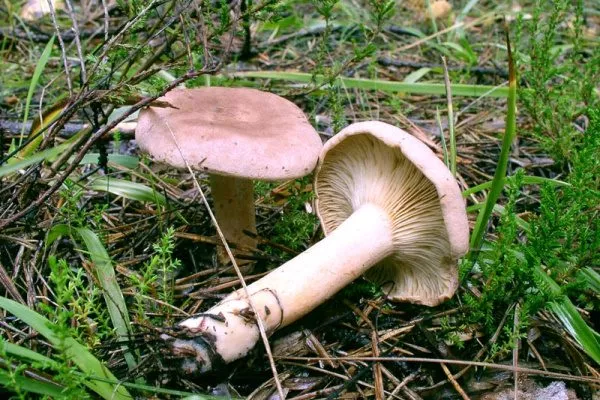
The gray-pink milk cap also resembles the milk cap. This is a dangerous lookalike, as it causes severe poisoning, sometimes fatal. Be sure to familiarize yourself with all its characteristics:
- color - ocher-red, but can change to purple, brown, lilac;
- cap diameter – 12-15 cm;
- shape – funnel-shaped;
- the surface is covered with a mucous substance, smooth - without villi;
- the pulp is fleshy and yellowish;
- the milky juice is white, turning green when cut;
- stem – maximum 8-9 cm, cylindrical shape, looseness is noted at a young age, and a cavity at a mature age;
- aroma - spicy-unpleasant, reminiscent of the aroma of lovage or chicory, pronounced.
Other similar mushrooms
As it turns out, there are many mushrooms with which the milk mushroom can be confused. It's worth considering those that share few characteristics, but some of them are nonetheless dangerous to eat.
| Name | Hat shape | Cap color | Features of the leg |
|---|---|---|---|
| Death cap | Hemispherical or flat | Light, with a greenish, olive or gray tint | Tall, with a moiré pattern |
| Fat pig | Convex-hemispherical | Brown-rusty or brown-ocher | Dark, sometimes black, with a woolly-velvety surface |
| Spruce rowan | Flat-spread | From whitish to dark brown | Dense, hollow in maturity |
Death cap
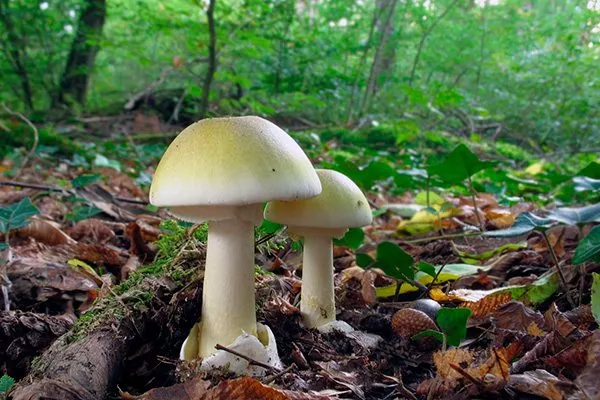
The death cap is very similar to many edible mushrooms, but it is deadly, so study the signs carefully:
- at a young age the fruiting body has the shape of an egg, at a mature age it has the shape of a hat;
- the cap diameter varies from 5 to 15 cm, the edges are smooth, but the surface is fibrous;
- color – light, with a greenish, olive or gray tint;
- cap shape – hemispherical or flat;
- the pulp is very fleshy, has almost no smell or taste, the color is white, unchanged when cut;
- the stem is high – reaches up to 12-16 cm, the shape is cylindrical, the color is white, but there is a moire-type pattern on the surface;
- the lamellar layer is white and soft, located freely;
- there is a ring that sometimes disappears at the end of the growing season (it is wide inside, with a fringe);
- in rare cases the cap is covered with membranous scraps, more often the veil is absent;
- amyloid type spores, semi-oval;
- aroma and taste - quite pleasant at the initial stage of development, very cloyingly sweet later.
Piglet
The mushroom variety comes in thick and thin varieties. The thin pig mushroom is poisonous, but it doesn't resemble the milk mushroom very much, as its stem is too thin.
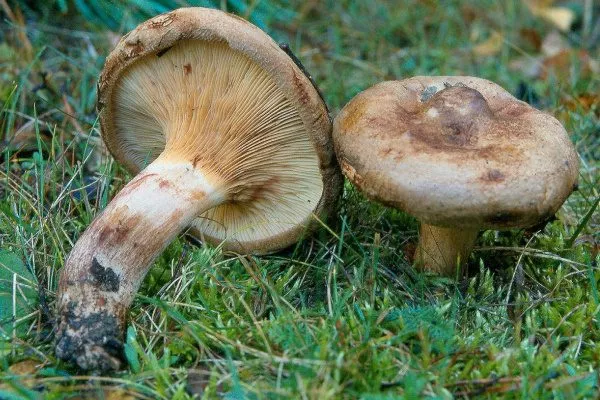
The thick pig mushroom is similar to the milk mushroom, but it is not at all dangerous to human health.
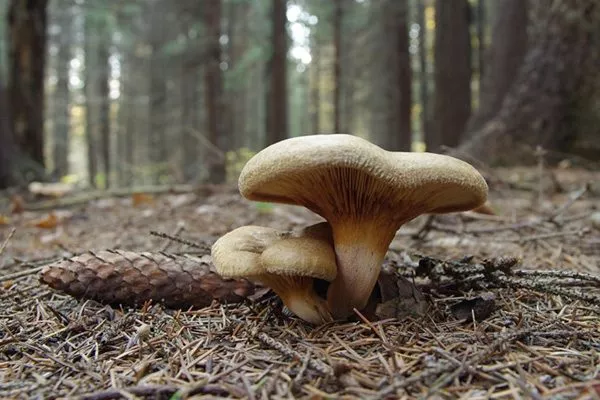
It can be recognized by the following signs:
- the average cap diameter is 10-15 cm, but there are specimens up to 30 cm;
- shape – initially convex-hemispherical, later spatulate (the presence of a depressed center is mandatory);
- the edges are tucked in and fleshy;
- the surface of the cap is brown-rusty or brown-ocher, velvety;
- leg - about 6 cm, but there are also 12 cm, located in the center or slightly to the side;
- the color of the stem is dark, sometimes black, with a woolly-velvety surface;
- The pulp varies from whitish to ocher in color, becoming darker when cut, has no smell, and a slightly bitter taste.
Spruce rowan
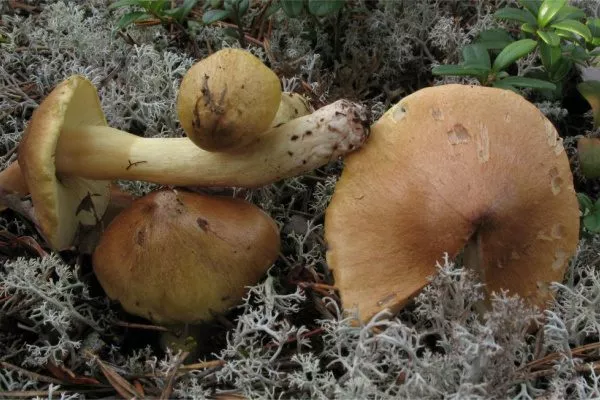
The main similarity between the milk mushroom and the ryadovka mushroom is the color of the cap—it's brownish. If you smell or taste it, you'll notice an unpleasant aroma and taste. How to recognize the spruce ryadovka mushroom:
- cap - flat-spread at maturity, can have a color from whitish to dark brown;
- edges bent or curled outward, wavy;
- surface - scaly or fibrous;
- the stem is located ideally in the center, dense when young, hollow when mature;
- there is no common cover;
- the structure of the pulp is fleshy.
Inedible milk mushrooms
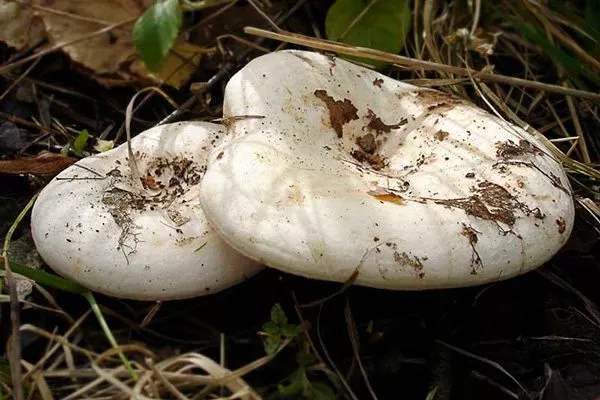
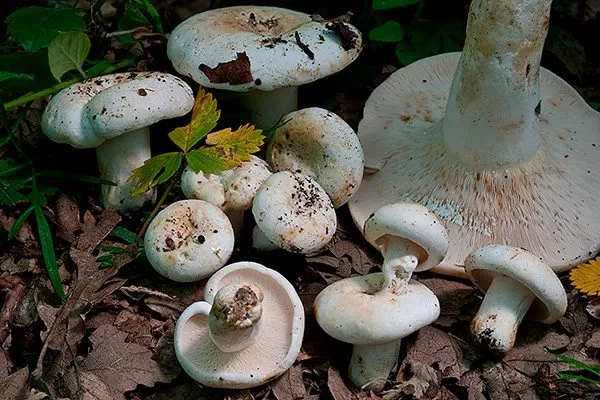
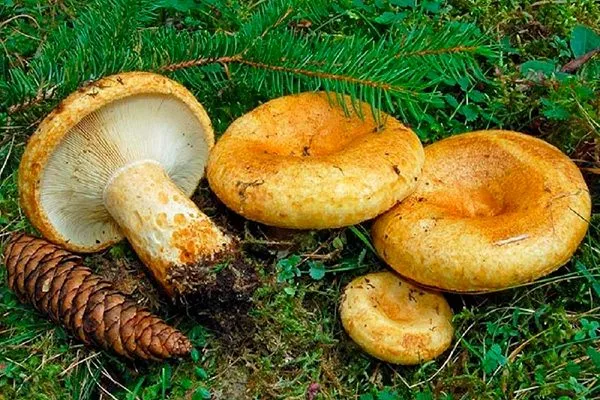
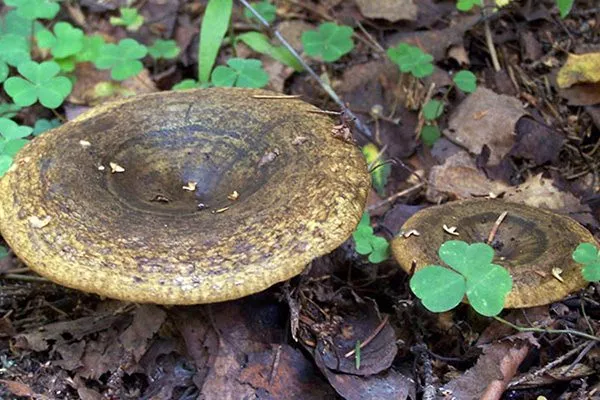
Paradoxically, poisonous milk mushrooms don't exist, but conditionally edible ones do. Unlike the former, they don't cause severe poisoning or death, but their taste or texture is inedible (most often, these milk mushrooms are very bitter or tough).
What kind of conditionally edible milk mushroom can there be that is similar to the true one, and how does it differ?
- Aspen. This variety has pink gills and grows under poplars, aspens, willows, and alders.

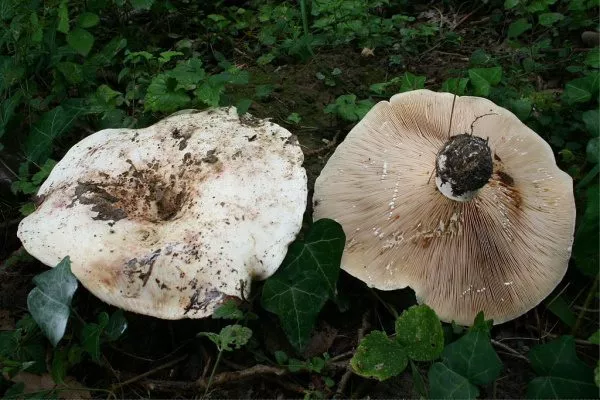
- Peppery. Its edges are completely straightened, and the taste is hot and bitter (like a chili pepper).
- Parchment. The cap skin is heavily wrinkled or smooth, the stem is extremely long (over 10 cm), and the harvest period is only a month (late August to mid-September).
- Glaucous. Its milky sap is always green, the stem is also tall (about 9 cm), it grows exclusively in deciduous forests, and fawn or yellow spots form on the surface of the cap.
- Yellow. Its milky sap is grayish-yellow, the stem is low-set, thickened, and covered with pit-like indentations.
- Black (black russula, dry milk mushroom). The cap is up to 20 cm in diameter, flattened with a depression along the central part; the edges are turned inward, have a felt texture; the color is olive-black, the flesh is dense, snow-white and very fragile; the cut areas become grayish; the milky juice is too caustic and abundant, always white; the stem varies from 3 to 8 cm in height, but reaches up to 3 cm in width (the rest are about 2 cm); the gills descend downwards, have a forked-branched structure.
The color of the nigella can vary to brown or brownish-yellow. Concentric zones sometimes form, but they are difficult to spot from a distance.
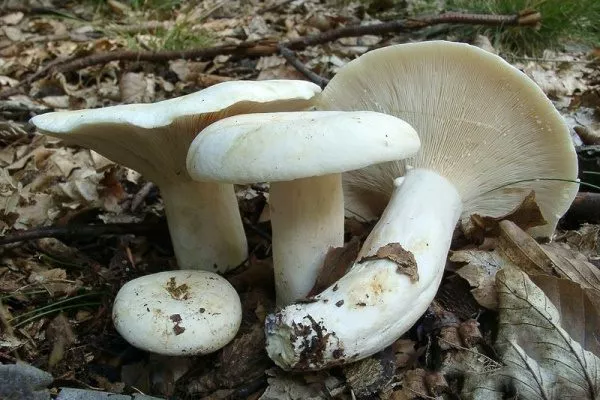
| Name | The main feature | Processing Features |
|---|---|---|
| Aspen | Pink plates | Requires long soaking |
| Pepper | A bitter, burning taste | Multiple boiling is required |
| Parchment | Wrinkled cap | Soaking and boiling |
- Camphor. It has very loose flesh, a camphor aroma and flavor, and darkens where cut.
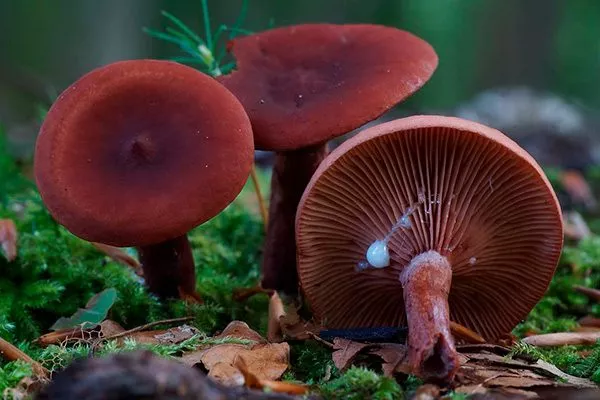
Knowing the description of mushrooms that resemble milk mushrooms allows you to safely harvest them. The most important thing is to recognize false mushrooms, which are poisonous, as well as those that are conditionally edible, which must be carefully processed to remove any bitterness or toughness.