
Many mushroom pickers don't take these mushrooms seriously. Beginners are afraid of confusing them with fly agarics and risking poisoning. Experienced mushroom pickers recognize only "true" mushrooms like porcini mushrooms and saffron milk caps, and don't even consider lesser-known ones. In fact, parasol mushrooms are delicious delicacies. Learn how to find and prepare them properly in this article.
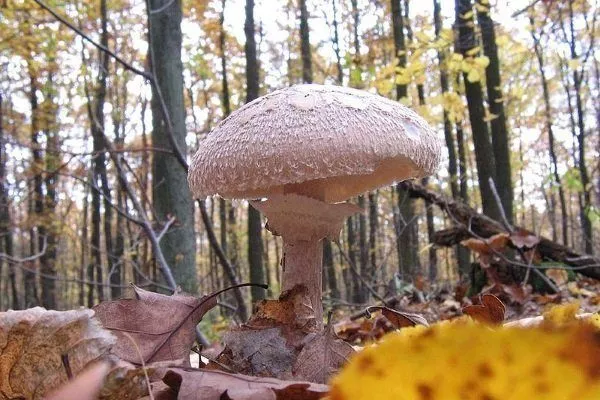
Where can you find the parasol mushroom?
Parasols are a very unusual type of mushroom. Their enormous caps, scattered across a meadow or copse, resemble flying saucers from outer space. And this is their main distinguishing feature. Connoisseurs of these mushrooms claim they have a very refined flavor. Some say it resembles chicken, others flounder. Their aroma is compared to a subtle nutty flavor. These qualities distinguish them greatly from their forest counterparts (porcini, birch, and others).
These mushrooms are found virtually worldwide, wherever there is fertile soil, humus, and a moist environment. They grow in mixed forests and almost always in deciduous forest zones. However, they can also be found in fields, meadows, pastures, public gardens, and city parks.
- ✓ Availability of fertile soil with a high humus content.
- ✓ Moderate humidity without stagnant water.
- ✓ Availability of sunlight, but not direct, but diffused.
Some species grow even in dark basements (like champignons). Eleven species of parasol mushrooms are known to date. They are found throughout Russia, Europe, America, and even in some Asian countries (Iran, Turkey). Seven species of parasol mushrooms grow in Russia.
What do parasol mushrooms look like?
True edible parasols are difficult to confuse with other mushrooms due to their large size. The cap diameter can vary from ten to thirty centimeters. When young, the mushroom is egg-shaped, later taking on a bell-shaped form. As it matures, the cap opens and becomes flat. It feels dry to the touch, occasionally slimy. The cap's skin is covered with thin, large scales. The color is white, brown, and can be slightly yellowish or reddish. The gills and spores are white and clear.
The stem of the mushroom ranges from ten to thirty centimeters in height (in larger mushrooms). It is 2-3 centimeters thick. At the top, there is a wide, flexible ring that does not disappear as the mushroom grows. The stem is also covered with scales.
Edible umbrellas
There are several commonly found types of edible parasols.
| Name | Cap diameter (cm) | Leg height (cm) | Cap color | Fruiting period |
|---|---|---|---|---|
| White field umbrella | 10-20 | 10:30 | White | June-October |
| A reddening shaggy umbrella mushroom | 10-20 | 10:30 | Grayish-brown | July-October |
| Colorful umbrella | up to 30 | up to 30 | Grayish | August-October |
| A girl's umbrella | 5-10 | up to 15 | Brown | Not specified |
White field umbrella (meadow)
This mushroom is found from spring to late autumn. It grows in meadows, forests, and steppe zones. In Russia, it can be seen in the forests of Siberia, Primorye, the European part of Russia, and the North Caucasus. The typical size of this mushroom (based on the cap) is no more than ten centimeters. The largest white umbels are found in humus-rich soils (most often in the steppe). There, their maximum size is 15-20 centimeters.
Like all parasol mushrooms, the porcini cap is initially spherical but straightens as it grows. The cap has a cone-shaped tubercle in the center. The stem is thin, low, and white or beige. Fruiting lasts from early summer (June) to late October.
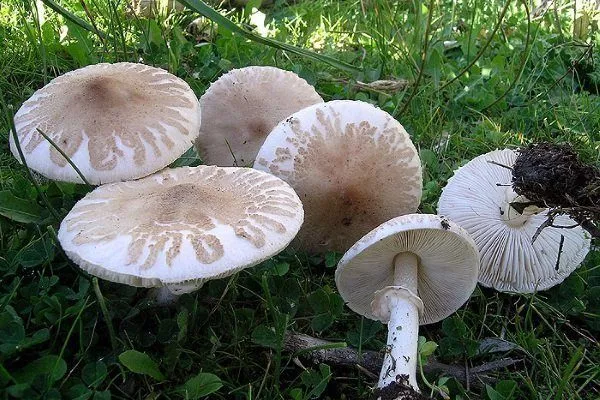
A reddening shaggy umbrella mushroom
Highly prized by parasol lovers, the mushroom has a pleasant aroma and taste. It grows in forests, on humus-rich soil. It can also be found in greenhouses and hothouses, with soil brought in from the forests. In such conditions, it grows like a button mushroom. Fruiting occurs from midsummer (July) to late October.
The mushroom is quite large and fleshy. The cap is ten to 20 centimeters in circumference. The color is grayish-brown or grayish-ocher. The surface cracks, revealing large brown scales. The thick, loose flesh takes on a reddish tint when exposed to air.
The height of the mushroom is 10-30 centimeters.
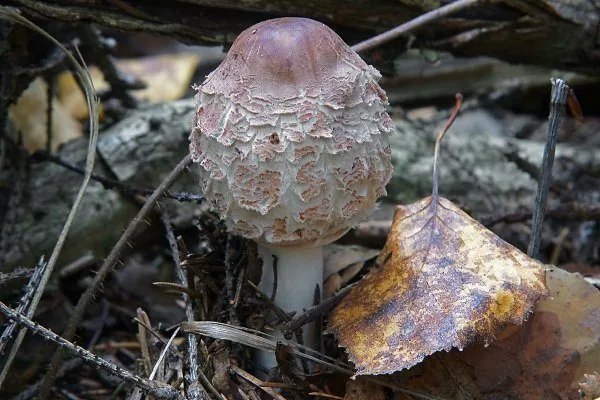
Variegated umbrella (large)
A large species of umbrella plant. It grows everywhere – in forests, fields, gardens, vegetable patches, and meadows. It can grow singly or in ring-shaped clusters.
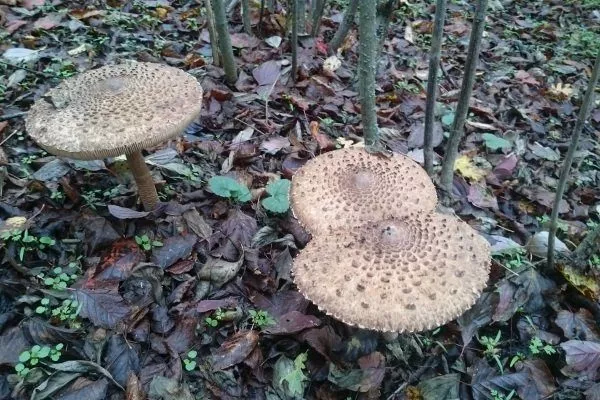
The mushroom cap is very large – up to thirty centimeters in diameter. Initially shaped like a large egg, it then opens into a large bell. As the mushroom matures, it resembles an open umbrella. The cap is grayish in color, with a tubercle in the center. The flesh of a young mushroom is white and loose. In older mushrooms, it becomes dense and tough, with a cartilaginous texture. The stem is long, up to thirty centimeters tall.
Fruiting lasts from August to October.
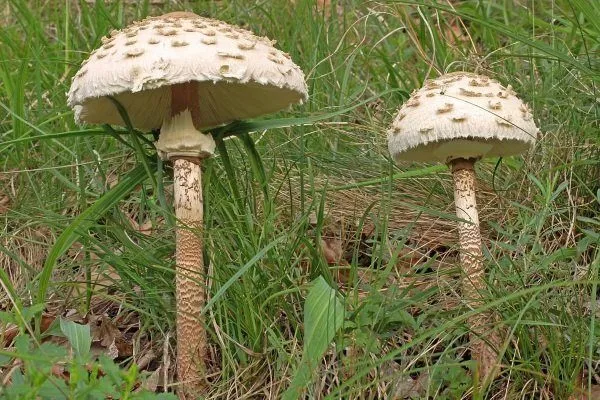
A girl's umbrella
A rare specimen listed in the Red Book. It is found in Russia only in the southern regions of the Far East. It grows primarily in coniferous and mixed-conifer forests. It can grow singly or in groups. It is often artificially propagated in nature reserves.
The mushroom is not large. The cap is 5-10 centimeters in diameter, with brown scales. The stem is no more than fifteen centimeters high and 2-5 cm thick. The mushroom has a pleasant aroma.
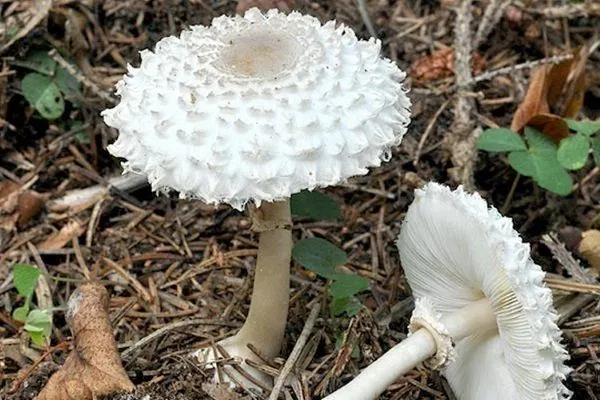
Besides forest harvesting, you can grow umbrella mushrooms in your own garden. Simply use purchased mycelium or transfer some soil containing umbrella mushroom spores from the forest to your plot. To germinate, cover the mushrooms with leaves and wood shavings and water them generously.
Poisonous umbrellas
In nature, there are not only edible parasols, but also poisonous varieties. Some can be fatal, while others cause poisoning.
| Name | Cap diameter (cm) | Leg height (cm) | Cap color | Fruiting period |
|---|---|---|---|---|
| Crested umbrella | 3-5 | 5 | White, gray, beige | June-October |
| Chestnut Lepiota | up to 5 | up to 10 | Reddish | June - first frosts |
Crested umbrella (lepiota)
From June to the end of October, it grows in meadows, pastures, and copses. It has an unpleasant smell reminiscent of rotting radish. It is inedible. It causes toxicity in the body, including vomiting, diarrhea, fever, and headache.
In appearance, it is similar to its edible relatives, but smaller. The cap is no more than 3-5 cm in diameter. The color is whitish, gray, or beige. The cap has numerous brownish scales.
It has white, thin flesh. The stem is approximately five centimeters high and one centimeter wide. The ring on the stem is white or reddish, and disappears when ripe.
Chestnut or red-brown lepiota (umbel)
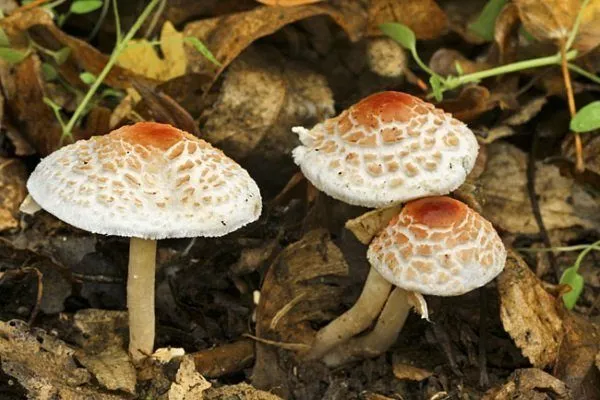
A poisonous mushroom that is fatal if consumed. It grows in mixed forests of temperate climates. It is found in Eastern and Western Siberia, as well as in European countries. Fruiting occurs from mid-summer (late June - July) until autumn (the first frost).
A medium-sized mushroom. The cap is up to 5 cm in diameter. Initially, it resembles a bell, but gradually opens up to form an umbrella. The cap has numerous brownish scales, which are darker in color than the cap itself. The flesh is reddish.
The stem is no more than ten centimeters tall, brownish or pinkish in color, and fragile. It has a white ring that disappears as the mushroom grows.
To avoid confusing an edible mushroom with its poisonous counterpart, gather as much information as possible and look at lots of pictures.
In this video, an experienced mushroom picker explains how and where to pick parasol mushrooms, and how to distinguish them from fly agarics:
Processing mushrooms
Since mushrooms are quite fragile, they need to be placed very carefully in the basket so that they arrive home whole, and not crumbled.
Processing mushrooms:
- cut off the legs (it’s better to do this in the forest);
- wash the caps in running water, removing any forest debris;
- cut out the black areas, cut off the dark top where the spores are contained;
- cut into several pieces.
Cultivation of parasol mushrooms
Although parasols belong to the champignon family, they have never been domesticated. Rare attempts by individual hobbyists to grow this mushroom in their gardens have not turned it into a commercial enterprise (unlike its close relatives, the champignons).
But you can try growing an umbrella plant in your own garden. You're unlikely to get a large harvest, of course, but you can treat yourself to some delicious dishes (if you're lucky).
Mushroom cultivation is carried out by propagation in two ways:
- Through the myceliumThis is the underground part of the rhizomes in which the mushrooms (their colony) are connected.
- Through disputesThese are small particles found in the cap of a mushroom. They are clearly visible on parasols.
Reproduction by spores
When propagating through umbrella spores, it is necessary to perform the following manipulation.
Find an old, overripe, limp, drooping parasol mushroom in the forest. Bring its cap to your plot and hang it over the area where you plan to grow the mushrooms (for example, by sticking it on a branch or threading it through a rope). The mushroom will dry, releasing spores onto the ground, and this is how seeding occurs.
The planting bed must be well prepared. Since parasol mushrooms prefer calcified soil, it should be fertilized with calcium. You can also add concentrated supplements used for growing champignons. After all, these mushrooms are from the same family.
- Select a site with diffused light and protection from direct sunlight.
- Preparing the soil with the addition of calcium and concentrated additives for champignons.
- Organizing an irrigation system to maintain moderate soil moisture.
Reproduction through mycelium
The only way to find the mycelium or spores is by carefully digging them up in the forest. Bring them home and plant them in a prepared bed. Prepare the bed as before.
It's important to remember that mushrooms have a hard time establishing themselves in a new location and with different microflora. The composition of forest soil and the natural landscape cannot be replicated in a garden plot.
There's another way to get a larger harvest of umbrella mushrooms. It involves expanding the mushroom-bearing area in the area where they were harvested. Caps cut from older mushrooms are hung above the harvest site, just as in the garden. This increases the area sown, and the mushroom harvest increases.
It's also worth making a rule: whenever you find an old, overripe mushroom near young ones, consider increasing your mushroom harvest. To do this, simply prick the cap of the old mushroom onto a nearby tree branch (to allow the spores to mature and disperse). This way, you can significantly increase the yield of parasol mushrooms in your forest plot without any effort.
If you learn to accurately distinguish edible parasols from their inedible and poisonous counterparts, your mushroom basket will be filled with valuable, healthy mushrooms. And growing them properly will allow you to enjoy this delicious delicacy often.