
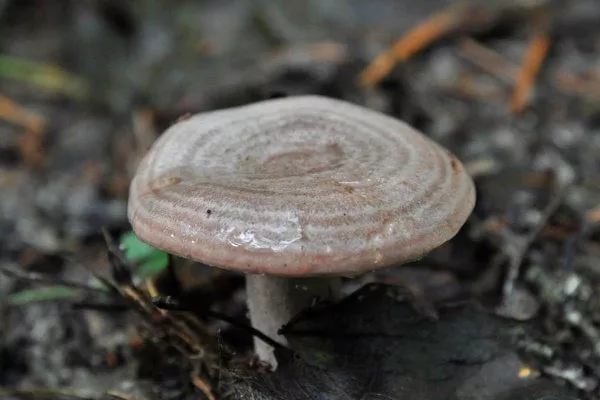
The russula (Latin: Lactarius flexuosus) is very similar to the russula, but has a more modest coloration. This inconspicuous mushroom is rarely included in baskets due to its bitter taste. But experienced mushroom pickers know that behind its modest appearance lies a mushroom that is excellent for pickling.
What else is it called?
Serushki is just one of many names. This mushroom has over a dozen. In Russia, depending on the region, these mushrooms are called:
- path;
- gray hollow;
- bitter;
- purple milk mushroom;
- gray milkweed;
- plantain;
- traveler;
- gray;
- serukhoy.
The names reflect all the remarkable properties of the mushroom – its taste, color, favorite growing places, and the secretion of milky juice.
Features of russula
The gray milkweed is perfectly camouflaged among grass and pine needles. This lover of marshy soils is easy to spot. And not so much by its appearance—though it has distinctive features—but by the drops of bitter sap that appear when cut.
Putik is beautiful in its own way. It not only has a unique flavor but also an exquisite appearance. Description of species characteristics:
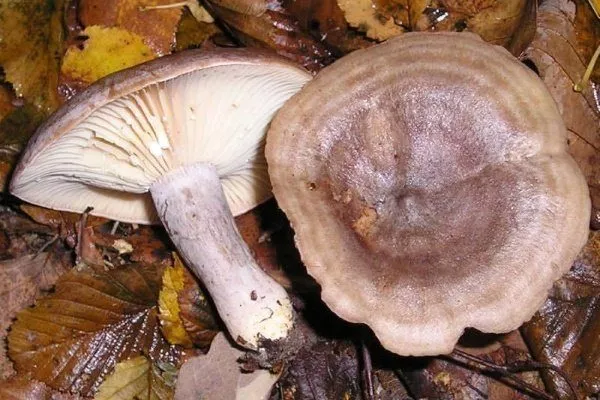
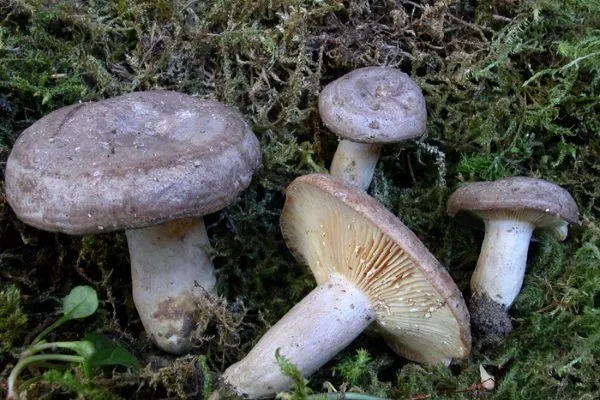
- Hat. The cap is grayish-purple in color. It can have pinkish, purple, or lead-brown hues. The cap is smooth to the touch, but slippery after rain. The top is covered with concentric circles. The shape is funnel-shaped. Small mushrooms have a convex shape. The cap margins are uneven, drooping, or curled inward. The cap diameter of an adult mushroom is 5-10 cm.
- Records. They are distinguished by their sparse arrangement. Color: pale yellow, beige.
- Disputes. Colour – yellow.
- Leg. It has a cylindrical shape, swollen or tapered at the base. In mature mushrooms, it is hollow. The color matches the gills or cap. It reaches 2 cm in width and 8 cm in length.
- PulpDense and firm. Has a fruity aroma. White in color. When broken, a milky juice oozes out—it has an extremely bitter taste. The mushroom remains unchanged when cut.
Where and when does it grow?
Serushkas are a regular inhabitant of deciduous and mixed forests. They are found throughout almost all of Russia, with a preference for the northern regions and Siberia. They are also found in the Urals and the Far East. They thrive in moist soils—loamy and sandy loam. They prefer birch and aspen forests, especially lowland ones.
- ✓ Presence of birch or aspen forests near water bodies.
- ✓ The soil should be loamy or sandy loam, with high moisture content.
- ✓ Areas with good lighting, but protected from direct sunlight, are preferred.
It's best to look for russula mushrooms in well-lit deciduous forests such as birch and aspen groves. They thrive on moisture, so it's best to look for them after rain. The harvest season begins in July and lasts until September. During drought, don't expect a harvest of russula mushrooms. What foragers need to know:
- This mushroom is prolific, growing in clusters. However, it can also grow alone. Its favorite habitats are forest edges and paths.
- The collection period is from the beginning of summer until October.
- The color of the cap varies from gray to yellowish-gray and ocher.
In this video, experienced mushroom pickers search for russula mushrooms. In the forest, they'll explain the growing and harvesting techniques for these mushrooms:
Who can be confused with?
| Name | Cap color | Cap diameter (cm) | Leg height (cm) | Color of the plates |
|---|---|---|---|---|
| Serushka | Gray-lilac | 5-10 | 8 | Pale yellow, beige |
| Tricholoma isolatum | Olive brown | 5-15 | 5-10 | White or pale yellow |
| Leafy greenfinch | Pale yellow, mustard yellow | 4-12 | 4-8 | Yellow |
The russula is most often confused with the russula, which isn't even related to the milk caps. These mushrooms belong to the Trichomycetes family. Inexperienced mushroom pickers confuse the russula with two species of russula:
- With a separate row. Unlike the lilac-gray cap of the putik, this rowan has an olive-brown color, with a darker center. The curled edge has sparse scales and a greenish tint. The stem is light green, olive, or white, while the underside is darker—dark gray or black. The flesh is white or pale yellow. The taste, like that of the putik, is slightly bitter. It has a floury odor.
- With leafy greenfinchUnlike the russula, the russula has a wide cap—conical, bell-shaped, or spreading. It has a tubercle in the center. The cap color is pale yellow, mustard yellow, or greenish-brown. The upper surface is covered with concentric scales—yellow-brown or brownish-green. Russula has yellow, notched, adnate gills and a cylindrical stem, widened at the base. The flesh is white or yellow. The flavor and aroma are mild.
The gray milkcap, or merrus, is very similar in appearance to the common milkcap. There's nothing alarming about this resemblance—all members of the milkcap family are edible, and if some are considered inedible, it's only because of their bitter taste, not because of their poison. The merrus is particularly similar to two milkcaps:
- Zonal. It has a cream or ochre cap.
- Zone-free. It is painted in shades of brown.
Putiki mushrooms are easy to distinguish—their juice, when cut, doesn't change color at all. Similar mushrooms' juice darkens when exposed to air.
The value and benefits of the mushroom
Easily digestible purple milk mushrooms are considered a dietary product, containing only 18.5 kcal. They belong to the third food category. Their nutritional value is as follows:
- proteins - 3.09 g;
- carbohydrates - 3.26 g;
- fats - 0.34 g;
- water - 91.46 g;
- fiber - 1 g;
- ash - 0.85 g.
Purple milk mushrooms are also rich in:
- vitamins C, D, E, B6, B12, K1;
- folic acid;
- thiamine;
- riboflavin;
- nicotinic and pantothenic acids;
- choline;
- betaine.
Putniks are also rich in selenium, calcium, magnesium, potassium, zinc, phosphorus, iron, copper, and manganese. Serushkas are prized for their rich array of vitamins, trace elements, and amino acids. These mushrooms contain beneficial elements in optimal proportions. Scientists claim this is the most beneficial combination. Perhaps this is why putniks were so widely used in folk medicine. They were used to treat many ailments, from skin lesions to consumption and cholera.
Purple milk mushrooms strengthen the immune system and blood vessels, nourish the brain, and cleanse the body of heavy metal salts.
The harm of milk cap mushrooms
Medicinal decoctions made from milk thistles should be consumed with caution by people with gastrointestinal diseases, pregnant or breastfeeding women, or those with allergies. They are also advised to avoid overindulging in any mushroom dishes. Excessive consumption of milk thistles can cause:
- An allergic reaction. This can result in constipation, digestive upset, and even abscesses in the gastric mucosa.
- Poisoning. The mushroom contains a lot of chitin. Overeating can cause nausea, vomiting, diarrhea, chills, bloating, dizziness, and other symptoms of an eating disorder.
- Inflammation of the duodenum.
- Frequent urge to urinate.
- Corrosion of the stomach walls by bioactive components.
The components contained in milk caps can destroy muscle cells and cause kidney failure.
Despite their many beneficial properties, milk thistles should be consumed with caution. They contain elements that thin the blood and prevent clotting. Milk thistles are strictly contraindicated for those with bacterial vaginosis and hydrocele.
Serushka mushrooms belong to the Russulaceae family, genus Lactaceae. Due to their bitterness, they are classified as conditionally edible in the third food category. Putik mushrooms are quite tasty when salted, but they must first be thoroughly soaked to remove the bitterness. Soaking takes several days. The bitter juice protects the mushrooms from worms and insects, so they can be salted without fear of worm infestation. Demand for putik mushrooms typically increases in years when other mushrooms are scarce.
Cooking Features
Putiki mushrooms are bitter—that's the main thing to remember when processing them. They don't have any particular flavor, but they're perfect for a mushroom platter.
Before pickling or marinating, soak russula mushrooms for three days to remove their bitterness. Soaking preserves their rich color. However, prolonged heat treatment is not recommended, as it will degrade their flavor. When pickling, boil russula mushrooms for no more than 20 minutes.
The beauty of putik is its clean flesh—worms don't like it. Usually, after starting with the stem, they quickly give up, leaving the caps intact—which is very convenient and profitable for processing.
Is it possible to grow russula mushrooms?
Growing russula mushrooms requires mycelium, substrate, and the right conditions. All of this requires investment, so mushroom cultivation is usually practiced as a business.
Compared to champignons, porcini mushrooms, edible polypores, or ringed cap mushrooms (cockerels), serushka mushrooms are not in widespread demand. In fact, many mushroom pickers are not even familiar with this mushroom. The bitter taste of the putik, which makes it difficult to prepare, has sealed its fate—it is unprofitable for commercial cultivation. Artificial production of putik mushrooms is not developed.
When prepared properly, russula can be a valuable and nutritious dish. It's not the most popular mushroom among mushroom pickers, but its distinctive flavor consistently finds its fans. It doesn't require special cultivation, as it's rarely used in food or other applications.