
One of the agaric mushrooms got its name from the distinctive olive-green color of its fruiting body—the greenfinch, green ryadovka, or green rowan. This mushroom is classified as a sandstone mushroom, meaning it grows in sand.
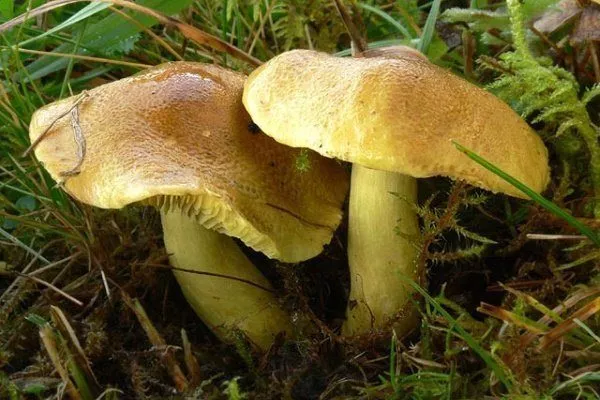
Description of the mushroom
The fleshy, greenish-yellow cap with a yellowish-brown center has wavy edges. Its surface is very sticky, so it's constantly covered in sand and debris. This is precisely why many mushroom pickers hesitate to collect them. Washing away all the sand without it crunching in your teeth is no easy task.
The cap is 3–15 cm in diameter. It is initially convex, then flattens. The flesh is dense, white, yellowish under the cap skin, starchy, and pleasant to the taste, with an aroma of fresh flour or cucumbers if the mushroom grows near a pine tree. The gills are closely spaced, fairly wide, and notched, and are greenish-yellow in color. The spore powder is white. The stipe is strong and short—4–6 cm long and 1–2 cm thick. It is colored the same as the cap. It is completely hidden in the sand.
Nutritional value of greenfinch
The mushroom is edible and belongs to the 4th category of nutritional value.
Chemical composition of greenfinch (100 g of product contains):
- proteins - 3.09 g;
- carbohydrates - 3.26 g;
- fats - 0.34 g;
- water - 92.45 g;
- ash - 0.85 g.
It is rich in B vitamins, contains vitamins C, D, E, K and PP, a number of amino acids and minerals - calcium, selenium, magnesium, potassium, iron, manganese, phosphorus, copper, zinc and sodium, fiber.
Nutritional value of 100 g of fresh mushrooms is 28 kcal.
Dishes made with this mushroom are contraindicated for people with poor blood clotting, as it contains toxic substances that give it its green color. Also, people with allergies to mushrooms, kidney disease, pregnancy and lactation, hypervitaminosis, and children under 12 should not consume these mushrooms.
Where and when do they grow?
Greenfinches can be found in the northern forest zone. They prefer to settle in dry pine forests, on sandy and sandy loam soils. They are rarely found in deciduous forests. They "hunt" for them in late summer, when precipitation increases. The sand becomes damp, and the mycelium "awakens."
- ✓ Ensure that the area has not been chemically treated within the last 5 years.
- ✓ Check that there are no nearby industrial zones or highways within a 1 km radius.
The first greenfinches are found as early as early August, the last in mid-September. However, if the Indian summer drags on, individual mushrooms can be found as late as November. They grow singly or in small clusters of 5-8. The mushrooms are almost never worm-infested.
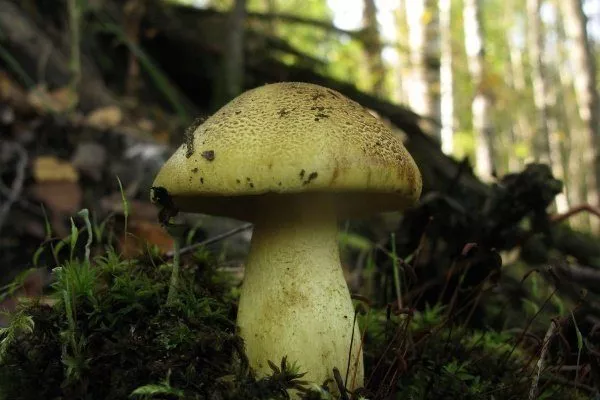
Varieties
The greenfinch is one of its kind, but it has similarities with inedible mushrooms - the sultry and sulfur-yellow row, and the deadly poisonous death cap.
How to distinguish edible greenfinch?
It's possible to distinguish the edible greenfinch from its poisonous or simply inedible counterparts. You just need to know the subtleties of each mushroom's appearance and distinctive features:
- Sulphur-yellow row. You can distinguish them from the greenfinch by the color of their fruiting body. Theirs is yellow. Their flesh doesn't have a pleasant aroma; it has a strong, unpleasant tarry smell and a bitter taste. However, they appear at the same time as the greenfinch and prefer to settle in the same places.
- Hot or spruce rowan. This mushroom is smaller, has a pungent taste, and an unpleasant odor. It often grows in the same forests as the greenfinch. It's worth taking a close look at the cap. Although they are similar in color—the spruce rowan's is light yellow with olive inclusions—the shape is significantly different. The inedible specimen's cap resembles a bell with a hollow in the center.
- Death capThe death cap has a ring and a volva—a covering that protects the young body of the mushroom—on its stem. The gills and stems are white, and the cap has smooth edges.
- Cobweb. Inexperienced mushroom pickers may confuse the greenfinch with the cobwebcap. They do look similar, but the cobwebcap grows in completely different places—it's not found in pine or spruce forests. The cobwebcap also accumulates a lot of slime on the underside of its cap.
The mushroom is similar to the green russula, a conditionally edible mushroom. It won't cause poisoning, but the cooking methods are different.
The benefits and harms of mushrooms
The beneficial properties of greenfinches are easily explained by their impressive nutrient profile. However, moderation is essential when consuming them. They contain substances that suppress pathogenic microflora, particularly staphylococci, thin and purify the blood, and normalize cardiovascular function. Greenfinches also strengthen bone tissue and the digestive system, improving intestinal motility.
Although the mushroom is edible, several fatal cases of poisoning have been reported. The cause was overeating greenfinches. It's important to remember that they contain a toxin that destroys muscle tissue. Long-term consumption of the mushrooms can negatively impact health:
- muscle weakness is observed, which is expressed in rapid involuntary contraction of the limbs;
- cardiovascular disorders occur;
- liver cells are destroyed;
- there is a malfunction in the kidneys.
The main symptom of toxin poisoning is a change in urine color. It turns dark brown. You should immediately seek medical attention and eliminate the product from your diet.
Greenfinches are also often found near highways or in industrial areas. These mushrooms absorb toxic substances and heavy metals from the environment. Eating these mushrooms can cause severe poisoning. Signs of poisoning include kidney problems, renal failure, and irritation of the bladder lining. Therefore, any mushrooms should be collected in ecologically clean areas.
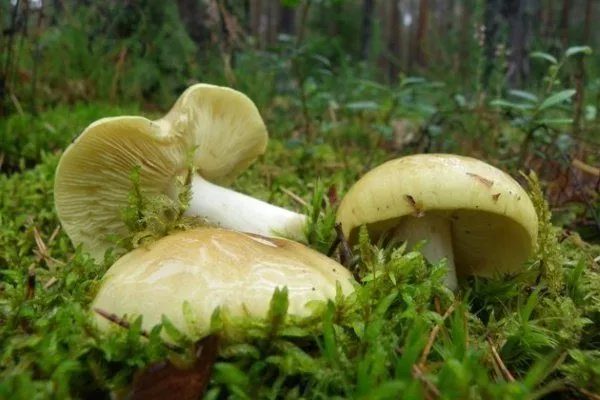
How to collect?
Greenfinches aren't easy to find. That's because they hide so well in the soil. Their stems are completely buried, and their sticky green caps camouflage natural debris and sand grains. Therefore, to find them, mushroom pickers have to dig deep into the sand.
It's best to go mushroom picking in dry weather. During prolonged rainfall, the caps become coated with a slimy substance that mixes with sand, making it difficult to find the mushrooms. Pick firm, young mushrooms; older ones are best left behind, as their flesh is tough and tasteless.
Is it possible to grow this type of mushroom yourself?
Greenfinches are not usually grown at home because:
- in terms of yield they are inferior to oyster mushrooms;
- they are difficult to clean, not every housewife will want to mess with them;
- The presence of a toxin in their composition does not make them more popular among mushroom growers.
But there are also fans of this mushroom species who grow them on their own plots. Seeds are purchased in stores, but they are rare.
Before sowing, mix the mycelium with sand or dry soil. Loosen the soil beneath the tree and make holes 5–15 cm deep, depending on the tree's root position relative to the soil surface. Spread the mycelium evenly and cover with forest soil, to which humus has been added in a 1:1 ratio. Water thoroughly with a watering can and cover with soil remaining after digging the holes.
- Select a site under young pine or spruce trees with sandy soil.
- Check the soil acidity (optimum pH 5.5-6.5).
- Two weeks before sowing, add humus in a 1:1 ratio with forest soil.
Plant in spring or summer under coniferous trees, preferably young pines or spruces. Water the plantation regularly during hot weather. The mycelium of greenfinches is long-lived and will continue to grow until the tree dies.
So, although greenfinch isn't very popular among mushroom pickers, it is used in cooking. Before processing, they should be thoroughly cleaned of debris and sand, then boiled. The mushrooms are also used for canning. When pickled, the caps turn brown or olive. When boiled, the flesh's color deepens, becoming greener.