
The blueleg mushroom, also known as the blueleg or purplelegged rowan, belongs to the Trichophyceae family. It is common throughout the European part of Russia. The blueleg mushroom tolerates the first frosts, so it can be harvested until late autumn.
General characteristics
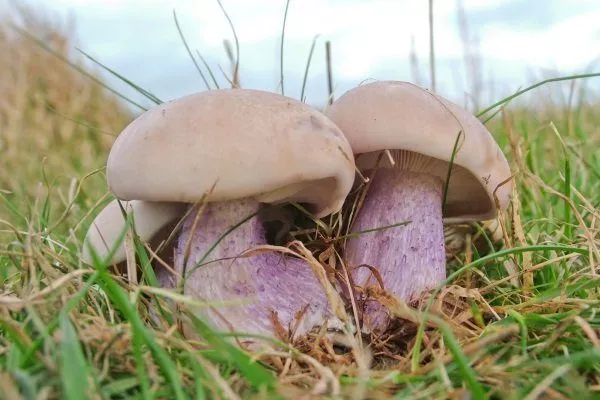
The blueleg mushroom has a distinctive blue-violet coloration on its underside, which deters many mushroom pickers. In fact, this mushroom is edible and does not contain any toxic substances.
You can distinguish the blue leg by the following external characteristics:
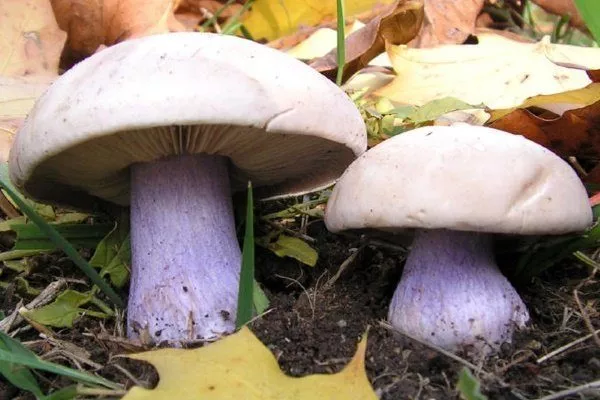
- a flat, convex cap of light yellow color with a slight purple tint, the diameter of which is on average 10 cm, but can sometimes reach 25 cm;
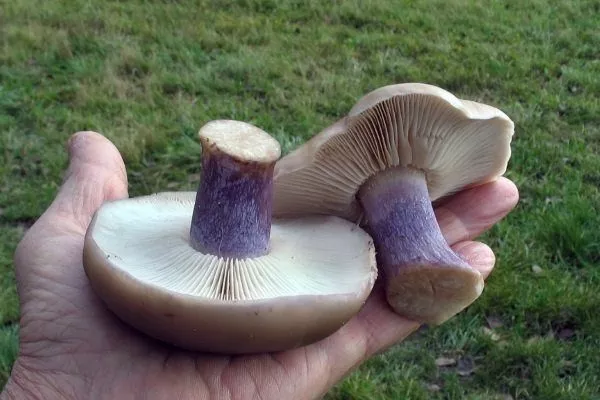
- on the lower part of the cap there are yellowish plates;
- The stem of this mushroom is fibrous, has a grey-violet or bright purple color, sometimes with a bluish tint;
- The flesh of the mushroom is dense and thick, but becomes loose when mature.
Bluelegs can be used in a variety of dishes. This mushroom is excellent for pickling.
The blueleg fruiting season begins in April and continues until the end of October. The greatest number of mushrooms can be found in the fall. Several harvests are collected in a single season.
Places of growth
The purple-legged rowan mushroom is common in temperate climates. It is widespread in Russia. It is also found in the forests of South and North America.
- ✓ Open, bright meadows
- ✓ Places with humus
- ✓ Areas under ash or coniferous trees
The purple-legged rowan usually grows under ash or coniferous trees. Large clusters of these mushrooms are observed in humus-rich areas, in meadows where cattle graze, and in areas where leaves have fallen.
Unlike many other mushroom species, bluelegs aren't tied to a specific tree; soil is much more important for them. These mushrooms grow in colonies, forming large rows or circles.
When picking mushrooms, you should take into account the following recommendations:
- It is better to collect bluelegs in sunny weather, since in humid conditions their caps become covered with slime and become unpleasant to the touch, the slippery surface of the mushroom will create difficulties when cutting;
- To find large colonies of mushrooms, you need to go to open, bright meadows;
- You shouldn't eat bluelegs raw, they are considered conditionally edible mushrooms and require heat treatment.
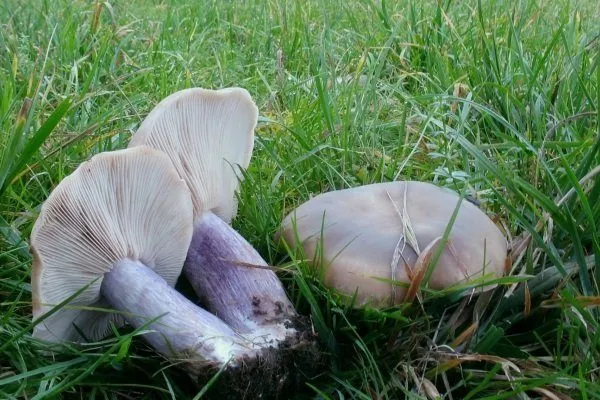
When harvesting purple-legged rowan mushrooms, avoid rotten or old specimens. Old but firm mushrooms with a fresh appearance can be kept, but remove the gills before cooking and eat them safely when cooked.
Useful properties and characteristics of blue leg
The bluelegs, like other members of the Trichomycetes family, contain many vitamins and nutrients. These include:
- amino acids;
- lipids;
- potassium;
- manganese;
- phosphorus;
- selenium;
- aspartic acid, which is a natural antibiotic;
- folic acid;
- vitamin E;
- vitamin K1;
- glycine.
Bluelegs have the following beneficial properties:
- suppression of the activity of pathogenic microorganisms;
- strengthening of coronary vessels;
- normalization of blood sugar levels;
- removal of free radicals from the body;
- improving the functioning of the cardiovascular system;
- stabilization of blood pressure;
- preventing the development of depressive states;
- removal of toxins from the body;
- reduction in the severity of inflammatory processes;
- stimulation of the urinary and biliary systems;
- prevention of the development of dermatological diseases.
Growing bluelegs at home
The purple-legged rowan mushroom can be grown indoors and harvested several times a year. The mycelium can be added to the garden soil or grown indoors in suitable conditions.
| Condition | In the garden | Indoors |
|---|---|---|
| Temperature | Not below +15°C | +10-15°C |
| Humidity | Regular moisturizing | High level |
| Lighting | Natural | Artificial |
| Ventilation | Natural | Required |
| First harvest | In 1.5 years | In 1.5 years |
Growing mushrooms in the garden
To grow bluelegs, you need to prepare compost, which serves as a nutrient medium for this type of mushroom. It can be prepared in several ways:
- mix 12 kg of dry, undecomposed straw with fresh cow manure (8 kg), the preparation time for the composition is about 25 days;
- mix 12 kg of straw with 8 kg of fresh bird droppings, preparation time is 24-26 days;
- mix 12 kg of straw with 8 kg of fresh horse manure, preparation time is 22-24 days;
Growing bluelegs in the garden is easy. The best time to plant is May, although it can also be done in the fall. The only requirement is that the air temperature not fall below 15 degrees Celsius. Bluelegs can be grown in garden beds, boxes, or bags.
After planting, the substrate with the added mycelium is covered and regularly moistened. When purple patches (mycelium) appear on the substrate after 2-3 weeks, a damp layer of soil (5 cm) should be applied over the substrate, covering the crop.
In 2-3 weeks, the mycelium will appear on the soil surface. The casing layer should always be kept moderately moist.
Bluelegs can withstand winter cold. In the fall, when temperatures drop below 5°C (41°F), the mushroom beds should be covered with bags and topped with a layer of straw or leaves at least 10 cm thick. This covering can be removed in the spring when temperatures rise above 10°C (50°F).
Watch a video in which a mushroom picker shares his experience growing these mushrooms on his plot:
Growing Blue Legs Indoors
Purple-legged rows can also be grown indoors. The temperature should be maintained between 10 and 15 degrees Celsius.
Also, rooms intended for breeding bluelegs must have high humidity levels. A good ventilation system and lighting are essential.
The most common mistakes that can ruin the efforts spent on growing bluelegs are:
- excessive illumination: if mushrooms are exposed to a large amount of sunlight, they become dehydrated and die;
- insufficient or excessive soil moisture;
- poor ventilation.
The blueleg produces its first harvest approximately one and a half years after planting.
Methods of cooking bluelegs
After harvesting and transporting, bluelegs should be processed as quickly as possible. They should be soaked in salt water for a while to remove any insects that may be present. Beforehand, the bluelegs should be cleaned.
Then, wash them under running water, boil them for 15 minutes, and drain the water. After this, they can be used in various dishes.
Pickled bluelegs
Bluelegs are often pickled. Mushrooms prepared this way are truly a delicacy, as they have a unique, pleasant flavor.
To prepare pickled bluelegs, you need:
- Boil peeled mushrooms (1 kg) for 20 minutes.
- Place in a colander and wait until the water has completely drained from the mushrooms.
- Pour a liter of water over the blue legs, put on the fire, and bring to a boil.
- When the water boils, add 2 tablespoons of coarse salt, a few bay leaves, and 12 black peppercorns. If available, you can also add a few oak or currant leaves – they will impart a special flavor and aroma to the finished product.
- Boil the mushrooms with spices for 10 minutes on low heat.
- Take 2 cloves of garlic, chop, add to the mushrooms along with two tablespoons of vinegar.
- Boil everything together for 7-10 minutes.
Pour the mushrooms and brine into sterilized jars, close, and place in a warm place until cool.
Bluelegs can also be used to prepare dishes for a full lunch or dinner - first course, second course, salads.
Bluelegs soup
To make the soup, you'll need 500g of mushrooms, one chicken fillet, three potatoes, two onions, a medium carrot, and one bell pepper. You'll also need salt, ground black pepper, and a bay leaf.
The soup with bluelegs is prepared as follows:
- The mushrooms are cleaned, washed, and boiled in salted water for half an hour.
- The fillet is cut into small cubes.
- Vegetables are peeled and cut: onions into small cubes, potatoes into sticks, peppers into thin strips.
- The carrots are grated.
- Fry the onion in oil until translucent, then add the carrots and cook until golden brown.
- The liquid in which the bluelegs were cooked is drained and filled with new water, chicken and potatoes are added, and the mixture is put on the fire.
- Cook the soup for 20 minutes. Add the sautéed vegetables and peppers 10 minutes before the end.
- Add salt and pepper, cook for a couple more minutes and turn off the heat.
This mushroom soup is especially good with sour cream and finely chopped herbs.
Mushrooms in batter
These unusual mushrooms also make a delicious appetizer—bluelegs in batter. They're perfect for both a family dinner and a holiday table.
For this recipe you will need: kefir (0.5 l), flour (500 g), bluelegs (1 kg) and vegetable oil.
- The mushrooms need to be cleaned, washed, and the caps separated from the stems.
- Next, prepare the batter. Combine the kefir and flour, stirring thoroughly until the mixture is smooth and lump-free. Let the batter rest for 10 minutes.
- Heat vegetable oil in a frying pan. Dip the bluelegs caps in the batter, making sure they are evenly coated on all sides. Then place them in the oil and fry on both sides until golden brown.
Battered mushrooms can be eaten hot or cold. Fresh dill and parsley go perfectly with them.
The blueleg mushroom, or purple-legged rowan, is a mushroom common in open clearings and areas enriched with humus. Although considered conditionally edible, it can be eaten safely after cooking. Blueleg mushrooms can be grown in your own garden or in specially designed indoor grow rooms.
Excellent article. I was skeptical when I first found these mushrooms, but after reading it, I realized they were edible. We pick them all the time now. Luckily, there are plenty of bluelegs in our meadows.