
Nature can create both miracles and terrifying things. There are beautiful flowers and plants, and others that are downright creepy. One of them is a mushroom called the devil's finger. Now the main question is whether this mushroom is edible, how to recognize it, and why nature gave it this appearance.
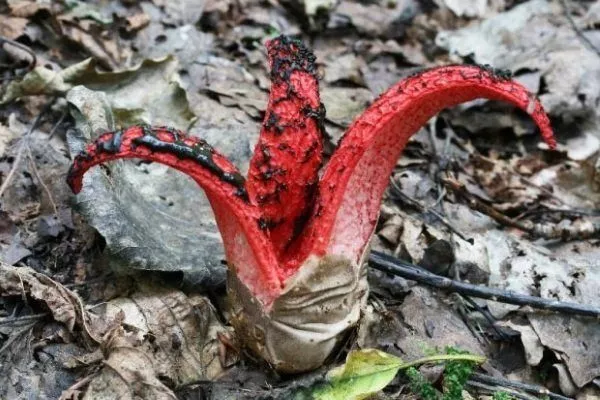
Description of the mushroom and its characteristics
As soon as the first photos of this mushroom appeared on social media, people couldn't believe it actually existed. Some said it was a montage, others claimed it was stills from a horror movie. Only specialists knew such a plant existed in the wild, having studied it themselves.
This demonic mushroom species was first mentioned in 1860 in a description of the flora of Tasmania. It then began to spread throughout the world and has now been seen in many countries.
The only mushroom that can change its appearance. A young mushroom looks like a five-centimeter-diameter egg. At this age, it can be mistaken for a creature from another planet or a toadstool. The mushroom is multilayered:
- The top layer is the peridium, under which is a mucous egg that protects the fetus from external irritants.
- A jelly-like mucous membrane.
- The core, which will soon become red tentacles (spore layer).
When the mushroom begins to bloom, which occurs from late summer (August) to mid-autumn, the devil's finger's shell bursts, revealing eight petals with joined tips. Each petal is 10 centimeters long. Afterward, the petals separate and straighten, at which point the mushroom closely resembles octopus tentacles. The peridium is white or slightly gray with a brown or pink tint. The flesh of the "tentacles" is soft and breaks easily.
The mushroom's interior resembles a porous sponge. Its petals are quite brittle, covered with dark spots of varying sizes and spores that emit a terrible stench. Eventually, the mushroom opens completely, resembling a large star, 15 centimeters in diameter. The mushroom has no stalk at all. The smell emanating from the Devil's Thumb attracts flies, which in turn spread the mushroom's spores. This is certainly not the ideal method of propagation, and is particularly unusual for the mushroom, but it is effective. After the "flower" fully opens, it lives for only 3-5 days, but this is sufficient time for reproduction.
When the flower fades, it falls down and looks very much like the pale hand of a dead man crawling out of the ground, hence the name "devil's fingers".
This video describes how the Devil's Fingers mushroom egg develops and what people thought of it when they first saw it online in the UK:
Prevalence of the fungus
Devil's fingers are native to Australia and New Zealand, and later appeared in Asia, Africa, the Americas, Saint Helena, and Mauritius. In European countries, this fungus is regarded as an alien, but no one knows how it came to be. It is believed that when textiles were imported into France in 1915, the fungus was placed in wool. It is also possible that its spores were brought in by soldiers from Australia who fought in France during World War I. Even if this was an accident, the fungus still naturally acclimatizes wherever it has been observed.
The mushroom adapts well to climate change and thrives in any climate or soil. Later, reports emerged that devil's fingers had appeared in Germany, Australia, the Czech Republic, and England. It's also possible that it was introduced with seedlings and soil, but it has established itself well in some southern and central regions.
This mushroom appeared in the USSR back in 1953, in Ukraine in 1977, and in Russia in 1978.
The Devil's Finger mushroom is listed in the Red Book and is considered the most terrifying plant in the world due to its disgusting appearance during flowering.
Distribution in Europe
In Germany, the Archer's mushroom is common, yet it is listed as endangered. In the Czech Republic, near the town of Hranice, a small Devil's Finger mushroom was spotted growing on rotting wood in a nature reserve. As for the UK, this amazing mushroom is a major discovery there.
This mushroom was first discovered and described by British mycologist Michael Joseph in 1860. A century later, British scientist Donald Malcolm in 1980 assigned it to the genus Clathrus, hence the name Anthurus archeri.
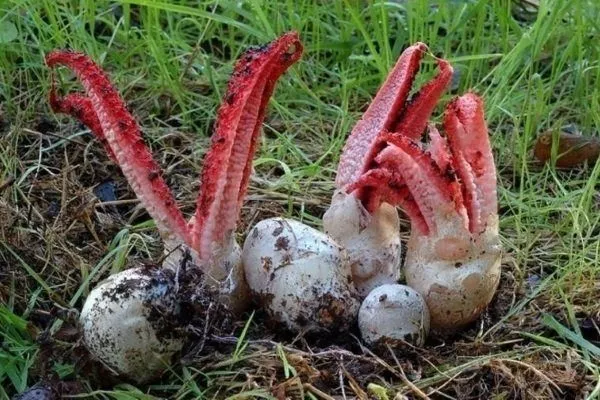
Where do the devil's fingers grow?
The habitats of this “interesting” mushroom are:
- deciduous forest;
- mixed (beech, pine, maple, elm, oak);
- in the area of humus soil and rotting wood.
| Type of terrain | Soil | Companion plants |
|---|---|---|
| Deciduous forest | Humic, moist | Oak, maple, elm |
| Mixed forest | Rotting wood | Beech, pine |
| Semi-desert | Sandy with organic matter | Xerophytic shrubs |
It can also be found in semi-deserts and deserts, in meadows and parks. They grow in large groups, as the climate allows it.
Edibility of the mushroom
Despite its horrible and disgusting appearance, it is still edible, but those who have tried it say that the taste and smell are as disgusting as the appearance.
It should only be eaten if one finds oneself in a situation where there's nothing else to eat but this mushroom. But if life allows for normal food, then there's no need to even try the devil's fingers.
This mushroom is actually very rare to see. When it blooms, it frightens people with its appearance and smell, similar to dog feces. Those who have tried to taste the Devil's Fingers have had to brace themselves for a long time, as the appearance and smell of spoiled meat are terrifying. Furthermore, the tentacles contain a horribly disgusting slime that sticks to your hands.
But there were still some people, thrill-seekers, who managed to cook a dish from an unbroken egg. According to them, it had a cloying taste, but the interesting sensation lingered for a long time.
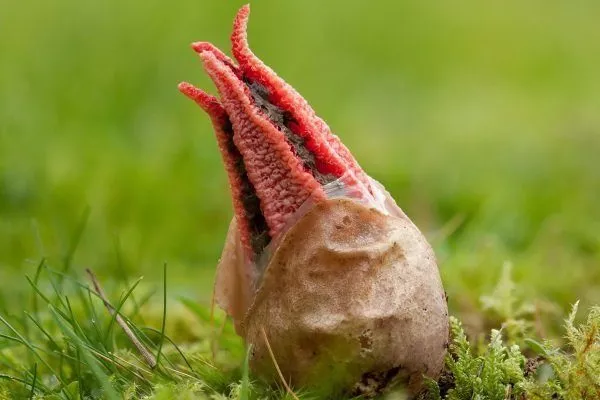
Mushroom relatives
The first photos of this wonder online generated a ton of comments. At first, people didn't believe it was real, but later they did. It's very easy to distinguish it from other mushrooms, as its appearance is unlike any other plant. True, a young mushroom somewhat resembles the stinkhorn, but the stinkhorn has green flesh when cut, unlike the devil's fingers.
Although it is a unique mushroom, there are still several similar mushrooms:
- Javan flowertail It lives in Russia, but unlike the devil's finger, its tip never separates or blossoms like a star.
- Red lattice Just like the devil's fingers, it hatches from a kind of egg covered in a slimy membrane. The mushroom quickly grows in size, becoming round and lattice-like.
- Veselka. Its main difference from the devil's finger is the presence of a stalk that reaches 15 centimeters in height. The mushroom itself grows rapidly, at half a centimeter per minute. The odor is also unpleasant, but the mushroom is widely used in folk medicine.
| View | Mature mushroom shape | Smell | Leg |
|---|---|---|---|
| The Devil's Fingers | Star (8 petals) | Rotting meat | Absent |
| Javan flowertail | Not disclosed | Weak putrefactive | Rudimentary |
| Red lattice | Ball lattice | Likewise | Likewise |
| Veselka | Cone with a cap | Rotten fish | Up to 15 cm |
The mushroom known as devil's fingers is both unique and terrifying. Many people don't know that this mushroom has already spread to many countries around the world. It's generally not eaten, but it's not poisonous. Those who have tried it say it's not tasty and has a distinctive, unpleasant odor.