
These mushrooms aren't very common among mushroom hunters. There are several reasons for this: their unflattering name, their appearance (completely unlike familiar species), and the paucity of information. Meanwhile, in other countries, these mushrooms are well-known and consumed. Want to know more about dung beetles? Then read on.
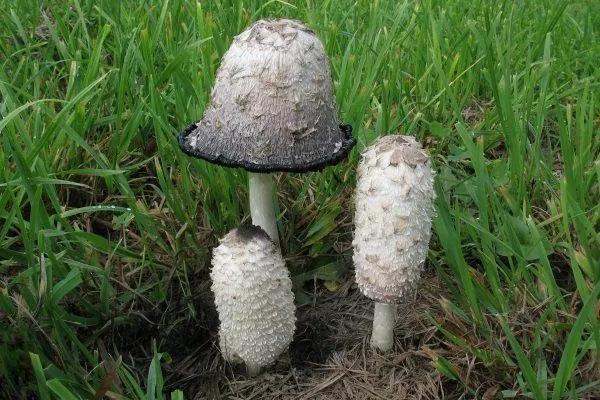
Coprinus comatus (White dung beetle)
How to recognize a white dung beetle – signs and habitats
Everyone has probably seen this mushroom. You don't have to venture deep into the forest to spot it. Dung beetles grow in large numbers even in cities. They sometimes even appear in flower beds. As their name suggests, they grow in well-fertilized soils. These can include compost heaps, decomposed organic waste dumps, cattle and poultry pastures, forests near rotted trees, and parks on decaying leaves. The first mushrooms appear in early summer and grow until the autumn frosts.
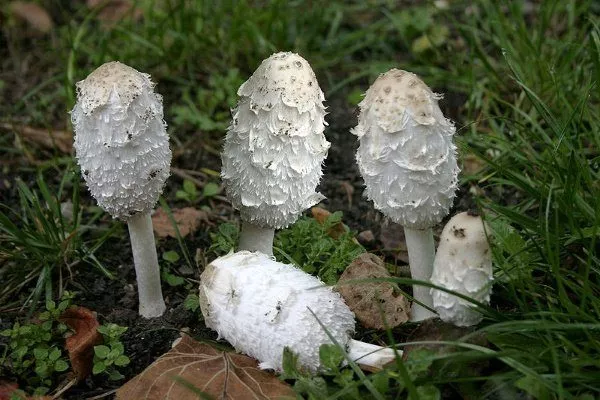
The mushroom is elongated and tapered, with a bell-shaped cap. It can reach fifteen centimeters in height. The stem is straight, hollow inside, and thickened at the base. It has a membranous ring at the top. The cap is ovoid, scaly, and bell-shaped. The cap is white, with an ocher tint at the top. The mushroom is worm-resistant.
To correctly identify a dung beetle, watch the video. A mushroom picker clearly shows where and how the mushroom grows, and how edible it is:
Types of dung beetles
There are over twenty species of this mushroom in nature, growing all over the world. Among them are both edible and inedible (but not poisonous). There are also several poisonous species.
The white dung beetle is used as food. It's distinctive from its relatives, making it impossible to confuse. It's the most common of its kind and is most often used in cooking.
| Name | Height, cm | Cap diameter, cm | Fruiting season |
|---|---|---|---|
| White dung beetle | 15 | 5-7 | Summer-autumn |
| Grey dung beetle | 10 | 3-5 | Late May-October |
| Ink cap | 5 | 2 | July-October |
| Plicate dung beetle | 4-6 | 2-3 | Spring-autumn |
| Woodpecker's dung beetle | 25 | 10 | September-October |
| Inedible white dung beetle | 8 | 2-3 | Summer-autumn |
| Downy dung beetle | 4-5 | 2 | Summer-early autumn |
| Ink cap | 10 | 4 | May-September |
| Flickering ink cap | Up to 10 | 5-6 | Spring-autumn |
| Hay dung beetle | 8 | 1.5 | Spring-autumn |
| Inky cap romagnesi | 10 | 5-6 | Spring-autumn |
| Downy dung beetle | 4-5 | 2 | Spring-autumn |
Grey dung beetle
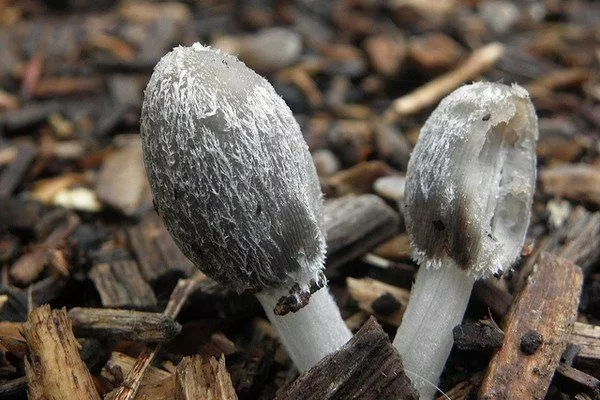
Its appearance is slightly different: the cap is smooth and gray, with scales at the very top. The base under the cap is brownish. This mushroom is also used as a food, but much less frequently and with greater caution. The gray dung beetle is more often used medicinally (although it can also be cooked). It is found in manure piles, garbage dumps, gardens and vegetable patches, and among deciduous trees. It grows from late May to October.
Inedible dung beetles include the scattered dung beetle, the folded dung beetle, the woodpecker's dung beetle, and others. These species are completely unlike the edible dung beetle, more closely resembling toadstools. Although some of these are considered conditionally edible, there's no guarantee they won't cause food poisoning or allergies. Don't risk your health; if necessary, perform a stomach lavage and consult an allergist or infectious disease specialist.
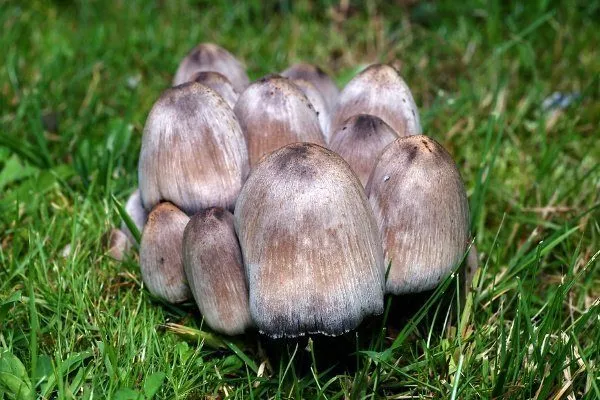
Absent-minded
It has a beige, ovoid cap with shallow grooves containing small seeds. It is no more than two centimeters in diameter. The stem is thin, up to five centimeters tall, hollow inside, and grayish in color.
It grows from July to October on stumps and rotten wood.
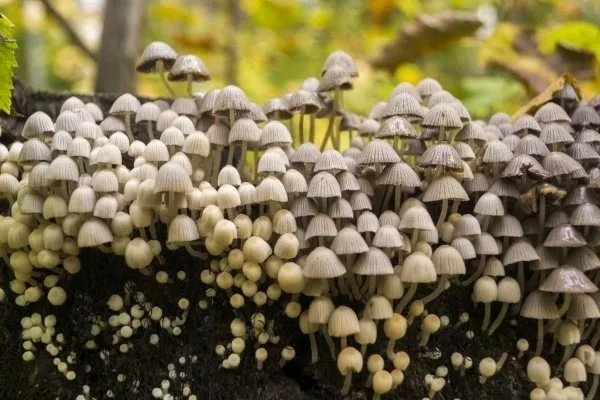
Folded
The cap is bluish-gray, bell-shaped, then opens into a pleated umbrella. The diameter is 2-3 centimeters. The gills are pale yellow, gradually turning black. The stem is 4-6 centimeters tall and thin. It grows along roadsides, in gardens, and meadows.
It bears fruit from spring until late autumn.
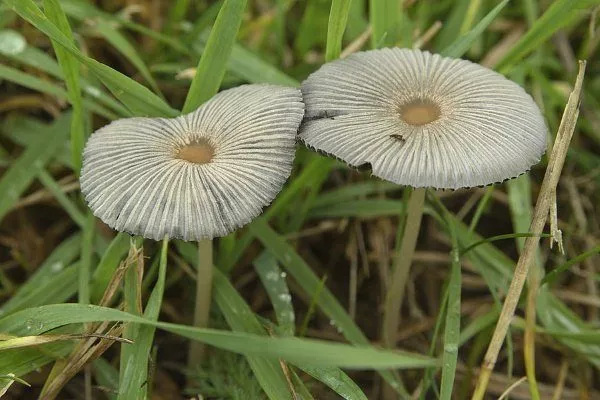
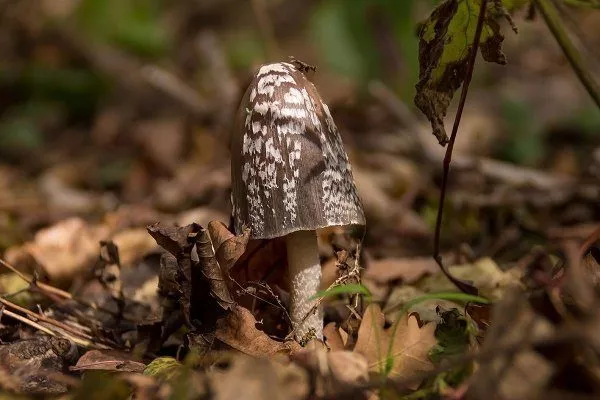
Woodpecker's dung cap (magpie or spotted dung cap)
When young, the cap is covered with white scales, which darken as the mushroom matures, taking on a magpie-like coloration. The cap diameter is up to ten centimeters, the stem height up to twenty-five centimeters. The stem thickness is one and a half centimeters.
Found from September to the end of October among deciduous trees.
This species of dung beetle is considered mildly poisonous. There are no statistics on fatal cases of poisoning from this mushroom. However, to avoid poisoning, it is best to avoid handling it.
White dung beetle is inedible
It grows throughout the summer and into warm, moderately rainy autumns. It can be found on manure piles and rotting grass.
Small, no more than eight centimeters tall. The stem is thin, no more than two millimeters in diameter. The cap is ovoid, bell-shaped, and gradually opens, with curved edges. The cap diameter is two to three centimeters.
Some consider the mushroom to be conditionally edible if it is cut as soon as it emerges from the soil.
Downy dung beetle (hairy-legged) is inedible
Found from early summer to early autumn in well-fertilized soil.
This dung beetle's distinctive feature is its fluffy cap, covered in small, hair-like scales. The flesh is fragile. The cap is shaped like all dung beetles—elliptical or bell-shaped. The mushroom is small. The stem is 4-5 centimeters high, and the cap diameter is no more than two.
The domestic dung beetle is inedible.
Found on rotting hardwood from mid-May to September. Grows in colonies.
The cap is ovoid, opening to a bell-shaped shape four centimeters in diameter and five centimeters in height. The cap is grayish-brown in color, with a darker center and a tubercle. The thin, light-colored gills have a dark edge.
The stem is short (up to 10 cm), thin (about one centimeter). The flesh is thin, odorless, and white.
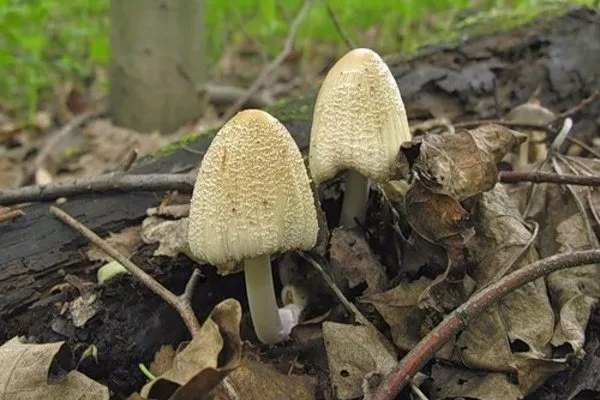
Flickering ink cap
It grows in large clusters on rotting trees from spring to late autumn. Only very young specimens are edible. It is not known for its distinctive taste.
The cap is shaped like other dung beetles (ovoid, bell-shaped). The color is yellowish-brown, with fine grooves and shiny scales.
The stem is long, smooth, and white. It is hollow inside. There is no mushroom ring.
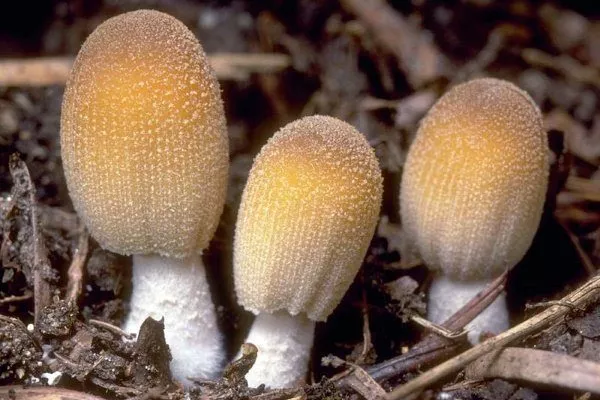
Hay dung beetle
Grows from early spring to late autumn. Prefers fertile, moist soil. Can grow in groups or individually.
It has a long, thin, curved stem, up to eight centimeters tall. The surface is smooth, hollow, and round inside.
The cap is gray-brown, bell-shaped, up to one and a half centimeters in diameter. It is plate-like inside.
It is considered an inedible mushroom.
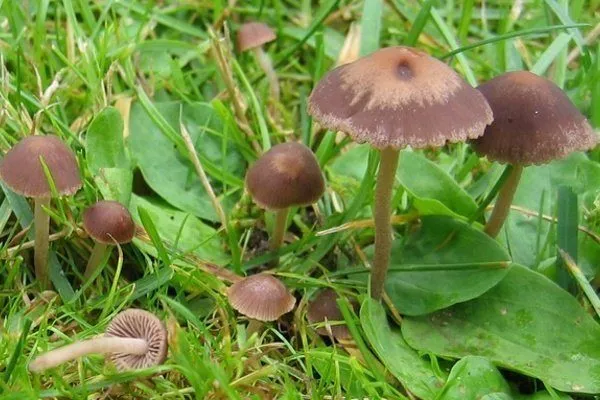
Inky cap romagnesi
It grows on stumps, fallen or rotted trees, and in fertile soil. Fruiting occurs from spring to autumn, with mushrooms being especially abundant during cool summers.
The cap is shaped like a large bell, up to five to six centimeters in diameter. The stem is up to ten centimeters long, hollow, and slightly pubescent.
Similar to the grey dung beetle. However, unlike its grey counterpart, the cap is generously decorated with brown scales. With age, the romagnesi turns black and turns into a black slime.
Conditionally edible when young, before it begins to turn black. However, to avoid various types of poisoning, it is best to refrain from eating it.
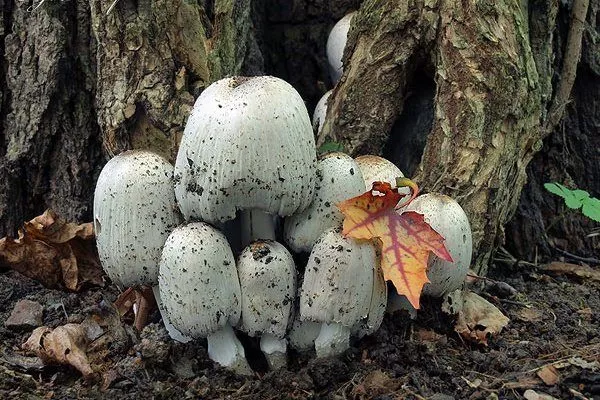
Downy dung beetle (hairy-legged, hairy-legged)
It grows from spring to autumn in well-fertilized and manured places, humus.
A short-lived mushroom that decomposes very quickly, literally after a few hours of life.
The cap is initially bell-shaped, gradually opening, the grey plates quickly turn black and turn into black mucus.
The stem is white and hollow; after the cap decomposes, it remains standing as a stump, smeared with blue-black ink.
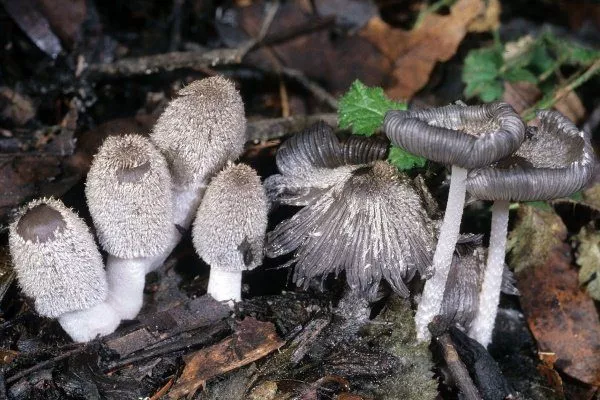
Value, calorie content and composition
The white dung beetle is an edible and tasty mushroom. It belongs to the fourth category of mushrooms. This means that only amateurs collect it, and the mushroom itself is of little value. However, in reality, the dung beetle contains a fair amount of beneficial substances and vitamins.
Like any mushroom, the main value of the white dung cap is its high protein content and low calorie content. It has just over twenty calories (per 100 grams) and is virtually fat-free. However, it is rich in (besides protein): phosphorus, selenium, zinc, sodium, potassium, manganese, calcium, glucose, B vitamins, and amino acids.
Contraindications and limitations for use
There are few restrictions on the consumption of this mushroom. The main ones are individual intolerance and allergic reactions. Children under 14 should avoid eating mushrooms, as they are difficult to digest. The same applies to people with stomach ailments.
But the most important limitation to its use is its incompatibility with alcoholic beverages. This doesn't apply to all dung beetles, but only to the gray variety.
The toxin contained in dung beetles is insoluble in water (during cooking), but is very soluble in alcohol. This toxin is quickly absorbed in the intestines, enters the bloodstream, and within an hour causes all the symptoms of poisoning:
- indigestion, vomiting;
- increased heart rate, increased temperature;
- intense thirst;
- the skin of the body and face becomes purple-violet.
These symptoms last for several hours. If the person next consumes dung beetles as a snack with alcohol, the reaction will be similar.
How to grow dung beetle yourself?
Growing dung beetle is similar to growing mushrooms. It can grow both outdoors and indoors, such as in basements. Its ability to thrive is demonstrated by the fact that it grows as a "weed" even in mushroom beds.
Unlike its cultivated relative, it's more fertile and less susceptible to various diseases and pests. Its only disadvantage is shelf life. It needs to be processed as quickly as possible, within a few hours, which is impossible on an industrial scale. However, it's much easier to do at home.
- ✓ The area should be in the shade, as the dung beetle does not tolerate direct sunlight.
- ✓ The soil should be rich in calcium and organic matter.
- ✓ Good ventilation is essential if growing indoors.
To grow dung beetles in your garden, you need to carefully select a suitable location. A sunny garden bed is completely unsuitable. Dung beetles don't tolerate full sun. If you can't provide the mushroom with constant coolness and shade, you'll have to grow it in basements. There's just one trick to this: dung beetles require fresh air, so good ventilation is essential.
- Add calcium carbonate to the mushroom substrate.
- Ensure the soil layer is at least 20 cm thick.
- Keep the soil moist and warm.
The soil for dung beetles should be rich in calcium. Plenty of calcium carbonate should be added to the mushroom growing medium. The soil layer should be at least twenty centimeters thick.
Dung beetles are grown using spores or mycelium. Mycelium for propagation can be purchased at gardening stores or online. It comes in liquid or powder form (as well as dried balls or cubes). The prepared mycelium is poured or sprinkled onto a bed prepared for mushrooms, then covered with substrate. Afterwards, the bed should be watered and covered with burlap, sawdust, or plastic wrap.
Planting is usually done in May, when the soil has warmed up well. The soil where the mushrooms are planted should be consistently moist and warm. After two months, the first mushroom harvest can be harvested. There will be five or six such harvests, spaced two to three weeks apart.
Ink cap can also be grown like champignons – in basements. The requirements are the same as in a garden bed, with the exception that fresh air is essential. Overheated air can kill the mycelium.
Another enemy of the dung beetle in the basement are mice. They are particularly attracted to wheat grains, which are often sold as mycelium infected with the dung beetle's spores.
In basements, dung beetle grows no worse than in a garden bed and produces a good harvest.
What is it grown for?
This mushroom is grown not only for food but also for medicinal purposes. It has gained widespread popularity, being able to combat alcoholism. Only the gray dung beetle possesses this property.
Coprine, a substance isolated from this mushroom, became the basis for anti-alcohol medications. Not only natural substances from the mushroom began to be used in medicine, but also artificial analogues were produced.
Therefore, grown mushrooms can not only be sold on the food market, but also actively traded on the pharmaceutical raw materials market.
Processing and storage
To properly and safely prepare dishes from dung beetle, you need to follow several rules:
- Use medium-sized mushrooms (not too small – at least three centimeters tall) and not overgrown. It's best if the caps are still closed.
- They need to be cleaned and cooked quickly, as the caps will darken, become slimy and inedible.
- Mushrooms should be washed very quickly. Washing is more about removing forest debris than thoroughly cleaning them. Be sure to remove any remaining water, as the mushrooms themselves tend to be quite watery when cooked.
- For long-term storage (for example, in the freezer), mushrooms must first be boiled and fried (heat treated).
- When preparing, use one type of dung beetle (preferably white), as a combination of different types can cause intoxication.
Although its name and appearance may not make it so common, the dung beetle is a valuable and delicious mushroom. It's very difficult to mistake it for any other mushroom. Collect dung beetles, cook them into delicious dishes, or grow them in your garden.
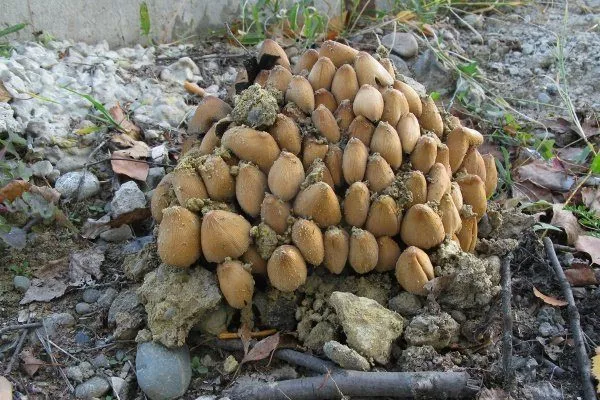
Thank you so much for the information—it was really interesting to learn so much about the dung beetle. I read somewhere that it's grown, but I couldn't find the answer to the question of WHY it's needed anywhere. Only from you. Thank you so much. I have a dung beetle growing like this: