
Zamioculcas 'Zenzi' is a dwarf dollar tree that retains its decorative qualities even when grown in partial shade. The plant is easy to maintain, but the key is to strictly follow watering guidelines. This variety was developed at the beginning of the last century in a Dutch nursery. The originator is Newcoop Europe.
Description of the variety
The Zenzi dollar tree belongs to the Araceae genus, a zamiifolia species of Zamioculcas. It is considered a succulent that can accumulate moisture in its root system and aboveground parts. Micropropagation was used during selection, ensuring the mutation was fixed.
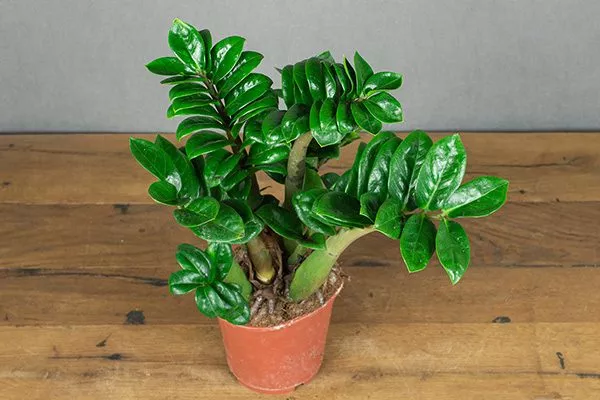
Plant structure
Zenzi, unlike other succulents, has a stemless structure. Instead of a shoot, it has a compound leaf from which feather-like leaves emerge. It is the rachis that acts as the stem, which is why many gardeners call it that.
Other design features:
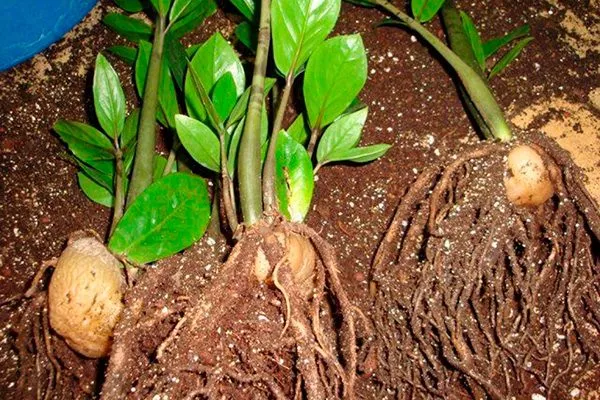
- The root system consists of a modified stem, a tuberous thickening. Roots grow from this tuber, absorbing nutrients and water from the substrate.
- The compound leaf, also known as the rachis, has a central axis from which small pinnate leaves grow. They are distinguished by their glossy surface and waxy coating. The pinnates are quite stiff, closely spaced, and look artificial.
- The aboveground part is light green when young, but as it matures, it first acquires a rich green hue, eventually turning dark green. This can also vary depending on the type of lighting.
- The flowers are very small, arranged in a spadix-shaped inflorescence. The petals are usually light-colored.
- Formation of buds occurs after reaching 8 years of age.
Differences from other varieties
Although Zenzi is classified as a dwarf plant, it's tall for a houseplant, reaching up to 70 cm in height. This particular Zamioculcas variety can be identified by the following distinctive features:
- the rachis are thickened, which is especially noticeable at the very base;
- the root system is small - it is equal to the parameters of the compound leaves, while other varieties have massive roots;
- internodes are short;
- the feather leaves are located very close to each other;
- the feathers are curved downwards, which is why Zenzi is called curly;
- Unlike the dwarf variety Dwarf and Beetle, Zenzi is considered a tall plant.
Other features
The Zenzi Dollar Tree, like other Zamioculcas, grows slowly, reaching maturity only at eight years of age. This variety is best suited for growing on windowsills or stands, rather than on the floor due to its dwarf size.
The flower also has other features:
- rachis never scatter to the sides and do not stretch out, since the internodes are very compact;
- in partial shade and shade the color of the green mass will be pale;
- Dark spots may form on the rachis, which is normal;
- It was Zenzi that gained popularity in our latitudes at the beginning of the 21st century, and therefore is still an exotic flower;
- The cost of this variety is higher than others due to its exoticism and low prevalence.
The flowering of this variety deserves special attention. The flowers are located in spadix-shaped inflorescences, which are covered by a spathe. The flowers emit a very pleasant aroma. Other characteristics:
- the inflorescence contains male and female flowers - the first at the top, the second at the bottom;
- there is a sterile zone between the flowers to prevent self-pollination;
- flowering begins in spring and ends in autumn;
- the inflorescence is almost invisible, as it is covered with a blanket of the same shade;
- towards the end of ripening the cob bends downwards;
- The seeds do not have time to ripen; they are found in small brownish fruits.
Caring for Zamioculcas Zenzi
Zenzi is considered an easy-to-grow Zamioculcas plant; however, it's important to follow certain cultivation guidelines, particularly regarding watering and humidity.
After purchase
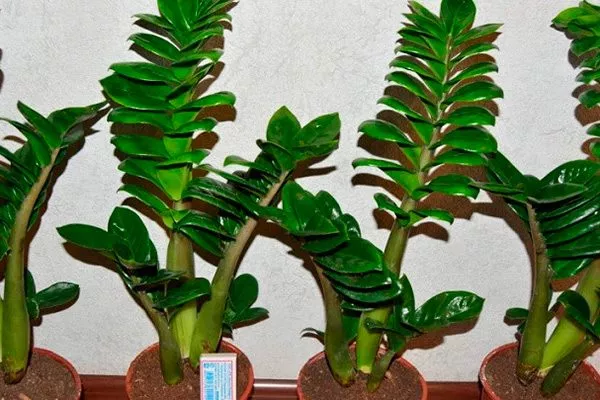
Immediately after purchasing the Zenzi Money Tree, it's important to quarantine the plant. To do this, place it away from other houseplants for 15 days. The light should be as diffused as possible. If the roots have already outgrown the pot or the substrate is unsatisfactory, repotting is possible.
Location and lighting
The Zenzi money tree's unique feature is its shade tolerance, so any windowsill can be chosen. However, keep in mind that if planted on a south-facing surface in hot regions, artificial shading will be required, such as with light curtains, especially at midday. Drafts should be avoided.
Temperature of content
Zamioculcas Zenzi has a temperature limit of at least 16°C and at most 35°C. However, the optimal growing season ranges from 20°C to 25°C. In winter, temperatures drop by 2-3°C.
Watering
This is the most important point in growing the Zenzi variety of Zamioculcas. The tree has the ability to retain moisture, so avoid frequent and excessive watering of the substrate, otherwise, root rot will develop.
- ✓ Use only room temperature water that has been left to stand for at least 24 hours to remove chlorine.
- ✓ Check the moisture content of the substrate at a depth of 2-3 cm before each watering.
However, don't allow the soil to dry out excessively, as this can cause the leaves to thin and wilt. The watering schedule is as follows:
- In spring and summer, humidification is carried out 3, maximum 4 times a month.
- In late autumn, watering once a month is sufficient.
- In winter – once every one and a half months.
Some features:
- water only with settled water;
- the temperature of the liquid should be about +25 degrees;
- watering should be carried out only after the entire substrate in the pot has completely dried out;
- Remove excess water from the tray half an hour after watering.
Humidity and spraying
Spraying zamioculcas is prohibited, and dust should be removed with a slightly damp cloth. Bathing should be done no more than once a month, but it is possible to do without it.

If overwatering occurs, the plant signals this by forming droplets on its leaves. This process is called guttation—when the plant expels excess fluid from its cells or replenishes what it lacks.
Top dressing
If you repot your Zamioculcas Zenzi annually (which you should do until it reaches maturity), then fertilizing is not necessary—the peat moss will supply enough nutrients. However, if the plant grows in the shade under similar conditions, it's important to stabilize its immune system with fertilizer.
Peculiarities:
- You should not use nitrogen fertilizers that are used for other types of indoor flowers - they contain a destructive concentration of this substance;
- You can fertilize once a month, for which you can purchase specialized succulent mineral complexes;
- The first feeding after transplantation is carried out after 60 days.
Trimming
Zenzi is a versatile variety that requires no pruning or crown shaping. Furthermore, it doesn't require any support, as its rachis leaves are quite strong and upright. The only thing you need to do is periodically remove any leaves that turn yellow with age. However, keep in mind that this should not be done right before the plant begins to dry out.
Transfer
Zamioculcas Zenzi should be repotted annually until it reaches at least four years of age, when the plant has become more or less established and strong. After that, it can be repotted every three years. Keep in mind that the more frequently you move the plant to fresh soil and a larger pot, the faster it will grow.
Choosing a pot and soil
The choice of container and substrate must be approached carefully, as the plant's success in establishing and adapting depends on them. Pay particular attention to the material the pot is made of:
- Plastic. On the one hand, it's fragile, and the zamioculcas root system is powerful, so it can easily break through the container. But on the other hand, if the plant is difficult to remove during repotting, it's not a big deal to simply cut or break the plastic pot.
It's also easier to determine when repotting is needed—the plastic will bulge. Multiple drainage holes are a must. - Clay. This is the most reliable option, as unlike plastic and ceramics, for example, the material is moisture- and air-permeable. Clay is durable, so the roots of the dollar tree won't be able to break through the walls, but it's significantly more expensive than alternative pots.
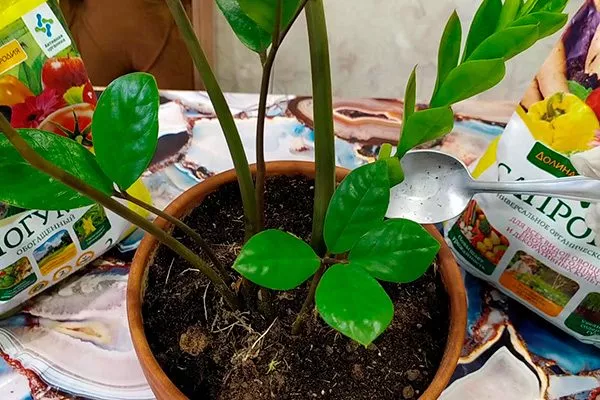
It's also important to choose the right size. Remember, the Zenzi container should be at least 2 cm larger than the height and diameter of the root system. Avoid choosing an overly large pot, as this will cause the root system to grow, not the above-ground portion.
You can buy potting soil at a flower shop. It should be suitable for succulents or cacti. You can also make your own. Options:
- universal soil mixture with expanded clay, coarse sand or perlite;
- Akadama composition;
- in equal proportions - turf and leaf soil, sand and peat;
- bark intended for growing orchids, mixed with peat;
- Coconut chips with peat.
Fine-grained river sand is not used – only coarse-grained.
Step-by-step instructions
Repotting should be planned in advance, as watering the plant a week beforehand is prohibited, making it more difficult to break the tuber. Keep in mind that if the pot has become too tight, removing the flower will be very difficult. In such cases, the pots may need to be broken. Therefore, repot the plant promptly.
To facilitate the extraction process, you can water the flower generously, although this is not recommended. The process is as follows:
- Carefully remove the plant from the soil.
- Shake off excess substrate and inspect the root system. If there are any rotted, dried out, broken, or pest/disease-infested areas, trim them off and dust the cut areas with crushed activated charcoal or wood ash.
- Place the plant on a towel to dry completely. The location should be shaded.
- Place a drainage layer of pebbles or expanded clay at the bottom of the pot. Make a layer of about 3 cm.
- Sprinkle half of the prepared soil mixture on top.
- Place the seedling in the center.
- Fill with the remaining substrate and tamp lightly. Keep in mind that the roots should be just above the surface; cover them with a thin layer of soil.
To learn how to transplant a zamioculcas, watch this video:
Methods of reproduction
Zamioculcas Zenzi is propagated in different waysEach has its own characteristics, advantages, and disadvantages. Therefore, before increasing the variety's population, carefully familiarize yourself with all the methods.
Seeds
The seed method is the most labor-intensive and time-consuming. But the main difficulty is that the money tree blooms extremely rarely, and the seeds don't have time to fully ripen. However, there is another option: if you're lucky, you can buy seeds at a specialty store.
Brief description of the procedure:
- Prepare a very loose peat-based soil.
- Place it in a container or small planting pots, plastic cups.
- Moisten the substrate.
- Place the planting material at a distance of 3 cm.
- Cover with glass or plastic wrap.
Open the container daily for ventilation and water the seedlings periodically. When the shoots with the first two leaves appear, transplant them. Once they've grown, plant them in a permanent pot.
- Select a healthy compound leaf with no signs of disease or pests.
- Dry the cut for 2 hours before planting to prevent rot.
Cuttings
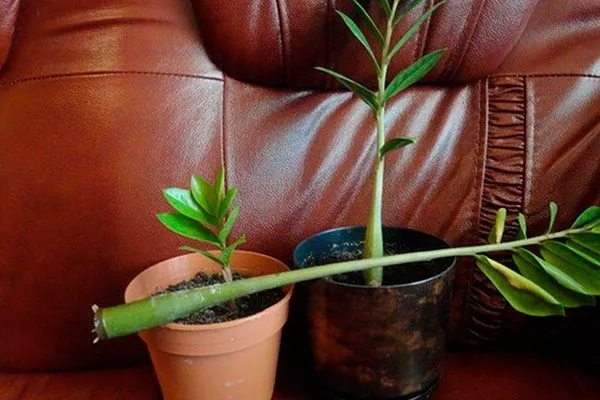
In the case of Zamioculcas zenzii, cuttings refer to a compound leaf. The procedure is simple:
- Cut off the compound leaf at the base.
- Remove the bottom 4 tiers of feathery leaves.
- Sprinkle the cut area with activated carbon or soak it in a rooting agent.
- Prepare a substrate of peat and coarse sand, or a glass of water. Hydrogel can be used.
- Place the cutting in a pot/glass.
- After about 2-2.5 months, transplant into a pot.
By dividing an adult plant
The procedure is best performed during repotting. The bush must be at least four years old and healthy. This method is advantageous because it allows the grower to immediately obtain several fully mature flowers. The procedure is straightforward:
- Remove the flower from the pot.
- Get rid of excess substrate.
- Separate the tubers with roots by hand, not with a knife. Each piece should have at least two buds.
- Dry the broken areas.
- Sprinkle activated charcoal on the bottom.
- Plant in the standard way.
You cannot water the plant for the first 7-8 days, and fertilizing is prohibited for 2 months.
Leaf blades
Zamioculcas zenzi is easily propagated from leaf blades. The leaf must contain a petiole. The sequence of steps and rooting methods are identical to those for cuttings.

Diseases and pests
The Zenzi dollar tree is rarely susceptible to diseases and pests, only if proper cultivation practices are not followed. What may occur:
- Root rot. Occurs when the soil is overwatered and subject to sudden temperature changes. Fungicides are used for treatment.
- Aphids, spider mites, and scale insects. Insecticides are used against them.
Sometimes the leaves on the dollar tree turn yellowMany novice gardeners believe this is a disease, but in reality, it's simply a natural process of aging. Sometimes it's caused by drafts.
Problems of growing
There are no particular problems with growing the Zenzi variety, but sometimes novice succulent enthusiasts encounter the following problems:
- improper watering leads to loss of decorative properties;
- If you add too much water at one time, the plant will shed its feathers;
- If the room is cold, the leaves will turn black.
Reviews from flower growers
Valentina Molkina, 34 years old, Voronezh. My apartment gets very little light (it's on the first floor with tall trees outside the window, plus it faces north), so growing houseplants is challenging. But the Zenzi Money Tree grows without a problem. The only thing I don't like is that it grows very slowly.
Olga Alyokhina, 44 years old, Izhevsk. I don't have time to take special care of houseplants, so I try to choose the most undemanding plants. Among succulents, I prefer the Zamioculcas Zenzi—it needs little watering, doesn't require much bathing or misting, and never gets sick. It's also quite interesting to watch the seedlings propagate from leaves. I highly recommend this plant.
Anastasia Verevkina, Moscow region. I wouldn't call the Zamioculcas 'Zenzi' a dwarf plant—my bush has grown almost 70 cm in six years. But it certainly looks magnificent—the leaves are dark, glossy, and very closely spaced. I'd love to see it bloom.
Zamioculcas zenzi is considered a dwarf succulent characterized by its complete undemanding nature. It easily adapts to new conditions, quickly takes root using all propagation methods, and requires no support due to the rigidity of its rachis and leaf blades.