
Zamioculcas is a perennial, evergreen plant that belongs to the Araceae family and is classified as a succulent. Its botanical name in Latin is Zamioculcas, and common names include dollar tree, everlasting tree, flower of celibacy, and so on, depending on the country.
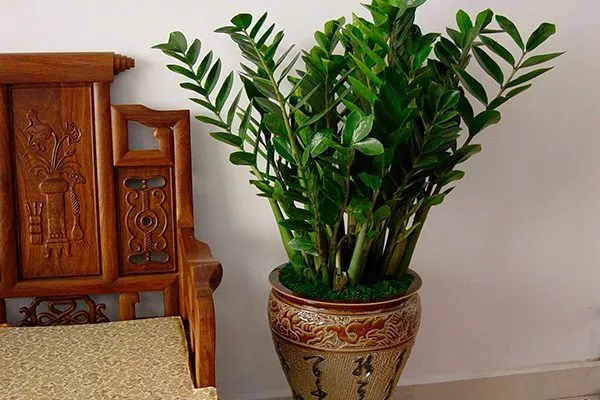
Description of the flower and general information
Zamioculcas is not divided into many speciesToday, only one exists—zamielistny. Despite this, other names are quite common:
- Lanceolate. It was described in the 29th year of the last century, but at the end of the century it was classified as zamiifolia.
- Buaven. The world learned about it a little later – in 1970, and later the species was classified as Gonatopus (this is a different type of plant).
Zamioculcas has been known for a long time—in 1829—but the plant only gained popularity in 1996. Dutch breeders are to thank for this. Today, a huge number of subspecies have been developed—variegated, green, black, dwarf, large, variegated, etc. Among them there are many varieties.
The structure, description and characteristics of this exotic indoor flower:
- The plant has a very unusual structure, lacking a trunk or shoots. Therefore, the root system develops on a compound leaf composed of rachis pinnae.
- The roots are underground and rather massive tubercles with thickened root shoots. Many people compare them to worms. The rhizome grows very strongly, easily breaking through the walls of a pot. The tuber stores most of the moisture, which it releases to the above-ground portion as needed.
- The leaves are erect and have a glossy, waxy surface. Other characteristics of the compound leaves include:
- structure – fleshy;
- the lower part has a petiole thickening;
- the height of the compound leaf reaches 40-60 cm (in room conditions), but there are specimens that are much taller;
- it has from 8 to 12 feather-like leaves;
- rachis (leaf axis, vein) thickened;
- ink spots are present on the rachis and petioles;
- The feathers have a leathery, dense texture.
- All parts of the flower have the ability to store moisture in large quantities. This property is common to all succulents, preventing them from dying during drought. To prevent excessive evaporation, the plant can shed excess leaves.
- The lifespan of a money tree is 5-10 years.
- The growth pattern is slow. Over the course of one year, growth varies from 10 to 15 cm. During this time, only a few new pinnate leaves may form.
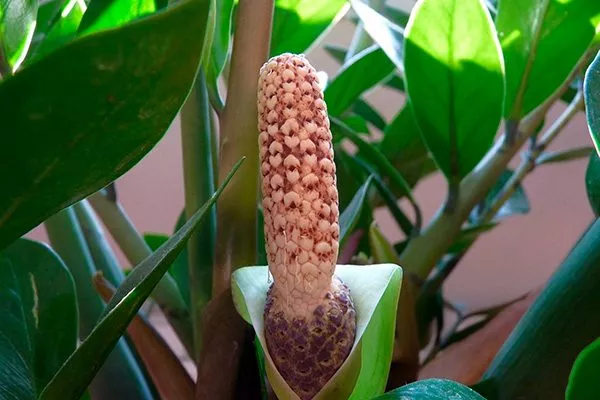
- Flowering deserves special attention – it occurs almost at the end of its life, beginning in the last month of spring and ending in late autumn. The flowers exude a pleasant, intense fragrance. Other features:
- the inflorescence resembles a thickened ear;
- it contains small flowers (the shade depends on the specific variety);
- The location of the cob is on the bottom of the peduncle, always covered with a green petal cover.
- Seeds do not form. Experts attempted artificial pollination, but this too was unsuccessful. Instead of a seed capsule, the inflorescence produces fruits, each containing a single seed.
- The plant's sap is poisonous, so children and animals should be prevented from picking the leaves, much less eating them. When propagating and pruning, it's important to wear protective rubber gloves.
- ✓ The appearance of new leaves: a sign of healthy growth and proper care.
- ✓ Yellowing and dropping of lower leaves: This is a natural aging process, but widespread yellowing may indicate problems with watering or lighting.
Signs associated with the dollar tree
Zamioculcas is actively used in Feng Shui. According to this, the flower is capable of attracting success, prosperity, and money into the lives of household members, as it has very strong energy. However, it is recommended to place the pot only in the wealth zone – on southeast windowsills.
But there are also some signs that superstitious people believe in:
- the appearance of a new leaf promises unexpected profit;
- if a flower appears in the house as a gift, then this means new happiness for a woman;
- when leaves turn yellow and fall, material collapse is expected;
- If the zamioculcas blooms, the girl will get married or meet her betrothed.
There are quite a few superstitions, but none are scientifically proven. Problems with the plant occur for one reason: when you don't follow the proper growing instructions for the succulent.
Caring for a Money Tree at Home
Many gardeners consider Zamioculcas to be the most easy-to-care-for succulent. Despite this, experts still recommend following certain growing guidelines. This is the only way to ensure the plant's robust health, resilience, and beautiful appearance.
- ✓ Light level: Zamioculcas requires bright but diffused light; direct sunlight can cause leaf burns.
- ✓ Temperature conditions: the optimal temperature for growth is +22-28°C in summer and +16-18°C in winter. The minimum allowable temperature is +12°C.
Location
Zamioculcas prefers plenty of light and warmth, so the best location for a pot is on the south or southeast side of the apartment/house. However, it can easily grow even in partial shade and on north-facing windowsills. However, in these cases, flowering is difficult, and the feathery leaves will be smaller.
In summer, it's essential to place the plant outside or on a balcony, even exposing it to direct sunlight (except between noon and 4 p.m.). Furthermore, the plant tolerates drafts, but only warm ones.
Priming
Like any succulent, the money tree prefers a loose, light, and breathable soil, but it should be neutral in pH. Store-bought potting soil designed for cacti is typically used, but it's also possible to make your own at home.
The best option is to mix equal parts river sand, high-moor peat, turf, and leaf mold. To improve air and water permeability, add some small pebbles and lump charcoal.
Choosing a pot
Zamioculcas have a very extensive and shallow root system, so the pot should be wide in diameter and low in height. Any size pot can be used when planting, but if you immediately plant it in a large one, the plant will begin to grow roots rather than foliage. Therefore, it is recommended to select a container that accommodates the plant's root system.
Pay special attention to the choice of material:
- Ceramics and plastic/plastics. Such pots are absolutely unsuitable. Firstly, they don't allow air to pass through, and secondly, they're not strong enough to withstand the pressure from growing roots.
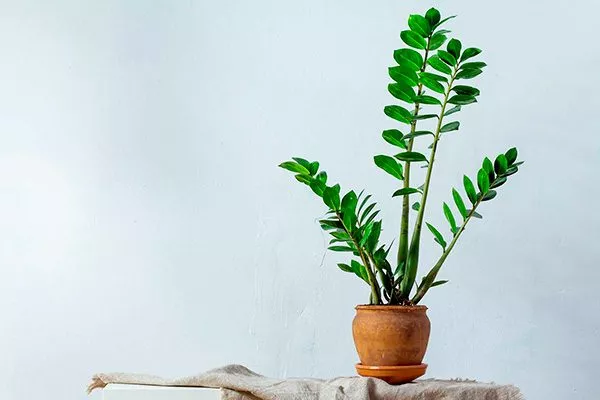
- Clay. This is an ideal option because the natural material is highly breathable and highly durable. Furthermore, the hydrated water in the clay pot acts as a thermostat, releasing heat in cold weather and cooling in hot weather.
Temperature
Zamioculcas thrives in temperatures ranging from 22 to 28 degrees Celsius in summer and 16 to 18 degrees Celsius in winter. Critical temperatures, which will kill the plant, are 11 degrees Celsius and below and 38 degrees Celsius and above.
Humidity
This succulent adapts well to indoor conditions; in fact, it tolerates dry air better than high humidity. The reason for this is simple: Zamioculcas is native to Africa. Therefore, it is not recommended to mist the leaves or the air or install artificial humidifiers, as is the case with other succulent species.
However, it's important to periodically remove dust with a damp cloth or shower. The key is to thoroughly dry each feather and leaf rachis after washing.
Fertilizers and dressings
To ensure Zamioculcas thrives, the plant needs to be fed during the growing season, from early spring to late fall. Fertilizers designed for cacti or succulents are best, and a liquid formula is best (it's easier and more quickly absorbed). Other fertilizers are also permitted, but in these cases, the dosage should be reduced by exactly half.
Root feeding is done twice a month, and foliar feeding is done once a month. For the latter option, you can purchase urea. Dilute 1 g of the substance in 1 liter of water.
Watering
Zamioculcas requires moderate watering. In fact, it's better to underwater than overwater. It's especially important to avoid stagnant water, as this will severely damage the root system. On the other hand, don't allow the soil to dry out too much, as this will cause the plant to shed its leaves. And if you neglect watering completely, spider mites will quickly appear.
Rejuvenation and pruning
Zamioculcas grows slowly, but to speed up this process and ensure all the leaves receive the necessary oxygen and light, the plant needs to be thinned and shaped. Sanitary pruning is also essential, as it reduces the risk of pests and diseases.
Some features:
- pruning time: from early spring to late summer;
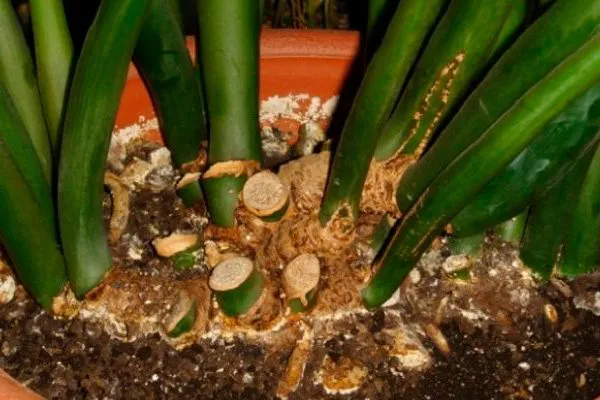
- What is most important to remove is damaged, dried out, rotten and broken parts, as well as elements growing in the wrong direction;
- What to do after pruning: disinfect the cut areas, for which you can use potassium permanganate, brilliant green, wood ash, or activated carbon;
- The necessary tools are pruning shears and a knife, which must be disinfected beforehand.
If you cut the stems, you should leave the stumps. Pulling them out will damage the tuber. Therefore, they can be removed when replanting.
Propagation of the money tree at home
Zamioculcas is considered universal in terms of quantity methods of reproductionEach method has its own characteristics, advantages, and disadvantages. Therefore, carefully review each one before beginning the procedure.
By dividing the bush
Zamioculcas bushes are divided during repotting. This method is hassle-free and allows for the fastest results. However, there is a drawback: if the bush isn't strong and healthy, the divided parts will easily die. Therefore, choose only the most viable plants for propagation.
How to divide a bush:
- Use a tool to dig around the bush.
- Carefully remove it from the pot, turning the container on its side.
- Shake off the substrate from the root system and, if necessary, rinse the roots.
- Select sections for division. Keep in mind that each section should have tubers with already formed roots.
- Make cuts and powder the areas with activated carbon, which is pre-crushed to a powder state.
- Place the plants on a towel and let the cut areas dry. This should take no more than 3 hours.
- Plant in the standard way.
Care for the seedlings in the same way as after regular planting.
By cuttings or rachis leaf
Cuttings are considered the most common propagation method, as there are no risks of long-term adaptation, and the money tree retains its maternal qualities. To do this, select a rachis leaf. Then follow the instructions:
- Disinfect the containers. You can use large disposable cups or pots.
- Make holes in the bottom to drain water.
- First, lay down drainage material - pebbles, gravel, expanded clay or pebbles.
- Sprinkle a general-purpose substrate for cacti or succulents on top. Alternatively, you can use sphagnum moss or coconut fiber instead of potting soil.
- Prepare the cuttings. To do this, cut a leaf at the very base with a sharp knife. Cut it into several 10-cm pieces. Keep in mind that only cuttings with a pair of feathery leaves and at least one node are suitable for rooting. Treat the cut areas with a rooting hormone and let them dry for 2 hours.
- Moisten the substrate.
- Insert a rachis leaf into it.
- Fill with the remaining substrate or moss. Tamp it down lightly. Make sure the top of the node remains above the soil surface.
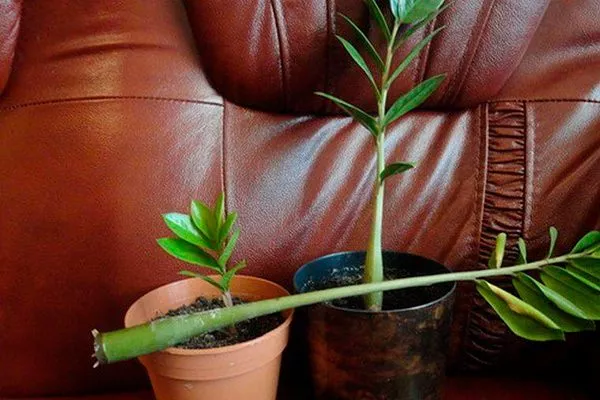
You can also root the plant in water, which will reduce the time required. Simply insert the rachis leaf into water up to half its length. Cover it with a plastic bag or a plastic cup. Open the cover daily for ventilation, and once roots appear, remove it completely.
Add water periodically to the desired volume. You can transplant the plant to its permanent location after a maximum of six weeks.
Leaf blade
For propagation, you can also use feather leaves from a healthy rachis leaf. There are two methods for rooting: in substrate and in water. The procedure is the same as for rachis leaves, but there are some differences:
- the leaves need not just to be treated with a rooting agent, but also to be kept in the solution for 2-3 hours;
- the petiole must remain on the leaf - without it, roots will not appear;
- The depression in the pot is made to a third of the total length of the leaf.
Planting in a permanent location is possible in at least 2 months.
Seeds
Zamioculcas can also be propagated by seed, provided you wait for it to flower and produce fruit, each containing a single seed. Alternatively, you can purchase planting material from a flower shop. This method is not considered popular, as it will take several years to produce a mature bush.
The algorithm of actions is as follows:
- A large container is prepared, disinfected, and filled with a special substrate. This substrate is made by mixing equal parts of river sand, washed sand, and peat or vermiculite.
- The planting material is processed by soaking the seeds in a pink solution of manganese for 20-30 minutes.
- Next, the seeds are dried and mixed in half with sand.
- The substrate is moistened and the seeds are scattered on top.
- The container is covered with polyethylene and placed in a warm place.
- Then it is watered periodically and opened for ventilation.
- Seedlings will appear in approximately 3 months (+/- 2 weeks). The covering should be removed completely.
- When the seedlings reach a height of 4-5 cm, thinning is carried out.
- Next, the plant is picked and transplanted to a permanent location in a pot.
Replanting a Money Tree at Home
Zamioculcas need to be repotted regularly – annually until they reach 4 years of age, then every 3 years is sufficient. However, there are other reasons for repotting:
- tightness of the pot;
- disease;
- the need for reproduction;
- roots emerging from drainage holes.
Sometimes, instead of replanting, for example, when the plant has become too old and massive, you can simply add more substrate on top.
The optimal method for replanting is transshipment. Here's how:
- Remove the bush from the pot, transferring it onto the plastic sheet laid out in advance.
- Transfer to a new pot.
- If necessary, cut off excess and unusable roots, tubers, and stumps.
- Plant in a new container.
Pests and diseases
The only disease that zamioculcas is susceptible to is root rot. It occurs due to overwatering of the substrate due to excessive and frequent watering. The disease manifests itself as yellowing of the leaves and wilting of the rachis. How to treat:
- Remove the flower from the pot.
- Trim off any rotten roots and tubers.
- Treat them with manganese.
- Plant in a new container and treat with fungicide.
The most common pests are:
- Spider mite. Signs include the presence of multiple light spots and traces of cobwebs. For control, use Fitoverm or Kleschevit.
- Aphid. The plant becomes infested with small pests that eat the leaves. To get rid of the aphids, treat the money tree with Fitoverm, Karate, or Biotlin Tanrek.
- Scale insect. This pest is difficult to control because it has a shell on its back. Therefore, it's best to remove it by hand and then apply rubbing alcohol to the affected areas. Afterwards, wash the plant with soapy water and treat it with Actellic.
Frequently asked questions and answers
Sometimes questions arise that are difficult to find answers to right away, for example:
Zamioculcas, or the dollar tree, is considered a low-maintenance houseplant; however, it does require some care. It can be propagated in a variety of ways and has many popular varieties, each of which requires specific growing guidelines.