
The red spathiphyllum is a striking member of the family of flowers popularly known as "women's happiness," and a product of floral marketing. This flower stands out strikingly against its snow-white counterparts, making it truly striking and a perfect fit for modern interiors.
What is red spathiphyllum?
Red or pink spathiphyllums are common in many flower shops. The red spathiphyllum's red spathiphyllum spathiphyllum is not a natural or varietal characteristic; it's simply the result of gardener intervention.
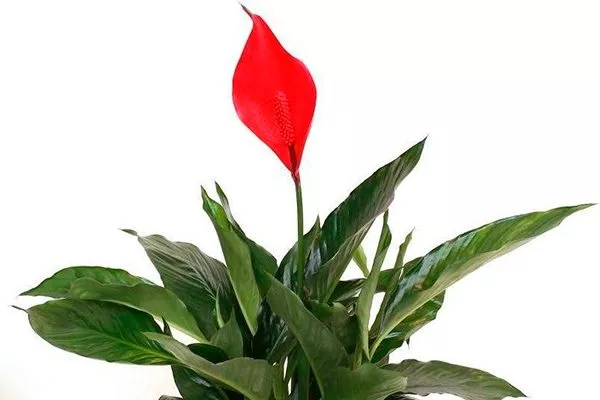
The spathe's red color is due to a dye injected into the flower stalks. Red spathiphyllums are never found in nature; they are usually white, cream, or greenish. Red varieties and hybrids bred through selective breeding also do not exist.
Where does it grow?
Peace lilies grow primarily in the jungles of the Americas. This plant can be found in humid and warm tropics, such as the Philippines, Mexico, Brazil, and New Guinea. They are most commonly found in swampy forests, on seashores, and in river and lake valleys.
Description and flowering
Red peace lily is an evergreen perennial, reaching a height of 40-50 cm or more (depending on the variety). It has dark green, glossy, oblong leaves, often slightly wavy, with a pointed tip.
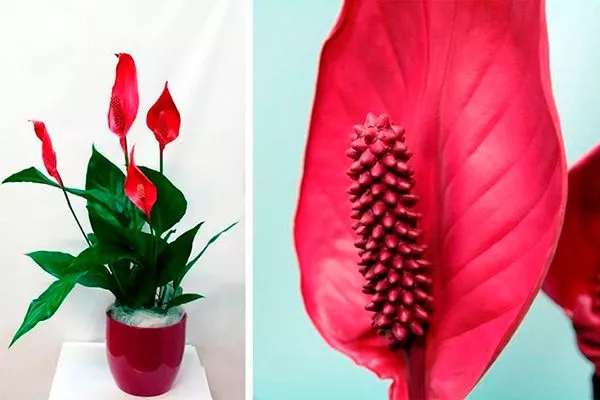
The leaves are gathered in a basal rosette. There is essentially no stem. The leaf petioles are long. The flowers have an elongated, pointed veil that envelops a creamy or pale yellow spadix.
Spathiphyllum can bloom twice per season. The first bloom begins in May and lasts for about a month. The second time, the flower produces flower stalks in the fall or winter.
What flower is it confused with?
In terms of the size, appearance, and structure of its flowers, the spathiphyllum is very similar to the anthurium, popularly known as "male happiness." Unlike the spathiphyllum, anthuriums are not limited in color. Moreover, they don't require dyeing; there are many varieties of anthurium in a wide variety of colors—red, burgundy, yellow, pink, and green.
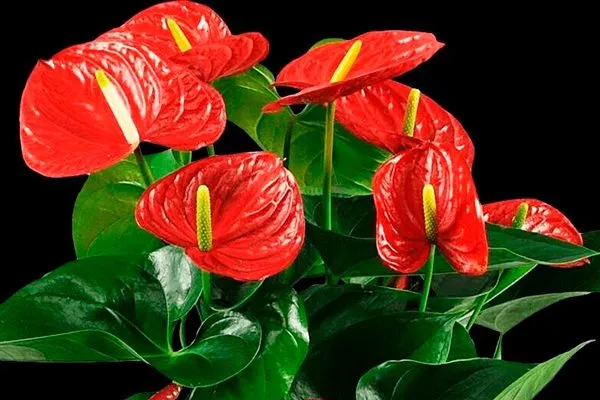
Anthuriums, unlike spathiphyllums, have a more pronounced aroma. It can be light and subtle, or it can be harsh and headache-inducing. Anthuriums have denser and stiffer inflorescences than spathiphyllums.
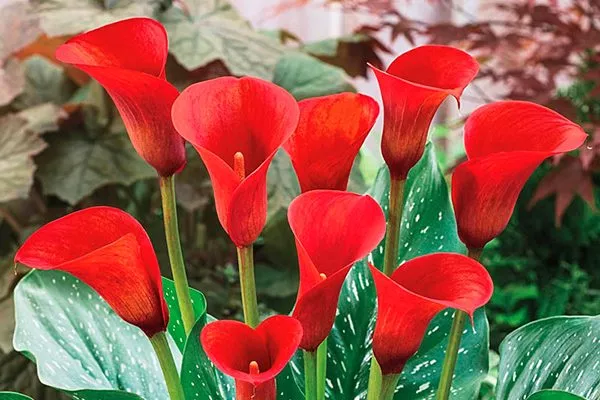
Another flower that can be confused with artificially colored peace lilies is the calla lily. This plant's flowers also have large spathes, which can be not only white or red, but also pink, purple, lilac, and yellow. Only a novice gardener could confuse peace lilies with calla lilies and anthuriums; an experienced gardener can easily distinguish them by the shape of their leaves and flowers.
Is it possible to get a red flower yourself?
In principle, dyeing spathiphyllum at home is possible, but the process is quite complex. Moreover, the technology used in the flower industry is little known; dyeing is performed by specialists.
Those who want to experiment and achieve "feminine happiness" with red flowers can resort to the technology used for dyeing other flowers - roses, chrysanthemums, dahlias.
What you will need for painting:
- a special dye mixture - you can buy it at any flower shop;
- a container filled with water at room temperature;
- a couple of spoons of granulated sugar.
- ✓ The dye must be specifically designed for plants.
- ✓ The dye concentration must comply with the manufacturer’s recommendations.
Any spathiphyllum with white flowers can be used for coloring.
Procedure:
- Dissolve the paint in water.
- Remove the flower from the soil, along with the root ball.
- Separate the plant from the soil as carefully as possible.
- Immerse the roots in a container with dissolved dye for 8 hours.
There's a simpler dyeing method. It's not as effective, but it doesn't require removing the plant from its pot, which is always stressful for the plant. To dye the spathe red, water the plant with water diluted with red dye. The color won't be particularly vibrant, but some noticeable effect will be noticeable.
Does artificial coloring harm flowers?
There's no definitive answer to this question. But one thing is certain: numerous experiments with dyeing different varieties of peace lily have shown no negative effects or impact on the plant's immune system.
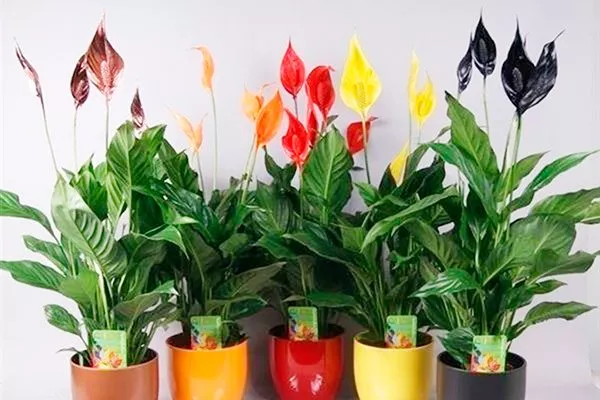
Colored spathiphyllum flowers are just as strong and healthy as their white and cream counterparts. Just be sure not to use enamel, oil, or other paints not intended for coloring flowers.
Growing conditions
Spathiphyllum is unpretentious and does not require owners to create special conditions.
Recommended conditions:
- Temperature. The optimal temperature range is from 18°C to 25°C, with a maximum of 30°C. Lower temperatures can cause the plant to become ill or even die.
- Lighting. Avoid direct sunlight. Place the plant near windows facing east, southeast, or southwest. If there's insufficient light, supplement with grow lights. Avoid shade, as the leaves will become pale and small.
- State of the environment. The flower requires clean, well-ventilated air. Drafts are strictly contraindicated. Humidity should be normal or high; dry air negatively affects the plant's condition and appearance.
- Soil. Red spathiphyllum thrives in loose, slightly acidic soil. Heavy or waterlogged soils are strictly contraindicated.
Flower care
To ensure the plant maintains its attractiveness, thrives, grows, blooms, and develops, it's important to provide it with timely care. Spathiphyllum doesn't require a lot of effort; this flower requires minimal care, mostly limited to watering and fertilizing.
Watering
Spathiphyllum, as befits a tropical plant, prefers moist but not soggy soil. It's recommended to place red spathiphyllum in a special pot with a built-in tray. Fill the tray with water, which soaks into the lower layers of soil and nourishes the roots. This approach helps prevent overwatering, waterlogging, and stagnant water.
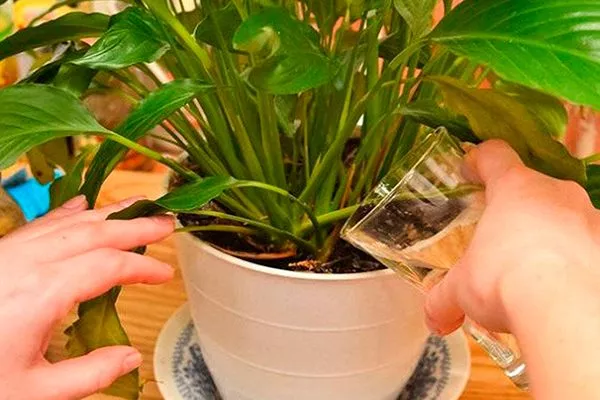
The plant responds well to foliar spraying. A spray bottle can be used for this procedure. Use only settled or filtered water at room temperature for spraying. The plant requires increased watering in summer and during flowering.
Top dressing
Red spathiphyllum is recommended to be fed with mineral fertilizer every 2-3 weeks. Dosage: 1-2 g diluted in 1 liter of water. Mature plants require less frequent feeding. In winter, reduce the frequency of feeding or do not fertilize at all.
Liquid nutrient solutions can also be used for spraying. Preference is given to complex fertilizers with a low nitrogen content. Potassium-phosphorus fertilizers will give flowers a denser and more vibrant bloom. Organic fertilizers, such as diluted bird droppings, can also be used for top dressing.
Trimming
Spathiphyllum doesn't require any additional pruning. Lateral shoots are removed during repotting—this helps maintain large leaves and ensure regular flowering. Dry or diseased leaves should be removed promptly. Faded flower stalks should also be trimmed back to the base to allow room for new buds to form.
Diseases and pests
Proper care of the plant will help prevent disease. In addition to standard care, it is recommended to regularly wipe the leaves with lukewarm water.
Most often, problems with this plant arise from improper care. The plant typically signals these problems by the condition of its leaves. If the leaves turn yellow, it may not be getting enough light; if spots appear, there's a risk of root damage (rot). For prevention, spraying the plant with fungicides is recommended.
Most often, the flower is affected by insect pests:
- aphid;
- scale insect;
- thrips;
- spider mite.
Wiping with a soapy solution will help combat these. For severe infestations, it is recommended to treat the plant with a broad-spectrum insecticide.
When treating the plant with poisons, cover the soil with plastic wrap. After 12 hours, rinse the leaves with a shower. The plant is treated 2-3 times.
Transfer
Young plants are repotted once a year, choosing a pot 1-2 cm wider and taller than the previous one, no more. In pots that are too large, the plant will refuse to bloom. Mature plants can be repotted once every three years.
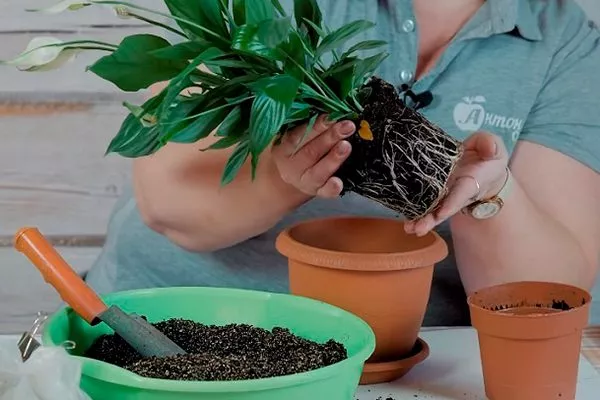
A pot made of any material will do—plastic, ceramic, even asbestos-cement pipes. The soil must be changed when repotting. You can use a ready-made store-bought substrate or a homemade potting mix.
An example of a soil mixture for spathiphyllum:
- turf soil - 1 part;
- leaf soil - 1 part;
- sour peat - 1 part;
- coarse sand - 1 part;
- a handful of crushed charcoal;
- some brick chips;
- 2 or 3 granules of mineral fertilizer;
- broken pine bark.
Place a 2-3 cm layer of drainage material at the bottom of the pot. This ensures air permeability and prevents water stagnation in the pot.
Spathiphyllum is repotted 2-3 weeks after flowering has finished. The easiest and safest method is to transfer it from pot to pot.
Procedure:
- Water the plant beforehand to soften the soil. This will make it easier to remove the plant and soil from the pot.
- Carefully remove the flower.
- Transfer the plant to a new pot filled 2/3 full with potting soil. Cover the roots with soil and compact it lightly.
- Water the transplanted plant generously. Avoid watering for the next 2-3 days, only misting the leaves.
How to propagate?
Spathiphyllum is most often propagated by cuttings and lateral shoots. In greenhouses, seed propagation can also be used; this method is time-consuming and laborious, so it's not popular among indoor gardeners.
How to propagate spathiphyllum by cuttings:
- In spring, separate the formed shoots from the plant.
- Place the cuttings in moistened sand. Cover them with transparent film. Ventilate the mini-greenhouse regularly.
- Plant the rooted cuttings in separate pots.
If the plant is large enough, it can be propagated by division, separating the lateral shoots.
How to propagate spathiphyllum by division:
- Water the flower a day before replanting.
- Remove the plant along with the root ball. Shake the soil off the roots and rinse them with running water if necessary.
- Separate the side shoots from the bush, along with leaves and a section of the rhizome. Trim the roots with a sharp, disinfected tool. Sprinkle all cuts with crushed charcoal.
- Transplant the separated shoots into new pots filled with substrate.
Flower dyeing is a common practice in the floral industry. This is how the vibrant and unusual red spathiphyllum is created, infusing its owners with good spirits and positive emotions.