
Before planting peony seedlings, carefully review the information on how and when to do it correctly. If all requirements and details are followed, the bush will quickly take root and grow, delighting you with lush bushes and abundant blooms. Pay special attention to the planting timing, preparation, and step-by-step instructions.
When to plant peonies in open ground?
Peonies' root systems develop root suckers, which provide the plant with all the necessary nutrients and moisture. However, these absorptive roots only grow twice during the growing season.
In the spring
This is a suitable time for planting peonies, especially in cold climates. This is because the seedlings will have time to fully adapt to their new location and take root during the summer.
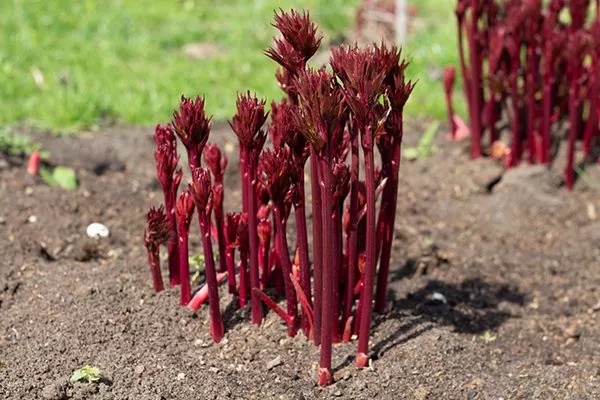
It is in the spring that plants grow green mass, not their root system, so in the south and central parts of Russia it is better to give preference to autumn work.
In summer
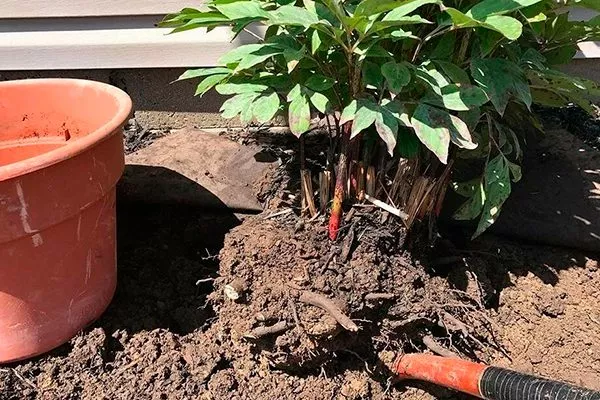
Summer is not the best time to plant peonies, as the seedling's root system will not develop. An exception is August, starting in mid-month. However, this schedule is only suitable for Siberia, the Urals, and other regions with harsh weather conditions. August is too hot for warmer climates.
In the fall
The best period is when the above-ground part will not grow, but the adventitious roots, on the contrary, will begin to develop rapidly.
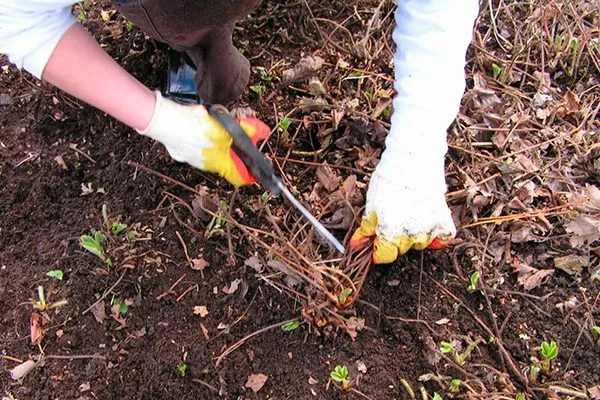
An additional benefit of fall planting is increased humidity due to rainfall. However, keep in mind the key rule: there should be at least 20-25 days before the first frost. Therefore, carefully check the weather forecast.
Rules for planting peonies
Successful planting is based on specific rules for this crop, and if they are not followed, the seedlings will wither rather than develop, and the time of first flowering will shift forward by several years.
What should a seedling be like?
| Name | Root system type | Bush height | Flowering period |
|---|---|---|---|
| Herbaceous | Normal | 100 cm | Spring-summer |
| Arborescent | Tuberous | 200 cm | Summer |
| ITO hybrids | Combined | 50-90 cm | Summer |
First, decide what type of peony you want to plant. Bushes come in the following varieties:
- Herbaceous. The most common peonies, characterized by lush, compact bushes. At the end of the growing season, the aboveground portion dies off. Average height: 100 cm.
- Arborescent. This species is distinguished by thick shoots that are covered with bark. Before winter, the bushes merely shed their leaves, leaving the shoots intact. The height of the bushes is 200 cm.
- ITO hybrids. They were created by crossing tree-like and herbaceous varieties. Therefore, they combine the characteristics of both species—they resemble tree-like varieties in appearance, but lack the above-ground part. Height ranges from 50 to 90 cm.
Regardless of where you purchase a seedling (from a nursery, from friends, or from your own garden), you should give preference only to high-quality planting material.
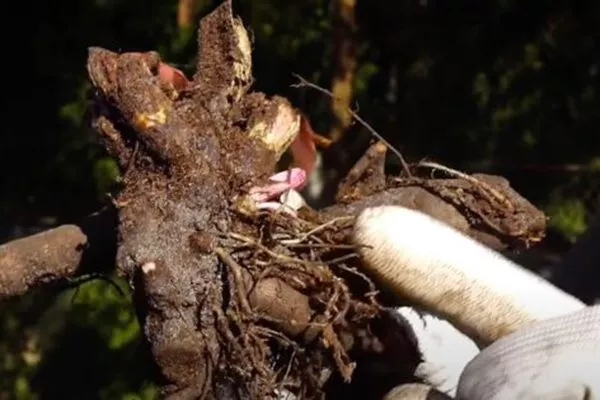
Please note the key indicators:
- the age of the seedling or division (for tuber crops) is 3-4 years, due to which flowering will begin early, but it is also permissible to use younger specimens;
- presence of buds - 4-year-old seedlings should have at least 3 buds, 2-year-old seedlings - 2 buds;
- the buds should not be over-dried or have a dark color;
- the optimal length of root shoots is 17-20 cm;
- What should be absent are unpleasant musty odors, signs of disease, pests, mold, dryness, and mechanical damage.
In other words, both the aboveground and underground parts of the seedling should look healthy and viable.
Preparing the seedling
Before planting, the seedlings are carefully examined - if unsuitable parts of roots or shoots are found, they are cut off with sharp pruning shears, and the cut areas are dusted with crushed wood ash.
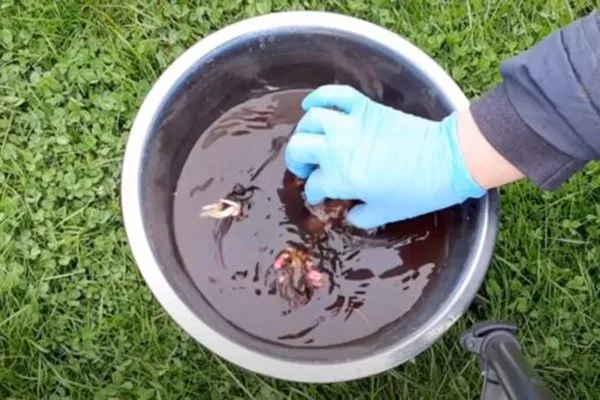
What else is advisable to do:
- If the root shoots are not of uniform length, trim them slightly, shortening any excessively long roots;
- To prevent the development of fungal diseases and to provide additional nutrition, keep the roots in a solution of Fitosporin for 24 hours (5 ml of the preparation is needed per 1 liter of water);
- To ensure rapid root development, soak the underground portion of the plant in any growth stimulant (Epin, Heteroauxin, Kornevin, etc.). Prepare the solution according to the instructions for the specific product.
Choosing a site for planting peonies
Each flowerbed crop requires its own growing conditions, so choose your location carefully.
What is important for all peonies:
- Lighting. Peonies require ample sunlight. If planted in shaded areas, shoots will grow only upward and become too elongated, the flower color will fade, and the buds will become small. Light afternoon shade is acceptable.
- Protection from blowing. Peonies are highly sensitive to drafts, especially cold ones.
- The height of the groundwater level on the site. Peonies absolutely cannot tolerate waterlogged soil, so groundwater should be at least 1.5 meters below the soil surface. Otherwise, the root system will be susceptible to rot and fungal attack.
- Bad predecessors. Do not plant peonies after large perennials, fruit trees, other shrubs, or trees of any species. If you previously planted peonies of a different variety or species in your flowerbed, abandon the idea, as you need to wait at least 2-3 years.
- Optimal distance from tall trees and various buildings. Peonies often grow roots extensively on their sides, so buildings or other plants shouldn't be placed too close. The optimal distance is 2-2.5 meters. Furthermore, tall plants and buildings cast undesirable shade for peonies.
What kind of soil should I plant in?
All peony varieties prefer loose, well-drained soil. Black soil, loam, and sandy loam are considered optimal. The soil should be neutral or slightly alkaline, with a pH of 6.0 to 6.5. Fertility is also essential.
Preparing the soil and planting hole
It's best to prepare the site 2-3 months before planting, but if this isn't possible, do it 1-2 weeks in advance. Remove all debris, leaves, branches, and weeds, then dig the soil over. If planting is still a few months away, add organic matter during the digging process—approximately 7-10 kg of humus, compost, or fresh manure per square meter.
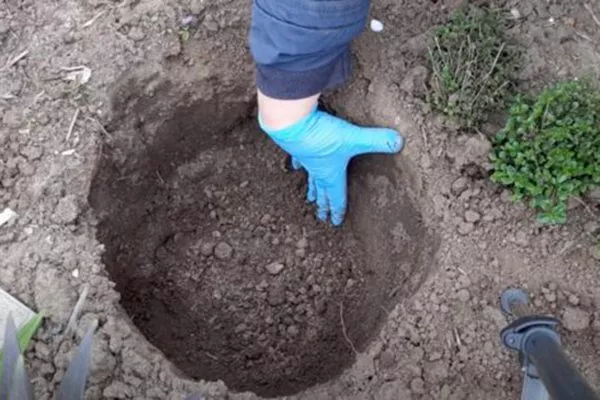
How to prepare the holes and what to add in what quantities – exact dosages:
- Dig planting holes according to the diagram.
- Use garden tools to loosen the soil. It's a good idea to sift it afterwards to ensure it's as loose and oxygenated as possible.
- Prepare a fertile soil mixture. To do this, mix the soil from the hole with equal parts well-rotted manure (fresh manure is prohibited) or 2-year-old compost. Add 2 cups of Double Superphosphate, 1.5 cups of crushed wood ash, and the same amount of dolomite or bone meal to the mixture.
- Mix everything thoroughly and pour it into the hole to 2/3 of its total volume.
- Sprinkle quartz or river sand on top. Use a thin layer – about 3-5 cm.
- ✓ For peonies, the presence of microelements in the soil, such as boron and magnesium, which are not mentioned in the article, is critical.
- ✓ The soil pH level should be tested not only on the surface, but also at the planting depth to avoid unexpected problems with the root system.
Planting patterns can vary depending on the peony species and variety. However, there are some general guidelines:
- depth – from 50 to 70 cm;
- diameter – from 70 to 100 cm;
- the distance between seedlings in one row is from 90 to 200 cm, depending on the expected size of the bush;
- distance between rows – 200 cm.
Planting peonies in open ground step by step
Once the planting holes and seedlings have been prepared, you can begin planting. It's best to do this in calm, cloudy weather or in the evening. Morning is not recommended, as the young plants may be damaged by the sun's rays, and the moisture will evaporate quickly.
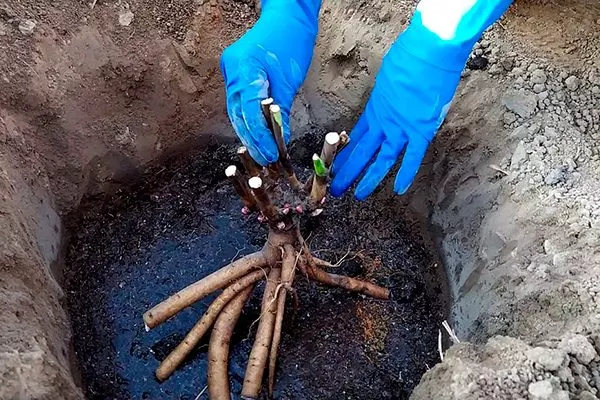
Algorithm of actions:
- Make a mound in the hole from the available substrate.
- Place the seedling on it. If the root system is normal, carefully spread the roots out to the sides. Make sure the root shoots lie as naturally as possible. If the root system is tuberous, simply place the tubers on top.
- Cover with soil mixture. Do this gradually, alternating with light compaction of each layer. If the roots are normal, the buds should be located 5 cm above the surface of the beds; if the roots are tuberous, then 5-6 cm below the ground.
- Form earthen mounds around the bush to prevent water from flowing out when watering.
- Water generously, but make sure the liquid is completely absorbed and not allowed to stagnate.
- Lay down a layer of mulch. Wood shavings, dry compost, and similar materials can be used.
Planting at home
If a seedling is purchased before planting time, for example, as early as October or June, it must be stored properly. Other reasons for planting indoors include diseases that need to be addressed or missing buds that will need to be nurtured first.
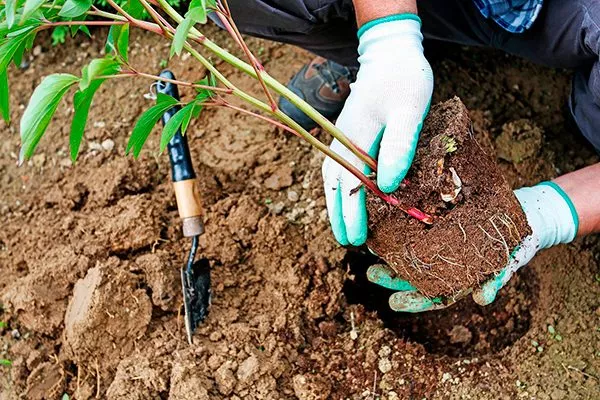
To do this, plant in larger pots. Here's how:
- Select a container. It should have a capacity of at least 5-6 liters.
- Disinfect the pot. If there are no drainage holes in the bottom, make some.
- Fill the container with Universal Substrate or a soil mixture based on deoxidized peat. Fill the pot 1/3 full.
- Plant the seedling in the standard way, filling all the empty spaces with soil.
- Water with warm, settled water.
Place the seedling in a cool room. If necessary, treat it for diseases or apply rooting hormones.
How to care for a peony after planting?
During the first year of planting, peonies require special attention, but the following season, they are cared for as usual. Growing seedlings in open ground involves the following steps:
- Watering. When planting peonies in spring, water the bushes daily for three days. After that, moisten the soil every five to seven days. In hot summer weather, water every three days. Make a groove about 6 cm deep around the trunk.
When planting in the fall, water peonies every other day for the first week, then once every 10 days, but no more than a month. Exactly 30-35 days after planting, stop all watering. If it rains, avoid watering completely. - Loosening. This procedure is necessary for air exchange—the supplied oxygen accelerates root development. Loosen the soil after each soil moistening. Within 20 cm of the trunk, garden tools should be inserted a maximum of 7 cm deep, and beyond that, 15 cm. While loosening, remove weeds.
- Mulching. This is done after watering and loosening the soil. This procedure will provide the seedling's root system with additional nutrition and prevent moisture from evaporating from the soil. Sawdust, dry grass, compost, humus, and similar materials are best. The layer should be about 5 cm thick.
- Top dressing. This procedure isn't performed within two years of planting, provided all recommended components have been applied. However, there are exceptions: if the plant begins to wilt, isn't establishing well, etc., additional mineral supplements can be added.
- Trimming. If planting was done in the spring, the shoots should be pruned in the fall. When pruning in the fall, branches are removed in the spring, which stimulates growth above ground. All stems are shortened in the fall.
- Pre-winter preparation. Regardless of the planting season, seedlings need to be insulated, as they are not yet fully formed. To do this, the trunks are earthed up to half their height after pruning. A 10-cm layer of mulch is applied on top. The bush should be covered with any non-woven material.
Planting peonies isn't considered a labor-intensive or complicated process—all the steps are standard for flower crops. It's important to follow the rules specific to peonies—when planting, consider the species and varietal characteristics—the success of the work depends on this.