
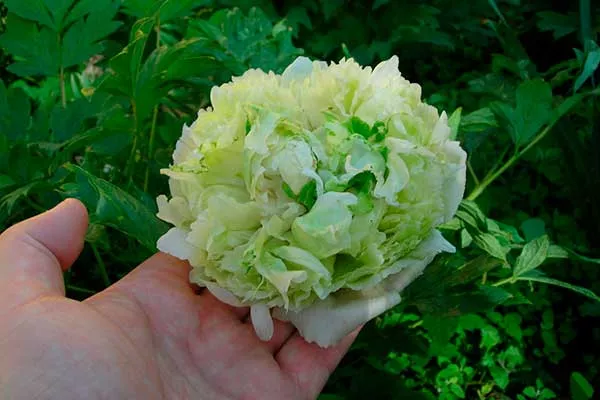
Green Beans (Dou IV) is the name of an unusual tree peony variety, whose signature feature is its lush buds with delicate, salad-colored petals. Domestic gardeners enjoy growing it in their gardens, praising it for its ornamental qualities, good cold tolerance, and suitability for cut flowers and bouquets.
Where are you from?
The tree peony is widespread in Eastern countries, where local breeders are constantly developing new varieties. Its homeland is considered to be China. The plant has been known to the Japanese since the Tang Dynasty. It arrived in Europe in the second half of the 18th century.
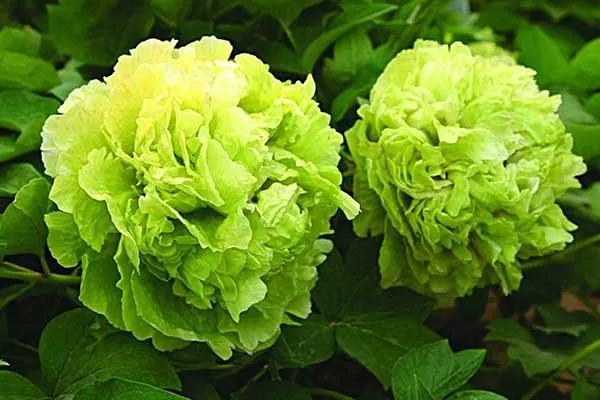
Green Beans are a product of Chinese breeding, a hybrid of origin. Information about their creators is unknown.
Uses in landscape design
This variety is versatile in its purpose. Florists grow it for the following purposes:
- design of flower beds, borders, rockeries, alpine gardens, mixborders;
- cutting, making bouquets (flower lifespan is at least 1 week).
The variety's primary use is in landscape design. It's suitable for both single and group plantings. Its bushes with pale green, lush flowers add a special charm to the garden.
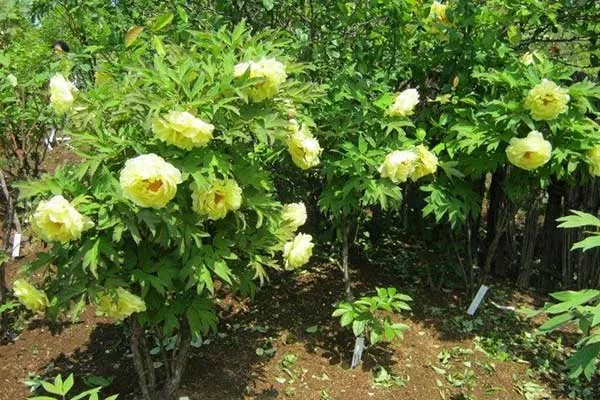
Peonies blend well with the strict lines of a laconic flowerbed, and fit harmoniously into a pompous composition.
This ornamental plant is widely used in group arrangements. Florists effectively combine it with the following plants:
- peonies of other varieties with brighter colors;
- with bushes that have colored foliage (for example, bladder senna);
- variegated weigela;
- spirea;
- coniferous species;
- with low-growing flowers as a background;
- with a large-leaved blue hydrangea as a foreground for it.
The tree peony, with its pale green buds reminiscent of voluminous pom-poms, looks most attractive in gardens designed in a Japanese style.
Botanical description
The Green Bean bush is spreading but not very tall, reaching no more than 0.9 m. It is characterized by dense foliage, elongated leaves, and glossy, dark green color.
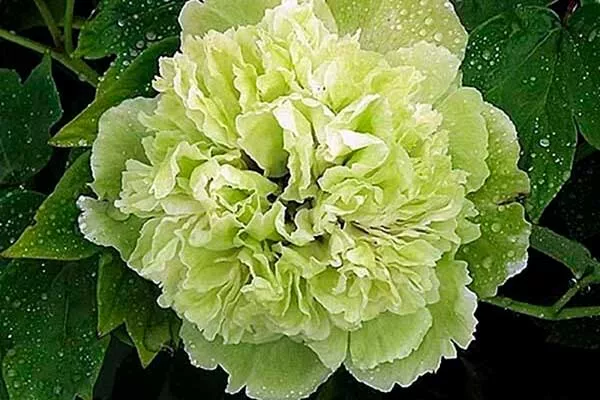
The plant requires no support. Its stems are strong: they don't bend under the weight of the buds or break. It retains its decorative appearance all summer long.
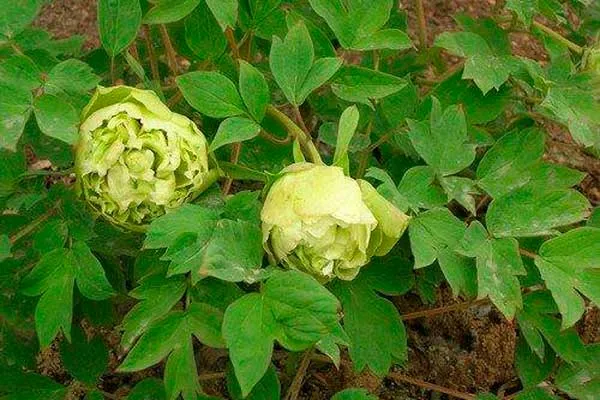
The flowers are characterized by a discreet beauty, double or semi-double, and a light aroma (not intrusive, slightly sweet, pleasant).
The description of their appearance includes the following indicators:
- diameter - 17 cm;
- crown-shaped form, which over time transforms into a spherical one;
- slightly corrugated petals;
- their coloring is of low saturation, white and green;
- contrasting center.
Features of flowering
Green Beans are a late-blooming variety. Their bushes delight gardeners with their blooms in June. The blooms last for two weeks until the end of the month. They are considered quite profuse.
One plant produces 30 to 70 buds. It reaches full vigor at 4-5 years of age (young seedlings bloom sparsely or produce no buds).
Frost resistance
This variety has good cold tolerance. It is recommended for growing in USDA Zone 4. With proper insulation, the bushes can withstand temperatures as low as -29°C.
They thrive best in the southern regions. In the central regions and the Moscow region, they require winter shelter.
Landing rules
Plant this tree-like variety in your garden in spring or late summer. Follow the instructions and advice from experienced gardeners to ensure the seedling takes root successfully, grows, and delights you with its luxurious blooms in due time.
How to store Green Bean Peony when purchasing?
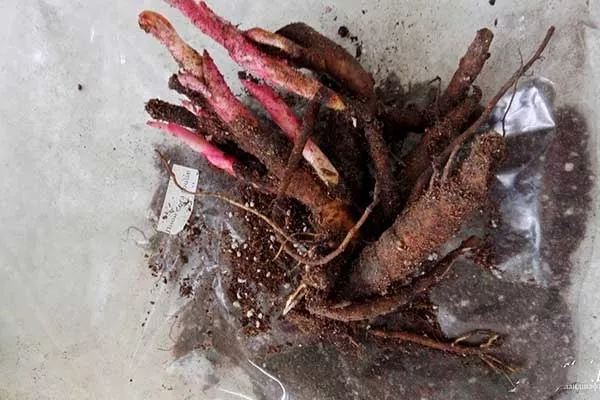
If you purchased green bean seedlings in advance, you'll need to store them properly before planting. Follow these guidelines:
- If the plant has dormant buds, place it in a bag with wet moss and leave it in the refrigerator or keep it in a box with soil in the cellar (recommended temperature range is from 0°C to +4°C);
- If the peony you bought has already started to grow buds, plant it in a pot or a greenhouse (temperature +15-17 °C).
Selecting and preparing a seedling
When purchasing a Green Bean tree peony from a nursery, choose a specimen with the following characteristics:
- strong;
- healthy (without signs of spoilage and without damage);
- with live kidneys;
- with woody shoots up to 25 cm high;
- with developed roots.
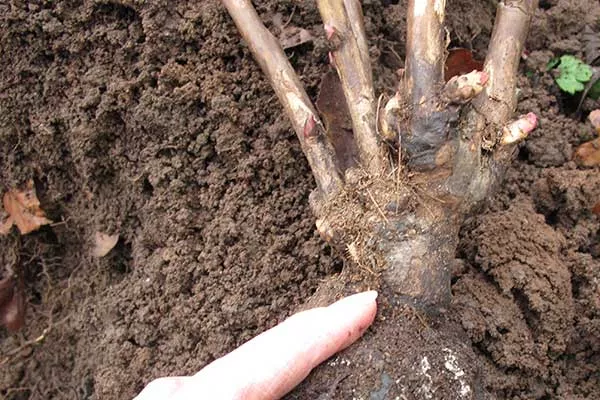
If you purchased a seedling in advance and stored it in a cellar or refrigerator, inspect its condition before planting. If any rotten areas appear on the roots, take action: carefully remove the damaged parts and treat the cuts with Topaz or Fitosporin.
How to choose and prepare a planting site?
This tree-like variety grows in the same place for two decades without losing its decorative qualities. It does not transplant easily, so it is best planted immediately in a flowerbed, where it will remain for the rest of its life.
Choose your site for growing your Green Bean peony carefully. It must meet the following requirements:
- be well-lit by the sun (do not allocate areas for flower beds located on the north side of the building);
- windless, protected from drafts;
- without close groundwater table;
- where rainwater does not drip from the roof onto the flowerbed;
- located far from fruit trees and shrubs that would compete with the peony for water and nutrition;
- with any soil except peat (the crop grows best on well-drained loams, loose and fertile, with an acidity index from 6 to 6.5).
- ✓ The optimal soil acidity for tree peony should be within 6-6.5, which is not mentioned in the article.
- ✓ It is necessary to use a drainage layer of at least 30 cm to prevent water stagnation, which is critical for the health of the root system.
Prepare the planting site in advance, at least a few weeks before the scheduled date. Dig a cone-shaped hole (its diameter should be twice the base). Measure it: 60 cm deep and 80 cm in diameter.
Fill the hole for the tree peony layer by layer:
- first lay out the drainage: broken brick, gravel, coarse sand (layer thickness - 30 cm);
- Spread granulated mineral fertilizers with prolonged action on top of it (it is permissible to add organic matter as well);
- Form the top layer from light, air- and water-permeable soil mixed with dolomite flour or ash (add additives if the soil in the area is acidic).
When to transfer plants to open ground?
Experienced gardeners plant the Green Bean peony in a flowerbed in the second half of August or early September. This can also be done in the spring (April-May).
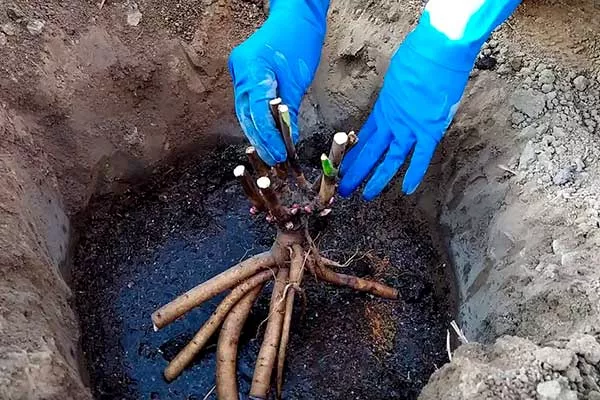
Tree peony planting algorithm
Perform the manipulation step by step:
- Place the seedling in the central part of the hole.
- Straighten out its roots.
- Cover them with soil, making sure the root collar doesn't end up below ground level.
- Water the plant.
- Add more soil if necessary.
- Mulch the planting.
How to care for it properly?
Caring for the Green Bean peony is not difficult, although this plant is not exactly low-maintenance. It delights gardeners with its healthy appearance and lush blooms only if proper care is followed.
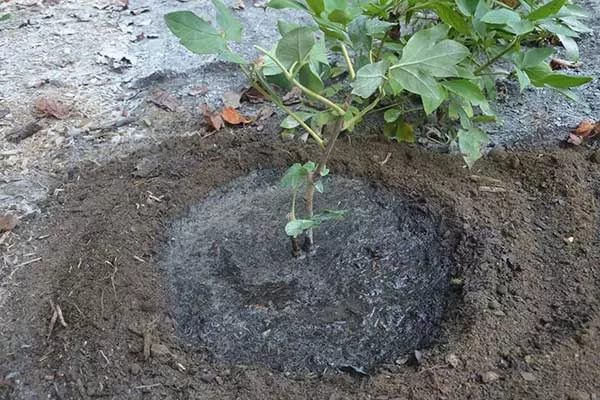
Watering and fertilizing
Water the flowerbed with the tree-like flower, following the rules:
- perform the procedure on average 2 times a month;
- Water the peony bush more generously when flower buds are forming on it, and water it moderately the rest of the time;
- use 7-8 liters of settled water per 1 plant;
- the soil moisture in the tree trunk circle should be deep;
- pour water into a groove made around the bush at a distance of 15 cm from the trunk;
- in hot weather, water the ornamental plant more often;
- In August, irrigation should be sparse and will need to be gradually stopped;
- 2 days after watering, loosen the soil under the flower bush to a depth of 5 cm, and then mulch with humus;
- At the same time as loosening, remove weeds in the area around the tree trunk.
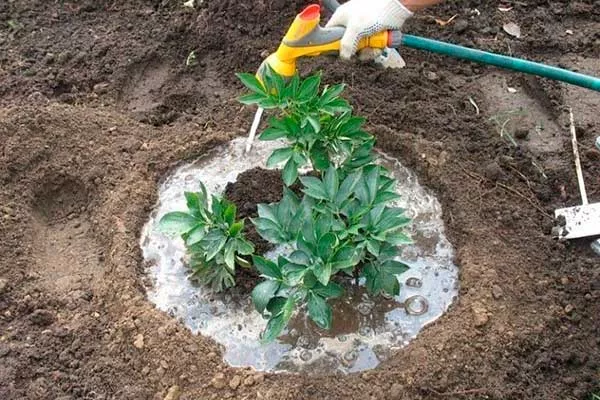
During the first three years, tree peonies don't require fertilizer. The nutrients added to the planting hole are sufficient. If desired, you can use foliar feeding during this time. Afterward, use organic matter to replenish nutrients:
- bone meal;
- wood ash.
Apply loose fertilizers rich in potassium and phosphorus to the area around the trunk. Work them into the soil. Two applications per season are sufficient: before the bush blooms and after the buds fade. The plant also responds well to fertilization with humus. Use it as mulch.
Pruning and shaping
To properly shape your green bean bush, maintain its decorative appearance, and prolong its life, perform rejuvenating pruning every spring. Follow these rules:
- start performing the manipulation as soon as the buds awaken;
- cut healthy branches to the first living bud;
- shorten weak shoots to a height of 10-15 cm.
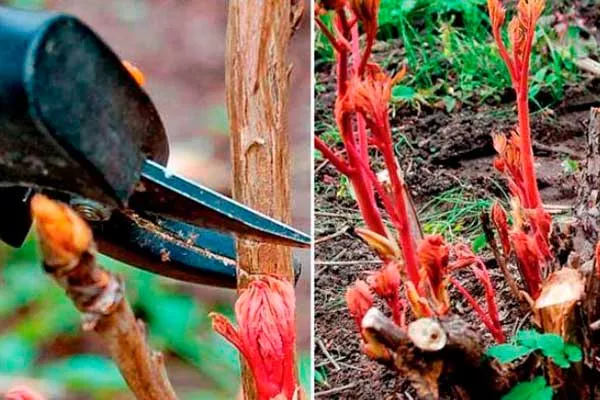
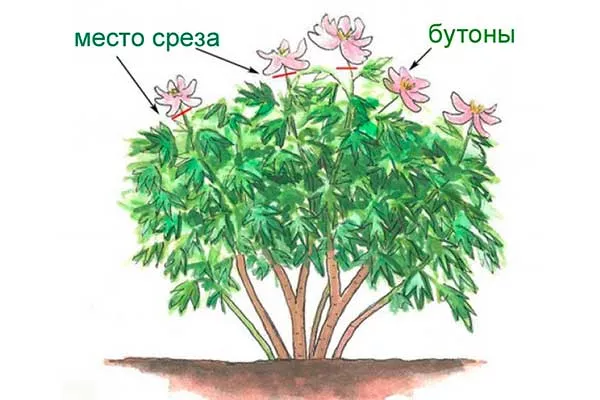
In the fall, a light pruning is recommended for the tree-like variety, performed before sheltering the bush for the winter. When doing this, remove the following plant parts:
- faded buds, which take away energy from the flower (thanks to pruning, it will direct it to the formation of new buds);
- weak thin stems, as well as intersecting ones (cutting them out will make it easier to build a shelter and reduce the likelihood of diseases during the winter).
If desired, you can shape the peony's crown by removing excess shoots and shortening overly long ones. Be careful not to over-pruning. Be careful not to damage next year's flower buds.
What to do after flowering?
In addition to removing wilted and dried buds, the spent bush will need to be fertilized with compost. There's no need to remove the foliage. Preserving it will encourage the formation of flower buds for the following season.
Transfer
Unlike other garden peonies, tree peonies don't need to be relocated once they reach maturity. They don't like being disturbed. Repotting can be very stressful for them. After this procedure, negative consequences for the Green Bean bush are possible:
- deterioration of appearance up to loss of decorative value:
- decreased immunity and infection (the plant may be sick for several years after transplantation).
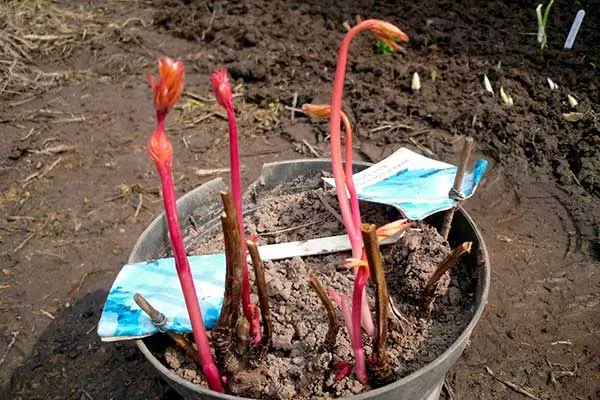
Use this method only when absolutely necessary (for example, if you want to propagate a bush by dividing the rhizome). Plant the resulting divisions in a new location in the flowerbed, following the planting instructions described above.
Protection from diseases and pests
The hybrid Green Beans variety has good resistance to infections and pests. With proper care, the plant is disease- and pest-free.
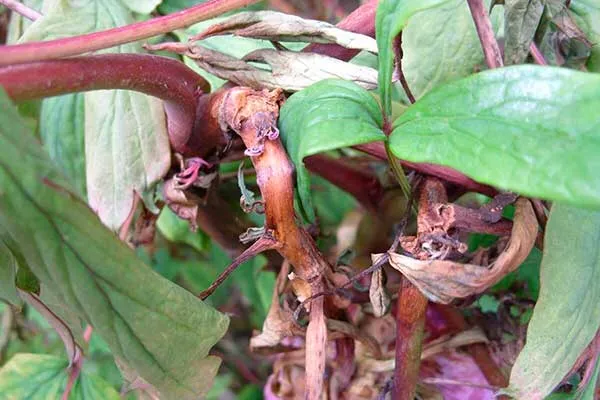
In unfavorable weather conditions and poor agricultural practices, tree peony bushes become susceptible to the following diseases:
- Gray rotThe diseased plant dries up, and the leaves curl. Use Hom for treatment.
- Brown spotThe foliage of an infected bush gradually turns red and wilts. To prevent disease, use nitrogen fertilizers sparingly and avoid dense plantings.
Among the insects that most aggressively attack garden crops, gardeners highlight:
- CaterpillarsThe parasite eats the green parts of the bush. To combat it, use Aktara.
- MuravyovThese insects don't cause much damage to peony plants, but they do carry aphids. You can get rid of their colonies using boric acid powder mixed with a sweet bait.
- AphidsThe parasite feeds on the peony's sap, causing damage. If the pest is found in small numbers, remove it by hand. If an infestation occurs, the plant will need to be treated with Iskra-M.
Reproduction
You can obtain planting material for your flowerbed by propagating hybrid bushes growing in your garden. You can do this in one of the following ways:
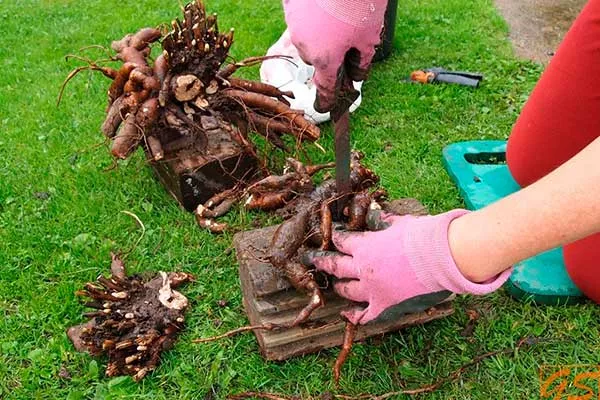
- By dividing the rhizomeAt the end of August, dig up a bush older than 5 years and divide it into sections. Each section should have several buds and developed roots. Place the bottoms of the sections in a clay solution and leave them there for half an hour.
Then plant them in a flower bed. Continue caring for the young plants the same way you would for mature ones.

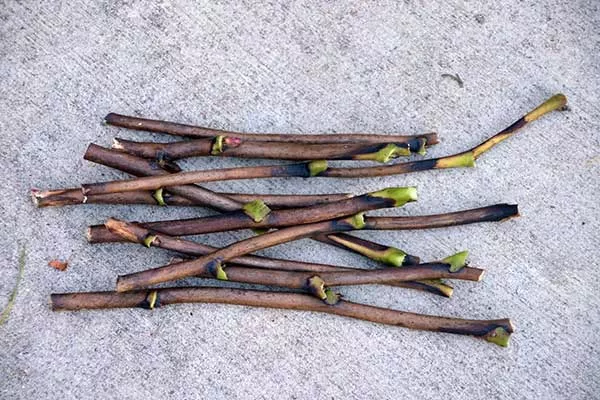
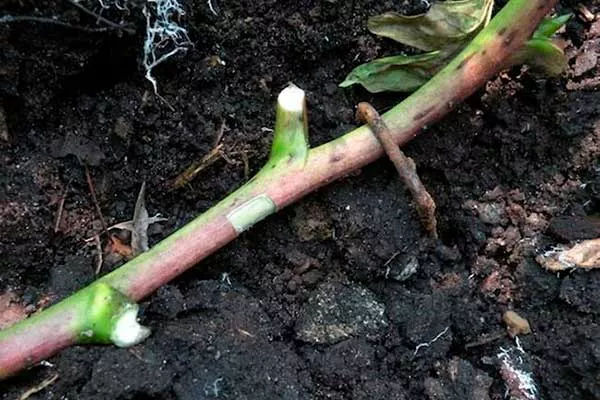
- By cuttingsIn midsummer, select a healthy bush. Cut semi-woody shoots with one bud and leaf. Before planting, trim the leaf on the cutting by half. Then root the shoot in a mixture of soil, peat, and sand. Plant the cutting 2 cm deep. Cover it with plastic wrap.
Regularly ventilate the seedling and moisten the soil beneath it. After 2.5 days, transplant it into a greenhouse. Leave it there until spring. Once the peony begins to grow, move it to a flowerbed.
- LayeringThis is a labor-intensive and time-consuming process that will take at least two years. In late spring, select healthy, strong shoots from the plant. Make a cut in each of them. Treat the cut with a plant growth stimulant. Dig in the cuttings, covering the cut with a 10 cm layer of soil.
Care for them and water them frequently. After the shoots have rooted, separate them from the mother plant in early fall and plant them separately in a permanent location.
Covering the peony for the winter
The tree peony "Green Beans" is fairly cold-hardy. However, in most regions of Russia, particularly in the central regions and the Moscow region, it requires winter protection.
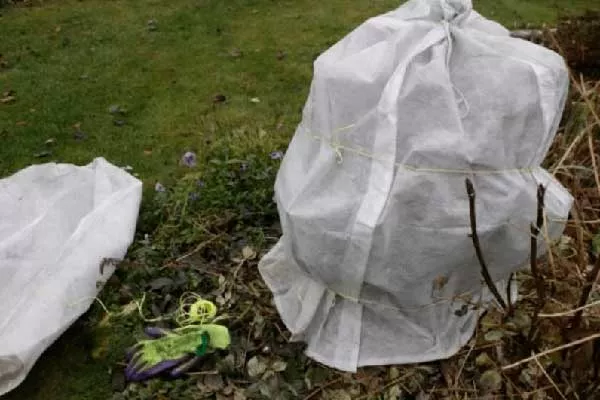
At temperatures of -35°C, the bushes freeze to the ground. However, there remains a chance that adventitious buds at the base of the stem will produce new shoots the following season.
- Start reducing watering in August to allow the plant to begin preparing for the dormant period.
- At the end of September, mulch the tree trunk circle with a layer of at least 10 cm to protect the roots from frost.
- Before the onset of persistent frost, wrap the bush with non-woven material for additional protection.
Cover the plant for the winter by following these steps:
- generously mulch the soil around the tree trunk with chopped bark and leaves;
- wrap the shoots with non-woven material;
- cover the plant with spruce branches or a jute bag;
- Cover it generously with snow.
Positive and negative qualities
Among the undeniable advantages of the hybrid variety, gardeners highlight:
Reviews
Green beans are a tree-like variety of the plant, developed in China. They are characterized by the incredibly beautiful color of their buds. Due to their ornamental qualities, they are widely used in flowerbeds and landscape design.