
The Sorbet peony, or Sherbet as it's commonly known, is a double-flowered variety characterized by its ease of cultivation, unusual coloration, and high decorative value. If all cultivation practices are followed, pests and diseases are avoided.
Who developed the variety and when?
Dutch breeders developed the variety, resulting in the highly frost-resistant Sorbet in 1987. Herbaceous and tree peonies were used for the cross, but information about the specific varieties is lacking. Luc Klinkhammer is considered the originator.
Description of the milky-flowered peony Sorbet
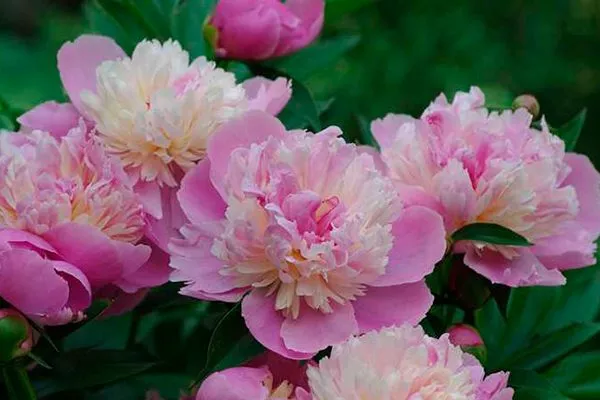
Sherbet is a beautifully blooming peony whose name evokes the famous oriental dessert. It is prized not only by gardeners but also by landscape designers and florists, because its decorative and striking appearance persists even after the blooming season.
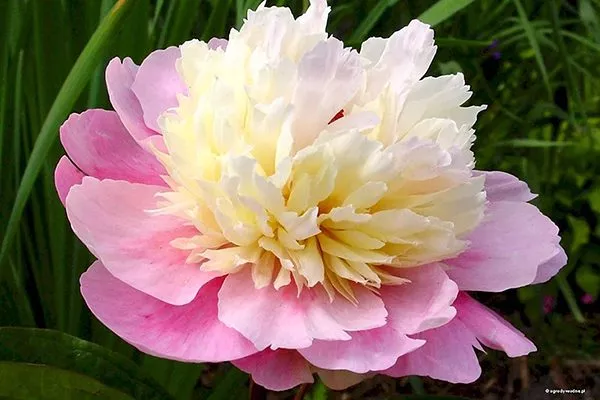
Size and shape
The variety's distinctive coloring and bud structure—it's considered three-layered—make it a unique combination of three shades: milky white, cream, and delicate pink. Other distinctive features include:
- size – large, diameter varies from 16 to 20 cm;
- petals are large and slightly concave;
- color intensity – saturated;
- pistil and stamens are always yellow;
- Features of the petals: in the central part of the bud and at the edges they are large and rounded, and in the middle they are smaller and pointed and thin;
- petal structure type – fringed and delicate;
- flower shape – cup-shaped;
- aroma – attractive, strong;
- fruits are star-shaped;
- seeds – black, oval, glossy.
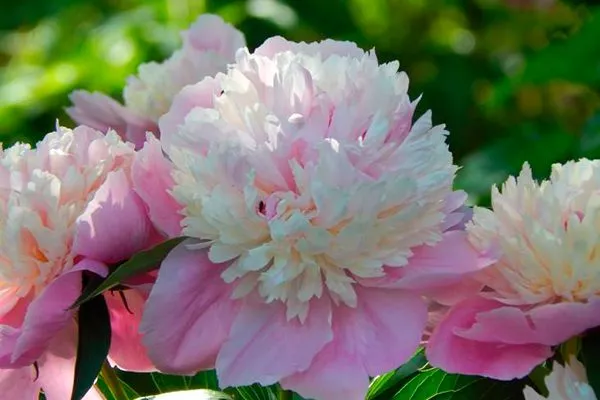
Root system
The Sorbet peony has a very powerful and dense root system, which extends to a depth of 5 meters. This prevents planting in areas with high groundwater levels—at least 6 meters above the ground is required.
Leaves, stems
The bush is characterized by its spreading form, varying in width from 80 to 90 cm. The stems reach similar heights. Other external characteristics of the bush:
- branching - dense;
- leaves – pointed-dissected, lacy, large, 10 to 15 cm long;
- the color of the above-ground part is dark green, but in autumn it acquires crimson shades;
- shoots are erect and have a rigid structure.
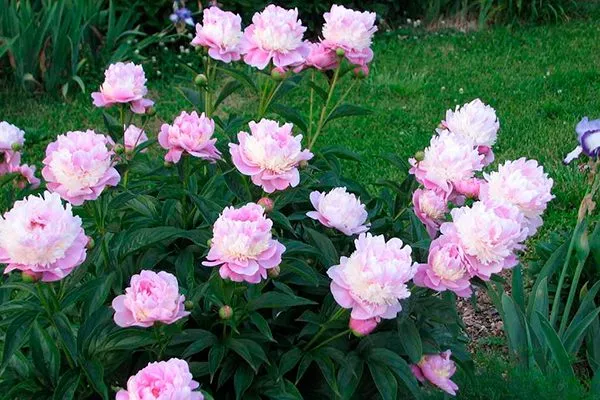
Most often, gardeners don't use supports, but if the blooms are very lush and the buds reach their maximum size, the sturdy stems may droop downwards. It's best to create a ring structure in advance.
Flower characteristics
Sorbet is a eukaryote of the class Dicotyledonous and the order Saxifragales. Note the key characteristics:
- frost resistance is high, since shoots and roots do not freeze at temperatures of -40 degrees;
- growing regions - absolutely everything, from south to north;
- The bushes can grow in one place for 20 years, but their decorative value declines over such a long period. Experts recommend replanting the bushes every 6-8 years.
- drought resistance is good, the bush will not die without watering, but flowering will be sparse;
- cutting – flowers last 15-20 days in a vase with water;
- The soil requirements are high, it must be as fertile as possible;
- Resistance to pests and diseases is average, so preventative treatments are necessary.
Features of flowering
Sorbet begins blooming in early June, and the blooming period lasts for 15 days. During this time, the petals emit a strong scent that spreads for several meters. The buds are strong and firmly held on the stems, ensuring they never droop, always pointing upward, as if reaching for the sun.
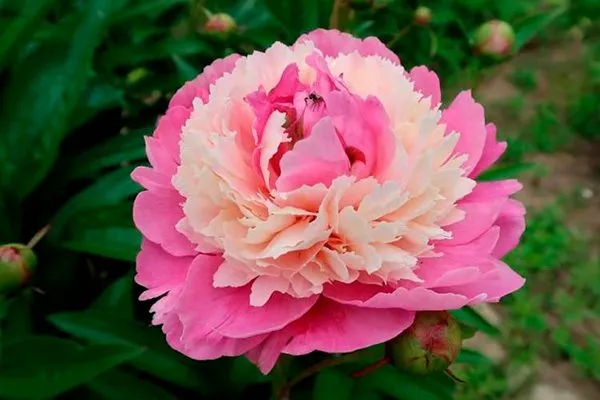
Application in design
Landscape designers love this variety because it impresses with its unique coloring, which pairs flawlessly with other plants. It looks especially striking with honeysuckle, daylily, salvia, asters, carnations, phlox, barberries, and other plants with lush foliage.
Three-layer peonies are used as:
- background in a long flower bed;
- element in a multi-tiered flower garden;
- central accent in a round flowerbed;
- hedges for zoning space;
- framing walls, fences, gazebos, benches, etc.
Methods of reproduction
Sorbet, being a cultivar and not a hybrid, can be propagated by any method, and even with seed, future plants will retain the maternal characteristics. Brief information:
- Seeds. They are planted in late February and grown indoors until autumn. In the spring, they are transplanted to a temporary spot in the flowerbed, and the following year they are moved to a permanent location. The process is long and arduous, but you can get up to a hundred seedlings at once.
- Stem cuttings. They are cut in the fall and planted in a permanent location in the spring. Expect flowering within a year.
- By dividing the rhizome. The bush should be at least 3 years old. It's important that the bushes bloom in the spring if propagated in the fall.
| Reproduction method | Time to first flowering | Percentage of successful rooting |
|---|---|---|
| Seeds | 3-4 years | 60-70% |
| Stem cuttings | 1-2 years | 80-90% |
| By dividing the rhizome | 1 year | 95-100% |
Landing rules
Like all peonies, planting follows the standard procedure. However, keep in mind the varietal characteristics:
- Due to its powerful and very deep root system, repotting is rarely necessary, so choose the right location immediately. This variety prefers sunny areas. Partial shade is possible for only a few hours a day.
- The optimal time is autumn, but a couple of months before frost. In harsh climates, planting can even take place in late or mid-August.
- The planting hole size is 50x50 cm. The distance between plantings is at least 2-2.5 m.
- The top bud should be located 5 cm below the ground.
- ✓ Soil pH should be between 6.5-7.5 for optimal growth.
- ✓ The soil must be well drained to avoid water stagnation at the roots.
Aftercare
As with planting, consider some varietal nuances:
- Watering the bushes. This variety does not tolerate frequent watering; water should be added no more than once every 7-10 days. One bush requires 30 liters.
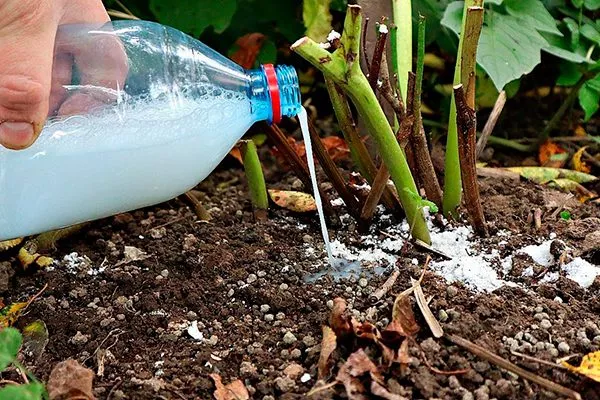
- Top dressing. Sorbet can thrive without fertilizer, but nutrients prolong the flowering period and improve the lushness of the buds. Diagram:
- At the beginning of shoot formation (early spring), add ammonium sulfate or urea:
- during budding, nitrophoska or superphosphate is required (can be replaced with a mixture of phosphorus and potassium);
- during the period of active flowering, use any mineral complex;
- In the fall, immediately after flowering, only potassium and a little phosphorus are used, due to which spring flowering will begin earlier.

Preparing for winter
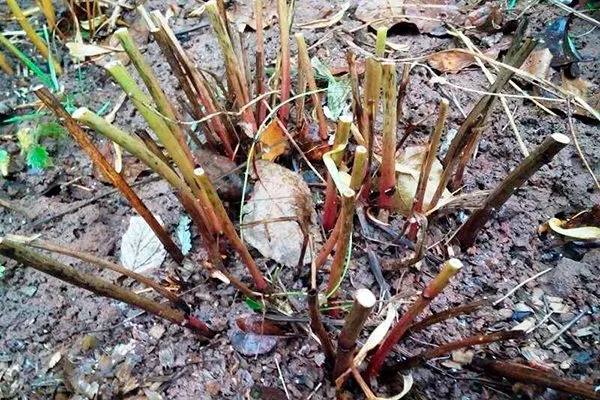
Preparatory work should begin immediately after the flowering period ends. To do this, gradually reduce the frequency of watering, using less water at a time. After this, trim off all faded blooms and, 2-3 weeks before the expected frost, do the following:
- Apply fertilizer.
- After a week, loosen the soil and lay down a mulch layer of 10-20 cm, depending on the climate.
- Shorten all shoots so that the height of the cuttings is 3-4 cm from the ground surface.
Pests and diseases
Sorbet isn't particularly resistant to diseases and pests, but it's not susceptible to all diseases. The most common ones are:
- Powdery mildew. Symptoms include a light, powdery coating on the leaves. The disease can be treated with Bordeaux mixture or other fungicides.
- Gray rot. It manifests itself as black spots on the above-ground portion of the plant, after which the stem becomes waterlogged and dies. Use copper sulfate for treatment.
- Rust. Rusty, then brownish, spots appear on the leaves. Fundazol is used.
Septoria leaf spot, root rot, and cladosporiosis are extremely rare. Targeted medications are used for treatment.
Pests that can be a problem include rose chafers, aphids, ants, and nematodes. These should be controlled with insecticides. To avoid problems, carry out preventative treatments three times per season, starting in early fall. Be sure to follow all agricultural guidelines, especially regarding humidity levels.
Reviews of Peony Sorbet
The Sorbet peony is an easy-to-grow and undemanding variety, but it does require a high water table due to its extensive root system. This same factor makes it difficult to transplant mature bushes. However, in summer, the plant offers its grower an unforgettable experience of beauty and an intense fragrance that permeates the entire garden.