
The Solange peony is an old cultivar, not a hybrid. It belongs to the milky, large-flowered herbaceous variety, characterized by late flowering. It prefers full sun and has a compact habit, but the buds may fall apart when opening. It is easy to care for.
History of creation
Solange is a product of French breeding, introduced to the world in 1907. The primary goal of its development was to make it suitable for growing in harsh climates. Development was carried out by the Lemonie agricultural company.
Until 1931, the originators continued to work on improving the peony, as a result of which the flower was awarded a prize at the International Competition in America that year.
Description of the peony Solange
It is characterized by increased frost resistance and belongs to Zone 3, as it can withstand temperatures down to -35-40°C. This allows it to be grown even in the harsh Russian climate.
Appearance indicators:
- Bush. The height of the bush varies from 70 to 90 cm, the shoots are erect, medium-thin with medium spreading, light green hue and a small number of buds, about 10 stems are formed on one bush.
- Leaf blades. They are dark green, pinnate (tripartitely dissected), up to 5 cm long, and densely foliated. The leaves have a glossy surface, an oval-elongated shape with a pointed tip, and a slightly reddish vein.
- Root system. It is distinguished by its massive, spindle-shaped form. It is covered with a brownish-brown crust. It produces buds that send out offsets.
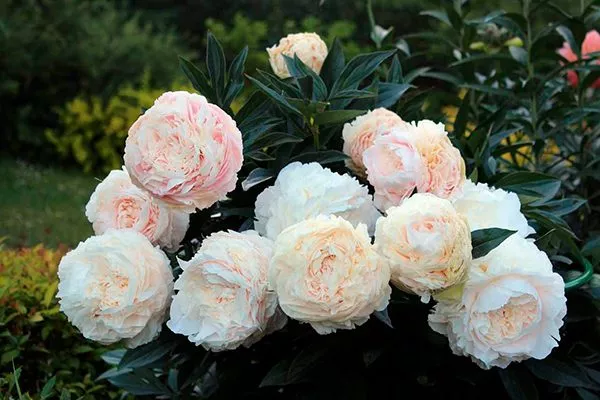
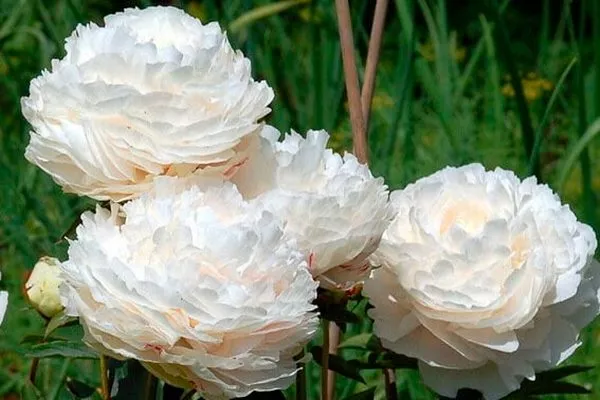
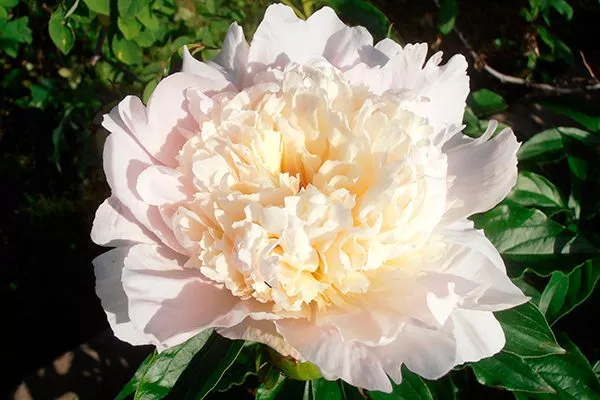
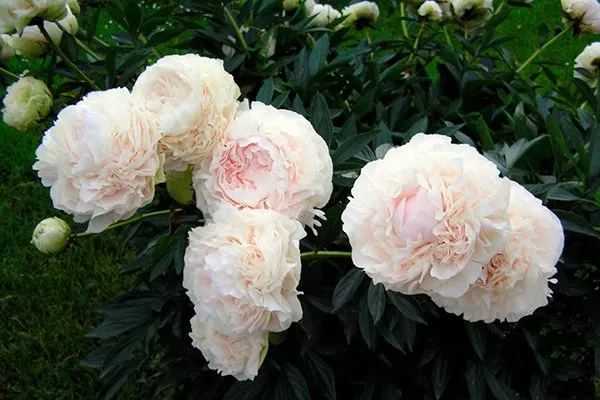
- Flowers. They are characterized by a spherical shape with a huge number of petals—about 75-80. They are closely packed together, giving the buds a lush appearance. The shade is extraordinary—a combination of light cream and a delicate pink hue.
In different lighting, white and even salmon-colored flecks appear. The diameter at bloom is 17-19 cm. The fragrance is pleasant and delicate.
Solange can grow in one place without replanting for about 15-20 years. The variety has good resistance to all diseases and pests, so problems only arise under adverse conditions. It easily tolerates heat and heavy rains.
Timing and characteristics of flowering
Solange is a late bloomer, so budding begins in late June or early July. The buds open slowly, so the blooming period is prolonged, but a single flower remains open for about a week to a decade. If the fruit is not cut after wilting, the planting material can be harvested in the fall.
The first bloom occurs in the second year after planting. To encourage more profuse flowering, be sure to fertilize the bushes throughout the growing season and in the fall, increase watering during budding, and protect them from harsh, cold winds.
Use cases
Thanks to the lushness of its buds and shrub, the peony can brighten up even the most unsightly area, making it a popular choice among landscape designers. Applications:
- in the central part of the lawn;
- like a tapeworm;
- in a mixborder in the background;
- near dwarf conifers;
- near plants with crimson leaves;
- as a corner element on garden paths;
- near the entrance to the house;
- as a high border and a small hedge;
- for framing ponds;
- near the benches and behind them.
This peony pairs beautifully with all roses, clematis, delphiniums, lilies, irises, and daylilies. It can also be planted among petunias, daffodils, lobelias, and other annuals.
Florists prefer to create voluminous bouquets for any occasion. Many grow this variety in containers. In this case, the container should be 20-25 liters in volume, and the number of stems should not exceed six.
Advantages and disadvantages of the variety
Solange combines both positive and negative aspects. Among her strengths, the following stand out:
There are fewer disadvantages:
Landing rules
Solange differs from other honeycombs in that planting is done only in the fall, starting in late August and ending 1.5 months before the first frost. The planting principle is classic, but there are a few nuances:
- the area should be illuminated by the sun for most of the day;
- when planting near buildings and fences, leave a distance of 100 cm;
- the reaction in the soil should be slightly acidic;
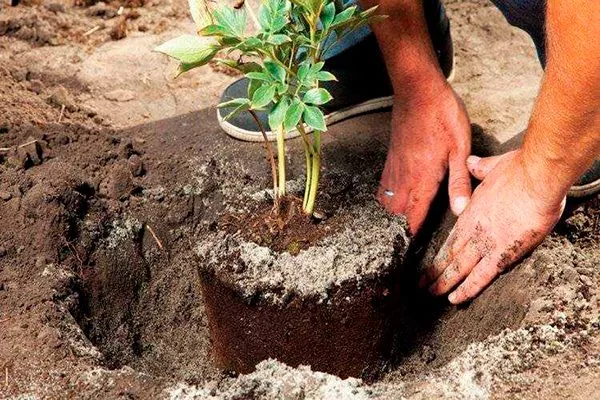
- the depth of the planting hole is 50 cm, the distance between bushes is 100 cm;
- the hole should be filled with a fertile mixture - equal parts soil and humus, 500 g of wood ash, 70 g of superphosphate;
- The buds should be planted 8-10 cm deep.
- ✓ Make sure the soil is slightly acidic (pH 6.0-6.5) before planting.
- ✓ To prepare the planting hole, use a mixture of equal parts humus and garden soil, add 500 g of wood ash and 70 g of superphosphate.
Aftercare
Care measures also have their own characteristics for this variety:
- watering is carried out twice a week, and not once, as usual;
- if there is a drought, water is added every other day or two;
- one bush requires about 25-30 liters;
- loosening is carried out lightly, since the root system is superficial;
- Fertilizing is also carried out in the following year after planting - without it, flowering will not begin.
This variety requires the following fertilizing regimen:
- at the beginning of April – urea or ammonium nitrate;
- in May – potassium and nitrogen;
- after flowering - Superphosphate.
Reproduction
Peonies are most often propagated by division and cuttings, but since Solange is a cultivar and not a hybrid, seed propagation is also used. Briefly about propagation:
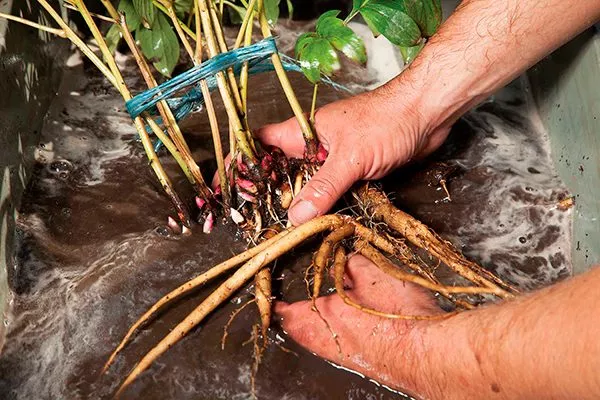
- Division of rhizome. Use when replanting in August or fall. With proper care, the survival rate is 100%, as numerous renewal buds form in the root system. The bushes are ready to bud the following season.

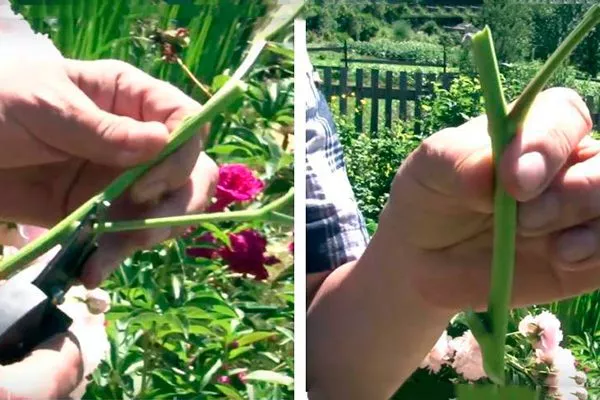
- Cuttings of shoots. The survival rate is 30-80%. This is influenced by the age of the bush—a young plant has a low chance. Cuttings are taken immediately after flowering. The first budding begins in the fifth year. Therefore, cuttings are rarely used for this variety.
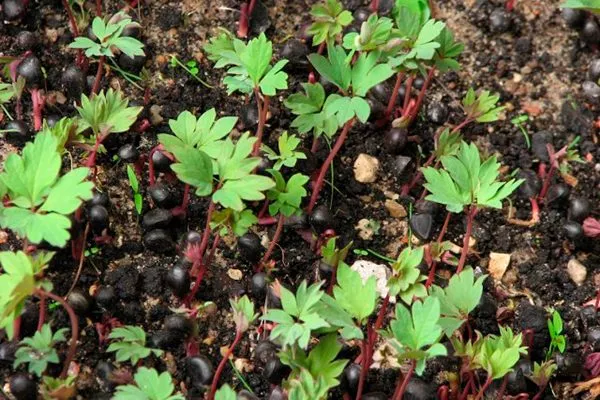
- Planting seeds. Seed germination is good, using the standard seedling process. Sowing time is late February, and transplanting into the ground is in the fall.
What to do after flowering?
As soon as the bud begins to fade and the petals fall, trim them off immediately, along with the flower stalks. However, if you want to collect seeds, leave the capsules until autumn to allow the planting material to fully ripen. From mid-August, begin reducing the amount of water and the frequency of watering, but do so gradually.
Preparing for winter and replanting
The Solange peony doesn't require winter protection, but it's important to prepare the plant properly. Here's how:
- Stop watering completely.
- Apply pre-winter fertilizing with Superphosphate.
- Cut back all shoots, leaving stems no more than 5 cm high.
- Hill up lightly.
- Mulch the soil with dry sawdust or deoxidized peat, humus.
If desired, you can sprinkle the bush with dry leaves. If frosts below -40°C are expected, cover it with non-woven material and secure it to the ground. Alternatively, create low metal arches and cover it with agrofibre. If the winter is dry and snowy, a dusting of snow is sufficient.
This variety can be replanted every 15-20 years, but gardeners typically do this more frequently for propagation purposes. Keep a few things in mind:
- the optimal time is April-May or August-September;
- Due to the peculiarities of the root system development, the bushes need to be dug at a distance of 20 cm from the trunk;
- the peony is extracted with a lump of earth;
- After replanting, at least 30 liters of water must be added, and the soil must be mulched with humus;
- If you plan to divide the bush, you need to get rid of the root ball, and wash the roots with water and clean them;
- If root shoots are damaged by a shovel while digging, treat these areas with a solution of manganese or ash dust;
- Before digging, the bushes are trimmed to a shoot height of 10-15 cm;
Diseases and pests
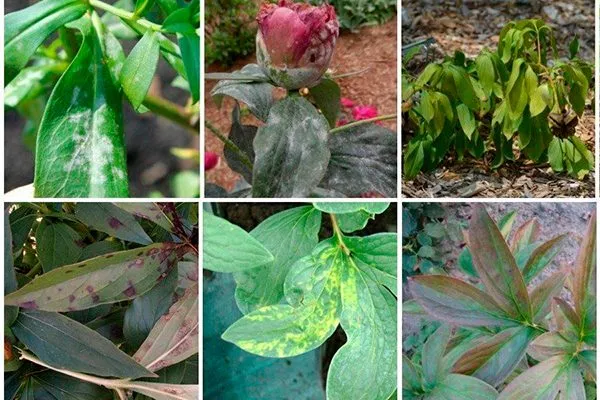
This variety is resistant to all diseases and pests, but if you're an inexperienced gardener or expect adverse weather, treat the bushes with insecticides and fungicides in the spring. Alternatively, use Bordeaux mixture or copper sulfate (both solutions at 1% concentration). Spray three times, spaced 10-15 days apart.
Problems in growing
Beginners and those new to Solange peonies often encounter unpleasant situations. The following problems can arise due to incorrect actions and factors:
- If the planting location is chosen incorrectly, there will be no flowering;
- if planted too deep, budding is weak;
- if the planting is too shallow, the roots will dry out;
- in rainy weather or over-watering during watering, gray mold and black leg appear;
- If there is a lack of moisture during the budding period, flowering becomes sluggish.
Reviews
The Solange peony is easy to grow, but requires fertile soil and frequent watering. It is distinguished by its increased winter hardiness and tolerance to hot weather. It can grow in both full sun and partial shade and is used to decorate garden plots.