
Peonies have become an integral part of many gardens around the world. One popular member of the family is the herbaceous variety 'Shirley Temple.' Proper care is essential to ensure lush blooms and a strong immune system.
Who developed the variety and when?
It was created by American breeder Louis Smirnoff in the mid-20th century. It was the result of crossing two varieties – Festival Maxima and Madame Edvard Doria. The name was given in honor of the famous Hollywood actress, who won the prestigious Oscar.
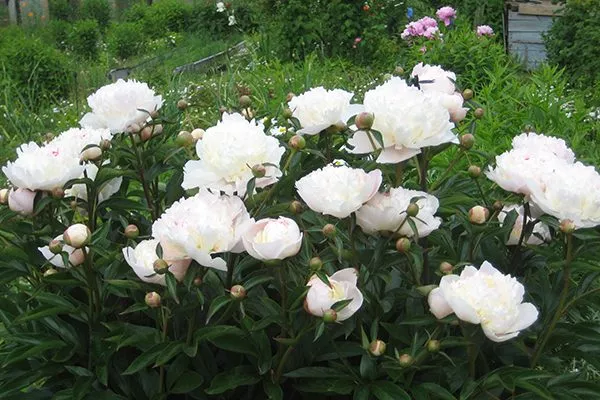
Description of the Shirley Temple peony
It features medium-sized, spreading bushes, reaching a height of 80-90 cm and a width of approximately 100-110 cm. The shoots are strong, ensuring they withstand stress during bud opening, and require no additional support.
The leaves have a lacy texture and are a rich, dark green in summer. By autumn, they turn crimson, providing a decorative effect until frost sets in. The shoots die back in winter.
The underground part includes thickening root shoots and renewal buds, protected by scales containing future leaves and flowers. The root penetrates to a depth of 1 m, imparting high frost resistance, withstanding temperatures down to -40°C. It thrives in various regions of the country.
Features of flowering
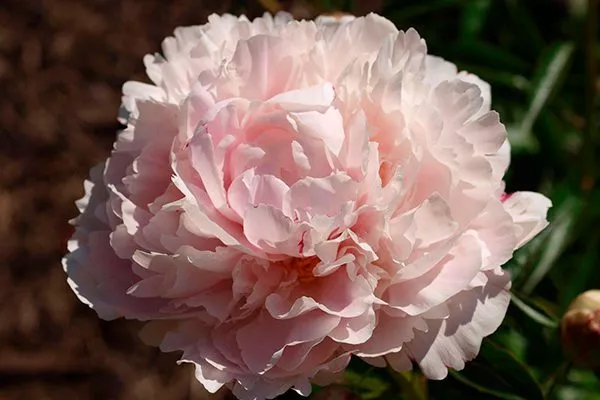
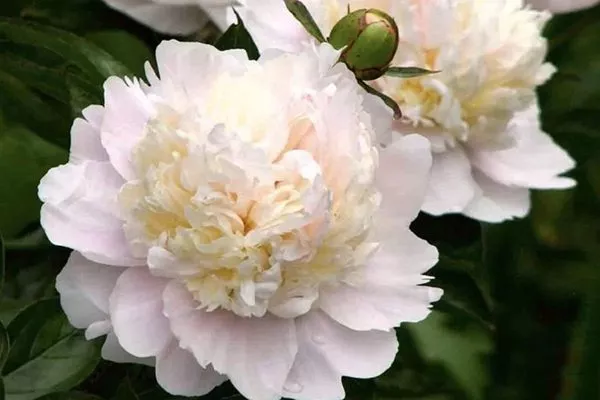
This double-flowered peony is characterized by globe-shaped flowers up to 20 cm in diameter. At the bud stage, the flowers have a delicate pink hue, which later turns milky white. The petals are straight, notched, narrow, and closely adjacent to the outer petals, forming a compact, spherical flower.
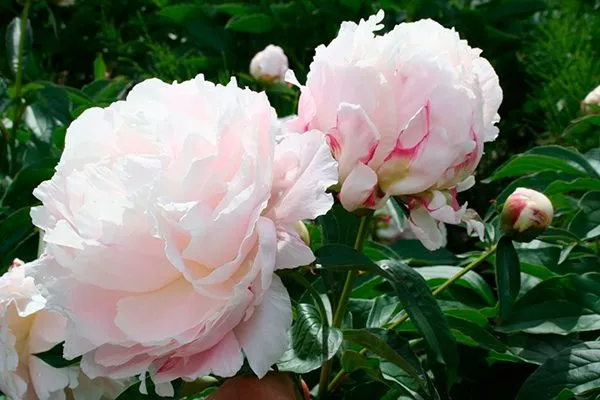
The fragrance is subtle and pleasant, and can be detected as the buds open. The first buds bloom in early May, and the blooms last for 2-3 weeks, depending on growing conditions.
The number of buds formed on a bush directly depends on proper care and placement. Insufficient light can lead to excessive leaf growth at the expense of bud formation.
Application in design
Shirley Temple will be a true highlight in your garden, yet it's easy to care for. Here are some ideas for incorporating this plant into your landscape designs:
- Single or group planting on a lawn, possibly with a border of groundcover perennials such as bergenia.
- Placement in the center of a large round flowerbed, surrounded by low-growing, brightly colored annuals with different flowering periods (petunias, asters, gerberas).
- Use as a lush border along a garden path, where gladioli, foxgloves, and columbine can serve as “companions”.
- A wonderful combination with hybrid tea roses of a suitable shade, choosing pastel or pink colours.
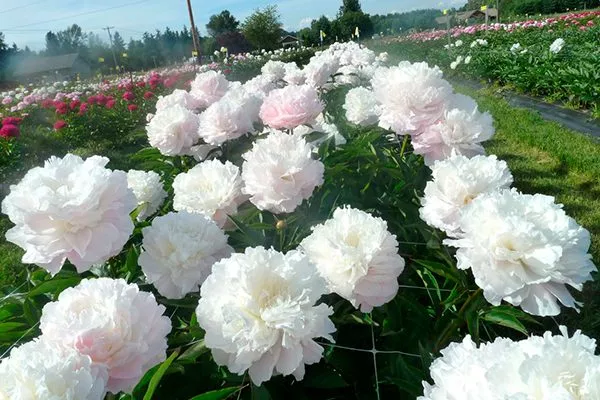
Regardless of the flower's location, it will always attract attention and occupy a leading position, with the other plants merely serving as a background.
Landing rules
Planting is best done in September and early October, provided there are at least three weeks before the first frost. Planting in spring and summer is also possible, but the adaptation period will be significantly longer. Timing depends on the growing region.
Helpful tips:
- Choose well-lit areas. In hot weather, light shelter from bright sunlight may be necessary.
- There should be no shrubs or tall trees nearby, and maintain a distance of at least 3 meters from nearby buildings, and 2 meters or more between other plants. This promotes good ventilation and prevents disease.
- Prepare the planting hole thoroughly, taking into account the extensive root growth. Even if the soil is fairly loose, add drainage material such as gravel, crushed stone, sand, or broken brick to the bottom.
- To provide the young seedling with nutrients, add 40 kg of humus, 500 g of wood ash, and 250 g of mineral fertilizer containing potassium and phosphorus, such as superphosphate or potassium sulfate. Mix everything thoroughly into the soil.
- Light, slightly acidic soil is preferred. Add lime if necessary.
- ✓ The optimal soil acidity for the Shirley Temple peony should be within the pH range of 6.0-7.0.
- ✓ The planting depth of the rhizome should not exceed 5 cm to avoid rotting.
Water the plant generously, and the next day, mulch the root area with humus to retain moisture. When planting, avoid leaving the renewal buds on top to prevent them from freezing over the winter.
Aftercare
To ensure abundant flowering, proper care is essential. The plant is drought-resistant, but regular watering is essential for optimal growth. During periods of prolonged heat, water once a week, using approximately 20-60 liters of water per mature plant.
It's especially important to provide adequate watering in spring and early summer, during flowering. In July, increase the interval between waterings to 10-20 days. Starting in August, water the flowers more frequently (once a week) to promote the formation of flower buds for spring. It's best to water in the evening.
To achieve lush and spectacular flowering, fertilize 3 times per season:
- At the beginning of spring, add organic matter or nitrogen mineral fertilizers in dry form to the soil.
- During bud formation, use potassium-phosphorus products.
- 14 days after flowering ends, feed the bushes with potassium and phosphorus.
Experienced gardeners recommend fertilizing only 3-4 years after planting.
What to do after flowering?
It's important to take several steps to ensure the plant's health and prepare it for the next season. After the flowers have faded, prune them carefully. This not only maintains the plant's aesthetic appeal but also helps prevent seeds from forming, which can weaken the plant.
Leaves play an important role in providing nutrition to the plant. Therefore, don't cut them off; leave them on to ensure they receive enough sunlight for photosynthesis.
Preparing for winter
Before winter, cut back shoots to 5 cm above the soil surface and sprinkle the surrounding soil with wood ash. Mature bushes don't require shelter, as they are resistant to low temperatures. Simply apply a 5-7 cm layer of mulch around the root zone.
- After pruning the shoots, treat the cuts with garden pitch to prevent infections.
- Make sure the mulch layer does not come into direct contact with the base of the plant to prevent rot.
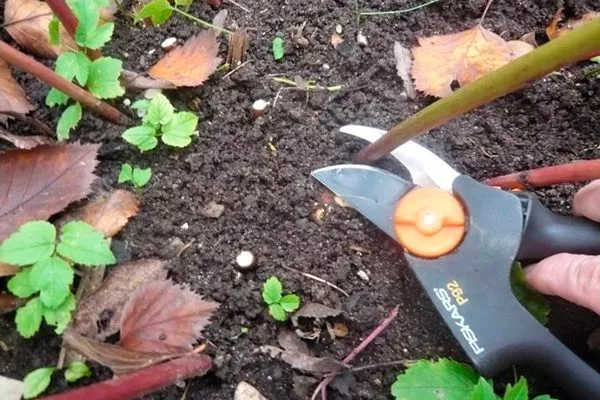
Young seedlings, which have a weaker immune system, need to be protected for the winter. After pruning, cover them with fallen leaves or spruce branches. Remove the cover in early spring, before the weather becomes consistently warm, to prevent stunted growth.
Pests and diseases
It is distinguished by its high resistance to common diseases and pests. However, if growing conditions are not met, it may lose its resistance. There is a risk of infection from the following diseases:
- Gray rot. It develops in spring due to excess nitrogen in the soil, wet weather, and dense plantings. It manifests itself as gray spots on the stems and leaves, which enlarge over time.
Remove the affected areas and treat the shoots and soil at the base with copper sulfate (50 g per 10 l).

- Rust. It manifests as brown spots on leaves and shoots, which can lead to premature drying and, ultimately, death of the plant due to disruption of photosynthesis. To treat, treat the bush with Strobi or Kumulus.


Reproduction
Shirley Temple can be propagated using several methods. One of the most accessible is division, which ensures the preservation of all the characteristics of the parent plant. There are several ways to increase the number of seedlings:
- Division. Carry out the procedure in late August or early September. Dig up the mother plant, clean it, and divide the bush into sections with 2-3 above-ground shoots and well-developed roots. Immediately plant the resulting sections in their permanent location.
- Reproduction by lateral shoots. This method is suitable for 6-year-old plants. In April, when the renewal buds begin to open, bend several young shoots to the ground, secure them, and cover them with soil, leaving only the tips. Mulch the shoots, water them regularly, and fertilize them.
By the end of summer they take root, and transplanting to a permanent location is recommended in the fall of the following season. - Cuttings. Recommended for 4-year-old specimens. Take 15 cm long cuttings with two internodes starting in late May. Before planting, treat the lower cut with a heteroauxin solution to improve survival. Cover the seedbed with plastic film to create a greenhouse effect.
The choice of propagation method for herbaceous peonies depends on the personal preferences of the gardener and the characteristics of the plant.
Advantages and disadvantages
It is one of the attractive varieties, sought after by gardeners for its exquisite beauty and unique characteristics. Before planting, it is important to study its positive and negative qualities.
Reviews of the Shirley Temple peony
Peonies are flowers that embody beauty and elegance in the plant world. Shirley Temple delights with its large, double blooms and refined fragrance, and exemplifies ease of care. Planting and subsequent cultivation are easy for both experienced gardeners and novice flower enthusiasts just beginning to explore flower gardening.