
The Lollipop peony is characterized by its decorative qualities and hardiness, making it a popular choice among gardeners in our country. Large, double flowers with vibrant variegation will enhance any garden and retain their freshness for a long time when cut. Its frost and disease resistance, as well as ease of propagation, make this plant a reliable choice for garden decoration.
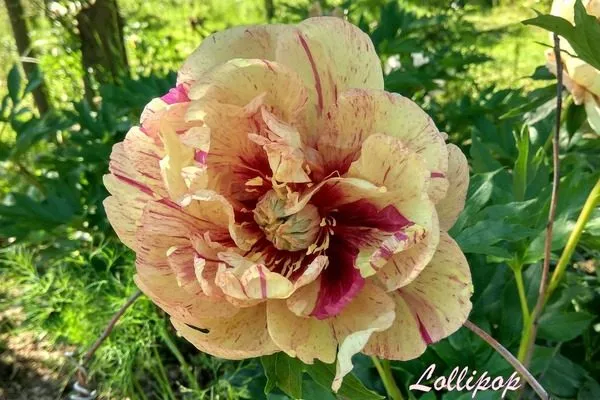
Characteristics of the Lollipop peony
Peonies are rightfully considered among the most spectacular garden flowers, and today many varieties have been developed. Among them, the Lollipop variety holds a special place – interesting and unusual, it can add individuality and expressiveness to a garden. It has many unique characteristics.
History of selection
The founder of modern peony hybridization is considered to be the Japanese Toichi Ito. In the late 1940s, he created the first hybrid between a tree peony and a herbaceous peony. Due to illness, Ito was unable to continue his work, but the project was passed on to Western breeders.
This variety was bred in 1999 by American Roger Anderson. It combines the best traits of the Alice Harding and Cacodena varieties. They are eye-catching with their dense foliage and large size.
Description of Ito-peony Lollipop
A medium-sized plant with erect, compact stems reaching approximately 80-90 cm in height. Distinguishing characteristics:
- The foliage is green, glossy, with clearly visible veins: the upper leaves are three-lobed, the lateral ones are oblong-oval with a pointed tip.
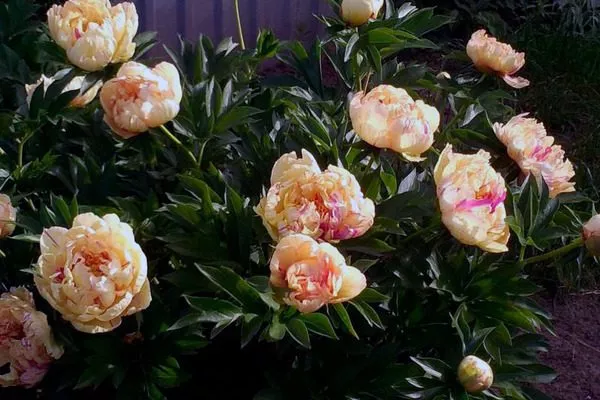
- The bush doesn't grow very quickly, but the shoots are densely packed at the base, so dividing the plant every 3-4 years is recommended. Staking isn't necessary—the stems are quite strong.
- Several buds can form on each shoot.
- The variety is distinguished by its high winter hardiness (USDA zone 4), easily tolerates frosts down to -35°C and feels good even in northern regions.
Features of flowering
The Lollipop peony is a double variety and is distinguished by its unique coloring: yellow petals are adorned with random strokes of reddish-purple. Flowering begins in late May and continues for up to 1.5 months. The flowers average 14-15 cm in diameter, rarely reaching 17 cm.
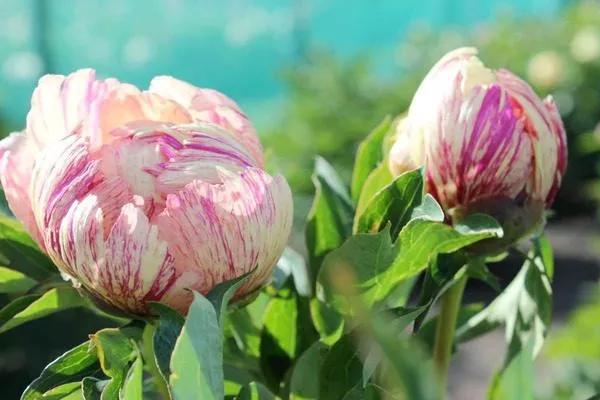
A single shoot often blooms not only with a central bud but also with several side buds. The flower has a faint but pleasant fragrance. A green pistillate column is located in the center, surrounded by a ring of bright yellow stamens about 15 mm high. All the petals are double—both at the edges and in the center of the inflorescence; there are practically no straight petals.
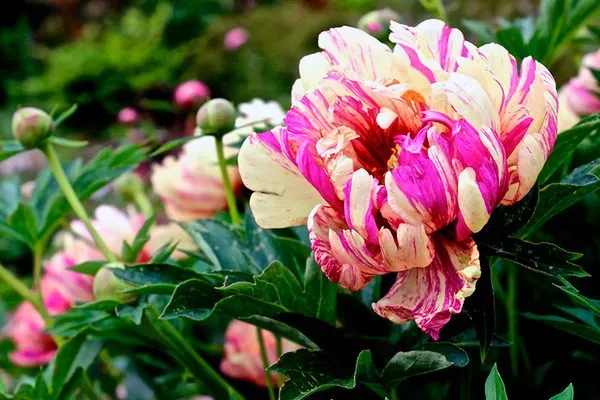
The abundance of flowering depends directly on the amount of light: the more sun, the larger the buds and the more of them are formed. However, weather conditions have little effect on the duration of the flowering period—the variety is resistant to wind and temperature fluctuations.
Application in design
Thanks to its dense, neat bush, this plant is ideal for decorating various areas of the garden – peonies are planted along paths, next to benches, gazebos, and other decorative elements.
Unique features:
- Flowers that completely cover the top of the bush attract attention, so the variety is often planted solo as an accent plant.
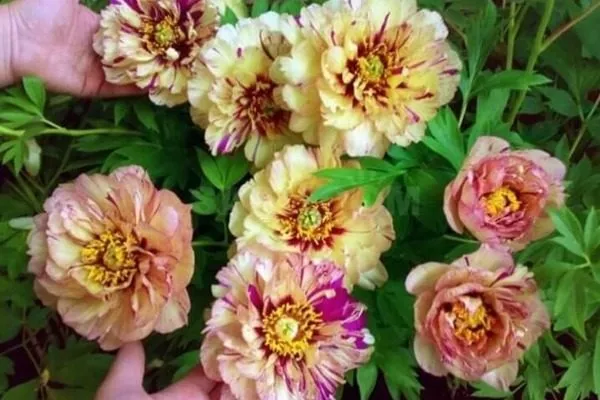
- The flower looks especially impressive next to plants of rich red or bright green shades.
- In flowerbeds, the plant can be used as a bright centerpiece of a composition or as a color accent among other crops.
- Due to its powerful root system, the peony does not develop well in a confined space, so growing it in pots or structures with little soil is not recommended.
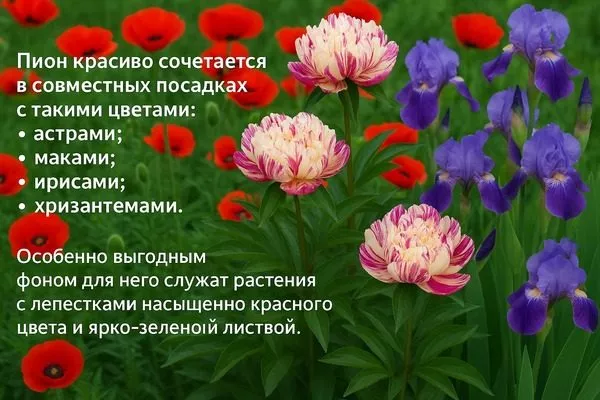
- Pairs well with asters, poppies, irises and chrysanthemums.
Methods of reproduction
There are several methods for increasing the number of seedlings at home. The Lollipop peony is propagated using standard methods:
- root cuttings;
- by layering from lateral shoots;
- dividing the bush;
- seeds.
Interesting facts:
- The seed method is rarely used, as it can take up to 7-8 years for a flowering plant to develop. Other methods yield faster results: layering produces flowering specimens in 2-3 years, while cuttings produce flowering specimens in 4-5 years.
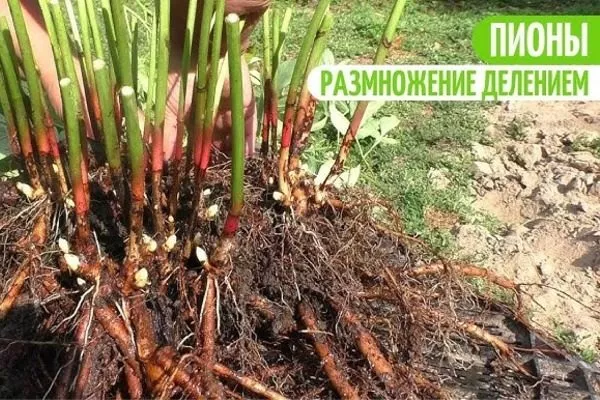
- The most effective method remains dividing the bush—it's the only way to guarantee flowering the following year. Furthermore, this procedure is essential for maintaining the plant's health, as division is recommended every 3-5 years.
This is usually done at the end of the season, after the seeds have completed forming.
Before digging, cut the bush completely back, leaving shoots up to 50 cm long. Use a shovel or sharp knife to divide the shoots. Try to preserve at least one shoot on each division.
Growing rules
To ensure rapid growth and abundant blooms of Lollipop peonies, it's important to follow basic planting guidelines. Proper care will ensure the plant's health and beauty for years to come.
Landing site
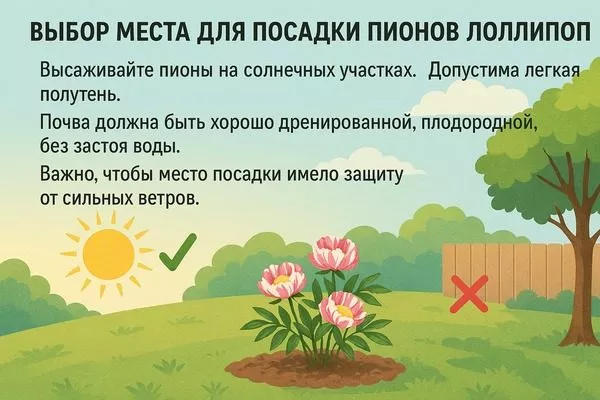
To ensure plants develop well and flower on time, it's important to choose the right growing site. Key requirements:
- Ideally, this would be a place with light shade during hot hours – without scorching sun, but not in deep shade either.
- The culture loves light, so the area should be well lit, especially in the morning and evening.
Soil requirements
The best soil for growing the Lollipop peony is loamy soil with a neutral pH. If your soil doesn't meet these requirements, you can improve it by adding:
- peat;
- humus;
- sand;
- wood ash.
This mixture will create favorable conditions for the growth and flowering of varietal peonies.
Landing
Begin this process in August-September to allow the root system to establish and strengthen before frost sets in. In spring, these plants are already capable of forming their first buds. In regions with a temperate climate, spring planting—in April or May—is also acceptable.
Although ITO hybrids were bred in Asia and registered in the United States, they are well adapted to Russian conditions. Peonies thrive in moderately humid conditions. Excessive moisture and proximity to groundwater, streams, or wells increases the risk of root rot and disease.
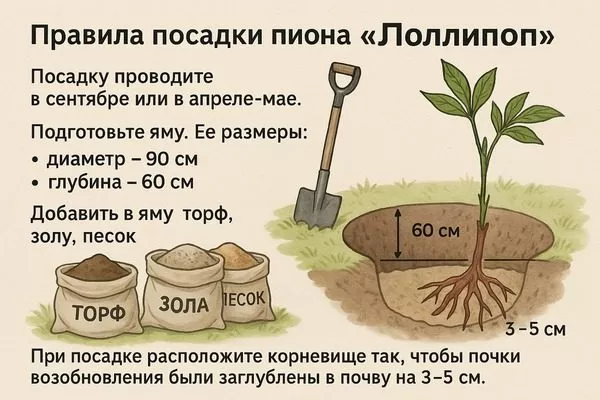
Stages of planting the Lollipop peony:
- Treat the planting material with a fungicide.
- Dig a planting hole measuring 90x60 cm and place small stones as drainage material at the bottom.
- Add peat, ash and sand to the soil.
- Leave the hole for 3-4 weeks to allow the soil to settle.
- Place the rhizome in the hole, gently compact the soil at the base of the stem.
- Water generously and mulch with dry grass.
Aftercare
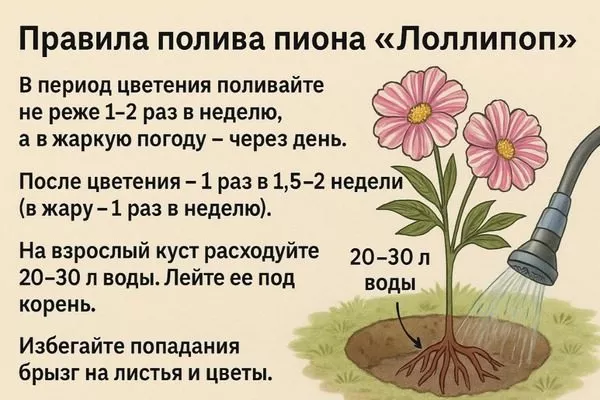
Water every 1.5-2 weeks, and during droughts, reduce the intervals to one week. During rainy periods, stop watering the bushes altogether.
Apply fertilizer four times per season:
- at the beginning of April – nitrogen fertilizers, such as urea;
- at the end of May – phosphorus-potassium mixtures, with an emphasis on Superphosphate;
- after flowering is complete – repeated use of phosphorus-potassium compounds;
- at the end of autumn – pre-winter feeding with organic matter, preferably wood ash.
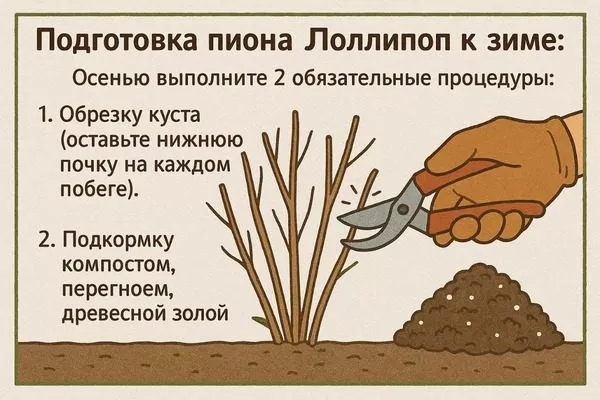
Pruning should be done once a year to prepare the plant for winter.
Preparing for winter
The Lollipop peony is a very hardy plant, easily withstanding temperatures down to -35°C and cold winds without shelter. Even young bushes tolerate harsh winter conditions well. Preparing for winter involves cutting the stems back almost to the ground, leaving only the bottom bud on each shoot.
Before the onset of cold weather, feed the peony with organic fertilizers:
- compost;
- humus;
- wood ash.
The use of mineral phosphorus-potassium fertilizers is acceptable, but in autumn the dosage should be half that of summer.
Pests and diseases
Ornamental plants, including hybrid peonies Lollipop, are susceptible to fungal and viral diseases, which most often arise due to violations of agricultural practices.
The most common diseases and insects:
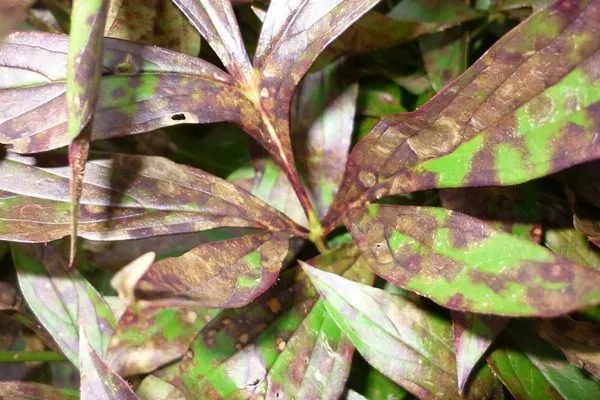
- Rust. It appears on leaves and stems as brown or black spots. It is caused by a fungus from the Pucciniales family. Without prompt treatment, the bush loses foliage and buds within a month and may die.
To control the disease, remove and destroy the affected parts, and then treat the plant with a 1% solution of Bordeaux mixture.
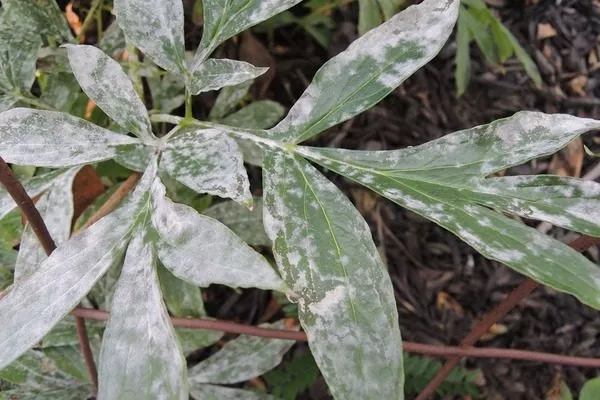
- Powdery mildew. It manifests itself as gray or white spots that quickly spread across the foliage. The disease inhibits flowering and fruit set.
Copper-containing preparations have a weak and long-lasting effect, so regular spraying with a 0.5% sodium carbonate mixture or Figon preparation at intervals of one week for a month is recommended.
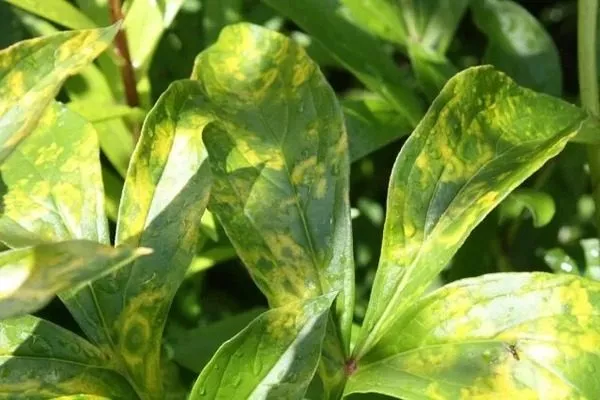
- Mosaic virus. It manifests itself as a complex yellow pattern on the leaves, most often in the second half of July. If detected early, remove and burn affected leaves and shoots; otherwise, the bush will have to be destroyed, as there is no cure.
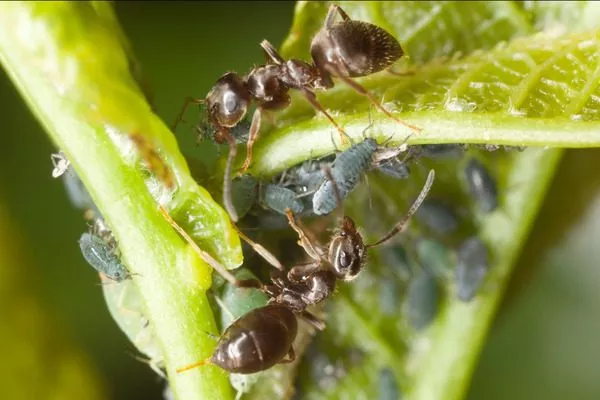
- Aphids and ants. Common aphids suck the plant's sap, weakening its growth. Ants promote the spread of fungal diseases by carrying spores on their legs.
Aphids are highly resistant to many pesticides, so strong insecticides such as Actellic, Akarin, and Entobacterin are effective against them. Less toxic treatments, such as Fitoverm, are often ineffective.
Pros and cons
Reviews
Lollipop is a striking example of a hybrid peony, combining the robustness of tree peonies with the abundant blooms of herbaceous varieties. It is distinguished by its variegated coloring, compact habit, and high frost resistance. This variety is prized for its low maintenance, long flowering period, and ability to thrive even in challenging climates.