
Coral Supreme is the name of a hybrid herbaceous peony variety characterized by large, coral-pink blooms. It has been known to Russian gardeners for decades. It is popular due to its low maintenance, hardiness, and long flowering period. Its buds are among the first to open in the flowerbed.
Who developed the variety and when?
Coral Supreme owes its creation to American breeder Samuel Wissing, who worked on its development for 26 years. In 1964, the scientist achieved success. By crossing the milky-flowered variety Minnie Shaylor with the foreign variety Otto Froebel, he created the pinkest of all coral peonies.
In 1981, the interspecific hybrid was registered in the United States. It has received awards from the APS (American Peony Society): a gold medal in 2023 and the Landscape Merit Award in 2009. In addition to its high ornamental value, it is characterized by drought and frost resistance down to -40°C and disease resistance.
Description of the appearance of the plant and flowers
This peony variety produces vigorous bushes with well-developed roots that extend deep into the soil. They are compact and do not collapse when grown, but sometimes require support. They have the following appearance:
- "height" - 0.6-0.9 m;
- erect, strong peduncles on which there are no lateral buds;
- Foliage: dark green with a glossy finish, twice trifoliate, narrow, pointed.
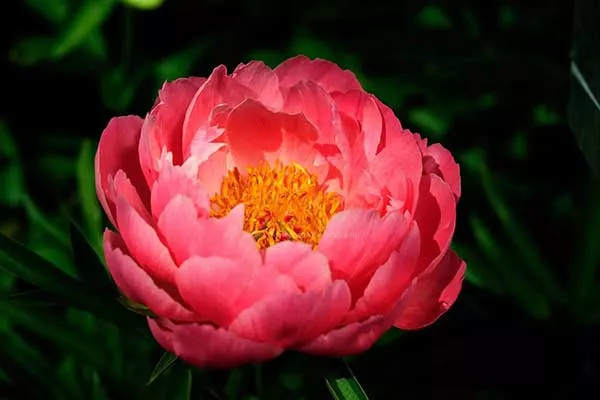
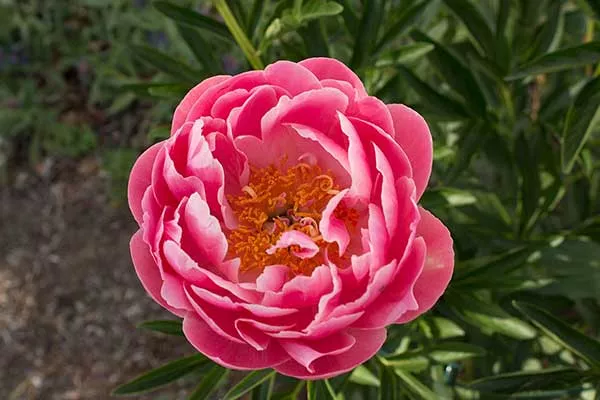
The plant produces up to 30 semi-double flowers per season. These are distinguished by their large size and stunningly beautiful color. Their description includes the following characteristics:
- cup-shaped flat shape;
- diameter - 16-20 cm;
- interesting coloring of the petals, which is a mixture of delicate pink, coral and salmon shades (over time, the flower changes its color to pearly beige);
- light yellow core;
- pink color of the stigmas on the pistils.
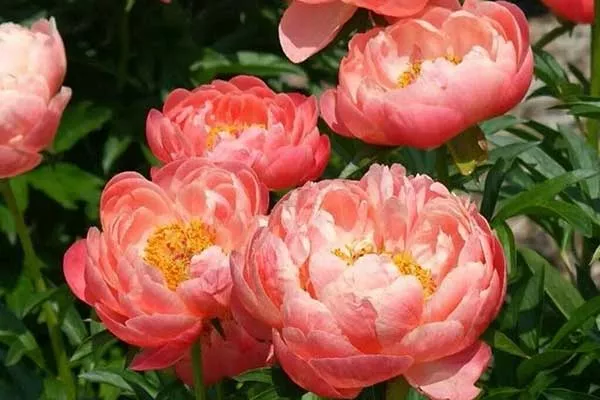
The buds of this cultivar are lighter than those of double peony varieties, but they also tend to droop under their own weight. They are distinguished by a delicate fragrance that is soft and pleasant.
Timing and characteristics of flowering
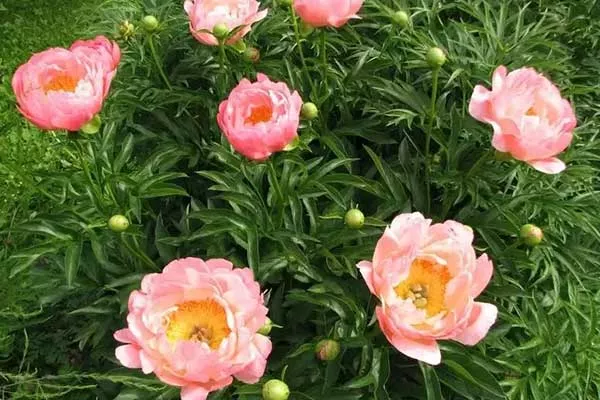
The Coral Supreme peony is one of the first herbaceous varieties to bloom in flowerbeds in May. It blooms slightly ahead of other garden varieties, opening its delicate buds earlier than others.
Period of activity and rest
Gardeners recognize the early and long flowering of this hybrid variety. The plant's active period begins in the second half of May and continues into early June, lasting three weeks. During this time, buds open, each lasting 7-10 days. After flowering, the bush enters a dormant period.
Care during and after flowering
A peony in its active phase requires special care:
- before the buds appear and after they bloom, the plant requires abundant watering, carried out at least once a week (the water consumption rate is 40 liters per 1 bush);
- shortly before the buds open, it makes sense to spray the peony with a solution of Plantafol or Platafid to speed up this process;
- During flowering, the plant needs fertilizers rich in potassium and phosphorus (the crop responds especially well to the application of the complex mixture Kemira Universal);
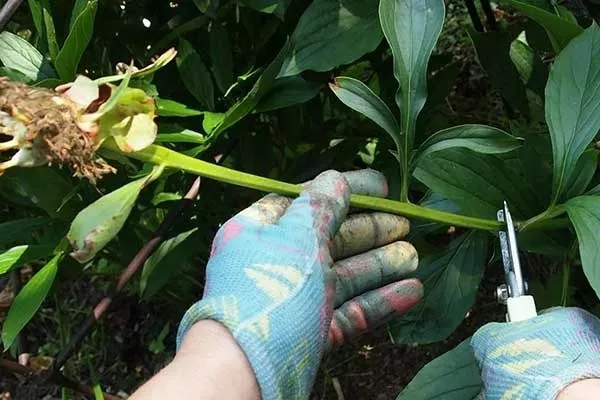
- After the season is complete, remove any faded and dried buds, as they weaken the bush and deprive it of its decorative appearance (the green mass does not need to be removed; preserving it promotes the formation of flower buds for the next season).
What to do if it doesn't bloom, possible reasons
Bushes under three years old won't delight you with their blooms. During the first couple of years of their life, they devote all their energy to root growth. The few buds that appear during this time will need to be removed. If allowed to bloom, the flowers won't match the variety's description.
You will be able to admire the Coral Supreme peony's flowering in all its glory only in the plant's third year of life.
The list of reasons explaining why a bush does not bloom, in addition to its youth, includes:
- thickening of rhizomes (observed in plants older than 4 years, they need to be divided into parts and replanted);
- too deep planting;
- close occurrence of groundwater on the site;
- lack of sun and nutrients in the flowerbed soil.
It's very easy to fix this. Replant the bushes in a new location, without planting them too deep in the garden soil, or apply a phosphorus-potassium fertilizer.
Use cases
The hybrid variety Coral Supreme is versatile in its uses. It is grown for the following purposes:
- for cutting and making bouquets;
- for decorating garden and urban flowerbeds, decorating paths in the garden, planting in front of the house or under the fence.
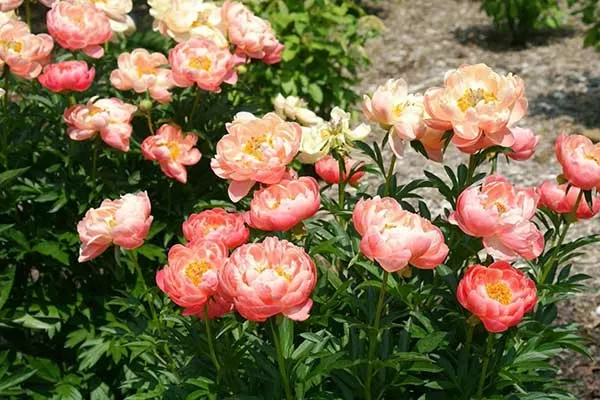
Coral peony bushes are self-sufficient. They look beautiful planted alone against a backdrop of green lawn grass or conifers such as mountain pine and juniper. When creating a flowerbed, they can be combined with other garden plants:
- peonies of white or dark burgundy varieties;
- roses;
- delphinium;
- phloxes;
- dicentra;
- host;
- heuchera;
- bergenia.
Methods of reproduction
Like other herbaceous peonies, Coral Supreme plants are propagated by gardeners in two ways:
- division of the rhizome;
- seeds.
Planting with root cuttings
Dividing a bush is a simple method for propagating ornamental plants, accessible to every gardener. For temperate climates, the best time to do this is the second half of August and the first two weeks of September.

Prepare root cuttings using mature peony bushes with the following characteristics:
- age - 3-4 years;
- which bloomed well this season;
- with 7 or more stems that do not grow in a bunch from one point;
- with well-developed rhizomes (in such plants the growth site of the stems is more than 7 cm in diameter).
Dig up a suitable bush in your garden and trim its stems, leaving 10 cm (4 in) tall stumps. Gently wash the roots. Leave the plant in the shade for a couple of hours to soften the roots and prevent them from breaking during the division process. Then get started.
Dismantle the bush into divisions, leaving a portion of the roots (10-15 cm in size) and 2-3 renewal buds on each. Avoid taking larger cuttings, as they don't take root well.
What time does boarding take place?
Plant Coral Supreme peony root cuttings in the fall. Ideally, plant in late September or October.
Selecting a location
Grow garden crops on your plot where there are suitable conditions for their development:
- plenty of diffused sunlight (light partial shade is acceptable);
- protection from wind and drafts;
- humus-rich loam with neutral acidity (the crop is unpretentious and can grow on any soil, but for luxurious flowering and maintaining health it requires fertile soil of the correct texture);
- with groundwater levels no closer than 1 m to the surface of the earth (otherwise the roots will begin to rot).
Although a herbaceous peony bush can grow in the same spot for up to 10 years, its flowers tend to become smaller in the fifth year. The plant requires repotting to maintain its attractive appearance. Choose a suitable location carefully to avoid having to repot it more frequently.
How to prepare the flower and soil?
Before planting, prepare the root cuttings by performing the following manipulations:
- soaking the roots for 30 minutes in a dark pink solution of potassium permanganate;
- keeping the divisions for 10-12 hours in a solution of Heteroauxin (to obtain it, dissolve 1 tablet of the preparation in 10 liters of water);
- drying the planting material, rubbing the cuts with coal powder;
- Treating the roots with a clay slurry containing copper sulfate (the cuts are rubbed with crushed charcoal). It's also helpful to dip the cuttings in a clay slurry containing copper sulfate (16 g per 10 l).
The soil in the flowerbed also requires preparation for planting peonies. If it's too heavy and clayey, add humus, peat, or sand. Peonies don't like acidic soils. If necessary, alkalize the soil using chalk or dolomite flour.
Step-by-step landing procedure
Plant the Coral Supreme peony divisions in your flowerbed, following these steps:
- Dig planting holes. Measure them as follows: 50 cm deep, 60 cm in diameter. Leave 90 cm between holes.
- Line the bottom of each hole with drainage material.
- Add a mixture of turf and leaf soil with compost (or humus) and peat to the holes. The ratio is 2:1:1:1. Enrich it with wood ash (200 g), superphosphate (40 g), and potassium sulfide (30 g).
- Place the seedling in the hole. Carefully straighten its roots.
- Cover them with soil. Monitor the planting depth. It should be 4-5 cm above the renewal buds.
- Water the peony generously.
- ✓ The optimal soil acidity for Coral Supreme should be within the pH range of 6.0-7.0, which is not indicated in the article.
- ✓ To prevent fungal diseases, it is recommended to leave a distance of at least 1 meter between bushes, which promotes good ventilation.
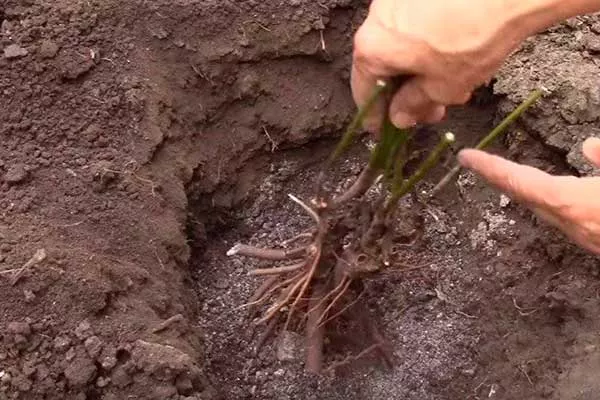
In the first year after planting, the plants will look weak. Don't expect them to bloom. The normal number of stems for annuals is 1-2. In the second year, they should have 3-6 shoots. Visually, the bushes will appear stronger and healthier, but it's still too early for them to form and open buds.
Planting seeds for selection
Gardeners prefer not to propagate herbaceous peonies by sowing seeds, as this method is considered labor-intensive and time-consuming. Before planting, stratify them and soak them for 48 hours.
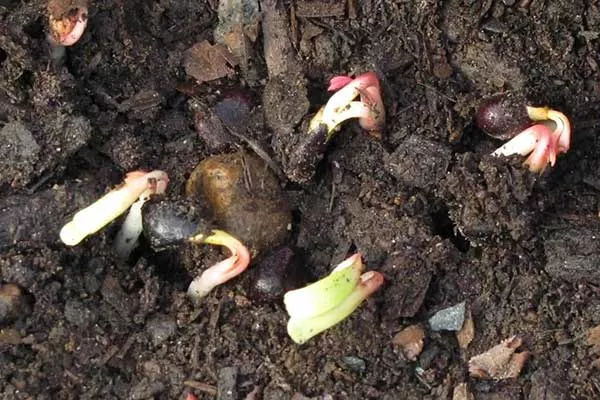
Sow directly into the flowerbed in shallow trenches six weeks before frost. Plant 10-15 cm apart and 2 cm deep. Cover the seedlings with a thick layer of mulch.
Agricultural technology for cultivation and care
After planting, the plant requires proper care. With proper agricultural practices, the peony will grow strong, healthy, and bloom beautifully and for a long time. These include:
- watering;
- application of fertilizers;
- loosening the soil under the flower;
- its mulching;
- weeding;
- disease prevention;
- pest control.
Watering and fertilizing
Water the bushes of the hybrid variety Coral Supreme, following the rules:
- the frequency of watering adult plants in the absence of rain is once every 7 days;
- the liquid consumption rate is 20-30 liters per 1 bush (the hybrid's rhizomes go deep into the ground, so the soil needs to be irrigated with a large amount of water);
- do not allow the soil to become over-watered or waterlogged;
- avoid drying out the soil;
- water the peony at the root;
- Do not allow water drops to fall on the leaves.
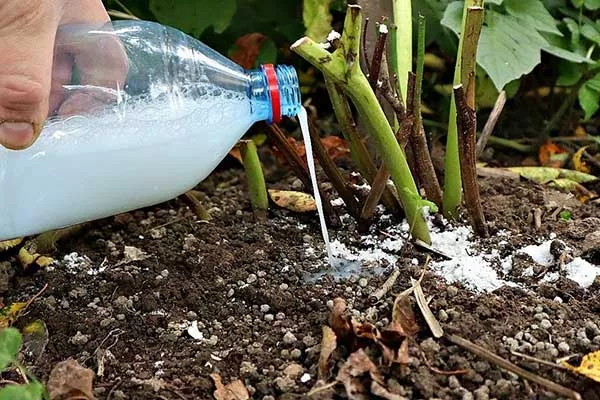
When planting a cultivar in fertile soil, there's no need to fertilize it for several years. Start feeding it when it's three years old.
For lush and long-lasting flowering, apply nutrient solutions according to the schedule:
- In April-May, use a complex mineral mixture with a high content of nitrogen, a nutrient that promotes the growth of green mass;
- at the end of spring (beginning of summer), feed the blossoming bush with a phosphorus-potassium composition;
- after flowering, add organic matter (compost, humus) to the soil under the peony;
- In the autumn, don't forget to feed the plant with fertilizer containing a high amount of potassium and phosphorus to prepare it for winter.
Loosening and mulching
To ensure better air and moisture flow to the Coral Supreme peony's root system, loosen the soil beneath the plant. Perform this procedure a few days after watering or rain. Combine this with weeding.
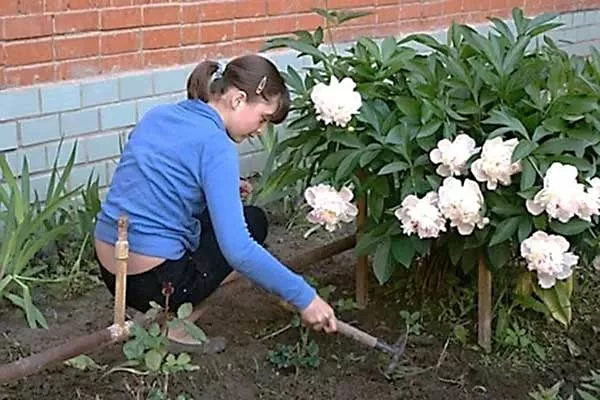
To retain moisture in the soil and additionally enrich it with nutrients, mulch the root circle of the plant with organic matter (layer thickness 3-5 cm):
- tree bark;
- peat;
- mown grass.
Peonies after flowering
Peony bushes require special care after their buds fade, which determines how lush their blooms will be next year. These measures are also aimed at preserving the health of the garden plant and maintaining its decorative appeal.
Transfer
At the end of summer or in the fall, transplant your Coral Supreme hybrid bushes to a new location in your garden. This procedure is recommended for plants that are 4-5 years old. If you don't do it, you won't be able to enjoy the large blooms of the following season. Older peonies tend to have smaller blooms.
Combine this manipulation with dividing the bush to obtain more plants for your flowerbed. Follow the instructions for planting root cuttings above.
Trimming
After flowering, peony bushes require pruning. This involves the following steps:
- cutting off all faded flower stalks from plants;
- autumn pruning of peony stems at a height of 10-15 cm from the soil surface;
- removing shoots from the bush in the spring that have dried out and been damaged during winter.
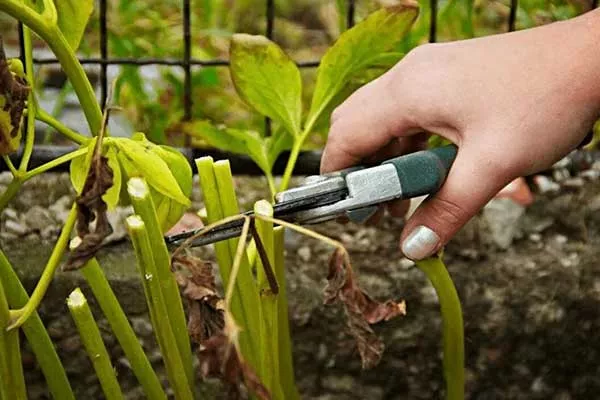
Remove the buds immediately after they fade and dry out to avoid weakening the plant. Avoid cutting off all flower stalks and leaves. The plant's root system develops through the above-ground portion of the plant, setting flower buds for the next season.
Preparing for winter
This hybrid variety is frost-hardy. Mature plants don't require winter protection. They only need some preparation for the cold season, which includes the following steps:
- pruning all shoots near the base of the bush at the end of October;
- mulching the soil underneath with humus (layer thickness - 7-10 cm).
Young peonies that are under three years old will need to be additionally covered with spruce branches to ensure they survive the winter safely.
With the arrival of early spring, remove the covering material and mulch. Don't wait until the weather becomes consistently warm to do this. Otherwise, the risk of damping off the renewal buds increases.
Diseases, pests and methods of control
The Coral Supreme hybrid is renowned for its robust immunity. Its bushes are distinguished by increased resistance to major garden diseases and pests. Poor agricultural practices are the main cause of infection and pest infestation.
Plants that do not receive quality care often suffer from the following diseases:
- Powdery mildewFungal infections of peonies are promoted by excessive soil moisture, caused by excessive waterlogging, a high water table, or prolonged rainfall. Its main symptom is a white coating on the foliage. This interferes with photosynthesis and causes the foliage to wilt.
To treat a plant affected by infection, use fungicides Topaz or Skor. - CladosporiosisA characteristic sign of the disease is the formation of brown spots on the leaves, which tend to increase in size over time.
To treat the plant, spray the bushes with Bordeaux mixture. Perform two treatments, once a week. - Gray rotThis is a fungal disease that develops due to excess moisture in the soil. To combat it, reduce watering, remove damaged parts of the bush, and treat it with a solution of Fundazol or Sumiclex.
- Curly hairThis viral infection causes the peony's foliage to wrinkle and the plant to stunt. The affected bush appears as a misshapen, dwarfed plant.
The disease is incurable. Affected flowers must be removed from the flowerbed and destroyed by burning outside the garden.
A flowerbed with Coral Supreme peonies, neglected by a gardener, is attacked by pests:
- AntsInsects appear on bushes when buds are forming. Their attacks cause flower deformations. To get rid of pests, treat the plant with Inta-Vir.
- AphidsThe pest sucks the sap from the leaves and young shoots of peonies. It forms entire colonies, which damage the bush. To eradicate them, treat the plantings with insecticides such as Enzhio, Aktara, Adjuvant, Actellic, or Fufanon.
- NematodeThe parasite is a worm. It attacks both the peony's roots and its above-ground parts. You'll need to destroy any bushes affected by the pest, and water the infested soil in the flowerbed with a solution of potassium permanganate.
- Spider miteFlorists identify this parasite by the appearance of a fine web on the green parts of the bush. Like aphids, control this sucking pest by treating peonies with Fitoverm, Aktara, or Fufanon.
| Pest | Method of struggle | Processing period |
|---|---|---|
| Aphid | Insecticide treatment (Aktara, Fufanon) | Before flowering and at the first signs of appearance |
| Ants | Use of the drug Inta-Vir | During the period of bud formation |
Ants and aphids pose the greatest threat to ornamental plants. They suck the sap from flower buds, causing them to dry out. Parasitic infestations often lead to a lack of flowering.
To avoid flower plantings from becoming diseased, resort to preventative treatment:
- with the arrival of spring, treat the peony bushes with Bordeaux mixture;
- Spray the plants in the flowerbed with insecticides and fungicides 2-3 times during the season.
Positive and negative qualities
The Coral Supreme hybrid has become a favorite among domestic flower growers for its many positive characteristics:
The coral peony variety has no significant drawbacks. Among its few drawbacks, gardeners note the need for fertilizer to ensure abundant blooms and the need for a ring-shaped support to prevent the flower stalks from drooping toward the ground.
Reviews
Coral Supreme is a popular interspecific peony hybrid that captivates gardeners with its stunning salmon-pink semi-double petals, large buds, and early, long-lasting blooms. It is considered one of the best representatives of the coral variety. It is grown for garden decoration and for cut flowers.