
The Kansas peony is a herbaceous plant that is resistant to temperature fluctuations, frost, diseases, and pests. However, timely fertilization and planting in sunny areas are essential. This is an old American variety that was introduced to Russia relatively recently.
History of creation
Bigger, a renowned American breeder, worked on the development of this variety. Kansas was registered in 1940, and just 10 years later it became the champion at the National Plant Show in the United States. In 1957, it was awarded a gold medal by the American Peony Society.
Description of the appearance of the plant and flowers
Kansas is considered a milky-flowered species that can grow for about 15 years without replanting. It is highly frost-hardy, surviving temperatures down to -35 degrees Celsius without shelter. It also thrives in drought and hot weather, making it popular throughout the country, from south to north.
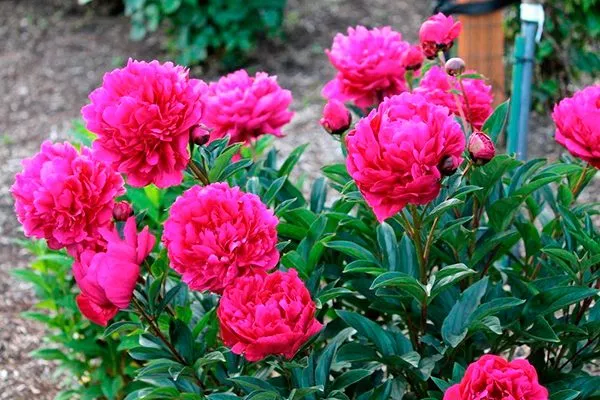
Botanical description:
- Bush. Reaches a height of 80-100 cm, characterized by a compact habit. The shoots are strong, upright, and dark green.
- Leaves. They are dark green and large. The leaf shape is lanceolate and alternate. The glossy surface has prominent veins. The underside of the leaf blade is lightly pubescent.
- Root system. Powerful and branched – grows in width up to 70-80 cm. Type – mixed, but mostly tuberous.
- Buds. The shape is hemispherical, the type is double. They are large in size, as their diameter varies from 18 to 25 cm. There are 15-18 flowers per bush. The petals are rounded at the edges, and the rosette in the center is neat.
The color is a bright crimson red, but if grown in partial shade or shade, the shade becomes pale. The anthers and stamens are yellowish, the aroma is floral, but of medium intensity.
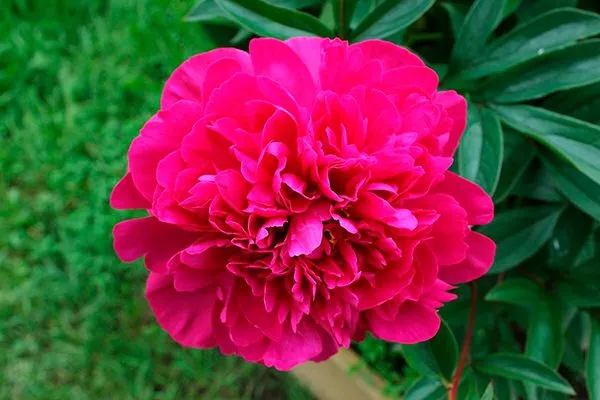
Timing and characteristics of flowering
The peony has a unique feature: mass cutting of flowers ensures that subsequent buds will be more lush and vibrant in color.
Period of activity and rest
The first flowering begins in the second or third year after planting, with the peak occurring in the third or fourth year. Budding begins in May, and flowering lasts for about a month, though a single open flower lasts just over a week. This variety is excellent for cutting, as it can last 16-19 days in a vase of water without losing its decorative appeal.
Care during and after flowering
During the period of active flowering, it is necessary to monitor watering, but after it ends, it is important to adhere to the following recommendations:
- You can’t pick off wilted flowers one by one – you need to wait until all the flowers have wilted;
- It is forbidden to trim the leaves until the inflorescences have been removed;
- flowers should be cut at the level of the first healthy leaf;
- 15 days after cutting, fertilizing is carried out;
- intensive watering is necessary until autumn.
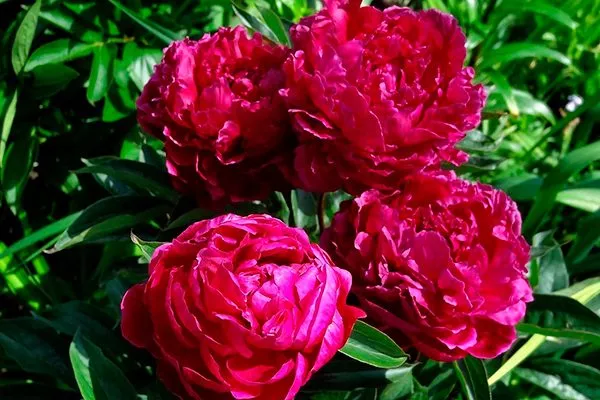
What to do if it doesn't bloom: possible reasons
There can't be an unexplained lack of flowering, but there aren't many negative factors for this either:
- Incorrect landing location. In this case, the plant tries to direct all its energy toward survival. This can be caused by a location that is too shaded or located close to other plants, especially large shrubs and trees. Drafts and stagnant water in low-lying areas can also have a negative effect.
- Violation of boarding rules. Most often, inexperienced gardeners plant seedlings too deep or, conversely, the top bud is located too high.
- Lack of nutrients. Many gardeners don't feed peonies in the fall, believing they don't need it. In fact, it's after flowering that the plants need all the nutrients they need to set buds in the spring.
- Lack of moisture. Increased watering should be done in the spring, when buds begin to form, and in the fall. Peonies draw water through their roots, which are located away from the trunk, so if watering is done at the right time but under the trunk, the water will simply drain into the soil rather than toward the plant.
- Diseases/pests. Many of these factors inhibit budding. Therefore, preventative treatments are carried out annually.
What kind of soil does a peony prefer?
Kansas is not fussy about soil, but it does require well-drained and fertile soil. The pH level should be between 5.5 and 6.5.
- ✓ The soil pH level should be strictly within 5.5-6.5 for optimal nutrient absorption.
- ✓ The distance from groundwater should be at least 2 meters to prevent rotting of the root system.
Where is the best place to plant?
For abundant flowering, it requires plenty of sunlight. If grown in the shade, the soil around the trunk will remain constantly moist, which encourages fungal diseases. The minimum distance from other plantings or buildings is 1.5 m, and the groundwater depth is 2 m.
Growth characteristics
Kansas grows quite quickly – by the third year of life the plant is considered fully formed.
Application in design
The Kansas peony can only be planted in a garden plot; its extensive root system makes it unsuitable for containers and pots. Despite this, landscape designers actively use the flowers to decorate gardens. The vibrant colors of their blooms make them suitable for planting alongside all types of crops, but only those that prefer the same soil pH.
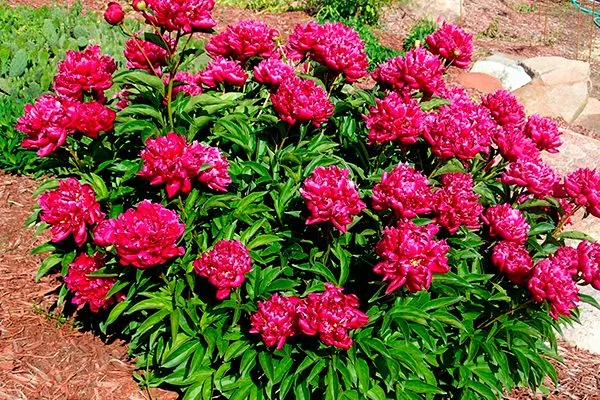
The best crops that Kansas pairs well with are:
- bells;
- roses;
- daylilies;
- cornflowers;
- euonymus;
- tulips;
- hydrangeas;
- dwarf conifers;
- ornamental shrubs.
Optimal design solutions:
- mass planting with other peonies of different shades, but their flowering period should be identical;
- mix of wild flowers on the lawn;
- border framing;
- mixborder with low-growing crops;
- lawn design;
- solitaire (place in the center);
- single plantings;
- flower beds.
Methods of reproduction
Kansas is a distinct variety, not a hybrid, so it can be successfully propagated even by seed. Other methods can also be used:
- Sowing seeds. The seedlings have a high germination rate and develop roots quickly, so experienced gardeners plant the seeds, grow the seedlings, and transplant them to their permanent location a year later. However, the first flowering occurs only in the fourth year after seeding.
- By layering. This is done in the spring by covering the shoots with soil. Repotting is done in the fall, and the first budding occurs in the second or third year.
- Cuttings. An excellent option in which flowering occurs in the 3rd year.
- Division of rhizome. The best way, since flowering begins the following season (since the bushes are already mature).
| Method | Time to first flowering | Complexity |
|---|---|---|
| Seeds | 4 years | Average |
| Layering | 2-3 years | Low |
| Cuttings | 3 years | High |
| By dividing the rhizome | 1 year | Average |
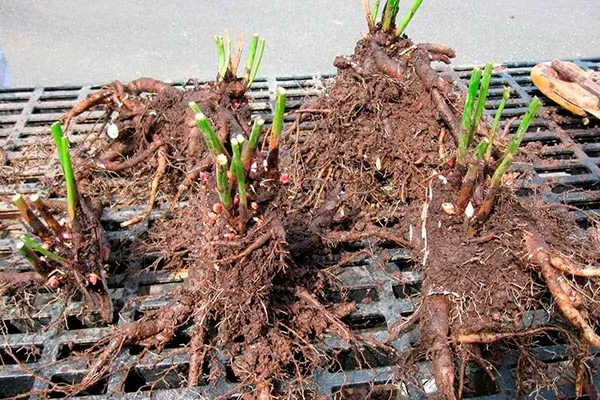
Landing rules
It's best to plant in the spring, as flowering will begin in the spring. If you plant seedlings in the spring, they will bloom within a year. There are some varietal nuances:
- seedlings are carefully wrapped in non-woven material for the winter;
- If the soil acidity is high, lime or dolomite flour is added when digging the area; if it is highly alkaline, granulated sulfur will be required;
- planting pattern – 60x60 cm;
- Substrate for the planting hole - soil, peat, compost and superphosphate, river sand is added if necessary.
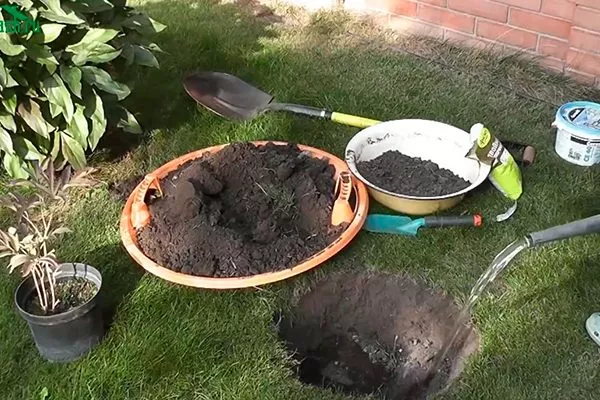
Aftercare
Kansas is undemanding to grow, but special attention should be paid to watering and fertilizing. Basic rules:
- Fertilization. Until the age of 3, the bush does not need additional feeding, but in the future, you need to adhere to the following scheme:
- immediately after the snow melts, potassium permanganate is added;
- ammonium nitrate is required during shoot formation;
- in May, any mineral complex for peonies can be used;
- during budding and after the end of the flowering period – potassium and superphosphate.
- Watering. A large volume of water is required at one time. The liquid is applied to the trunk area up to 100 cm in diameter, 15 cm away from the trunk. The amount of water for one mature bush is 20-25 liters, applied once every 10 days. After watering and rain, loosening and weeding are essential.
Preparing for winter
Kansas doesn't require winter protection in regions where temperatures don't drop below -30 to -35 degrees Celsius. However, even in southern Russia, bushes need to be prepared. Here's how:
- starting from mid-August, gradually reduce the frequency and amount of watering, and in September, completely eliminate watering;
- apply fertilizer at the last watering;
- shorten the shoots to a height of 10 cm.
- Hill up the bush and mulch it with humus, peat and sawdust mixed in equal proportions.
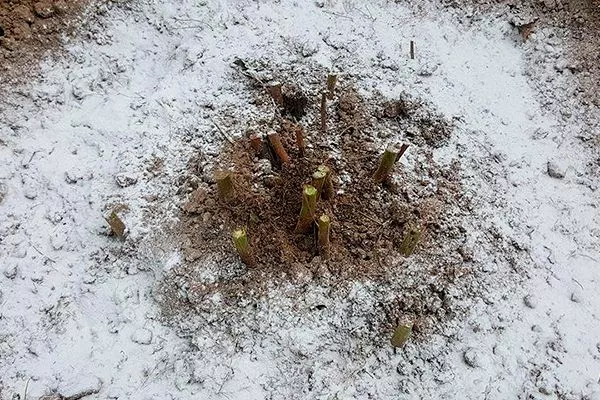
You can sprinkle dry leaves on top. If covering is required, use non-woven materials, but never plastic film.
Pests and diseases
Kansas is highly resistant to diseases and pests, as it has a strong immune system built through fertilization and proper agricultural practices. However, if these are ignored or unfavorable weather is expected this year, two fungal diseases may develop (the main cause is overwatering):
- Gray rot. Botrytis causes a gray, furry coating. Figon is used for treatment.
- Powdery mildew. It appears as a light, powdery coating on green foliage. Treatment involves using Fitosporin or Bordeaux mixture.
No crop is immune to pests, but peonies are particularly susceptible to aphids and ants, which attack the above-ground parts of the plant. Nematodes, which eat away at the root system, sometimes attack. Specialized insecticides are needed for control.
Reviews of the herbaceous peony Kansas
The Kansas peony is easy to grow, but requires specific feeding and watering guidelines. It's versatile and propagates using all available methods. No special planting guidelines are required, so even a novice gardener can handle the job. This flower is considered a true gem in any garden.