
The Highlight peony attracts gardeners with its reliability and surprising ease of cultivation. This variety delights with beautiful flowers, making it an ideal choice for those who value minimalist care. It requires certain guidelines, but is easy to plant and grow.
Peony lactiflora Highlight – what is it?
It was introduced in the United States in 1952. It was developed by breeder Edward Auten, in collaboration with floriculture experts from Gilbert H. Wild & Son.
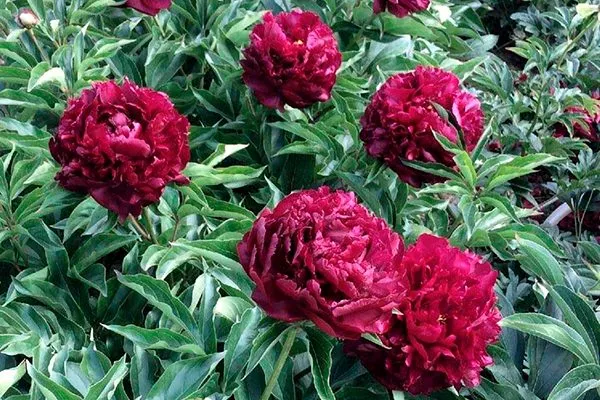
Main features of the culture:
- It is distinguished by its medium-sized and extremely long leaves, reaching a length of up to 38 cm.
- The shoots remain dark green throughout the growing season, maintaining their rich color even in autumn.
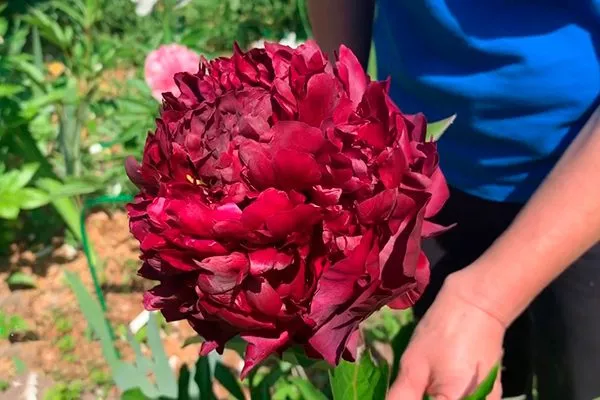
- Particularly noteworthy are the flowers, which have a diameter of about 20 cm and stand out for their double, rose-like structure, giving them visual volume.
- The velvety petals, directed inwards, create a striking contrast with the central part of the bud, which is slightly lighter in shade.
The breeders claimed a distinctive color—a burgundy-red with a deep sheen. Yellow stamens, located in the center of the flower, are juxtaposed with pinkish stigmas and a light-colored pistil. On hot summer days, the fragrance fills the garden with a light fragrance, mingling with notes of lemon and cherry.
- ✓ Resistance to temperature changes down to -36°C without cover.
- ✓ Ability to self-repair after damage to the root system.
Characteristics
It has a number of characteristics that make it popular in floriculture. It successfully survives cold periods. Its ability to cope with low temperatures makes it an excellent choice for regions with cold winters.
It easily adapts to low moisture conditions, so it easily tolerates a variety of climates. It is highly resistant to various diseases and rarely suffers from insect attacks. Regular care and moderate watering help maintain its health.
Flowering period
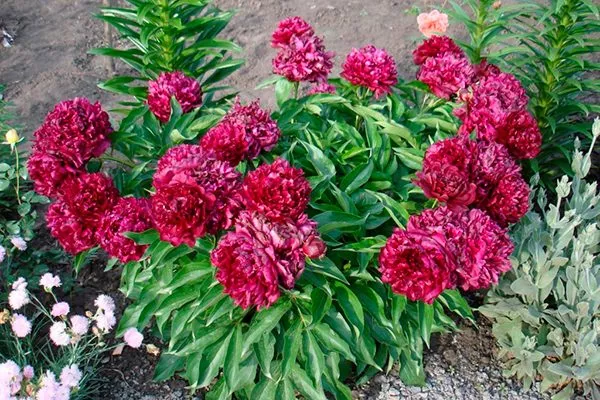
A mid-season variety. Bud formation and opening typically occur in June or July. Flowering is fairly long, lasting for a month under favorable conditions.
Planting and care
The plant thrives in dry, loamy soil with a neutral pH. Excessive soil acidity can be balanced by adding wood ash to the roots. When planting, avoid waterlogged areas, as stagnant water in the roots can lead to root rot.
Step by step guide:
- Dig a hole measuring 60x60x60 cm.
- Place a 25 cm thick drainage layer at the bottom of the hole, consisting of broken brick, wood debris, pebbles and coarse sand.
- Apply a 30cm layer of fertilizer, including humus, compost, lime and wood ash.
- Fill the hole from above with soil mixed with compost and leave for 10 days to settle.
- Place the roots of the seedling into the depression in the hole formed during the shrinkage process and cover them with a 4-5 cm thick layer of soil, without touching the root collar.
- ✓ The optimal planting depth of the root collar is no more than 5 cm to avoid rotting or, conversely, freezing.
- ✓ The frequency of watering adult plants should be adjusted depending on the soil type: more often for sandy soil, less often for clay soil.
Young plants don't require excessive fertilization. For the Highlight peony, it's sufficient to apply an organic fertilizer once at the beginning of the season and a second time with a mineral fertilizer before flowering. Apply foliar fertilizer to young plants.
Other care recommendations:
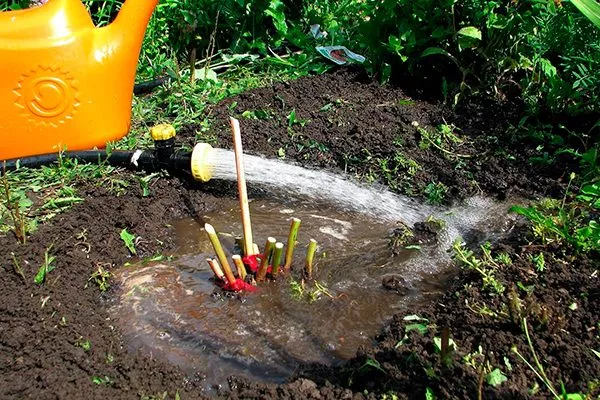
- Young seedlings require more frequent watering than mature plants. Mature peonies should be watered once a week, using 20-30 liters of water.
- Prune the above-ground portions before winter after stable frosts have set in. Cover the cut areas with a layer of compost.
- No special shelter is required; natural snow cover is sufficient. It exhibits resistance to sudden temperature changes and can withstand temperatures as low as -36°C without shelter.
It's grown in all regions of the country. Cover newly planted bushes with agrofibre. Mature plants overwinter on their own, under natural snow cover.
To prevent diseases such as gray mold, use solutions of potassium permanganate, copper-containing preparations (50 g of copper sulfate per 10 liters of water) and garlic infusion (8-10 heads per 1 liter of water).
To combat powdery mildew, use a copper-soap solution (250 g of laundry soap, 25 g of copper sulfate per 10 liters of water).
Subtleties of reproduction
You can increase the number of bushes in your garden yourself. The Highlight peony can be propagated in several ways:
- By division. Remove the rhizome from the hole and let it dry in a dark place for 2-3 hours. Divide it into 2-3 pieces, ensuring that each section has buds. Plant each piece in the prepared holes.
- Seeds. Soak the seeds in a weak solution of potassium permanganate for several days. Plant them in shallow pots with a mixture of fertile soil and river sand. Cover the containers with plastic wrap and place them in a warm place with a temperature of 25-30°C during the day and up to 15°C at night. Remove the plastic wrap regularly for ventilation.
- By root cuttings. Remove the rhizome from the hole and take several cuttings about 5-6 cm long, each with a renewal bud. Soak the cuttings in the potassium permanganate solution for 2-3 hours. Plant them in containers with fertile soil and move them to a well-lit location.
- Stem cuttings. Two weeks before flowering, cut off the stem with an undeveloped bud. Trim the leaves and shorten the shoot to 10 cm. Make a diagonal cut and treat with Kornevin.
Plant the cutting in loose, nutritious soil at an angle and cover with plastic film. Once rooted, remove the covering and transplant outdoors the following summer.
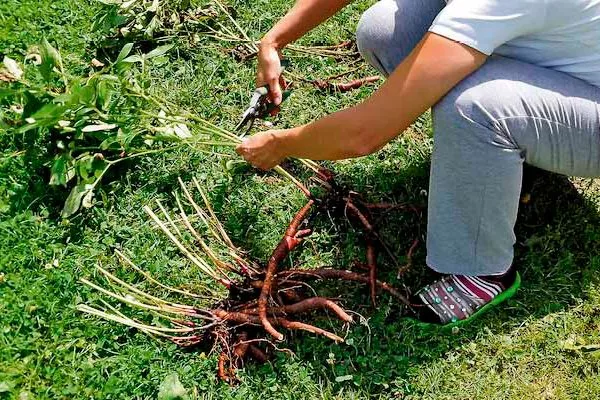
Choose the appropriate propagation method to grow planting material and decorate your garden with new flowering specimens.
Interspecific peony Highlight – reviews
The Highlight peony lives up to its name, serving as a striking example of a low-maintenance and beautiful plant. Unlike some of the vagaries of other varieties, it demonstrates tolerance to various conditions, ease of propagation, and minimal care requirements.