
The Purple peony belongs to the tree peony group and, thanks to its unique coloring, looks very unusual. This variety is not only beautiful on its own, but also finds wide application in landscape design, harmoniously combining with a variety of flowers and garden plants.
Description of the variety
The Purple Peony was developed by Russian breeders by crossing several tree species. This work resulted in a beautiful, double-flowered, drought-resistant, vigorous, and beautiful peony.
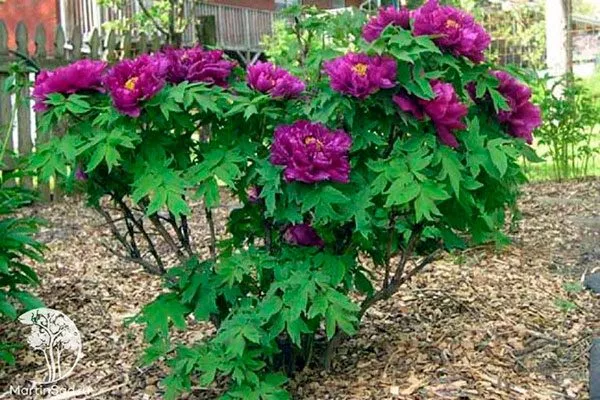
Brief description of the Purple peony:
- Bushes – tall, strong, and spreading. The crown is spherical, formed by numerous well-leafed branches. The plant height is 1-1.2 m.
- Stems - flexible, greenish-brown in color, smooth to the touch.
- Leaves — large, bright green, with jagged, serrated edges, composed of three plates covered in a marbled pattern. The veins, both lateral and central, are clearly visible on the leaf blades.
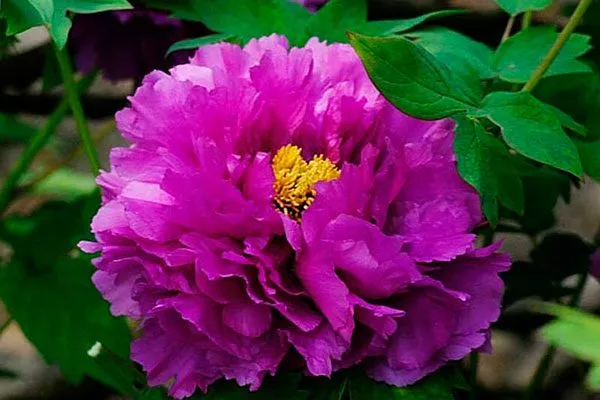
- Buds — large, bright purple, with velvety petals. The center is yellow. The petals are numerous and, like all double varieties, arranged in rows. The flowers reach 25 cm in diameter.
This variety has quite high frost resistance – from -34 °C to -29 °C.
Timing and characteristics of flowering
Flowering begins in early June. The bush attains its most decorative appearance. Several buds form simultaneously on each stem. These can be solitary or clustered in inflorescences.
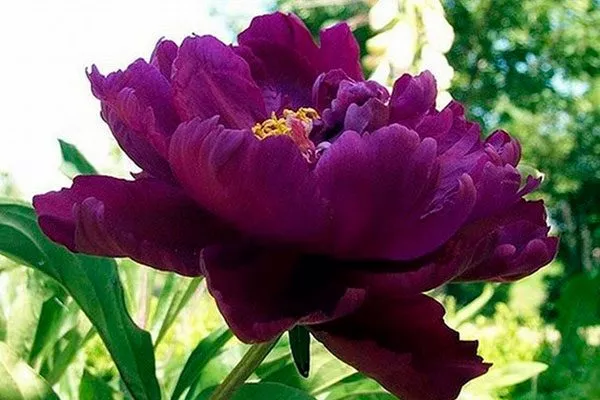
The blooms have a pleasant, rich fragrance with hints of sweetness. By mid-July, the flowers gradually fall off. The average bloom time for a single flower is 12-14 days. The Purple Peony produces beautiful, long-lasting, and abundant blooms.
Use cases
The Purple Peony is highly ornamental and ideal for growing in private gardens. This variety can be used in a variety of landscape designs.
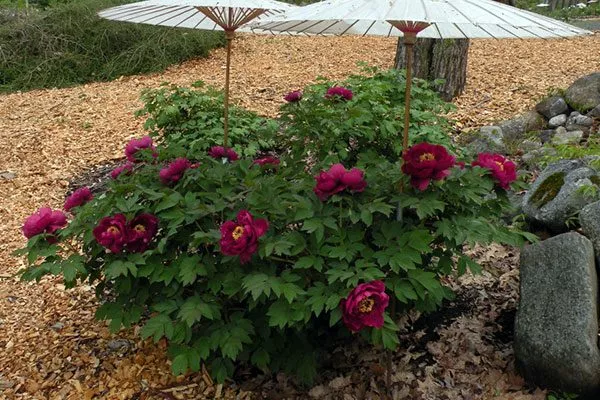
Application options:
- Rockery. A distinctive feature of alpine gardens is the presence of border stones. Within their borders, the Purple peony can be planted alongside dwarf arborvitae. Asters and junipers also pair well with it.
- Monoflowerbed. Flowers from the same family are usually planted in them. Purple peonies pair particularly well with white, white-pink, and lilac varieties.
- Multi-tiered flowerbed. Flowers are selected based on their height. Low-growing flowers—marigolds, pansies, petunias, and daffodils—are planted at the forefront. Taller plants—irises, sweet carnations, daisies, and baby's breath—are placed behind them. Purple peony bushes can serve as a backdrop for the first and second rows.
The Purple variety is often found in park areas and squares, on the banks of artificial ponds and lakes.
Pros and cons
Before planting the Purple peony, it's recommended to evaluate all its advantages and disadvantages. This variety may not be suitable for your needs.
Features of agricultural technology
The Purple Peony is fairly easy to grow, but there are a number of things to consider.
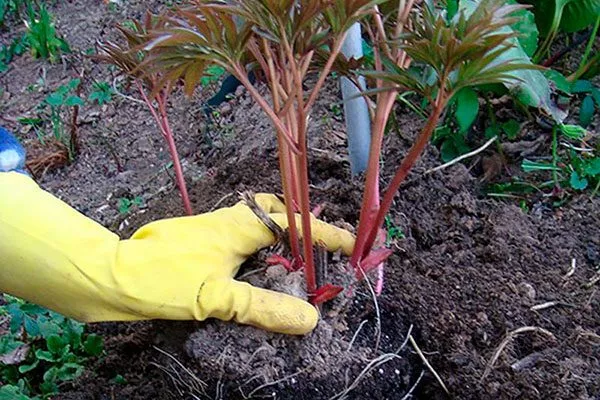
- ✓ Soil pH should be between 6.0-7.0 for optimal nutrient absorption.
- ✓ Drainage is required to prevent water stagnation and root rot.
Growing features:
- The Purple peony grows best in sunny areas or in light partial shade.
- Planting takes place in April-May or August-September.
- Optimal soils are fertile, loamy, permeable to water and air, and slightly acidic. This peony grows well in almost any soil, except podzolic and waterlogged soils.
- When planting, maintain a spacing of 150-200 m between plants. The planting hole should be 40 cm deep. The bulbs are planted upside down. Cover the planted bulbs with soil, compact them firmly, and water thoroughly.
- Watering should be moderate and regular. During the flowering period, water generously. The maximum amount of water per bush per watering is 5 liters.
- Fertilizing is carried out regularly, well-supplemented with organic and mineral substances.
- In regions with mild winters, there's no need to dig up the bulbs. Simply cover the bush with soil and then cover it with several layers of burlap, then plastic wrap.
Purple peonies are propagated primarily by bulbs. It is recommended to purchase planting material only from reputable suppliers. A Purple peony can grow and bloom in one location for over 20 years.
Resistance to diseases and pests
The Purple Peony is highly disease-resistant, but if agricultural practices are improper, coupled with unfavorable growing conditions, the bushes can be affected by viruses, bacterial and fungal infections, and the plant can also be attacked by insect pests.
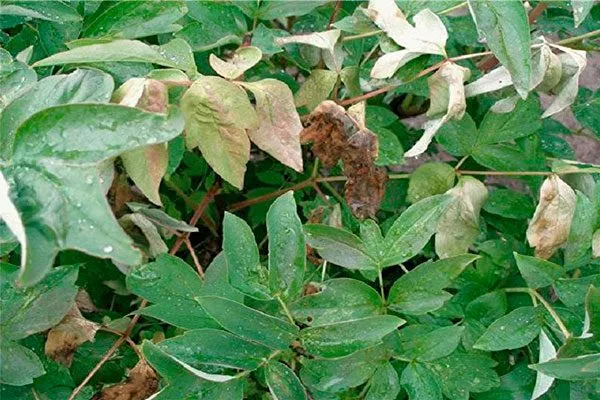
- ✓ The appearance of a sticky coating on the leaves indicates an aphid infestation.
- ✓ Sudden wilting of flowers while leaves are healthy may be a sign of verticillium wilt.
The Purple Peony is most often affected by:
- Verticillium wilt. The disease appears during the flowering period. When infected, the flowers appear healthy, but the stems and leaves wither. It is recommended to destroy the plant and disinfect the soil with formalin.
- Leaf spot. The leaves are affected by a fungus, developing brown spots. Treatment with a 1% Bordeaux mixture helps prevent the problem.
- Ants. If these insects aren't repelled in time, they begin to suck the sweet juices from the flower buds. Repellents are used to kill ants.
- Aphids. These tiny insects suck the juices from leaves and flower stalks. For minor infestations, a soapy solution can be used. For severe infestations, spray the bushes with Actellic or similar insecticides.
The Purple Peony is a truly versatile variety that easily complements any garden. This flower requires little care, and most importantly, thanks to its high frost resistance, it can be grown even in regions with harsh climates.