
Even novice gardeners choose the Etched Salmon peony. It requires attention, but care requires minimal time and effort. With proper planting and subsequent adherence to recommendations, you'll be able to grow a plant that will delight you with its lush, blooming crown.
History of creation
It was created in the USA in 1981. It was bred by Lyman Cousins and Roy Clem. In 1990, the hybrid won first place at the American Peony Society National Show. Almost immediately after its introduction, it attracted the interest of both specialists and amateurs.
Description of the appearance of the plant and flowers
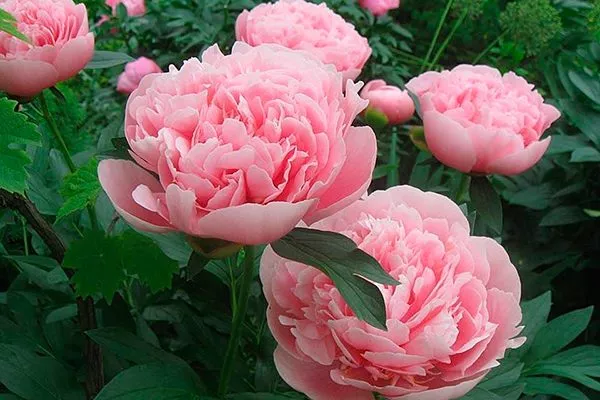
Etched Salmon is a herbaceous ornamental plant. Its shape and fragrance resemble a rose. Distinguishing features:
- It has a compact size and a neat shape, reaching up to 80 cm in height.
- Its strong, upright stems hold the buds and have no side flowers.
- The shoots are covered with large, petiolate leaves, colored in an emerald hue.
- The distinctive feature is the pink color with a coral hue and a golden border along the edges.
- The petals are corrugated, with narrow central parts and wide, outward-curved margins. The flowers are uniform in size – about 16-17 cm in diameter.
- The aroma is delicate, with light notes of lemon.
Timing and characteristics of flowering
This is a tree-like variety with large, double flowers of a regular, rounded shape and vibrant hue. The outer petals have a waxy texture, which helps them retain their shape well. Sometimes, the outer petals have a golden edge.
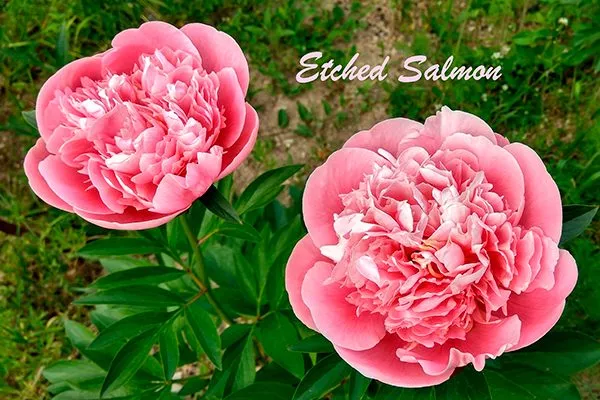
The flowering period is mid-early, occurring in early to mid-summer. Flowers are usually abundant and lush, depending on care (watering, fertilizing, mulching), soil fertility, ample sunlight, and a light soil texture.
Use cases
It's a complement to any garden plot and can be used in a variety of ways to create a cozy, aesthetically pleasing space. There are many design ideas:
- In the center of a green lawn or along a garden path.
- Near the house or entrance to the building
- Along the recreation area on the site or next to the gazebo.
- In the center of a complex flowerbed or in combination with other double varieties of peonies.
- Next to conifers (junipers, thujas and spruces).
- In combination with other flowers: red and white peonies, lupines, delphiniums, hydrangeas, catnip and decorative hostas.
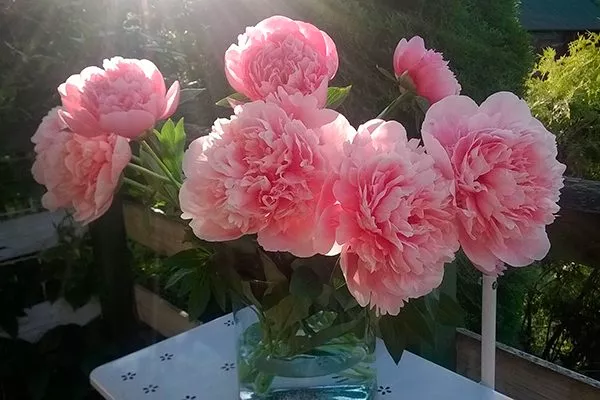
- Suitable for cutting and can retain its attractiveness in water for about a week.
Requirements for planting site and soil
The main threat to the crop is high groundwater levels. Being too close to the surface can cause serious damage to the root system. Follow these recommendations:
- Choose an area with good lighting – sunny or with partial shade.
- Cold drafts are not allowed; it is preferable to choose well-ventilated places.
- The soil should be fertile and slightly acidic. The variety adapts well to loose loam. If the soil is acidic, amend it with dolomite flour, lime, or ash to normalize the pH, which should not exceed 5.5-6.
It is desirable that the soil be slightly alkaline or have a neutral pH reaction.
- ✓ The soil pH level should be strictly within 5.5-6.0, measure it before planting.
- ✓ The depth of groundwater is at least 1.5 meters from the surface.
Agricultural technology for cultivation and care
The best time for planting is late August or early September, and for regions with a southern climate, late September or early October. The technique is simple and involves the following steps:
- Before planting, loosen the soil to a depth of 20 cm, remove weed roots, stones, and debris, and add compost or leaf mold. Do not use manure.
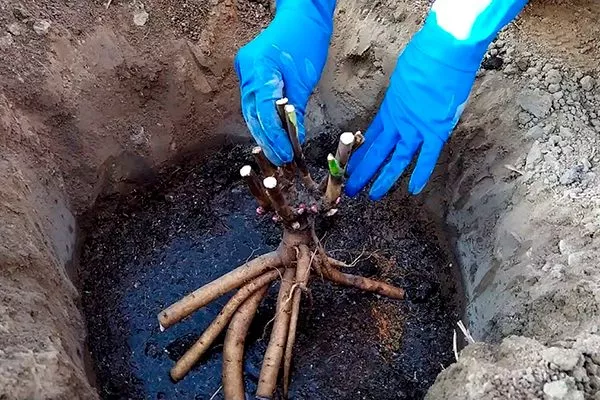
- Dig a planting hole about 60 cm in diameter and depth and fill it with a mixture of sand, peat, humus and garden soil in equal quantities, with the addition of wood ash, copper sulfate, and superphosphate.
- Place the seedling in the hole and fill it with soil without compacting it.
- Water the plant generously with 10-20 liters of water.
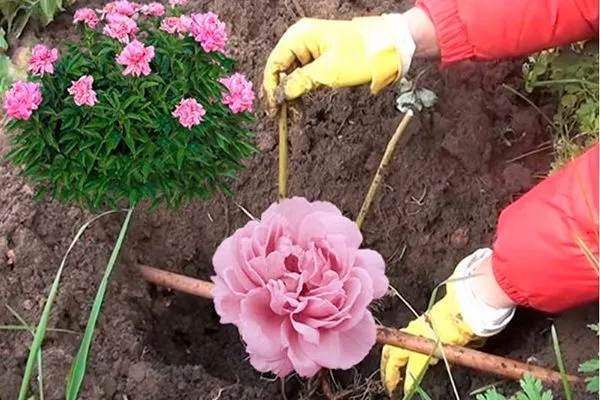
Maintain a distance of 80 cm to 100 cm between planted bushes.
Caring for the Etched Salmon peony is simple. In the spring, after the snow melts, water with a weak solution of potassium permanganate to disinfect the soil and stimulate bud swelling. To maintain soil moisture and control weeds, mulch the roots with sawdust, straw, hay, pine needles, or peat.
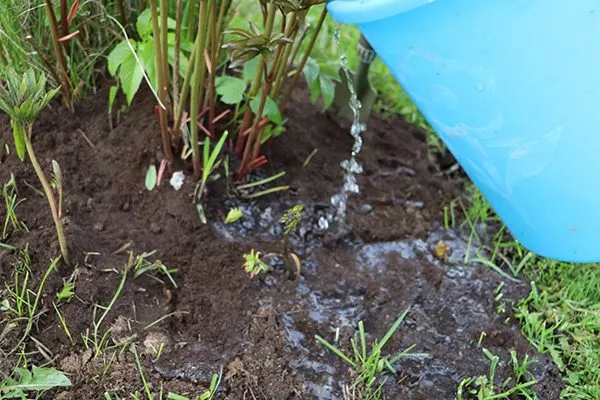
Feed the crop regularly:
- In the spring. Use nitrogen fertilizers – ammonium nitrate.
- During flowering and immediately after it. Use superphosphate and potassium salt.
- In autumn, a month before frost. Use similar compositions.
Frost resistance and preparation for winter
Despite its high frost resistance, this plant requires careful preparation for winter. A few weeks before the first frost, trim the stems to a stump height of 5-7 cm. After this, water the plant generously, using 30 liters of water. Hill up the bush and cover it with a suitable covering material: humus, straw, or spruce branches.
Resistance to diseases and pests
The Etched Salmon peony is susceptible to various fungal and viral diseases, such as rust, mosaic, powdery mildew, and gray mold. If improperly cared for, it can be attacked by thrips, nematodes, cockchafers, ants, and aphids.
For prevention, treat the plant with insecticides such as Biotlin, Karate, or Actellic. In the early stages of insect infestation, folk remedies are effective, such as wood ash, baking soda solution, laundry soap shavings, onion peel decoction, etc.
- In early spring, before the buds appear, treat the bush and the soil around it with a solution of copper sulfate (100 g per 10 l of water).
- During the growing season, at the first sign of pests, apply insecticides according to the instructions, preferably in the evening.
- After flowering, carry out preventative treatment with fungicides to prevent fungal diseases.
Methods of reproduction
Basic propagation methods include dividing the bush, growing from root cuttings, and the Shlomin method. Choose the method that suits you best for increasing the number of seedlings:
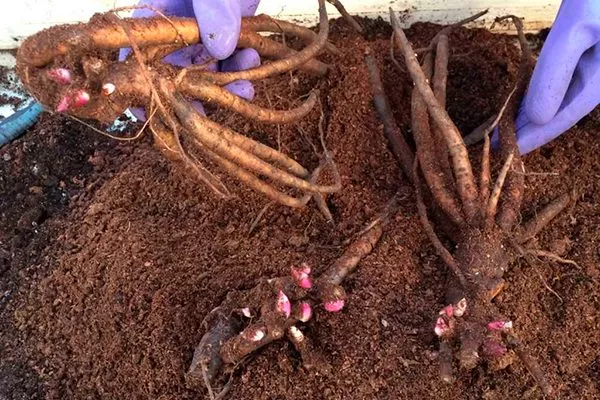
- Dividing the bush. Suitable for plants aged 5-7 years. The optimal time for this procedure is mid- to late August. Dig up the bush and rinse the roots in a weak solution of potassium permanganate. Divide them into sections, leaving 3-5 developed buds on each.
Treat the resulting rhizome sections with a fungicide to prevent fungal diseases. Plant them in separate holes. - Obtaining plants from root cuttings. This method is the most economical. Dig the soil to a depth of 12-15 cm after the spring snow melts. Cut off the rhizome sections with buds using a shovel. Cover the remaining portion with humus and ash.
After the shoots grow and the bush recovers, additional rhizomes can be obtained from them for replanting. - Reproduction by Shlomin's method. This method is based on growing vertical layers. In the spring, place tall tin cans, open at both ends, over the shoots emerging from the soil. As the stems grow, add equal parts humus, soil, and sand.
By fall, individual roots will appear on each shoot. In September, trim each shoot below the jar and separate it from the mother plant. Plant it in a separate hole.
Provide proper care. This includes regularly providing the necessary conditions for its growth and development during the growing season, which is the key to abundant flowering next year.
Advantages and disadvantages
Before planting, research the variety's pros and cons to avoid any unpleasant consequences. Etched Salmon has many advantages:
Among the disadvantages, flower growers note the slow growth rate and the high cost of planting material.
Reviews of the Etched Salmon peony
The Etched Salmon peony is a popular variety that gardeners in our country have recently begun to cultivate. Many have come to appreciate its appearance, low maintenance, and ease of care. To ensure the plant remains disease-free and blooms abundantly, it's important to follow basic care procedures.