
Peonies are renowned for their beauty and ease of care. In recent years, hybrid varieties, distinguished by their exotic appearance, have become increasingly popular. One popular variety is the Julia Rose, which attracts attention with its unusually colored buds and large blooms.
Who developed the variety and when?
Developed in the 1990s by an American breeder, the variety quickly gained popularity and spread worldwide. Today, it is highly prized not only abroad but also in domestic gardens.
Description of the Itoh peony Julia Rose
A compact and well-proportioned bush with upright shoots and sturdy stems, it reaches a height of 80 cm. Its dark green leaves have an elegant, lacy texture. A single plant produces an impressive number of buds—40 to 50.
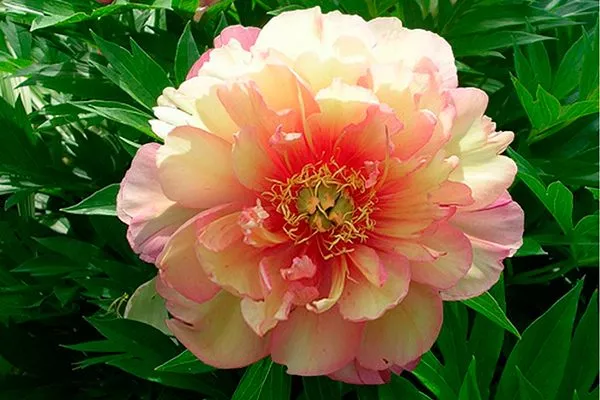
Large, semi-double flowers, 18 cm in diameter, open a rich, dark pink, gradually lightening to a pinkish-orange. Later, the flowers acquire a creamy yellow with delicate pink highlights. Lush blooms of various shades are also present.
The flower petals are curved and silky to the touch. Golden stamens and light green pistils with creamy stigmas are located in the center. It has a pleasant, light fragrance.
- ✓ The presence of golden stamens and light green pistils with cream-colored stigmas.
- ✓ Flower color changes from dark pink to creamy yellow with pink tints.
Characteristics
Julia Rose inherits the best qualities of its parents. Its frost resistance, like that of herbaceous peonies, allows it to survive the winter without shelter. The flower shape and color of tree peonies add a decorative touch.
Features of flowering
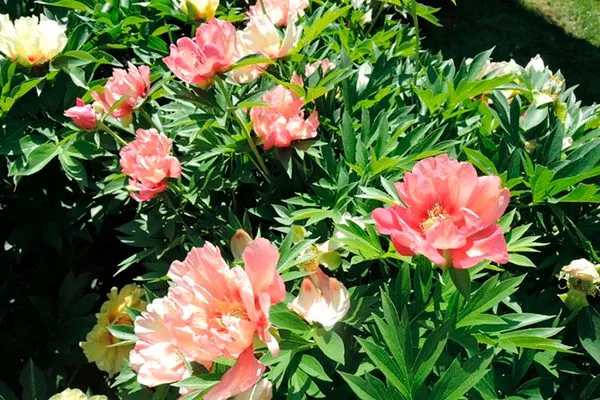
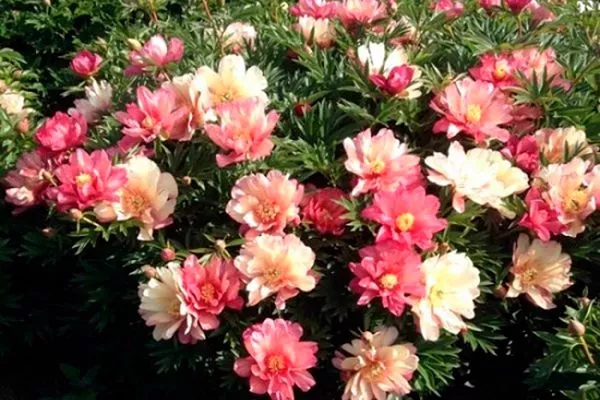
Abundant flowering begins in mid-May and continues until mid-July, and in some cases even longer.
Application in design
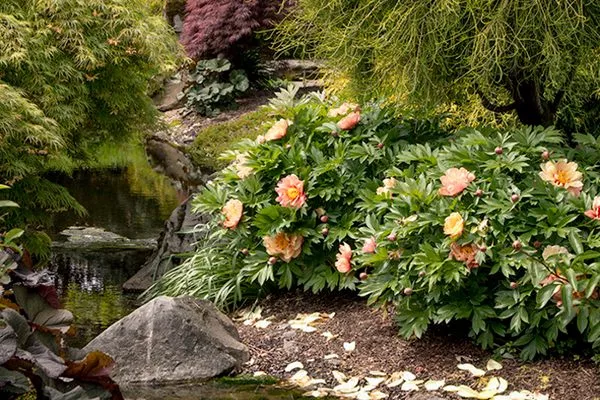
Lush shrubs can be a standalone garden decoration, but skillful combinations with other plants can create a unique landscape design. Below are some suitable options:
- Small-leaved plants are planted next to Ito hybrids to create a play of contrasts. They are often placed next to larger trees.
- The delicate buds of pastel colors will be emphasized by the rich greenery of the juniper.
- Peonies are a picturesque addition to lawns along paths. Low-growing plants are planted along the edges, and the plants are arranged in a second tier or in separate groups of 3-4 bushes.
- The hybrid's foliage retains a rich green hue throughout the season, making it popular with landscape designers.
Methods of reproduction
Since the Julia Rose peony is a hybrid, it is propagated exclusively vegetatively to preserve the variety's unique characteristics. Use the following methods:
- Stem cuttings. Use a strong shoot with an unopened bud from a healthy bush that's at least 3-4 years old. Trim the upper leaves by half and remove the lower leaves completely. Dip the cutting in a growth stimulant and plant it at an angle in loose, moist soil.
Cover it with a cut-off bottle or film to create a greenhouse effect. Ventilate it regularly. Roots and buds will form in the places where the leaves were removed. - Layers. Rake fertile soil around the young stems, hilling them up to a height of 30 cm. Water the shoots along with the main plant throughout the summer. In the fall, dig up the hilled stems and trim them off if roots appear at the bottom.
Replant the resulting specimens in a new location. Pinch off the buds on the selected shoots to prevent flowering and direct resources toward root development. - Dividing the bush. Cut the above-ground portion back to 10 cm in early September. Remove the bush from the ground and divide it into several sections, each with 3-4 buds. Treat the sections with a solution of potassium permanganate or wood ash to prevent rot. Replant in new holes.
- ✓ Soil temperature should be at least +15°C for optimal rooting.
- ✓ Air humidity in the greenhouse should be maintained at 85-90%.
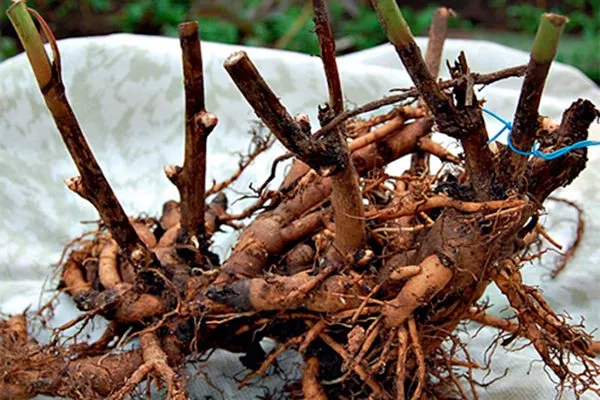
The most popular method is considered to be the method of dividing the rhizome.
Landing rules
The optimal time for planting is late August to early September. Choose plants that are at least 4-5 years old and have 6-7 stems.
Helpful tips:
- Remove any rotted parts and leaf debris from the cuttings. Treat the cuts with Fitosporin-M or HOM to protect against disease.
- Choose a raised, well-drained site with neutral or slightly alkaline soil. The soil should be frost-free to allow the plants time to establish.
- Prepare holes approximately 80 x 80 cm in size. Fill 2/3 of the hole with garden soil, adding 200 g of each of humus, manure, wood ash, bone meal, and double superphosphate. Add sand if the soil is clayey.
- Treat the seedling's roots with root stimulants. Place the rhizome in the center of the hole and lightly sprinkle with a sand-ash mixture to prevent rot. Cover the division with a 3-7 cm layer of soil.
Aftercare
The crop thrives when properly cared for. Follow these basic agricultural practices:
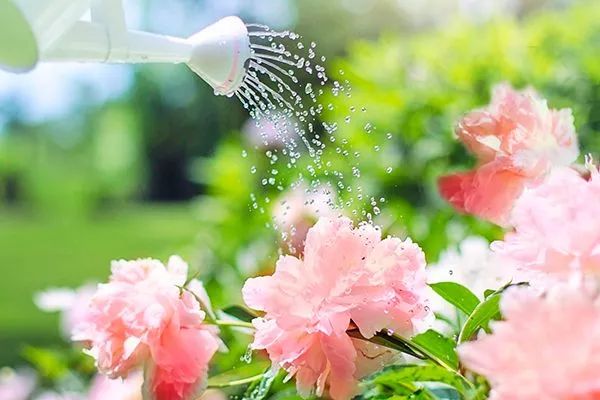
- Watering. Use soft, warm water. Water frequently, but avoid over-wetting the soil to avoid damaging the plant.
- Top dressing. Fertilize three times per season. Apply the first fertilizer in early spring, before flowering, using both mineral and organic fertilizers. Apply the second fertilizer during budding, and the third two weeks after the buds have finished opening.
- Mulching and loosening. This is essential for long-term soil moisture retention. After each watering, thoroughly loosen the soil to ensure oxygen and moisture reach the roots.
- Trimming. In the fall, trim the stems, completely removing the leaf blades. Treat the cut areas with crushed charcoal. This procedure is performed after the first frost.
Transplant to a new location only if absolutely necessary, usually combining this process with dividing the bush.
Preparing for winter
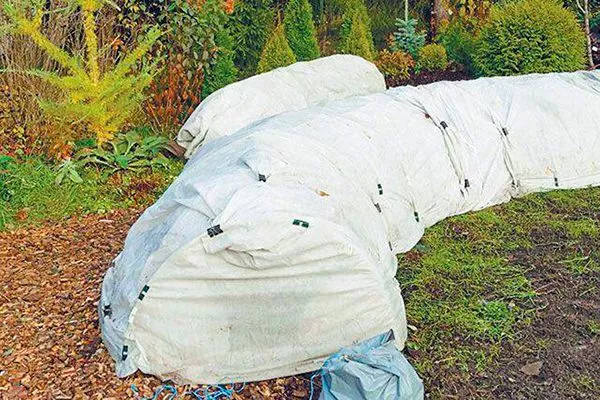
It can withstand frost and can be grown even in northern regions. To protect it from extreme temperatures, it's best to build a basic shelter. When cold weather sets in, mound up the remaining stems with soil. Fill the flowerbed with dry leaves or other organic matter to a depth of at least 10 cm. Cover with non-woven fabric, securing it to the sides.
Pests and diseases
Julia Rose is considered a disease-resistant variety, rarely subject to pest attacks. However, in conditions of significant temperature drop or high humidity, the bushes may be susceptible to gray mold.
To ensure protection of plantings, it is recommended to periodically change the composition of the fertilizer and adjust the amount of moisture during watering, taking into account changes in weather and climate conditions.
Among the pests, the most dangerous are:
- whiteflies;
- ants;
- aphid;
- scale insects.
If you spot insects in the early stages of growth, use folk remedies. Effective methods include a solution of finely ground laundry soap and a decoction of chamomile and dandelion. If the pest infestation is limited, use a decoction with wood ash.
If folk remedies fail, use insecticides to spray your crops. Effective options include:
- Confidor Extra.
- Diazinon.
- Imidacloprid.
- Bioshield.
Reviews of the Julia Rose peony
The Julia Rose peony is a true gem in the garden. Its flowers are among the first to open and delight with their blooms for several weeks. The plant is very hardy, resistant to frost and drought. It requires minimal care—watering, fertilizing, and pruning of spent buds. It's suitable for both experienced and novice gardeners.