
The Bartzella peony belongs to the Itoh group, as it is a hybrid created by crossing peonies and tree-type plants. The group's founder is Ito Toichi, and the Bartzella variety is named after the family pastor, Bart. The flower is characterized by increased hardiness, frost resistance, and ease of cultivation. It has a spreading bush with abundant foliage.
History of creation
The Bartzella peony is considered to have originated in America. It was here in 1986 that a hybrid was created by crossing the Kinko tree peony and the Kakoden herbaceous peony. However, some sources claim the flower's origins date back to 1974. Roger Anderson, a devoted student of Ito, is considered the creator. The hybrid has won several awards.
Description and characteristics
This variety is a perennial herbaceous plant that can be grown for 10 years without replanting. It is intended for cultivation in the central, southern, and central regions of Russia, but it can also be successfully planted in harsher climates.
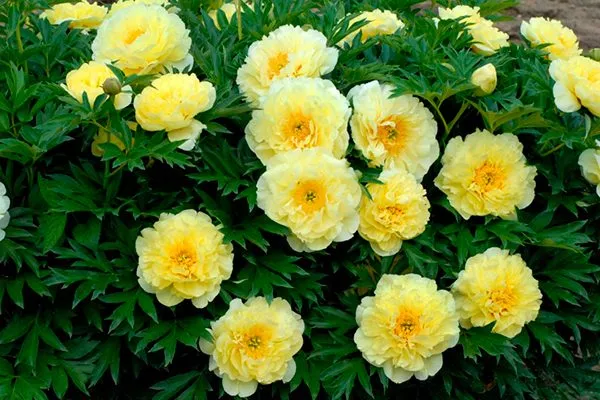
Appearance of plants
The hybrid is distinguished by a fibrous, shallow root system that grows rapidly and maintains strong soil hold. Key features:
- bush height – from 80 to 115 cm;
- crown width – 80-90 cm;
- stems are thick and strong, covered with bark at the bottom;
- the shape of the bush is round and neat;
- foliage - dense, dark green or emerald in color, with fine dissection along the edges;
- buds – reach up to 30 cm in diameter, semi-double type;
- the number of buds on one bush is minimum 20, maximum 60 pcs. (depending on the age of the plant);
- color – bright lemon yellow with a pink or red center;
- stamen type – fluffy golden;
- pistil - has a light green tone;
- The aroma is pleasant and delicate, with notes of lemon.
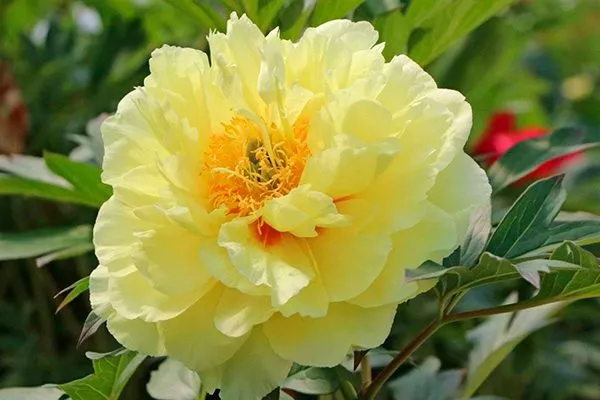
Features of flowering
The first flowering occurs in the second year after planting, but during this period, the bush produces only a minimal number of buds. The bush begins to flower in its third year in the south and in the fourth year in cooler climates. Buds begin to open after June 10, and the flowering period lasts about 30 days.
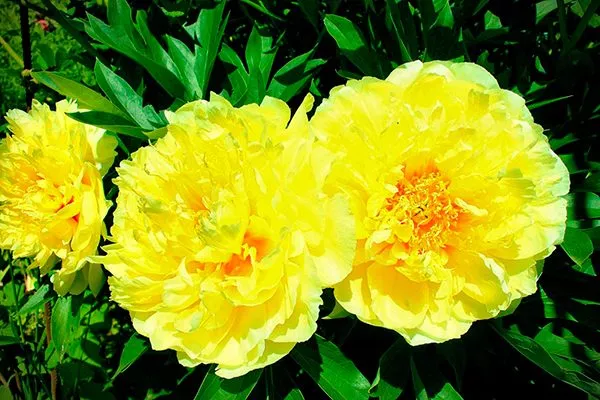
Frost resistance
Hardiness zone 5, the bushes can withstand temperatures as low as -29°C (-29°F). The hybrid is known for its ability to self-recover after winter, but experts recommend insulating the bushes to ensure longer and more profuse flowering.
Where is the best place to plant?
Due to the characteristics of their root system, seedlings can be planted near fences and buildings, but gardeners recommend maintaining a distance of 1.5-2 meters to prevent water from running off the roof onto the buds during rain. The plant prefers full sunlight, so even semi-shaded areas are not suitable.
Do I need to tie it up?
Since the stems are strong and woody on the underside, the plant doesn't need staking. However, if the peony is grown in a region with strong winds, it's best to tie it and attach it to a support.
Itoh peonies Bartzella and Garden Treasure: comparison of varieties
This hybrid is often confused with another Itoh peony, Garden Treasure, because both flowers have a rich yellow hue and a reddish spot in the center. However, Bartzella is 20 cm taller, and its buds are wider. There are other differences, too:
| Parameters | Bartzella | Garden Treasure |
| Arrangement of petals | Compacted, core covered. | Medium density, the middle is visible. |
| The period of the beginning of flowering | Mid-June. | The last days of May. |
| Frost resistance | Up to -29 degrees. | Up to -34 degrees. |
| Smell | Delicate, lemony. | Strong, floral. |
| Preservation of decorative qualities in one place of growth | Maximum 10 years. | Over 10 years. |
| Leaf color | Dark green with an emerald tint. | Classic green with bluish and reddish notes. |
Application in design
The hybrid's high decorative value makes it suitable for landscape design. The bushes look beautiful both singly and in groups, and combine well with other plants. They are planted along garden paths and fences, creating a low hedge.
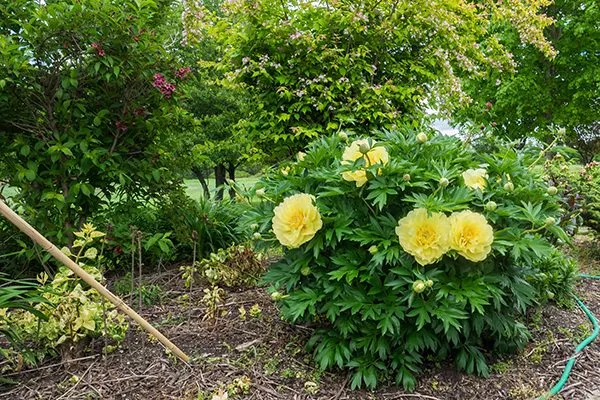
They look impeccable among evergreen shrubs and simply on the lawn. Yellow flowers and heavily foliated shrubs are planted near gazebos, benches, stairs, fountains, etc.
What plants pair well with Bartzella peonies?
- petunias – help peonies stand out from the crowd;
- lobelia – blue and purple shades are suitable;
- Brachycomas - successfully shade peonies;
- Alyssums - it is better to plant white, pink or lilac flowers;
- roses – best combined with red shades;
- irises - blue ones will do;
- hostas – peony bushes will look more lush;
- astilbes – create a frame for peonies;
- phloxes – enliven the space;
- nasturtiums - only orange and red flowers are used;
- tulips – will help decorate the flowerbed before budding;
- daffodils - it is better to plant white ones;
- bells - decorate the lower part of the peony;
- zinnias - planted in the foreground;
- delphiniums - blue perennials are needed;
- cornflowers are an ideal option for the foreground and the surrounding space;
- Peonies - only white and red.
Bartzella is used to create festive and ordinary bouquets - peonies do not fall off for a long time when kept in a vase with water.
Advantages and disadvantages of the variety
Landing
Planting procedures are standard, but it is important to pay attention to some requirements for varietal value:
- Boarding time. In the southern regions and the Moscow region, the hybrid can be planted in both spring and fall, but in cold climates, only in spring. Otherwise, the young and still fragile bushes won't have time to adapt before the frosts.
The optimal time is the last days of May or the first of June in spring and 1-1.5 months before the expected frosts in autumn. - Priming. Bartzella absolutely does not tolerate high acidity, so liming is necessary beforehand. The soil should be moderately loose.
- Plot. Peonies grow best in elevated areas free from stagnant water and cold drafts. The site should be well-lit; partial shade is acceptable only in the afternoon and for no more than 2-4 hours.
- Preparing the seedling. For growth to resume after planting, the seedling should have approximately four buds and the same number of living root shoots. For rapid rooting, experts recommend soaking the plant's roots in a rooting medium.
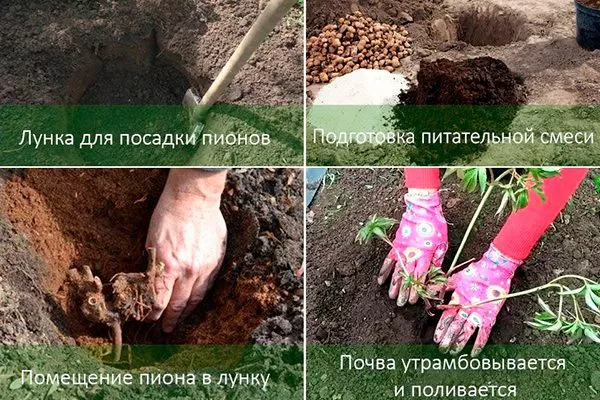
But first, they should be cleaned of mold and dryness, then sprinkled with wood ash. It's also advisable to perform additional disinfection by dissolving 2 grams of potassium permanganate in 5 liters of water. - The landing process. Planting is carried out according to the standard scheme, but for this hybrid it is important to take into account some points:
- First, the soil is dug up to the depth of 2 shovel blades;
- the hole should be 60x60 cm in size;
- drainage layer – minimum 10-12 cm;
- Add 2 parts of deoxidized peat and garden soil, 1 part of humus, 200 g of superphosphate, 150 g of crushed charcoal and 10-12 g of copper sulfate to the planting hole;
- The buds and root collar should be located 3 cm above ground level.
Critical parameters for a successful landing- ✓ Check the soil acidity level before planting using a pH meter, the optimal pH level should be between 6.5 and 7.5.
- ✓ Make sure that the drainage layer consists of expanded clay or broken brick, not sand, to avoid water stagnation.
Reproduction
The Bartzella peony cannot be propagated by seed, as it is a hybrid. Therefore, the parent's characteristics are not preserved. However, there are other ways to increase the number of bushes in a flowerbed:
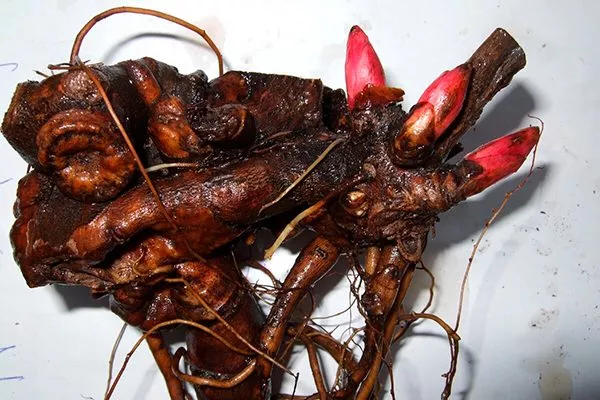
- By dividing the bush. This is the most popular method, as the bushes bloom the following season, and under favorable conditions, even in the year of propagation. To do this, the bush is dug up and divided into several parts, after which they are replanted.
The favorable period is April-May. The bush is at least 3 years old. - By cuttings. It's most often used to renew the root system. The first flowering occurs only five months after propagation. To do this, cut the healthiest stems with 2-3 internodes in the fall, place them in containers for root growth, and transplant them to their permanent location in the spring.
It's important to maintain a temperature of 18-20 degrees Celsius. The shrub must be at least 5 years old. - By layering. This method requires young, flexible shoots. They are bent into a trench in the ground in the spring, and the following year, they are separated from the mother plant and replanted.
Care
Peonies are undemanding in care. Simply follow these steps:
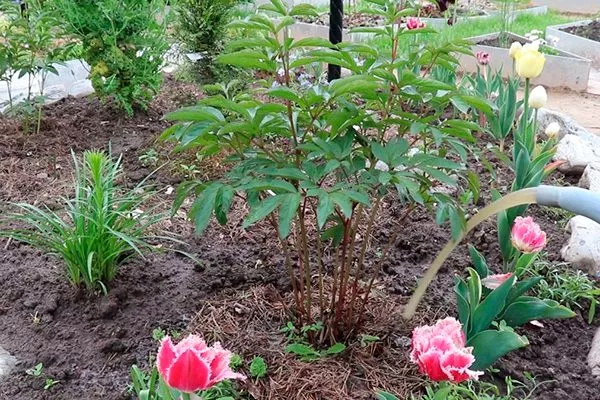
- Top dressing. Apply three times during the growing season. Before flowering, apply urea or carbamide (50 g per 10 liters of water). After flowering and in preparation for winter, apply superphosphate according to the instructions.
- Mulching and loosening. It is carried out after each irrigation of the soil.
- Watering and irrigation. The optimal watering frequency is once every 6-8 days. The recommended amount of water is approximately 15 liters. Avoid overwatering the soil.
- Pruning and replanting. Pruning involves removing buds at the beginning of flowering during the first three years. This will allow for abundant budding in the future. Furthermore, during the first few years of life, flowers are not large, which is not very attractive.
During the first 10 years, the bushes do not need to be replanted - only as needed.
Preparing the Bartzella peony for winter
To ensure a peony survives the winter safely, it needs to be properly prepared. Since the hybrid can withstand temperatures as low as -29°C (-29°F), it only needs to be insulated in cold climates. Here's what you need to do:
- Around September, the bush begins to fade, so at this time, all soft shoots are cut back and the foliage is removed. The lower, woody part is not removed. In the south, the bush can be pruned lower; in the north, at least 10-15 cm should be left.
- The tree trunk area must be cleared of any remaining vegetation and other debris, after which the bush must be thoroughly loosened and hilled.
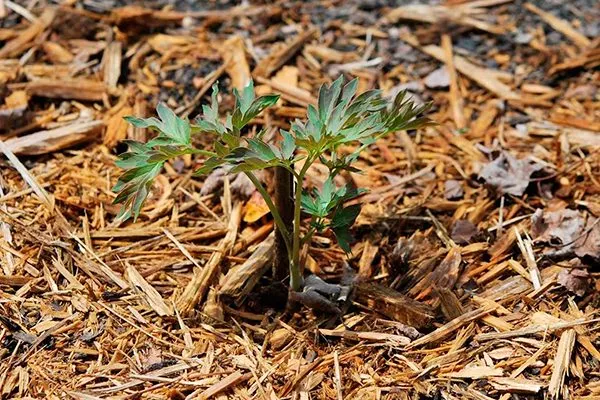
- The next step is to lay down a layer of mulch material about 20 cm thick.
- If necessary, the bushes are covered with spruce branches or wrapped in non-woven agricultural material.
Pests and diseases
Bartzella is considered resistant to diseases and pests, especially the latter, so preventative treatments in the spring are unnecessary. However, disease control is important, as the bush is sometimes affected by powdery mildew, rust, gray mold, and ring mosaic.
Problems with growing Bartzella peony
Despite the hybrid's increased hardiness, some problems do arise. These are most often encountered by novice gardeners.
The peony does not bloom and does not grow.
If a bush hasn't grown for a long time and refuses to bloom, the cause is most likely root disease. However, if the flower appears completely healthy, consider other negative factors:
- lack of sunlight;
- violation of planting rules (incorrect depth, lack of fertility, too acidic soil, etc.);
- lack of nutrients in the absence of supplementary feeding;
- the soil is too compacted.
Why doesn't the Bartzella peony hold a flower?
Itoh peonies are distinguished by the fact that their buds are firmly attached to the stem, so if the flowers fall off, it's an abnormal occurrence. The main cause is overwatering of the soil and a rainy summer. In this case, the petals fall off within five days of opening.
What you can do is immediately remove the mulch, avoid watering for a while, and tie the bush to a support. If the soil becomes excessively waterlogged, you'll need to replace the potting mix—this will quickly resolve the problem.
Reviews
The Bartzella peony is considered an easy-to-care-for plant, easy to maintain even for a novice gardener. However, to avoid problems, it's important to take a responsible approach to planting and care, fertilizing and watering the bush regularly. This will ensure lush blooms and healthy plants every year.