
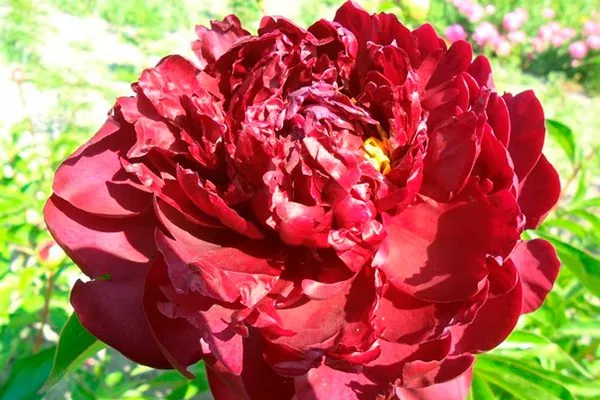
The Armani peony is a variety with a deep burgundy color and long, lush blooms. It is disease and frost resistant and requires little special care. It boasts a medium bloom time and is versatile in its uses.
Who developed the variety and when?
The variety was developed by the Dutch agricultural company Heemskerk Vaste Planten/Perennials. The exact year of selection is unknown, but it is known to have occurred at the end of the last century.
Description
Armani is distinguished by the luxurious appearance of both the buds and the shrub. The plant can be recognized by the following characteristic features:
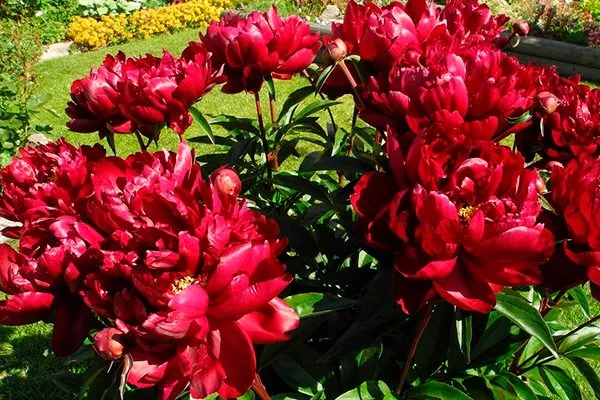
- Bush. Its height varies from 80 to 100 cm, but is most often around 90 cm. Its width is exactly the same, so the shrub is considered spreading. However, it has upright shoots with little branching. The stems are very strong, so supporting posts are not needed nearby.
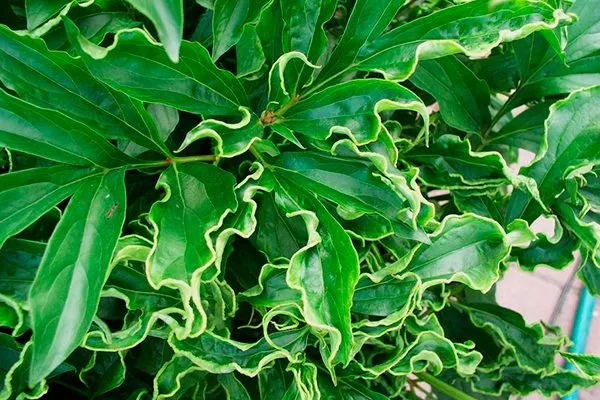
If there are too many buds during flowering, the branches may slightly bend to the sides. The leaves have a glossy surface and a dark green hue. They are lacy, slightly fluffy, and arranged alternately. In autumn, the foliage turns a vibrant burgundy-red. - Buds. During the growing season, they can change color—initially ruby red, later becoming a dark burgundy red. The flowers are spherical, with a lower skirt of double petals.
The size is large, about 20 cm in diameter. The petals are rounded and have a satin-silk surface. They are larger at the base of the flower and smaller in the center. A single bud contains 80-100 petals. - Roots. Very strong and thick, branched.
Flower characteristics
Armani can be grown in the same location without replanting for up to eight years. The shrub's lifespan is 20 years. It belongs to the eukaryotes, the angiosperm group, the dicotyledonous class, and the saxifrage order. Among red peonies, it is dark-colored.
Other characteristics:
- frost resistance is high, since the shoots do not freeze at temperatures down to -40 degrees, so they can be grown even in harsh climatic conditions (but with cover, and without it in other regions);
- wind resistance is excellent, due to which the buds do not shed their petals or fall off when exposed to the wind, and the stems do not break;
- drought resistance – at a high level, the plant is not afraid of hot weather and can withstand short-term drought;
- sun exposure - petals do not fade under the sun's rays, do not get burned, plants do not need to be shaded after lunch.
Features of flowering
Armani is characterized by a late flowering period, as buds begin to form in June. They bloom in late June and fade within 3 or 4 weeks. The first flowering occurs in the second year after planting, and the peak occurs the following season.
Application in design
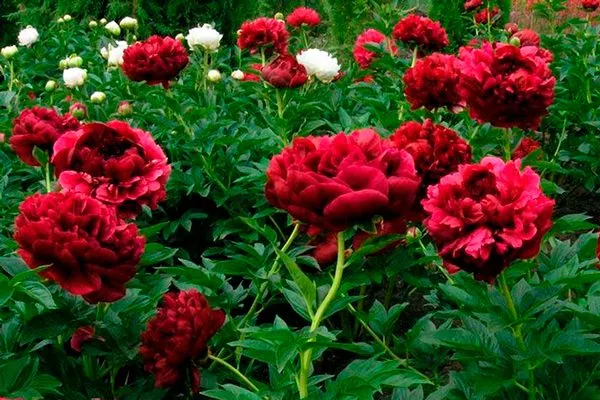
Armani peonies are often included in garden design projects because the flower pairs harmoniously with almost all crops and its relatives. The dark burgundy color looks striking against the light and pale buds.
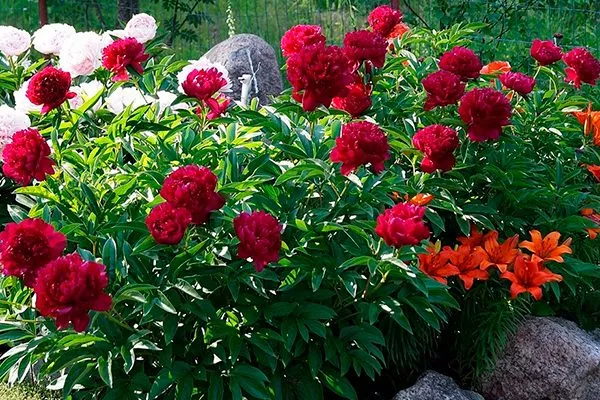
This means that Armani is chosen as a companion plant, not a companion plant. Its dominant position allows peonies to be planted alongside alchemillas, ornamental onions, daisies, columbines, geraniums, irises, tulips, begonias, violas, marigolds, yarrows, eryngiums, and grasses.
Peonies offer all possible options, making them a versatile variety. Florists use them because the cut buds retain their decorative qualities for at least 15 days.
Methods of reproduction
Armani can be propagated by absolutely every method available to peonies, including seeds, although experienced gardeners eschew this method. The reason is simple: it's labor-intensive, expensive, and time-consuming to obtain a seedling.
The following are great for beginners:
- Cuttings. The best time is early fall, as in spring, when the weather stabilizes at 15 degrees Celsius, the cuttings are transplanted to a permanent location. Shoots should be taken from a mature bush, starting at five years of age. The first flowering occurs in the fourth year.
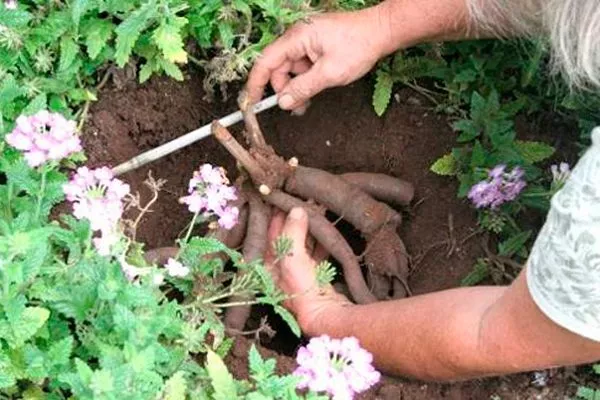
- Dividing the bush. The event takes place from mid-August to mid-October, depending on climate conditions. The bush is 3 to 6 years old and blooms in the spring.
- Trimming. Another simple and effective method involves separating a portion of the rhizome and its shoots and replanting them. This is a kind of dividing the bush, but without digging it up.
Landing rules
The algorithm for planting seedlings is standard, but there are varietal requirements that dictate their own instructions:
- Selecting a location. It should be in exceptionally sunny conditions. This applies to all regions of Russia except the south, where the sun is excessively scorching. This will result in a slight lightening of the petal color. The plant itself will not be harmed. Keep in mind that shade will result in a complete lack of budding.
- Time. Only autumn, starting from the end of summer and ending in mid-September.
- Priming. The lushness of the flowers and the duration of their bloom depend on the quality of the soil; it must be as fertile as possible. The optimal soil structure is loamy, with a neutral pH. Organic matter must be added to the planting hole.
- Distance. Due to the large diameter of the bush, the distance between plantings should be at least 100-120 cm.
- ✓ Make sure that the area is not subject to stagnant water, especially in the spring.
- ✓ Check the depth of groundwater – at least 1.5 m from the surface.
Aftercare
There are few nuances to caring for this variety. Just remember the basics:
- water once a week, adding 20 to 30 liters of water, but from the end of May to mid-August, 2 times a week;
- Do not apply water right to the root; leave at least 20 cm away from it, otherwise the roots that absorb moisture will not reach the liquid;
- Loosen the soil once a month;
- in spring, feed with organic matter and urea, and during flowering, with phosphorus and potassium twice;
- Be sure to mulch the tree trunk area – this requirement cannot be ignored.
Preparing for winter
Armani does not require shelter in all regions except northern ones, but the plants need to be prepared:
- Cut all shoots to a cutting height of 5 cm.
- Feed the plant. For this, use autumn peony fertilizers—approximately 30 g of Autumn fertilizer per square meter.
- Lightly hill up and mulch.
- Sprinkle with dry leaves or spruce branches.
Pests and diseases
Armani is considered a pest- and disease-resistant variety. However, if cultivation practices are not followed and weather conditions are unfavorable, it may be susceptible to certain diseases:
- rust - treated with Bordeaux mixture;
- gray rot - use Bordeaux mixture or Thiram;
- powdery mildew - it is enough to spray with a solution of laundry soap and soda ash;
- Lemoine's disease - is not treatable.
Among the pests, aphids, rose chafers, and thrips pose a threat. Insecticides or folk remedies, such as yarrow infusions and laundry soap solutions, are used against them.
Reviews
The Armani peony is a true gem for any garden. It boasts high frost resistance and other characteristics, but it's important to follow proper gardening practices to ensure the plant maintains a strong immune system and is disease-resistant. Avoid shaded areas and close planting with large shrubs and trees.