
Creating favorable conditions for overwintering pelargonium, also known as indoor geraniums by gardeners, is key to maintaining its health and attractiveness. This article will teach you how to choose the right location for this plant in your apartment and care for it during the cold season.
Rules for caring for flowers in winter
This easy-to-care-for houseplant is not difficult to care for. However, during the winter months, it requires extra attention and care.
Florists follow these rules for winter flower care:
- cool;
- abundance of light;
- reduction of watering;
- minimum of feeding.
Preparing indoor plants for winter
Winter for pelargoniums is a dormant period, which it needs to rest and recuperate. Gardeners begin preparing the plant for winter as early as September:
- gradually reduce the room temperature to +16-18°C;
- increase the time interval between waterings;
- remove emerging buds;
- Pelargonium is pruned, removing half of its crown (this measure will provide the flower with more uniform lighting in winter and reduce the risk of fungal attack).
Conditions required for a flower in winter
To ensure a successful wintering of indoor geraniums, gardeners try to create the most favorable conditions for them in their home.
Lighting
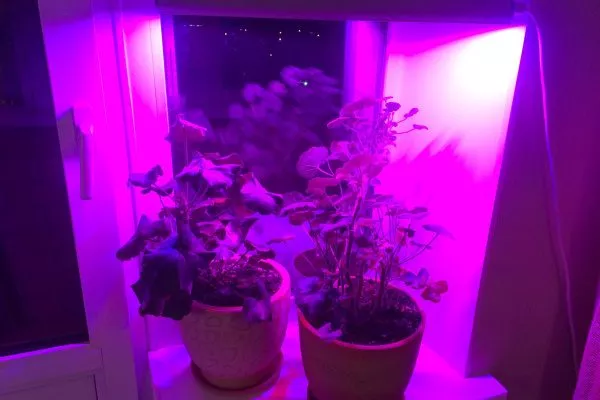
Pelargoniums require a long daylight period of at least 12 hours. Placing them on a windowsill and using phytolamps can provide this during the winter.
Air temperature and humidity
For the winter, move the plant to a cool room. A north-facing window is preferable. Make sure the foliage doesn't come into contact with the cold glass. Place the pot on a stand to protect the root system from freezing.
Maintain the temperature on the windowsill where the pelargonium overwinters at the following level:
- not less than +10–12°С — at night;
- +12-15°С — during the day.
Watering
Winter care for pelargoniums requires reducing the frequency of watering. If the plant is kept in a cool room, moisten the soil in the pot once every 7-10 days.
The soil in a potted geranium should be slightly moist, but not wet. Overwatering can cause problems for the plant:
- fungal root infestation;
- their decay;
- death.
Water the plant with soft, settled water. It's best if it's lukewarm.
Also watch a video about watering pelargoniums in winter:
Top dressing
Fertilize the flower during the cold season with the following frequency:
- Once every 30 days - if it is in a cool room;
- Feed even less often or completely avoid it if you keep the plant warm.
Feed the plant with a complex mineral fertilizer containing potassium, magnesium, zinc, iron, and copper. It should contain minimal nitrogen. Apply the fertilizer only after watering the plant.
How to prune pelargonium for winter?
Experienced gardeners prune pelargoniums before winter. This procedure is performed in the fall. It ensures the plant's health, encourages the production of side shoots, and promotes abundant flowering the following season.
The need for autumn pruning varies for different types of indoor geraniums:
- This procedure is contraindicated for variegated varieties; they are pruned in the spring;
- For the ampelous variety, pruning before winter will be beneficial (this type of flower is usually pruned as the crown grows);
- royal geranium needs to be pruned to a stump before winter;
- Miniature flower species do not require pruning.
Pruning pelargonium should be done step by step:
- Hand-pick off any leaves that look wilted or dried out.
- Remove every weak or unnecessary (thickening) branch, as well as shoots growing inward into the crown.
- Cut off spent flower clusters. Don't forget to remove any blooming buds to ensure the geraniums have enough leaves to survive the winter.
- Prune the shoots, leaving 10-15 cm from large branches. Leave four bud nodes on each branch, which will later give birth to new shoots with flower stalks.
- Dust the cuts with activated carbon, crushed into powder.
After the procedure, monitor the condition of the cuts. If they turn black or begin to rot, trim the shoots again (down to living tissue).
Watch a video about pruning pelargoniums:
How to replant pelargonium in winter?
It's not customary to repot the plant during the winter months. This is its dormant period. Disturbing it during this period is undesirable. Repotting it into a new pot can cause stress and illness.
Experienced gardeners perform this procedure in the spring (before flowering) or in the fall. In winter, the plant is repotted only in emergency cases:
- if its roots have started to rot due to over-watering of the soil in the pot;
- if the flower is affected by bacterial or fungal diseases;
- if the potted inhabitant has suffered from harmful insects.
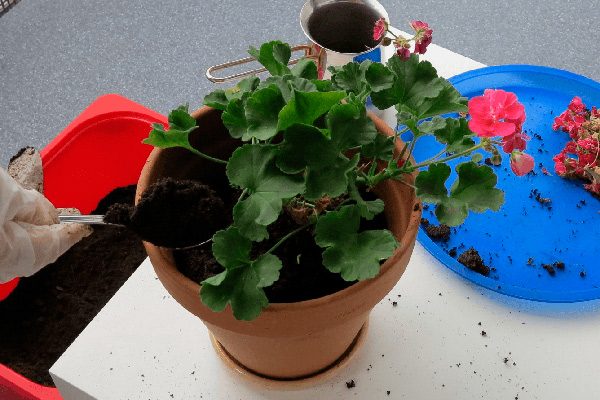
The transplant is carried out using standard methods.
Is it possible to propagate in winter?
During January and February, it is permissible to propagate pelargonium in one of two ways:
- seeds;
- cuttings.
Sow seeds either in a common tray with moist substrate or in peat pellets. Plant at a depth of no more than 0.5 cm.
The remaining cuttings after pruning are also suitable for propagating the flower. They must meet the following requirements:
- have several leaves;
- have 2-3 live "dormant" buds.
Before planting the cutting in the substrate, place it in a glass of water. Keep it there until roots appear. Then transplant the cutting into a pot with suitable soil and cover it with a transparent jar. This greenhouse will help the young plant take root faster.
Possible problems and their solutions
During the winter months, gardeners growing pelargoniums at home often encounter the following complications:
- Yellowing and shedding of foliage. Drafts and dry indoor air are the cause of this problem. Placing a container of water next to the pot and protecting the plant from drafts will restore its healthy appearance.
- Drying of the leaf blade along the edge. This is a sign of a nutrient deficiency, which affects pelargoniums. Applying a fertilizer (a complex fertilizer designed for geraniums) will help solve the problem.
- Blackening of the trunk, wilting of the flower. These are symptoms of gray mold. Pruning and then repotting the plant in a new pot with fresh potting mix will help save it.
- Curling of leaves. This is a sign of a bacterial infection. The solution is to prune the pelargonium, repot it, and spray it with Oxychom.
- Plant stretching. The complication is caused by insufficient light. Supplemental lighting with phytolamps will be required.
- Drying of some buds. The problem arises when moving the flower pot from one location to another. Pelargonium bud drop is a normal reaction to stress.
- Stunted growth, yellowing of foliage. These are signs of root rot, caused by overwatering the potted soil. Removing the rotted roots and repotting the plant in a new pot with fresh soil will help save the plant.
If you properly prepare your pelargonium for winter, provide it with favorable conditions and good care, it will remain healthy and attractive. A plant that has successfully survived the winter will thank you for your care with luxurious blooms next season.