
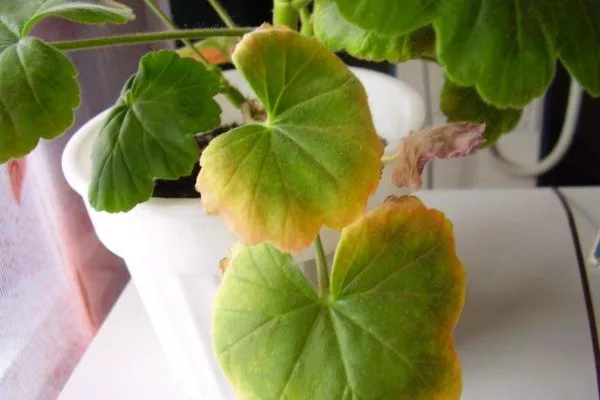
If your pelargonium turns yellow, you'll need to take immediate action, as inaction often leads to the plant's death. The first step is to determine the root cause or a combination of several negative factors. Based on this, you can proceed further.
Main reasons
The main reason for the drying out of green mass pelargoniums (or geraniums, as the plant is commonly known) is a violation of care and other rules. Although the flower is considered undemanding, there are many nuances that affect the overall condition and health of the plant. Pay special attention to these.
Problems with transplantation
The main difficulty is that pelargonium bushes are very sensitive and fragile, making them easily damaged during transplanting. This is especially true if the root ball is shaken off during planting. This is absolutely undesirable with this plant, as the roots are easily broken, leading to deterioration. As a result, the seedlings have trouble establishing.
Another factor is removing the plant from its old pot without first moistening the soil. This is also unacceptable, so it's important to first moisten the soil, leave it there for 1.5-2 hours, and only then repot.
Incorrect capacity
Don't just plant pelargoniums in any pot you come across—you need to strictly follow the experts' recommendations. If the pot is chosen incorrectly, the plant will suffer, which will be reflected in the foliage, which will turn yellow.
- ✓ The pot material must be porous to ensure air exchange for the roots.
- ✓ Mandatory presence of drainage holes to prevent water stagnation.
Peculiarities:
- If the pot is too small, the root system has no room to expand, causing the plant's growth to completely stop. This is especially dangerous for plants over three years old. This also manifests itself as leaf shedding and severe dehydration.
- When a container is too loose, the root system rots. It turns out that with too much empty space (without roots), the substrate barely dries out after watering, since there's nothing to absorb the moisture. As a result, fungal diseases develop.
Another reason is that the roots begin to activate their growth, so all their energy is expended solely on this. There's not enough energy and nutrition for the development of green mass, so the leaves turn yellow and dry out.
Poor or no drainage
No indoor plant can thrive without a drainage system, especially pelargoniums, which are often susceptible to rot. This is caused by water stagnation. To prevent this, create a drainage layer. Special materials such as expanded clay and similar materials are available at flower shops for this purpose.
If you can't buy these, you can use broken brick, pebbles, shells, or any medium-sized stones. A drainage layer of about 2-5 cm is required, depending on the size and age of the plant.
Incorrectly selected soil
Pelargoniums thrive in well-drained, breathable, and very loose soil. It should be light, so experts recommend purchasing special geranium substrates.
You can make them yourself. You need to take the following ingredients in equal proportions:
- river sand;
- peat;
- turf soil;
- humus.
Failure to comply with growing conditions
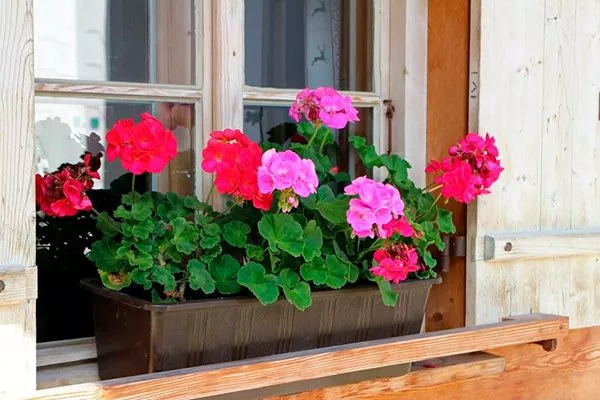
Pelargoniums require specific growing conditions. If they aren't met, the plant will respond negatively with yellowing foliage. This is only the first warning sign. Subsequently, various diseases develop, pests appear, the plant dries out or rots, ultimately leading to its complete death.
What causes yellowing of leaf blades and stems:
- Insufficient or excessive lighting. Geraniums absolutely hate shade, but excessively bright light is also undesirable. It should be diffused, moderate, and present for 12-14 hours a day. South- and east-facing windowsills are ideal for this.
But in winter this won't be enough, so be sure to purchase grow lights or fluorescent lighting fixtures. Turn them on in the evening and early morning. - Increased air humidity. As mentioned above, high humidity is critical for pelargoniums. This applies not only to the soil but also to the air. For this reason, spraying the plant directly onto the foliage is prohibited.
The problem is that any remaining drops immediately affect the delicate structure of the stems and leaf blades—taking a long time to dry, yellow spots form where the drops left behind. It's important to periodically perform a thorough hygienic shower, washing the plant completely. When doing this, be sure to thoroughly dry each leaf on all sides and the entire length of the stem. - Low air humidity. This leads to overdrying, causing the foliage to dry out and turn yellow, first at the edges and then throughout the entire leaf. Dry air occurs not only in summer but also in winter, when the flower pot is placed near radiators and other heating devices.
If you can't adjust the humidity, place open containers filled with clean water near the pelargonium. Alternatively, hang wet towels, changing them as they dry.
The best solution is a humidifier. Of course, you'll have to spend money, but it will solve many problems at once—living in an overly dry environment is dangerous for humans, too.
Keep in mind that dry air promotes the development of spider mites. - High temperature. The optimal temperature for geraniums ranges from 16 to 25 degrees Celsius. Higher temperatures can lead to heatstroke, which can lead to the plants drying out.
There are no cooling methods, so you will have to turn on the air conditioner or fan, but in such a way that the streams of cool air do not hit the flower. - Drafts. Pelargoniums' favorite spot is windowsills. While this is the most ideal location, it's also prone to drafts from vents or windows open for ventilation. Avoid this, as the leaves will only turn yellow on the side exposed to the wind.
- Sunburn. Pelargoniums can tolerate direct sunlight, but only in the morning and evening. If the plant is exposed to midday sun (even from 11:00 AM to 4:00 PM), the foliage and stems will become sunburned.
The problem manifests itself as yellowish-brown spots. Moving the pot twice a day is not recommended (this will stress the plant), so it's best to shade it. To do this, you can cover the window with light-colored curtains or blinds. Some gardeners simply install a screen around midday and remove it later.
Lack or excess of nutrition
Soil fertility is crucial for pelargoniums, as without nutrients, the plant will not bloom and will wither and die. Fertilizing the flowers once a year is not enough, as minerals quickly migrate from the soil into the plant.
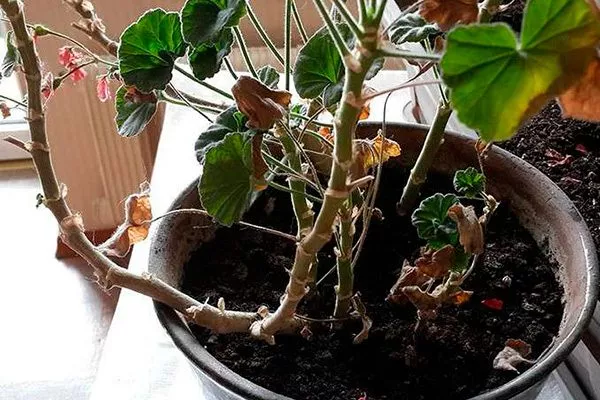
It's especially important to feed the crop during the active growing season—during growth, budding, and flowering. Why is mineral deficiency and nutrient overload dangerous?
- Nitrogen. When it's deficient, green mass fails to develop, and the foliage's hue changes dramatically. Because chlorophyll is lost and carotene levels increase, leaf blades, starting from the lower layers, take on a distinctive yellowish tint. The process initially affects the leaf tips.
An excess of nitrogen-containing fertilizers also contributes to yellowing, but the reason is different - the leaves simply “burn” like sunburn. - Potassium. The green mass only lightens when this substance is deficient. Yellowing occurs on older foliage, starting from the edges. It is accompanied by necrosis (tissue death).
- Magnesium. Leaves also turn yellow when there's a deficiency, as photosynthesis stops. First, the lower leaves become spotted. The yellowing is localized at the edges, then moves inward, but the veins and center remain bright green. Next, curling and wrinkling occur.
Magnesium can be replenished with both special preparations and wood ash. - Iron. Its deficiency causes chlorosis, which causes the leaves to dry out at the edges. The bush then stops developing further.
- ✓ Nitrogen deficiency: yellowing starts from the lower leaves, veins remain green.
- ✓ Potassium deficiency: leaf edges turn yellow and then die.
Herbicide contamination
Herbicides have a negative impact on pelargoniums. They most often end up in pots along with soil taken from garden beds previously treated with herbicides. The only solution is to completely replace the substrate.
Diseases
Disease is often the cause of yellowing leaves. What specific conditions can cause this problem?
- Gray rot. In addition to yellow spots, rotten growths covered with a grayish coating are developing on the green foliage. It's important to immediately remove all affected areas and sprinkle the bush with wood ash.
- Rhizoctonia leaf rot. Additional symptoms include root damage and spotting on the foliage. Treatment can include any fungicides, such as Abiga-Peak, Bordeaux mixture, etc.
- Bacteriosis. Initially, the leaves turn yellow, then blacken. Use Alirin, Skor, and Fundazol for treatment.
- Chlorosis. Occurs due to iron deficiency. Heterofos is used for treatment.
- Verticillium wilt. All parts of the plant, or just one part, turn yellow. Trichodermin is an excellent remedy.
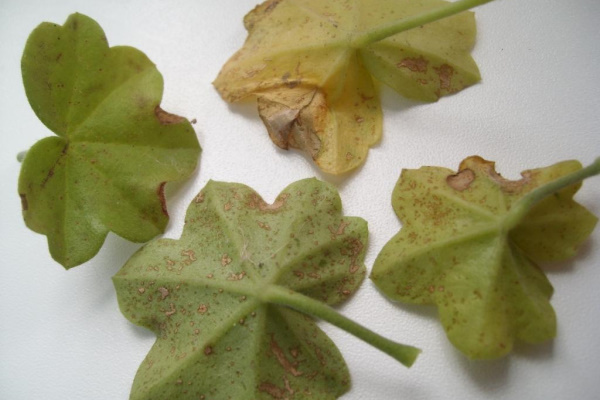
- Rust. The yellow spots associated with this disease are quite small and, as they progress, acquire a brownish tint. Topaz is used for control.
- Dropsy. Initially, blisters form, then yellowing appears in their place. The location is the underside of the leaf blade. Fundazol, Skor, etc. are used for edema.
Pests
Pelargoniums also turn yellow when insects appear. This can be caused not only by moving from another houseplant, but also by improper care. Which pests contribute to the formation of yellow spots?
- Ticks. They occur when the air is too dry. The spots only affect the leaf blade. Treatment involves spraying each leaf with a soapy solution, after which the mites are removed.
- Fungus gnats. They appear when air and soil humidity are high. Color changes are also observed on the leaves. The method of removal is identical to the previous one. If there is no effect, insecticides are used.
- Thrips. In addition to yellowing, lumpy swellings form on the bushes, and the inflorescences are also affected. Treatment with copper-based products is necessary.
- Aphid. This occurs rarely, only when there are vegetable seedlings nearby on the windowsill. The leaves first turn yellow, then curl up. A soapy solution is recommended.
- Caterpillars. Both leaves and stems are affected. They first turn yellow, then darken. Bactericidal insecticides are used for control.
- Whitefly. The butterfly eats foliage in various places, causing yellow halos to form in the affected areas. Potassium-containing products are used.
Damaged roots
When root problems occur, the foliage not only turns yellow but also often curls. Root damage can occur for various reasons, including careless repotting, a pot that's too small, being eaten by underground pests, or overwatering. In the latter case, the roots rot and break off.
How to fix the situation:
- Moisten the substrate in the pot.
- Wait until completely absorbed.
- Remove the plant from the pot.
- Rinse the root system after soaking it in water for 1-2 hours.
- Cut off damaged roots with a sharp knife or pruning shears.
- Treat these areas with wood ash or crushed activated carbon.
- Disinfect the pot, add new substrate and plant the flower in the standard way.
Pelargonium age
When geraniums reach 2-3 years of age, a period of rejuvenation begins. Human participation is essential in this process. Specifically:
- pluck off yellowing leaves;
- remove the entire lower tier of green mass;
- cut off old shoots.
In any case, this is a natural process, so you shouldn’t worry too much about yellowing.
Watering errors
Most of the causes are related to improper soil moisture, so pay attention to the following:
- Overdrying of the substrate. When a plant lacks liquid, it experiences thirst (like humans), so it tries to replenish its water reserves by sucking water from its above-ground parts through its roots. The leaves are the first to suffer in this case. They turn yellow and wilted, and tend to curl.
- Water quality. Much depends on it. Leaves turn yellow due to high water hardness and the presence of chlorine, various salts, and other harmful substances. In the first case, an overdose of calcium salts occurs, so it's important to soften the water promptly (with lemon juice or citric acid).
In the second case, harmful substances negatively affect the structure of the entire plant. Additional signs of poor-quality water include the formation of a whitish coating on the surface of the substrate. Getting rid of this problem is simple: replace the potting mix. - Too much watering. Overwatering promotes rotting and fungal diseases. In both situations, the flower turns yellow and wilts.
- Lack of regular watering. The flower needs to be watered regularly and preferably every other day.
Stress factors
Pelargonium is also subject to stress, but there must be a reason for this:
- transportation;
- a sharp cold snap and a draft;
- staying in a new home;
- treatment with preparations for the first time after planting;
- transfer;
- relocation;
- spraying with water;
- watering with cold liquid.
How to quickly save a plant?
After identifying the cause by analyzing your own actions, immediately move on to changing the conditions – if there was overwatering, replace the soil; if there was insufficient light, move the plant to a different windowsill, etc.
Experienced gardeners know the secrets to quickly get rid of yellowing:
- Using milk. For this, use only homemade products, not store-bought ones. What to do:
- Combine 1 liter of water and 100 ml of milk.
- Mix thoroughly.
- Water the flower.
- Use of glucose. Cannot be used only for Royal Pelargonium. Process:
- Crush 1 tablet of glucose.
- Pour it into 1 liter of settled water.
- Stir until the substance is completely dissolved.
- Water the plant.
Prevention of yellowing of leaves
Preventive measures boil down to several basic rules:
- water the flower in a timely and correct manner;
- avoid drafts and direct exposure to sunlight;
- monitor air temperature and humidity;
- Use preferably water that has been settled for 2-3 days;
- Treat with fungicides against diseases and insecticides against pests in advance;
- When planting, do not damage the roots and always dust the cut areas with wood ash;
- Place pots away from heating devices and window glass.
Pelargoniums turn yellow for various reasons, but they all stem from one negative factor: failure to follow proper growing practices. To prevent the plant from getting sick, follow preventative measures, and if you're unsure what to do, consult with more experienced gardeners.