
All pelargoniums in the PAC Viva series bloom long and profusely. Viva varieties boast large, vibrant blooms. These flowers look stunning in any interior, and in summer they can be used to decorate balconies, loggias, gardens, and parks.
PAC Elsner Nursery
Viva pelargoniums were bred by the German nursery PAC Elsner (Dresden, Germany). PAC is its trademark. The company was founded over 100 years ago, in 1889, and today is the largest flower growing company.
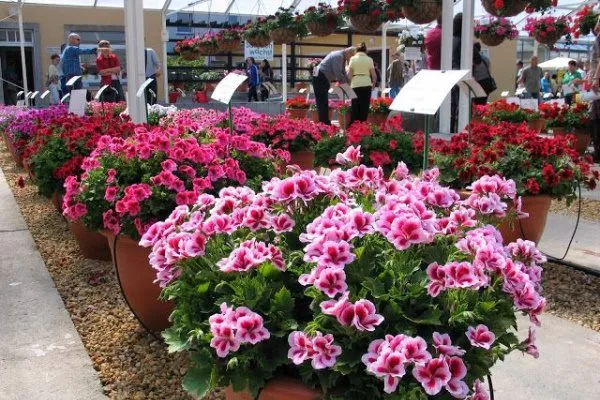
Elsner's main greenhouses, located in Germany, cover an area of 2 hectares. The nursery has branches in Bulgaria, Israel, and other countries. PAK pelargoniums are hardy, well-branched, and produce large flowers.
Pelargonium Viva's characteristics
Pelargonium PAC Viva is a small subshrub with creeping stems and fleshy leaves. Pelargonium enthusiasts and general gardeners appreciate this variety for its early and long-lasting blooms.
The appearance of Viva varieties is strikingly different from other pelargoniums. They resemble double Asian buttercups or small roses.
Pelargonium Viva features:
- compact bushes with frequent and dense branching;
- long and powerful peduncles;
- the leaves are dark green, dense, tough;
- flowers on one bush can be colored differently;
- one inflorescence can contain 5-30 flowers;
- bud diameter - 5-6 cm;
- the inflorescences are loose, not dense, each flower has its own outline;
- The flower stalks grow slowly, but then the plant blooms for a very long time - once opened, each bud remains on the bush for about 2 weeks.
- ✓ Viva Rosita: strawberry-red flowers, resistant to drafts.
- ✓ Viva Carolina: flower color change under the influence of sunlight.
- ✓ Viva Madeline: pure white flowers that require special lighting to maintain their color.
- ✓ Viva Maria: raspberry spots on white flowers, long flowering period.
Cuttings of Viva pelargoniums cost around 150 rubles, and grown plants cost 600-700 rubles.
Varieties
The PAC Viva series includes several pelargonium varieties, each with its own distinctive appearance. Below are descriptions of the four Viva varieties, along with photos, advantages, and disadvantages.
| Name | Bush height (cm) | Flower diameter (cm) | Color |
|---|---|---|---|
| Viva Rosita | 40 | 5 | strawberry red |
| Viva Carolina | 50-60 | 5 | white with lilac-pink strokes |
| Viva Madeline | 40 | 7 | snow-white |
| Viva Maria | 40 | 7 | white with crimson spots |
Viva Rosita
PAC Viva Rosita is a zonal rosebud-type pelargonium. It has strong, stocky, well-branched bushes reaching 40 cm in height. The shoots are upright, and the flower stalks are strong. The leaves are green, lighter than those of other Viva varieties.
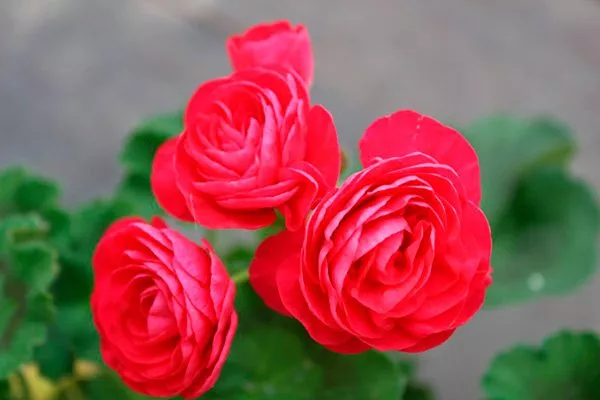
This large-flowered, double variety has buds reminiscent of buttercups. The flowers are vibrant strawberry-red and 5 cm in diameter. They are borne in loose rosettes that resemble lush flowering caps. Each inflorescence contains 5 to 7 buds. Each flower blooms for 2 weeks.
The Rosita variety is recommended for growing in well-lit areas, indoors, and away from drafts. The plant blooms from April-May until November. Peak flowering occurs in July-August.
Pelargonium Rosita can be grown alone or in a group. It looks beautiful in a single pot or container, including in arrangements. It can be placed on windowsills, terraces, verandas, and balconies. The shrub will complement rock gardens, retaining walls, vertical flowerbeds, and mixed borders.
Viva Carolina
PAC Viva Carolina is a trailing, ivy-leaved variety with compact, well-branched habit. It has long stems and dense inflorescences containing 3-5 buds. This large-flowered variety has semi-double flowers. The color is white with lilac-pink highlights.
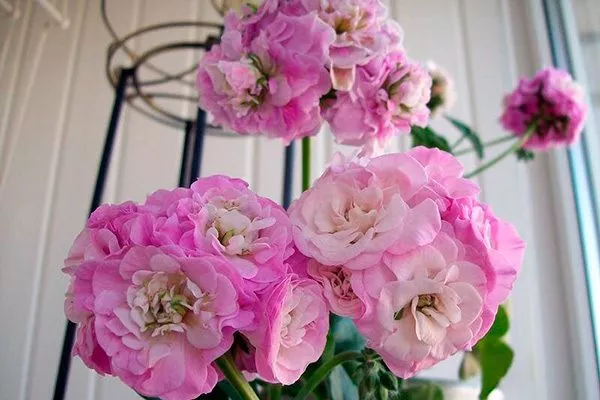
This rosebud variety is distinguished by its exceptional ornamental value. It boasts unusual, strikingly beautiful inflorescences that contrast harmoniously against the lush, ivy-like, dark green leaves. The young buds are indistinguishable from roses in appearance. The bushes are medium in height—50-60 cm—with creeping shoots.
This variety is widely used to decorate balconies, open verandas, garden plots, and greenhouses. It blooms from March to November, and with supplemental lighting, it continues blooming even in winter.
Viva Madeline
A zonal, large-flowered pelargonium with compact, mounding growth and upright stems. The flowers are pure white, double, multi-layered, with delicate, wavy petals. The plant looks incredibly elegant. The white flower caps are suitable for decorating a wide variety of interiors, as the blooming plant brightens and refreshes them.
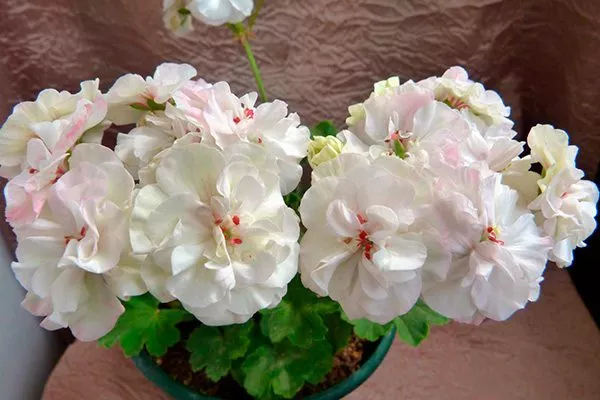
The PAC Viva Madeleine variety, introduced in 2009, immediately attracted the attention of flower experts and quickly became popular. The flower was later presented at the Moscow Flower Show, where it also caused a sensation and received numerous awards and titles.
The leaves play a special role in the appearance of the Madeline variety. They also contribute to its powerful decorative effect. They are so densely packed that there are virtually no gaps between them. In the light, the foliage appears even more dense, giving the bush a very lush appearance.
Pelargonium Viva Madeline is recommended to be kept on east- and west-facing windowsills if you want the petals to remain snow-white. Those who prefer a blush on white flowers should place Madeline on a south-facing windowsill.
In summer, it's recommended to take Madeline outdoors; it can be placed on a loggia, balcony, terrace, or open veranda. Pots containing pelargoniums can be used to decorate rock gardens and artificial ponds.
Viva Maria
PAC Viva Maria is a zonal pelargonium with unusual coloring and lush bushes. This variety has very neat and compact bushes, reaching a height of 40 cm. The leaves are small and medium green, the stems are flexible, and the inflorescences are large and double. The diameter is 7 cm.
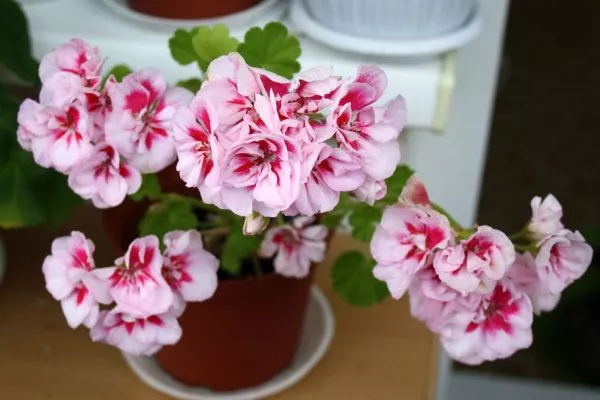
The flowers are primarily white, with crimson spots in the center. It prefers well-lit areas and does not tolerate drafts. Flowers are clustered in inflorescences of 6-30. There are spaces between the flowers, and the inflorescences are loose, not dense.
This variety has been grown in Russia since 2012 and is extremely popular due to its unusual inflorescences and low maintenance. In spring, it is recommended to move the plant outdoors to a well-lit location to stimulate shoot growth.
Viva Maria blooms almost year-round, but most intensely from June to August. The buds open slowly, and each bloom lasts for 10-12 days before being replaced by a new one.
How to plant
It is recommended to plant Viva pelargoniums between November and March – the plant’s growth should occur as daylight hours increase.
Preparing the substrate and pot
For planting, it's best to use a ready-made (store-bought) substrate. Choose soil with a neutral pH. You can also make your own soil mix by mixing equal parts turf, sand, and peat.
Plant the cuttings in small pots, and the seeds in wooden boxes (spaced 5 cm apart). Water the soil only with settled water, using a sprayer.
Lighting and location
Pelargoniums prefer good light, but the Viva varieties prefer partial shade. Therefore, it's recommended to place them near east- and west-facing windows. It's important to keep the soil in the pots from overheating. When warmer weather arrives, it's recommended to move the pots outside or onto the balcony.
The landing process
To plant a pelargonium, buy a young plant from a nursery. Leave it alone for about a week to allow it to acclimate to its new location.
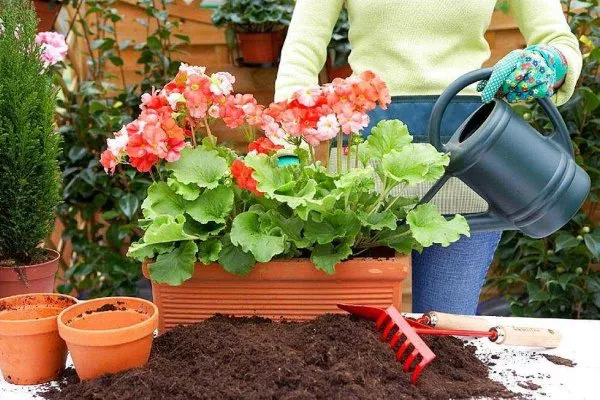
How to plant pelargonium:
- Place a drainage layer on the bottom of the pot.
- Sprinkle some substrate or soil mixture on top.
- Water the young pelargonium to make it easier to remove from the seedling pot, and then carefully pull it out along with the lump of soil.
- Place the plant in the pot, cover its roots with soil mixture, and compact it.
- Water the plant with warm, settled water.
How to care for it properly?
Pelargonium care It doesn't require much effort. All the activities are standard; the main thing is to do everything on time.
Caring for Viva pelargoniums:
- Watering. Watering frequency and volume should be moderate. It's important to avoid stagnant water and prevent the soil from drying out. It's best to water the flowers through the tray. Spraying the leaves is not recommended. After watering, loosen the soil if it's dry.
- Top dressing. Fertilizers are needed during the active growth period—from March to mid-October. They should contain all the essential elements for the plant: nitrogen, potassium, and phosphorus. Fertilizers should be applied twice a month.
- Trimming. It is carried out annually, leaving the shoots with four nodes untouched - this technique promotes lush flowering of the plant. The dry or yellow leaves Carefully trim the cuts. Sprinkle the cuts with crushed charcoal.
- Transfer. Young pelargoniums are repotted once a year, while adult ones are repotted when the pot is full of roots.
Recommended temperatures are +20…+25°C, humidity – 60-65%. Ventilation is required. In winter It is recommended to remove the plant from windowsills to prevent cold glass from freezing the flowers.
Diseases and pests
If care and cultivation guidelines are not followed, Viva pelargoniums can be susceptible to various diseases. Most commonly, blackleg, gray mold, and Puccinia fungus. When signs of damage appear, spray the bushes with effective fungicides—available at garden stores.
Pelargoniums can be attacked by various insect pests, most commonly various caterpillars, aphids, and whiteflies. In these cases, the plants are treated with complex insecticides.
Features of reproduction
Viva pelargoniums are usually propagated by cuttings. This is the simplest, fastest, and most accessible method for obtaining young plants. Seed propagation is extremely time-consuming and labor-intensive and is rarely used in indoor gardening.
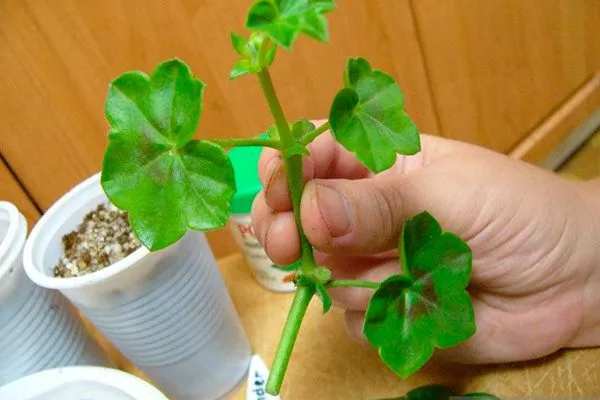
Pelargonium cuttings are placed in small pots filled with soil, watered, and placed in a well-lit area. No covering is required. Water regularly, and when roots appear, repot them in a larger pot.
PAC Viva pelargoniums have deservedly earned their awards and popularity among gardeners. These truly luxurious flowers can enliven even the most dull and dreary interiors. Their lush and vibrant beauty will not go unnoticed among the most impressive competitors.