
Pelargoniums from the Leona series are spectacular and profusely blooming varieties, ideal for interiors, insulated balconies, and loggias. The Leona line attracts pelargonium lovers with its diverse colors, wide selection of varieties, and beautiful blooms.
Pelargonium Leonii's characteristics
The Leona series was created by Elena Panova from St. Petersburg. It consists primarily of dwarf and compact varieties suitable for indoor growing. The series includes zonarthica and stellara varieties.
Varieties
The Leona series features over a dozen different varieties. They include double and single-flowered pelargoniums, white, salmon, pink, and other colors. Each flower has its own advantages, and sometimes even some disadvantages, which are best to be aware of in advance.
| Name | Growth type | Flower color | Flower size |
|---|---|---|---|
| Galaxy | compact | peach | 7 cm |
| Faverolles | compact | salmon pink | large |
| Snow carousel | dwarf | white | average |
| Euryale | dense | coral-salmon | 5 petals |
| Drops | stellars | white with a pink blush | large |
| Stardust | miniature | white with red stripes | large |
| Morning | dwarf | pink | small |
| Octave | semi-ampelous | orange, pinkish, salmon | 6 cm |
| Yeti | standard | snow-white | large |
| Maria | semi-ampelous | coral | 5-6 cm |
| Lel the handsome | standard | cool pink or soft lilac | large |
Galaxy
A compact zonal pelargonium with large, beautiful, dark green leaves. This zonal hybrid has branched bushes and strong, sturdy stems. This large-flowered pelargonium bears double, peach-colored flowers. The inflorescences are 7 cm in diameter. The buds, when open, resemble roses.
- ✓ The 'Galaxy' variety requires more intense lighting to develop the double flowers.
- ✓ 'Faverol' is sensitive to excess nitrogen, which can result in reduced flowering.
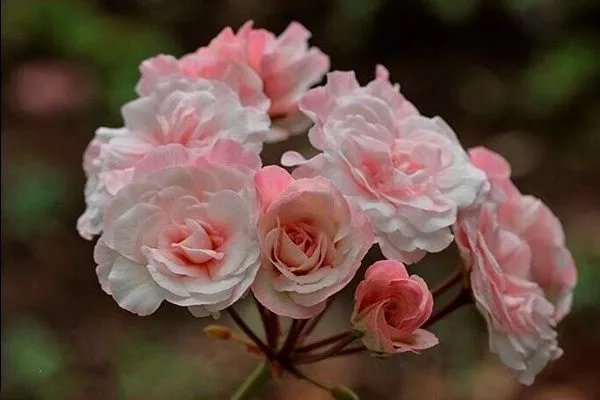
This pelargonium can be placed on a windowsill or a balcony, as long as it's well-insulated. Galaxy, like other pelargoniums, doesn't tolerate cold temperatures.
Faverolles
A zonal hybrid pelargonium with compact bushes. The leaves are standard-shaped and green, revealing zonation in full sun. The inflorescences are double, large, and spherical, with pleated petals. The flowers are a vibrant salmon-pink.
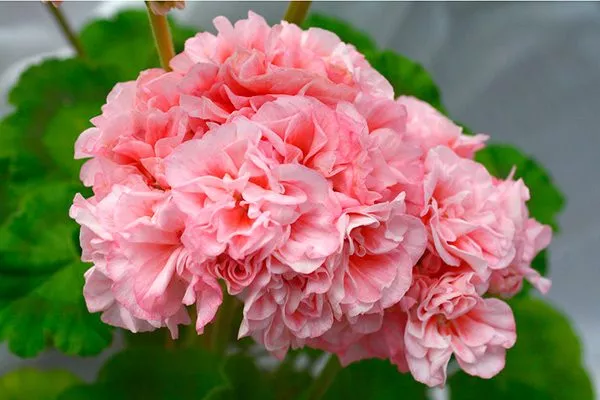
Leona Faverolles is a houseplant, but it can also be grown outdoors, for example, in a pot. The bushes have strong, dense, and rigid stems, reaching a height of 30-40 cm.
Snow carousel
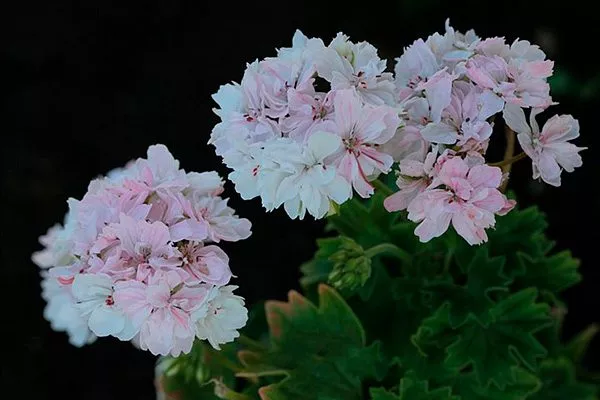
A zonal dwarf variety with compact bushes. This pelargonium has striking white inflorescences that turn slightly pink in the sun. The bushes can bear both white and pinkish flowers at the same time. The petals are wide, with serrated edges. The leaves are medium green, and the flower stalks are short. Zonal patterns emerge in good light.
Euryale
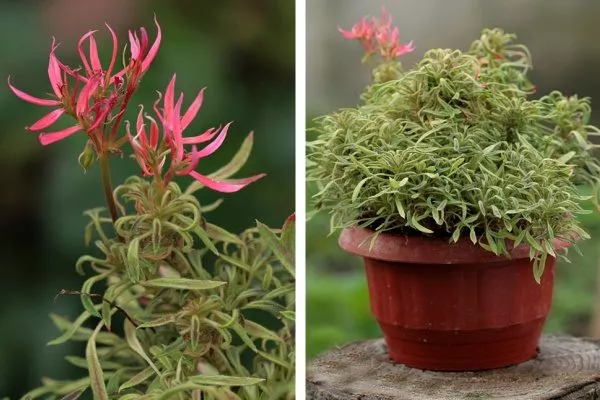
This variety belongs to the Medusa group. It has elongated, narrow, and thin leaves. Single, two- and three-fingered leaves may appear on the bush. In good light, zonation appears on the leaves. The bushes are dense, with short internodes. The inflorescences are a coral-salmon shade, with five-petal flowers.
Drops
A cultivar from the Stellar group. It has simple white flowers with a pink blush that intensifies in the sun. A distinctive feature is the pair of upper petals, which are narrower than the lower ones. The petals are serrated. The leaves are light green, with golden highlights appearing in the sun.
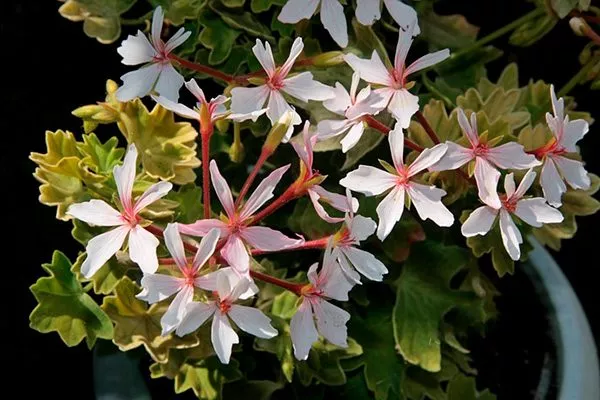
Stardust
A spectacular miniature star pelargonium. The flowers are white, with red stripes and speckles on the petals. In full sun, the flowers begin to turn pink, and the blooms become more intense. The petals are narrow, with the lower three wider than the others. The peduncles are short and sturdy.
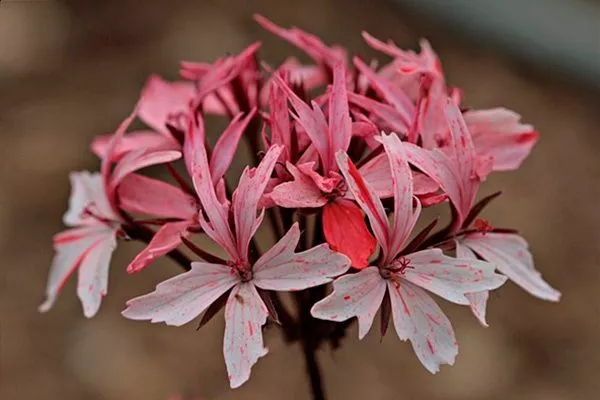
The leaves are dark green, darkening in bright light, revealing zonation. The bushes are compact and beautifully shaped.
Morning
A dwarf pelargonium of the star type. The flowers are delicate, radiant, pink, and unevenly colored. The color intensity intensifies in full sunlight. The petals are narrow and long, the inflorescences are double, dense, with strong, low-growing stems.
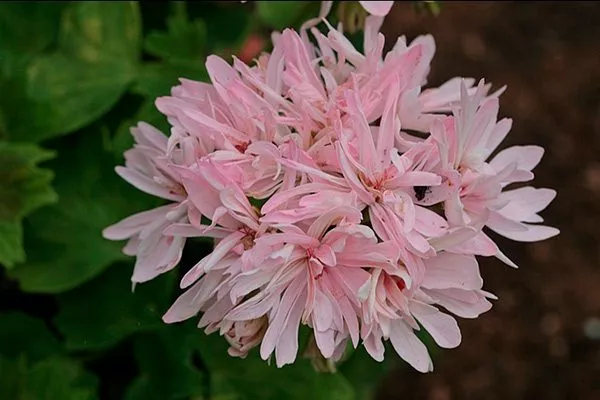
The leaves are green, with a dark zone appearing in bright light. With sufficient illumination, it can bloom even in winter. The bushes are beautiful and fluffy, ideal for apartment living.
Octave
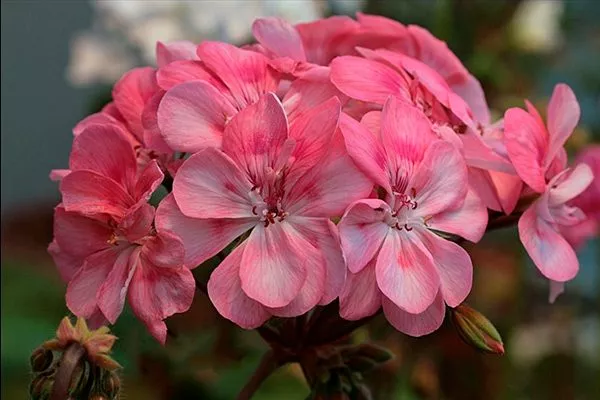
A semi-trailing zonartik with large flowers of varying degrees of doubleness. The petals have a distinctive pattern. The buds open orange, later turning pinkish and salmon. The flowers reach 6 cm or more in diameter. The flower stalks are medium-length. This flower looks beautiful in wide pots and hanging planters.
Yeti
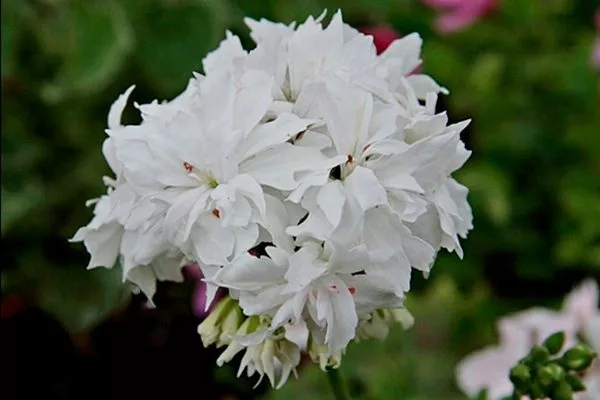
A star-shaped variety with a standard growth habit and double, snow-white flowers. They have orange stamens, and the petals have distinctly serrated edges. The flowers are large, and the inflorescences are dense. The leaves are green, without zonation. The bushes are beautifully shaped and compact.
Maria
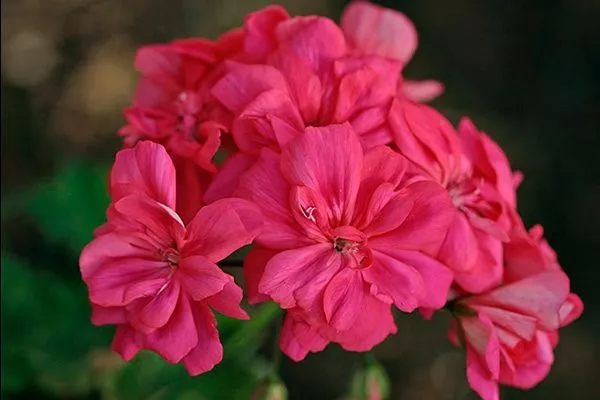
A semi-trailing variety with small bushes and sturdy stems. The inflorescences are coral, with flowers 5-6 cm in diameter. The coloring is unevenly distributed. The leaves are medium green, on short petioles.
Lel the handsome
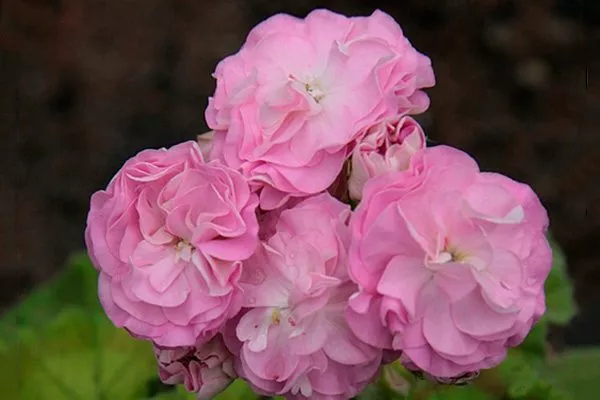
According to Leona, the series' creator, the "Lel' Prigozhiy" variety is one of the best. It's a zonal pelargonium with a standard growth pattern. The bushes and stems are robust, with numerous side shoots, vigorous flower stalks, and thick, dense leaves with pubescence. In bright light, the zonality becomes apparent.
Landing
Pelargoniums are usually purchased in small seedling pots, so it is necessary to purchase a new, spacious container along with the flower.
- ✓ The optimal temperature for the growth and flowering of Leon's pelargoniums is 18-22°C during the day and not lower than 12°C at night.
- ✓ To prevent diseases, it is necessary to ensure good air circulation around the plants.
In May, the flower can be transplanted outdoors. It's important that all risk of frost has passed by the time of planting.
Pelargonium planting features:
- Dig up the area where you plan to plant the pelargonium, adding humus, sand and wood ash.
- Then dig planting holes 10-15 cm deep.
- Carefully remove the plant from the seedling pot. Straighten the roots so there are no kinks or bends.
- Place the plant in the hole, trying not to plant it too deep.
- Fill the hole with the remaining soil obtained when digging the hole and water it generously with warm, settled water.
Growing and care
Leoni pelargoniums require standard care. Proper and timely care determines not only the health of the bushes but also the quality of their blooms, their abundance, and their lushness.
Care activities:
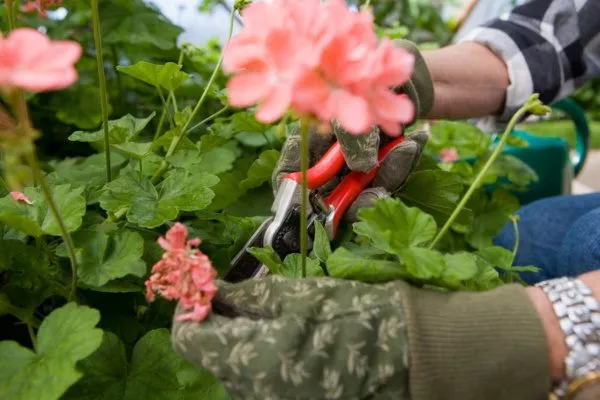
- Watering — standardized and regular. Stagnant water is prohibited.
- Top dressing — in spring, nitrogen is added; in summer, only potassium and phosphorus.
- Loosening — the soil is regularly loosened after watering, and any weeds that appear are removed at the same time.
- Spraying Plants are regularly inspected for diseases and pests. If characteristic signs or symptoms are detected, appropriate treatments are used. For prevention, flowers are sprayed with various biological products.
Reproduction
Pelargonium leonii can be propagated in a variety of ways. The most convenient and simple method of vegetative propagation is cuttings. This allows you to quickly obtain a fully grown plant without much effort, while preserving all the characteristics of the mother plant.
How to propagate pelargonium:
- Select the strongest shoot located closest to the base. The optimal height is 7-10 cm. It should have 5-6 leaves.
- Separate the shoot diagonally, below the bud. Tear off the lower pair of leaves.
- Place the stem in an empty container and leave it there for 2 hours so that the cuts dry out and become covered with a transparent film.
- Sprinkle the cut ends of the dried cuttings with crushed activated charcoal. Then transfer them to moist soil. There's no need to cover the cuttings. Place the pot in a warm, dry place, out of direct sunlight.
- Don't water the cuttings on the first day. Then, water them with a pipette. Roots will appear after a month.
- Transplant the resulting seedlings into pre-prepared pots.
In addition to cuttings, pelargoniums can also be propagated by division. The bush is dug up and divided into several sections. All cuts are treated with charcoal or activated charcoal.
Another method for propagating pelargoniums is by seed. This is the most time-consuming and labor-intensive option. Furthermore, it is only suitable for cultivars; propagating hybrids by seed does not fully convey the parental traits.
Diseases and pests
Pelargoniums of the Leon series have fairly good immunity, but if not properly cared for, they can be affected by various diseases.
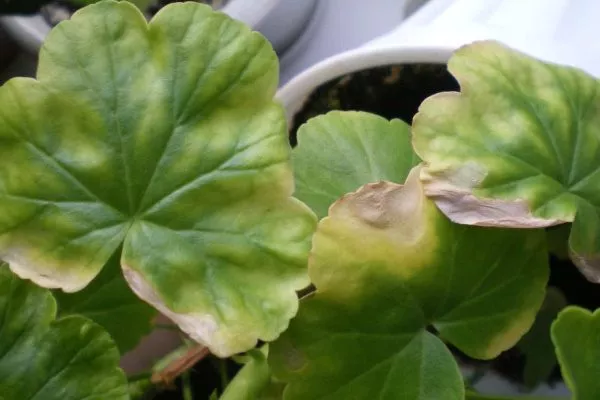
Most often, pelargoniums get sick with:
- With a black leg. It causes root rot and blackening of the stem. This is an incurable and rapidly spreading disease. The cause is overwatering. It is impossible to save the plant; it must be destroyed along with the soil.
- Gray moldIt is accompanied by the appearance of a white coating on the leaves and dark spots on the stems. The disease develops when the soil is overwatered. Treatment involves using appropriate fungicides.
- Rust. Yellow-brown spots appear on the bush. This viral disease causes the leaves to dry out and fall off. It is caused by high humidity and irregular watering. Affected leaves are removed, and the plant is treated with fungicides 2-3 times at 10-day intervals.
The Leona series deserves the closest attention from gardeners. Pelargoniums bred by Elena Panova are of great interest for indoor and landscape growing.