
Pelargonium, a close relative of geranium, is considered one of the most popular houseplants. However, growing this flower can be fraught with various problems caused by infections of various origins, including fungal, bacterial, and viral.
Fungal
Pelargoniums are most often affected by fungal diseases. There are quite a few of them, each with a variety of symptoms, but they are generally caused by the same factors. Treatment for various fungal infections also follows a similar pattern.
Gray mold
Gray mold is a common disease among pelargoniums and other houseplants. It is caused by the fungus Botrytis cinerea.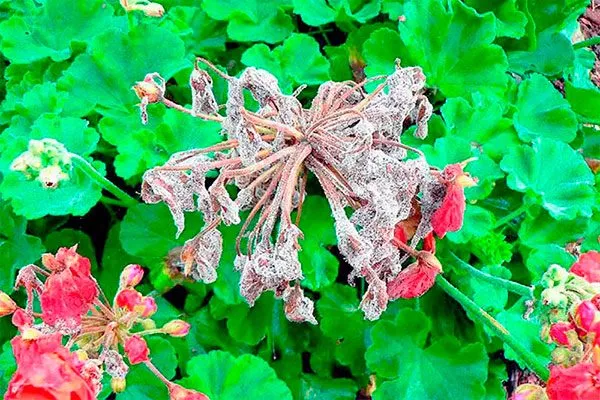
The main causes of gray mold include:
- waterlogging of the soil;
- high air humidity;
- poor ventilation;
- excessive spraying or sprinkling of plants;
- excess nitrogen in the soil.
Typically, the disease most severely affects the leaves located at the bottom of the plant, near the ground.
Signs of the disease:
- Brown spots rapidly develop on leaves and shoots. In some varieties, spotting also occurs on flowers.
- When air humidity is high, a thick gray coating appears on the affected parts of the pelargonium. They become soft, wet, and rotting.
The pathogen can survive in soil for 1-2 years. It is transmitted through soil, wind, water, and infected plant parts.
Preventing the development of gray mold is achieved by following proper agricultural practices and using preventative sprays. Maintaining a proper watering schedule and ensuring good ventilation is especially important.
Measures to combat gray mold:
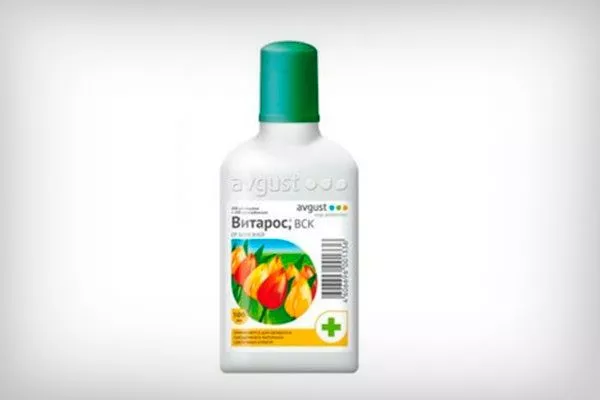
- When signs of disease appear, plants are sprayed with fungicidal preparations as soon as possible - "Vitaros", "Rovral", "Fundazol".

- When propagating pelargonium by cuttings, before rooting, they must be immersed in a solution of the above fungicides for 15-20 minutes.
- Affected plant parts – leaves, stems and flowers – are removed immediately.
To prevent gray mold, it is important to regularly remove fallen leaves from around the plants and water only in the morning so that the soil has time to dry out before nightfall.
Alternaria
This fungal disease is caused by the fungus Alternaria alternata. Like gray mold, it occurs due to excess moisture—overwatering, high humidity, insufficient ventilation, over-irrigation, and nitrogen overload.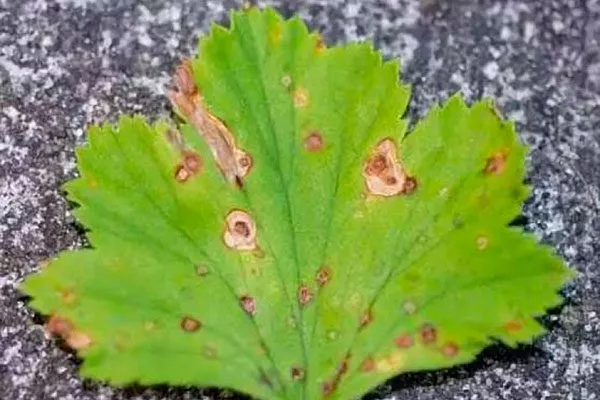
Signs of the disease:
- Brown spots, either regular or concentric, appear on the leaves, primarily along the edges. They have a lighter center and increase in size over time.
- With increased humidity, the spots begin to develop a dark, fluffy coating. Over time, the leaves wilt and fall off.
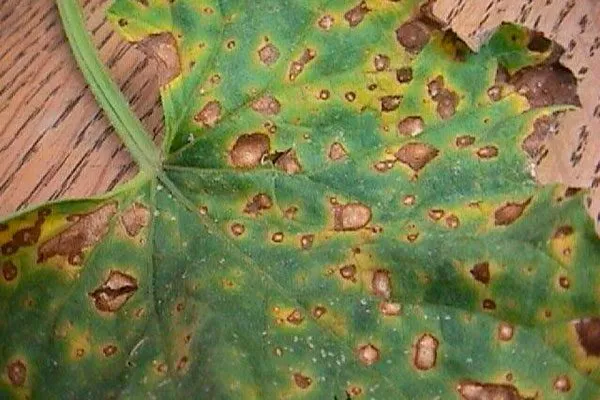
Alternaria blight is particularly common in zonal pelargonium varieties. The pathogen can persist for a long time in the soil, through which it infects plants.
Measures to combat Alternaria:
- Spraying with systemic fungicides, for example, "Skor" or "Ridomil Gold".
- Moderate watering, avoiding overwatering. Water only in the morning.
- Fallen leaves are removed in a timely manner.
- Periodic replacement of soil.
- Ensure good ventilation, prevent dense plantings and stagnation of moist air.
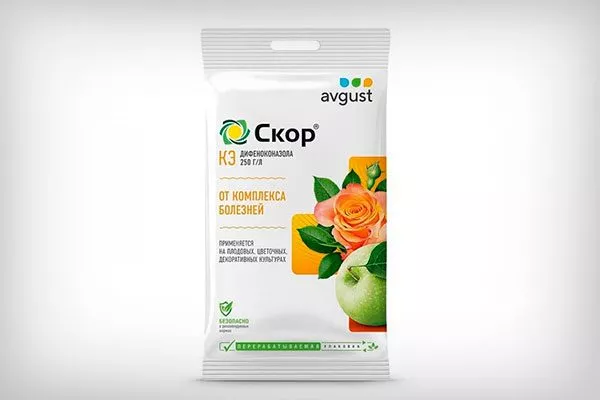
Before rooting, cuttings must be kept in a fungicide solution for 15-2 minutes.
Rhizoctonia leaf rot
Rhizoctonia rot of pelargonium - root and stem rot - is a fungal disease caused by the fungus Rhizoctonia solani.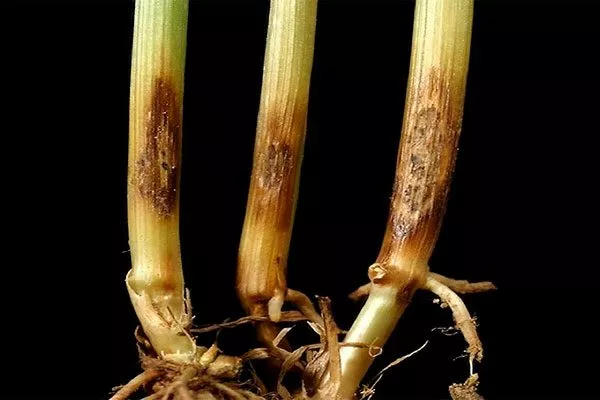
Reasons for development:
- overdose of fertilizers;
- excessively high air temperature;
- lack of light;
- insufficient ventilation;
- excessively large temperature difference between the soil and the air.
To prevent the development of rhizoctonia rot, it is sufficient to follow agricultural practices and use high-quality, loose, and well-aerated substrates.
Signs of the disease:
- The stems at the bottom become covered with dark, sunken spots, spreading from bottom to top.
- Grayish-white fungal mycelium develops in the affected areas. Over time, the plant begins to wither.
Measures to combat rhizoctonia rot:
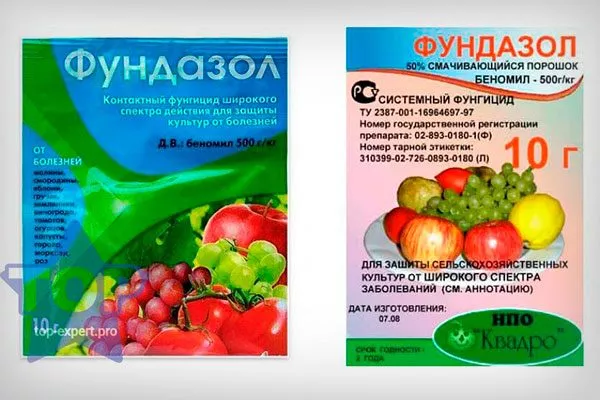
- If signs of disease are detected, watering is stopped and the plants are treated with fungicides, such as Fundazol.
- If the pelargonium is severely affected, it is preferable to destroy it; it is unknown whether it can be cured, and the infection is more likely to spread to neighboring plants.
Rust
This fungal disease is caused by the pathogen Puccinia pelargonii-zonalis Doidge. It exclusively attacks plants of the genus Pelargonium, primarily zonal pelargonium.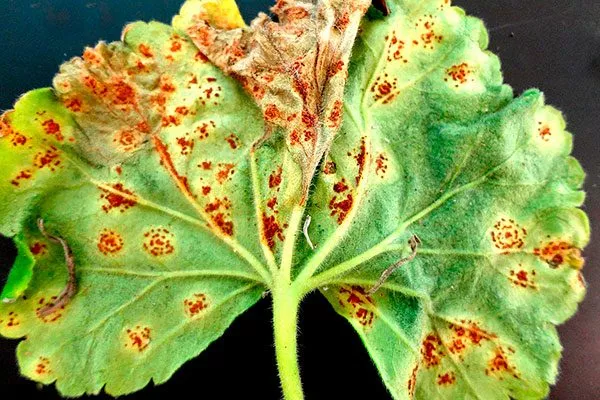
Like previous diseases, rust develops when the substrate is over-watered, the air humidity is high, the room is poorly ventilated, and plants are over-sprayed.
Signs of the disease:
- In the first stage of the disease, clearly defined yellowish spots appear on the leaf blades. Brown pustules form on the underside of the leaves in areas corresponding to the spots, often in a concentric pattern.
- As the disease progresses, the leaves become dry and fall off.
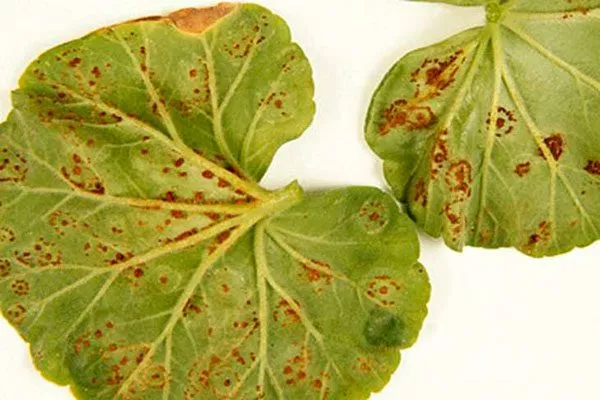
The pathogen is transmitted through infected plants, water, and air. The disease develops especially frequently in warm and humid environments.
Rust control measures:
- Use healthy planting material.
- When the first signs of disease appear, it is necessary to reduce air humidity and stop sprinkling the plants.
- Affected leaves are removed and destroyed.
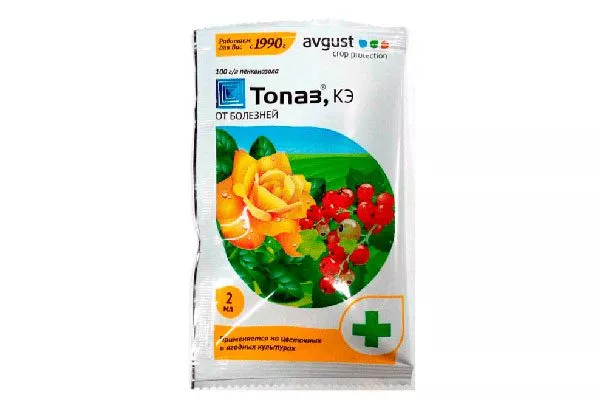
- Plants are treated with systemic fungicides, such as Topaz.
Verticillium wilt of pelargonium
This disease is caused by the fungi Verticillium dahliae Kleb and Verticillium albo-atrum R&B. They most often affect large-flowered pelargoniums.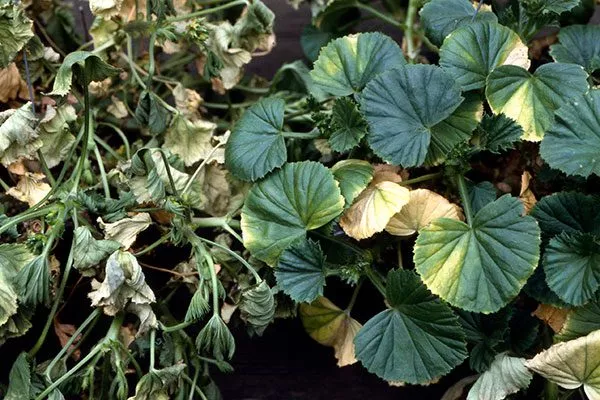
Causes of the disease:
- excess moisture in the substrate and air;
- insufficient ventilation;
- lack of lighting;
- the temperature difference between the substrate and air is more than 6-8 °C.
The pathogen is highly resilient, remaining active in the soil for up to 15 years. The fungal infection is transmitted through damaged roots and when propagating plants by cuttings.
Signs of the disease:
- Initially, individual sections of the lower leaves turn yellow. Then, the yellowing spreads to the entire leaf blade.
- Over time, the affected leaves wilt but do not fall off, remaining attached to the plant. Entire branches and inflorescences may also wilt.
When cutting the affected shoot, it is clear that its tissues are dark.
It has been noted that verticillium wilt most often occurs on light soils, as well as when grown in one place for a long time.
Verticillium wilt control measures:
- It is important to remove and destroy plant debris in a timely manner.
- When rooting cuttings, use only disinfected substrates.
- Maintain a watering regime, preventing the substrate from drying out or becoming over-wet.
Disease prevention is recommended by spraying with fungicidal preparations, such as Fundazol, Rovral, etc.
Root and stem blight
The disease is caused by a fungus of the genus Phytophthora, which causes rapid wilting and rotting of plants.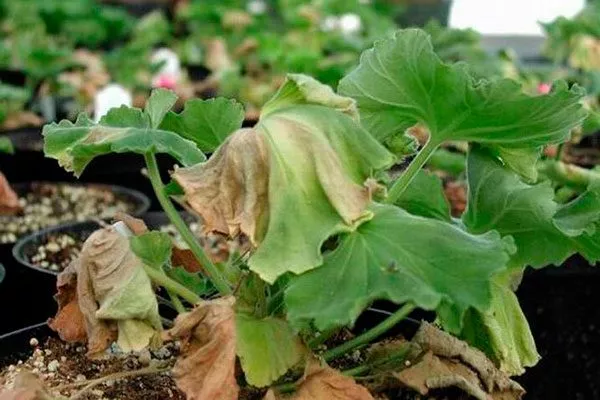
Causes of the disease:
- dense plantings;
- lack of light;
- excessive moisture of the substrate;
- high air temperature;
- overdose of fertilizers;
- there is a large difference between air and soil temperatures – about 6-8 °C.
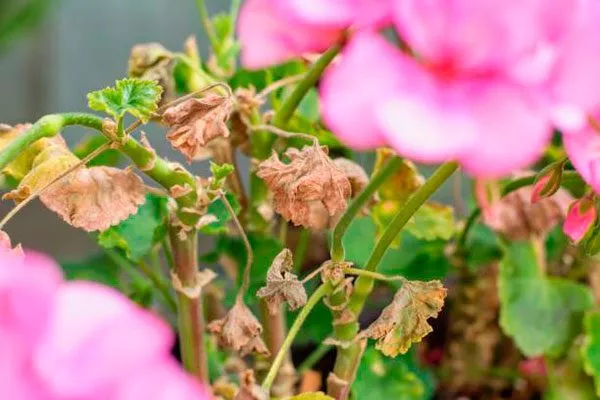
Preventing late blight from affecting plants is achieved by following agricultural practices and regularly inspecting plants for disease symptoms.
Signs of the disease:
- On the lower part of the affected plants, as well as on the roots, sunken spots appear, which spread upward.
- Wilting and rotting of plants.
- As the disease spreads further, a greyish coating appears on the affected parts of the plant – the fungal mycelium.
Plants become infected primarily through the soil, as the fungus survives very well in it.
Measures to combat late blight:
- Use of loose substrates.
- Good ventilation.
- If signs of disease appear, stop watering.
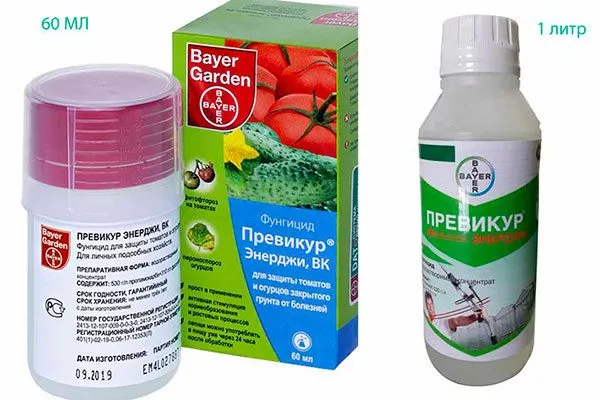
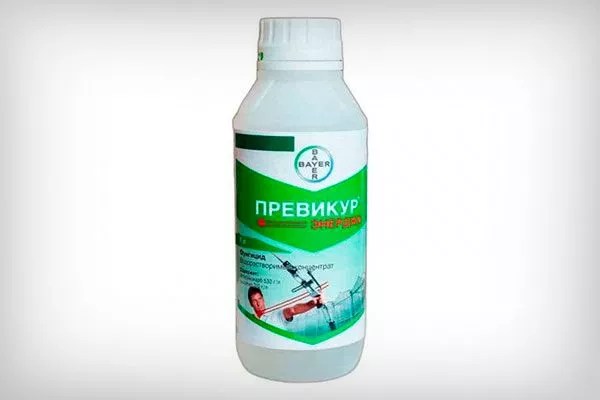
- Treatment with fungicidal preparations, for example, Previkur, Ridomil, etc.
Root and stem rot
Rot is caused by fungi of the genus Pythium and Rhizoctonia solani. These parasitic pathogens attack the lower part of the pelargonium—the root collar and the roots themselves.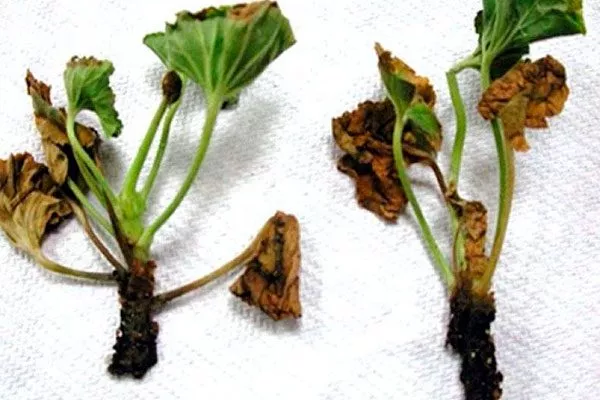
The causes of the disease are the same as those of most fungal diseases: dense plantings, lack of light, over-watering of the substrate, and an overdose of nitrogen.
Signs of the disease:
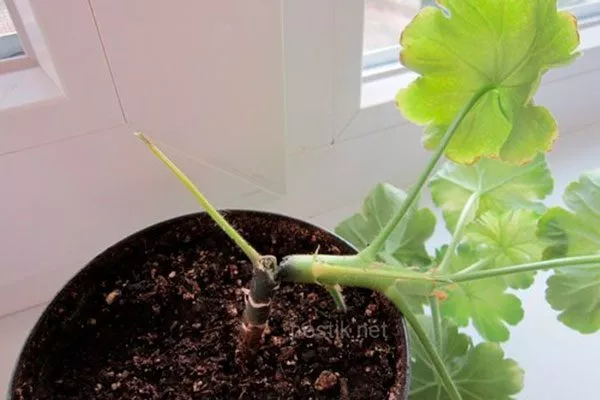
- Dark spots appear on the lower part of the plants, which over time begin to rot.
- Mycelium develops in the affected areas, creating a whitish-gray coating.
- The affected plant withers over time.
Measures to combat stem and root rot:
- Normalization of watering and lighting regime.
- Treatment with fungicides, for example, “Pervikur”.
Bacterial
Bacterial diseases are caused by bacteria and affect pelargoniums much less frequently than fungal ones. Most commonly, plants are affected by bacterial spot and fire blight.
Bacterial rot of pelargonium
Bacterial rot (spotting) is caused by the bacterium Xanthomonas campestris. The disease typically occurs when excessive heat and dampness combine. The pathogen is usually spread through water. Zonal pelargonium varieties are most often affected by bacterial rot.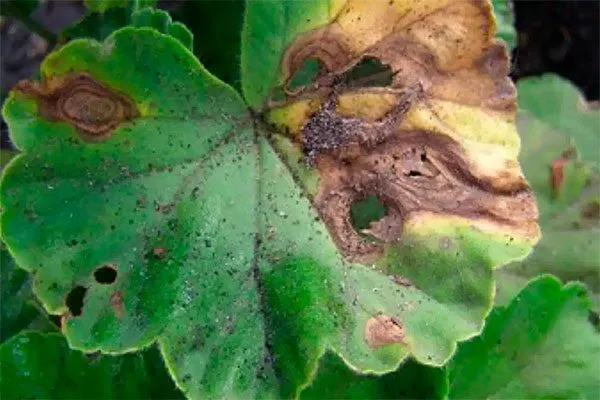
Signs of the disease:
- Initially, numerous small spots appear on the leaf blades, which over time enlarge and become water-soaked. Chlorotic halos form around the translucent spots.
- The spots are visible on both the outer and inner surfaces of the leaf. If severely damaged, the leaf blades turn yellow, then wilt and dry out, but they remain attached to the branches.
- Simultaneously with the leaf damage, a gray dry rot develops on the plant stems. The affected stems become twisted.
If left untreated, the infection becomes all-pervasive, the plant gradually wilts, and the shoots eventually die. The stems turn black. Unlike blackleg, however, this rot is a dry condition.
Measures to combat bacterial rot:
- Use only healthy plants for cuttings. All work is carried out with disinfected tools.
- Maintaining humidity levels.
- Minimize the use of sprinklers. Droplets should not remain on the leaves for long periods of time.
- Application of fertilizers with high potassium content.
- When signs of disease appear, pelargonium is sprayed with preparations containing copper, for example, "HOM" or "Oxyhom".

Fire blight
The causative agent of fire blight is the bacterium Xanthomonas campestris.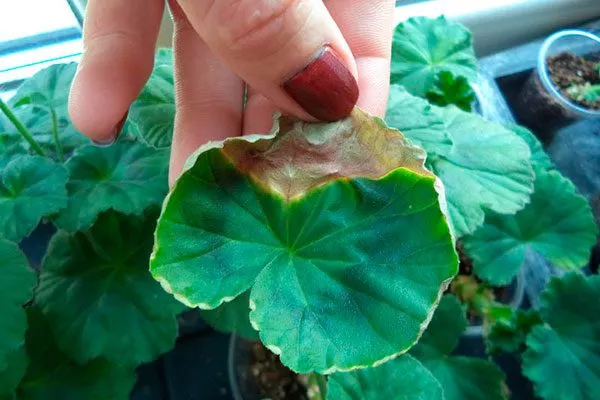
The disease may occur due to:
- infection through the soil or from diseased plants growing nearby;
- using dirty (not disinfected) garden tools;
- the spread of insects that carry infections.
The disease is easily diagnosed by its external signs. Affected plants rot, wither, and their leaves change color. The pathogen's incubation period is 7-10 days.
Signs of the disease:
- Leaves become covered with watery, oily spots, many of which have distinct edges.
- Dark lines appear on the leaves along the veins.
- Affected leaves rot and dry out.
- Pelargonium stems become deformed and twisted.
The disease slows plant growth and stops flowering. The plant doesn't die, as fire blight doesn't affect the roots, but the affected pelargonium looks unsightly and can infect neighboring plants.
There is no cure for fire blight. If you don't want to lose the plant, you can root unaffected parts. Before rooting, treat the cuttings with fungicides, and disinfect the planting containers and substrate. The affected pelargonium should be destroyed or at least isolated from other plants.
Measures to prevent the development of fire blight:
- Avoid overwatering and water stagnation in the pot.
- Removal of parts, leaves and stems infected with bacterial infection.
- Disinfection of tools, sectors, garden knives, etc.
- Isolate new plants from old ones to prevent infection.
Viral
Viral diseases of pelargoniums are caused by viruses that infect various parts of the plant. A characteristic feature of viral infections is the impossibility of treating them.
Leaf curl
Leaf curl can be caused by the Pelargonium leaf virus, which can persist for a long time in the soil and in diseased plants.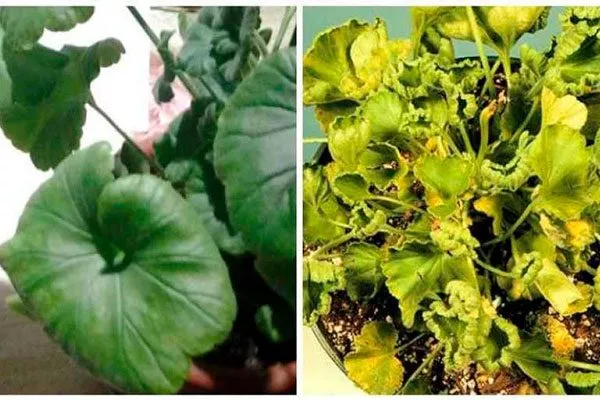
Ways of virus spread:
- during vegetative propagation of pelargonium;
- carried by sucking insects.
Signs of the disease:
- Small chlorotic spots appear on the leaves, mostly young ones, which grow larger over time.
- The spots have a distinct yellowish center, which is surrounded by light concentric rings that gradually become necrotic.
- Due to nutritional deficiency, leaves curl and become deformed, and the veins become light-colored.
In some cases, viral leaf curl may be accompanied by other symptoms, such as the appearance of gray, translucent spots on the leaves with a green center surrounded by yellow rings.
Measures to combat viral leaf curl:
- Use healthy material for propagation.
- Preventive treatment with insecticides.
Pelargonium leaves may curl not only due to a virus, but also for other reasons:
- Due to stress caused by changing conditions. This can occur, for example, after moving a plant from a south-facing window to a north-facing one.
- Due to violation of the watering regime, overwatering or insufficient moisture.
- Due to nitrogen and/or potassium deficiency.
- When exposed to too much sunlight, plants protect themselves from overheating by curling up their leaves.
- Due to dry air, drafts, sudden temperature changes
- Due to pest damage.
- Due to natural aging of the plant.
Ring mosaic
This disease is also known as ringspot. It is caused by the ringspot virus. It can be transmitted by insects such as aphids, nematodes, and others. The infection can also be spread through dirty tools.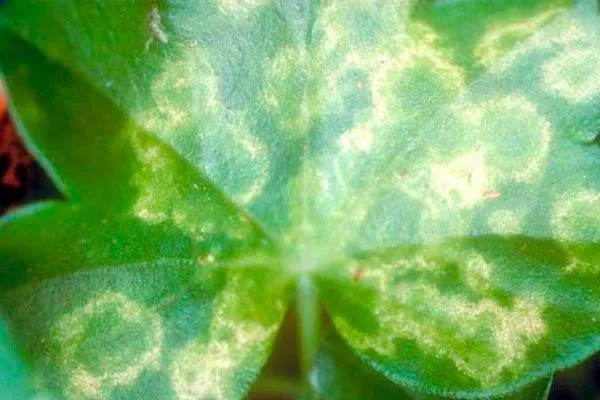
Signs of the disease:
- Light ring-shaped spots appear on the leaves.
- The leaf blades curl or droop.
- The plant stops growing and does not bloom.
- The leaves become deformed and curled.
Ring mosaic most often affects young plants, which are more susceptible to stress (temperature fluctuations, moisture and nutrient deficiencies). High humidity can also trigger the disease.
Control and prevention measures for ring mosaic:
- Destruction of leaves affected by viral disease.
- Use only healthy plants for propagation (cuttings).
- Isolate the affected pelargonium from other plants.
Pelargoniums are most often affected by fungal infections, all of which are spread by improper agricultural practices and plant maintenance. If these are detected early and measures are taken, the plants can be cured. Bacterial and viral diseases affect pelargoniums much less frequently, and the latter have no cure—the plant must be destroyed.