
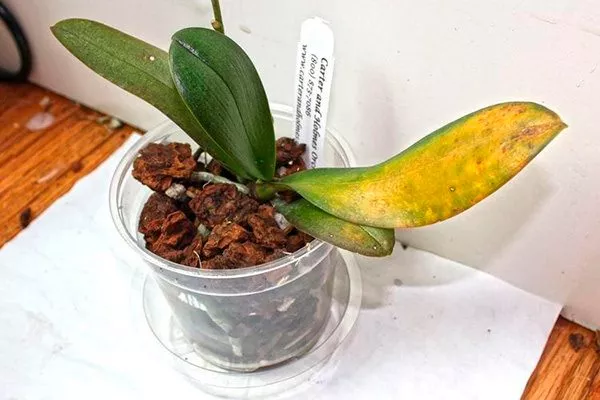
Uniform yellowing of leaves or the appearance of yellow spots on them is a common problem when growing orchids. These capricious flowers are sensitive to the slightest discomfort, and yellowing leaves are one of the reactions to poor gardening practices. It's important to recognize the problem early, find its cause, and resolve it as quickly as possible.
Why is surgical treatment necessary?
Regardless of the cause of yellowing leaves, it's important to begin treatment as soon as possible. Removing some leaves, if necessary, is less painful for the plant than trimming roots or stems. Therefore, if you notice yellow leaves, take immediate action.
Why it is necessary to start treating an orchid promptly:
- preserve the vitality of the plant;
- increase the chances of the plant's recovery and its rapid and complete restoration;
- prevent damage to healthy leaves;
- Protect neighboring orchids from disease.
If you notice yellowing of leaves, even slightly, you should begin treatment immediately. However, before doing so, it's advisable to determine the cause of the problem—this will determine the appropriate course of action.
Diagnosis of the disease
If you don't provide exotic plants with the right conditions—according to their requirements for humidity, temperature, etc.—they will get sick, wither, and die. It only takes one thing to be missed or a mistake in care for the plant to react sharply, including yellowing of the leaves, and subsequently the stems and peduncles.
Yellow orchid leaves are a common problem for novice gardeners, but even experienced orchid enthusiasts can sometimes neglect their care. As a result, the plant's leaves begin to turn yellow. The key is to spot the problem early and take corrective action.
Before starting treatment, it's important to determine whether the yellowing of the leaves is pathological. It could be a natural process associated with cyclical leaf loss—old leaves turn yellow and die so new ones can grow in their place. The plant may not even need treatment—simply eliminating the offending factor will be enough.
Reasons
Treatment methods and strategies for eliminating yellowing orchid leaves depend on the underlying causes. Find out what might be causing the plant's leaves to turn yellow, and then, based on external signs, care habits, and growing conditions, try to determine the cause.
Unfavorable neighborhood
| Name | Plant type | Flowering period | Disease resistance |
|---|---|---|---|
| Yucca | Decorative | Summer | High |
| Cordyline | Decorative | Spring-Summer | Average |
| Araucaria | Decorative | All year round | Low |
| Peperomia | Decorative | Spring-Autumn | High |
When placing orchids in a room, be sure to pay attention to the other plants they will be growing alongside. Some indoor plants are extremely harmful to orchids.
Yellowing of leaves can be caused by the close presence of antagonist plants:
- yucca;
- cordylines;
- araucaria;
- peperomia.
If you have one or more of the above plants in the same room as your orchid, separate the flowers into different rooms. If this isn't possible, you'll have to make a difficult choice. But you'll likely choose the orchids.
The flower was purchased during the flowering period.
Beginner gardeners often make the same mistakes when buying orchids from flower shops and nurseries. They rush into caring for the flowers they've bought, watering them, fertilizing them, and even repotting them.
In reality, the flower needs to rest. It needs to adapt to its new environment. Moving to a new location is always stressful for orchids. Therefore, leave the flower alone for two weeks. Then move it to a separate room for quarantine.
Poor quality water
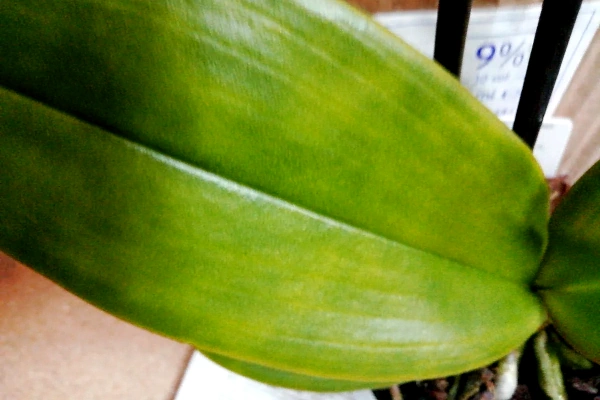
If you use excessively hard water to water orchids, they will develop chlorosis. This condition causes the leaves to turn yellow, while the veins remain bright green—this characteristic can be used to diagnose chlorosis.
How to fix the situation:
- transplant the orchid into a new substrate;
- Feed with specialized fertilizers for orchids;
- Use only high-quality water for watering - settled, melted or distilled.
- ✓ The water temperature should be 2-3°C higher than room temperature.
- ✓ Water hardness should not exceed 4°dH.
- ✓ The pH of the water should be within 5.5-6.5.
Overwatering
Beginners often try to water orchids more frequently and more generously, believing that this tropical plant requires constant moisture. In reality, orchids prefer high humidity and react extremely poorly to overwatering and over-watering.
Excessive watering leads to the following consequences:
- the substrate becomes compacted and air exchange is disrupted;
- the roots are rotting;
- the leaves are turning yellow.
If your orchid's leaves have become soft and its roots and stems have darkened, it's likely suffering from overwatering. To save the plant, immediately reduce watering and monitor the soil moisture with a wooden stick.
Moisture deficiency
A lack of moisture can also cause the leaves to turn yellow, and orchids to dry out. This situation occurs with very infrequent watering or excessive drainage. A quick solution is to increase the amount and frequency of watering. It's also recommended to soak the orchid pots in a bowl filled with warm water for half an hour.
The place is not suitable
If an orchid pot is in the wrong location, the plant can easily turn yellow and even lose its leaves. This plant is very sensitive to movement. Simply moving the pot can cause severe yellowing and wilting of the leaves.
Orchids react especially negatively to repotting while in bloom. The flower may even drop its buds. After repotting, it's important to provide favorable conditions for the orchid—indirect light, a stable temperature, and adequate humidity.
Violation of the feeding regime
Many novice gardeners overfeed their orchids, believing that fertilizer is beneficial—the more they feed, the longer and more profusely the plant will bloom. In reality, too much fertilizer leads to wilting and even death. For example, if the tips of orchid leaves turn yellow, it means they're overfed with calcium.
Nutrient deficiencies are no less dangerous. Blooming orchids must be fertilized regularly—this is necessary for leaf and bud growth. Yellow and uneven spots on the leaves indicate a nutrient deficiency. If left untreated, the orchid's shoots may turn yellow and die, along with the leaves.
Inappropriate air humidity
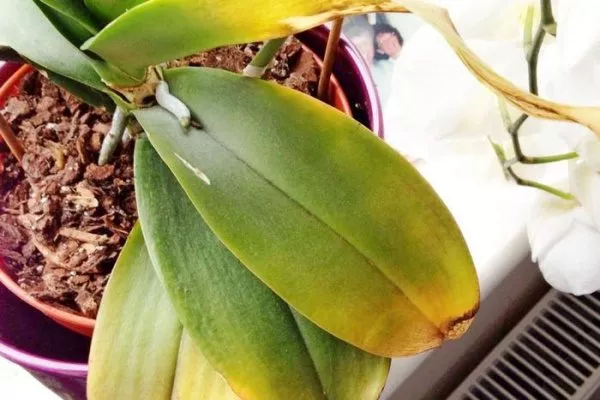
Orchids need the high humidity they're accustomed to in tropical climates to thrive. Apartments, however, tend to be much drier than these flowers require, especially if their pots are located near a stove or radiator. If orchid leaves begin to dry out and turn yellow, the indoor microclimate needs to be adjusted.
How to increase air humidity:
- buy a humidifier;
- place a container of water near the plants;
- spray flowers with a spray bottle.
Violation of the lighting regime
Orchids are demanding when it comes to growing conditions, including light. Moreover, different species and varieties have their own preferences in this regard. Some prefer full sun, others prefer partial shade.
A lack of sunlight leads to the production of green pigment, while too much causes sunburn. Insufficient light causes the leaves to turn uniformly yellow, while sunburn causes localized lesions. Damaged leaves should be removed and the cut surfaces sprinkled with crushed activated charcoal. If there's too much light, shade the plant.
Sunburn appears as a yellowish or whitish spot with a brown border. Over time, the leaf tissue around the burn turns yellow. It's not recommended to remove the burned leaves, as they continue to function. The plant simply needs to be protected from the sun by moving it away from the window.
Root rot
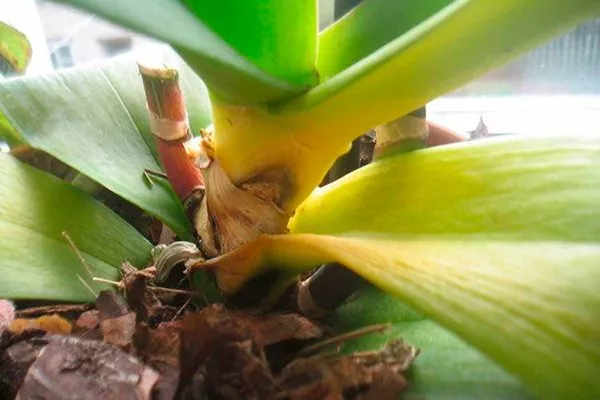
Root rot can be accompanied by various external changes, depending on the pathogen and orchid variety. Typically, yellowing leaves are caused by fungi growing in overly moist soil. If the yellowing is caused by root rot, the plant should be repotted.
How to save a rotting orchid:
- Remove the flower from the pot and shake out the old soil.
- Trim away rotted roots down to healthy tissue. Sprinkle the cuts with crushed charcoal or coat with brilliant green.
- Fill the pot with fresh substrate and transplant the flower into it.
The yellow leaves will continue to fall for some time, but over time new, healthy ones will grow in their place.
Insect pests
Orchid leaves are often attacked by pests. These insects are typically very small and difficult to spot with the naked eye.
How to tell if your orchid has pests:
- Spider mites. They hide on the undersides of leaves. Their presence can be detected by the fine web they spin.
- Aphid. These insects live in colonies and suck the juices from plants. Their presence is indicated by sticky coating on leaves.
- Scale insect or false scale insect. If it starts on an orchid, its leaves become covered with brown growths.
- Thrips. Yellow spots, dark dots and a silvery coating appear on the leaves.
- Nematodes. Along with yellowing, serious deformation of the leaves is observed.
- ✓ Spider mites leave a fine web on the underside of leaves.
- ✓ Aphids cause a sticky coating on the leaves.
- ✓ Scale insects form brown growths on the leaves.
- ✓ Thrips leave a silvery coating and dark spots.
- ✓ Nematodes cause leaf deformation.
Various methods are used to combat pests, including hand-picking, spraying, or washing the plant with a soapy solution, and, in severe cases, treating with insecticides. To rid the plant of spider mites, acaricides such as Fitoverm and Actellic are used. Products such as Aktara and Confidor are effective against aphids and other pests.
Diseases
Orchids can be affected by various pathogens, and treatments are selected accordingly. There are a number of diseases that can cause orchid leaves to turn yellow. Identifying them will help you choose an effective treatment.
What diseases do orchids suffer from?
- Fungal infections. They cause yellow spots to appear, typically first on the undersides of leaves and then on the tops. If left untreated, the lesions grow larger and turn brown or black.
To combat fungal infections, fungicides such as Fundazol, Topaz, and Previkur are used. The prepared solutions are sprayed on the plant or watered at the roots. - Bacterial diseases. They cause damp spots—yellow or brown. Affected areas must be removed—all or part of the leaf. Treat cut areas with cinnamon, crushed charcoal, etc.
- Viruses. They cause the appearance of yellow streaks, ovals, streaks, and the like. These diseases are usually incurable. The only way to neutralize the virus is to put it into "dormant mode." This requires adjusting the growing conditions—temperature, humidity, and lighting. Creating the ideal environment for the plant may weaken the virus.
Transplant stress
The lower leaves of repotted orchids often turn yellow. They gradually die and dry out. If this only affects one leaf and the problem doesn't spread, there's no need to take any action—the plant is simply reacting this way to the repotting and the change in substrate.
Orchids experience the most stress when repotted in an unfamiliar substrate or environment. In this case, the plant's leaves lose color and dry out. After repotting, anti-stress treatments such as succinic acid, Epin, and others are recommended.
Natural causes
All leaves have a specific life cycle, after which they wither. The lower leaves die first. They turn yellow at the edges, and then the yellowing spreads throughout the entire leaf. This usually occurs after flowering, in winter or early spring.
Yellowing leaves can also be a result of adaptation to sudden changes in environmental conditions. In this case, young, green leaves appear shortly after the old yellow leaves die off.
Overheat
In summer, when the heat is intense, orchids can turn yellow due to elevated room temperatures. This is especially difficult for plants on days when the heat doesn't subside even at night. This overheats not only the above-ground parts of the orchids, but also their roots, which literally "cook" in the sun.
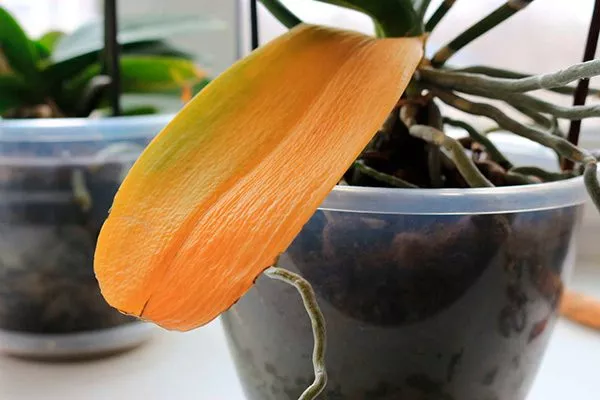
If it's hot, never expose your orchid to direct sunlight. The worst option is to water the plant and then place it in the sun. In extreme heat, it's recommended to remove orchids from windowsills during the day and open the windows at night (ventilation mode). You can also place the plant on the balcony at night.
Frostbite
Orchids don't tolerate cold temperatures well, and temperatures below 5°C cause frostbite, which is accompanied by yellowing of the leaves. Even briefly transporting an orchid in winter, such as when buying it from a store, can lead to irreparable damage.
Leaves damaged by cold weather wilt, turn yellow, and gradually fall off. To prevent the orchid from becoming too cold, transport it in a heated vehicle, wrapped in packing paper. In winter, keep the plant away from windows and ventilation shafts.
Problems with roots
Yellowing leaves are often associated with root diseases, pathologies, or poor root condition. Many orchids have aerial roots, not covered by soil, making them easy prey for rot, insect pests, and various other adverse factors.
Weaknesses of aerial roots:
- not protected from sudden temperature changes;
- susceptible to the negative effects of dry air;
- experience the effects of exposure to direct sunlight;
- are easily subject to mechanical damage.
If the roots don't have enough moisture, they begin to draw it from the leaves. As a result, the leaves turn yellow. First, the base of the leaves turns yellow, and then the entire leaf blade.
The problem can be solved by increasing the frequency of watering. It's recommended to "bathe" the plant rather than simply water it. Place the pot in warm water and leave it there for about two hours until the roots have had enough water.
If the roots are mechanically damaged, the plant will likely need to be repotted. The roots are freed from the substrate, the damaged areas are identified, sprinkled with charcoal, and then the plant is moved to a new substrate.
Treatment for yellowing
Regardless of the cause of yellowing leaves (other than natural aging), appropriate measures must be taken. Otherwise, the situation will worsen, rotting may begin, and the plant will die. This is especially dangerous when the orchid is infected with fungal or bacterial infections—immediate treatment is necessary.
If it turns out that the yellowing of the leaves is not natural, save the plant according to the following scheme:
- Analyze the orchid's growing conditions. Check whether the flower is exposed to direct sunlight, whether the substrate is good enough—not overwatered, or, conversely, too dry.
- Make sure the pot has enough room for the root system. If not, the plant will need to be repotted into a larger container.
- If you find traces of burns on the leaves, move the flower (or shade it).
- Next, check the soil. It should be slightly moist. If not, water it with filtered water. Monitor the condition of the soil and the plant. If the substrate is excessively wet:
- remove the flower from the pot and clean it from the substrate;
- check if there is any rot on the roots;
- if the roots are rotten, cut off the affected areas with a sharp and disinfected tool, and sprinkle the cut areas with crushed charcoal (wood or activated);
- transplant the flower into a new pot filled with fresh substrate.
If the yellowing is caused by a deficiency of nitrogen, potassium, or iron, you should apply the appropriate fertilizer. This should be done gradually, in small doses, while monitoring the flower's condition.
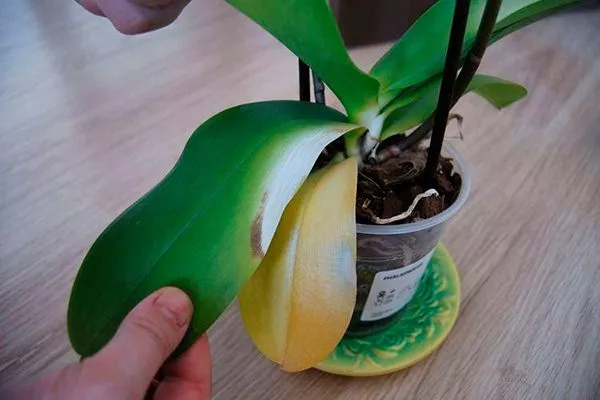
The leaves lose turgor, turn yellow and fall off.
A more complex situation is when the leaves turn yellow, soften, and begin to wither. If they not only turn yellow but also lose their turgor and begin to fall off, the orchid requires urgent resuscitation.
Recovery procedure:
- Analyze the conditions in which the flower is kept and identify the probable causes of the pathology.
- Change the watering regime and schedule.
- Move the orchid pot to a different location. If you find any plants that are unfavorable neighbors, remove them from the room. Or move the orchid to another room.
- Replace the pot with a new one and change the substrate. Be sure to disinfect the new container with a potassium permanganate solution.
- If the flower shows signs of fungal or bacterial infection, treat it immediately with effective fungicides.
Do not use fertilizers or growth stimulants for at least 2 weeks after replanting.
Aftercare
Once the problem is resolved—the orchid has recovered and its leaves have returned to green—it's time to provide it with proper care. This will help prevent similar problems from occurring in the future.
How to care for an orchid after recovery:
- Create ideal lighting conditions for the flower. Orchids prefer indirect light, and daylight hours should be at least 10-12 hours.
- Maintain the recommended temperature range. Daytime temperatures should be between 18°C and 27°C, and nighttime temperatures should be between 13°C and 24°C.
- Provide a difference between day and night temperatures - this is a necessary condition for successful orchid flowering.
- Maintain a regular watering schedule. Keep the substrate slightly moist, but avoid allowing water to stagnate in the pot. Use soft water, 2-3°C warmer than the surrounding air.
- Apply fertilizer no more than once every 2-3 weeks. Follow the recommended dosage (see packaging). Do not apply fertilizer to a repotted plant, as the fresh substrate contains sufficient nutrients.
- Avoid drafts in the room where orchids are kept. Cold air currents and sudden temperature changes are absolutely contraindicated. Ensure adequate ventilation in the room.
Answers to frequently asked questions
Beginning orchid growers often encounter problems when they take up orchid cultivation: plants become sick, dry out, and rot. This leads to a ton of questions from orchid experts.
Frequently Asked Questions:
- Why do leaf tips dry out? This symptom indicates a moisture deficiency in the substrate. It is necessary to adjust the watering regime.
- Why do the lower leaves always turn yellow? Most likely, the plant is simply shedding old leaves. This is a natural process, so don't worry.
- How often should I fertilize my orchid without harming it? It's essential to apply fertilizer early in the spring. Then, apply it as needed, but not too frequently.
- Where to put an orchid? The best option is an east-facing windowsill. South and west exposures are also suitable. However, in these cases, the plant will need shade—either with other plants or special screens that block sunlight.
If you don't give orchids the attention they deserve, they can easily be lost—these flowers are sensitive to adverse conditions, becoming ill and dying. To prevent this, carefully inspect your plants and take immediate action as soon as you notice the slightest change in their appearance.
So many illnesses and care details. My orchids, touch wood, aren't causing any trouble. I water them once a week with regular water, and all is well. They grow and bloom.