
Tropical orchids grown indoors are extremely sensitive to watering. To ensure these flowers thrive and bloom, it's essential to consider all the nuances associated with their moisture management. Overwatering is dangerous for orchids—they don't tolerate excessively moist soil. They thrive much better in dry soil than in damp soil.
How do you know when it's time to water your orchid?
To avoid overwatering the plant and causing rot, it's important to recognize when it's time to water. The rate at which the substrate dries out depends on environmental conditions. In hot weather, it takes 1-2 days for the water to evaporate; in rainy or cloudy weather, it takes more than 2 days. During the winter, during the dormant period, the substrate and roots retain moisture for a long time.
- ✓ A change in the color of the roots from green to silver is a clear sign that watering is needed.
- ✓ The absence of condensation on the inner walls of the pot indicates that the substrate is dry.
How to determine the dryness of the substrate and roots:
- Assess the weight of the pot - after watering it is heavier, and when the substrate dries out, it becomes lighter.
- Carefully rake the substrate and, having reached approximately the middle, determine its moisture content.
- Insert a thin wooden stick into the center of the pot; if its bottom is damp, it’s too early to water the flower.
- If your orchid is growing in a transparent container, learn to determine the moisture content of the roots and substrate by their color:
- the wet substrate is darker than the dry one;
- the absence of drops on the substrate and roots indicates that the plant is dry;
- Wet roots are green, dry ones are silvery.
At first, until a novice gardener develops a watering regime for their orchids, the dryness of the roots and substrate must be determined using all the above signs.
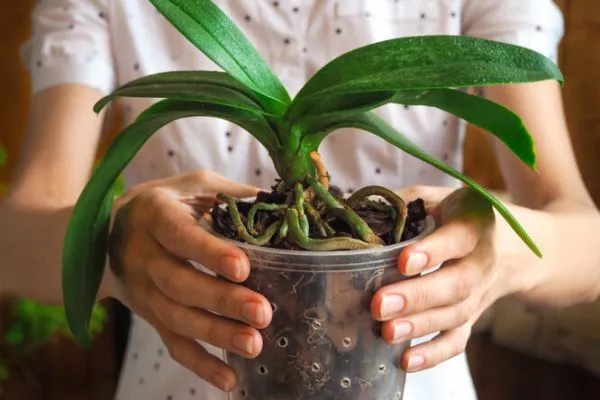
Watering recommendations:
- Water your orchid only when the roots and soil are completely dry. Even when they're dry, don't rush—it's best to wait a couple more days. Short-term droughts don't harm orchids in any way.
- Watering frequency depends on the season. In summer, water every 2-3 days, and in autumn and spring, once a week. However, this is only a rough guideline—each orchid species and variety requires an individual approach.
How often should you water an orchid?
There's no set watering schedule for orchids. Many factors influence watering frequency. During the growing season, the plant is watered "as needed," while during the resting period, it's watered infrequently.
The frequency of watering orchids depends on:
- orchid species;
- temperatures;
- air humidity;
- substrate moisture capacity;
- lighting;
- time of year.
The type of orchid also influences how often to water it indoors. However, most orchids require watering 1-3 times a week in summer and 1-2 times a month during the dormant period.
Water quality requirements
It's not recommended to water orchids with tap water. It's quite hard, contains chlorine, and contains sediment—all of which can have a detrimental effect on the delicate plant. Rainwater in the tropics is soft and clean. To bring regular water closer to this quality, disinfection and softening are necessary.
- ✓ The pH level of the water should be between 5.5-6.5 for optimal absorption of nutrients.
- ✓ The water temperature for irrigation should not be lower than +30°C to avoid stress on the plant.
To achieve this goal, the following methods are used:
- boil water;
- defend;
- filter;
- acidify;
- freeze;
- collect rainwater.
The optimal water temperature for watering orchids is 30-35°C.
Hard water can be softened:
- Oxalic acid. Dissolve 1/8-1/4 teaspoon in 5 liters of water. Then keep the water in an open container for 2-3 days to allow the chlorine to evaporate and the insoluble compounds to precipitate.
- High-moor peat. It's placed in a canvas bag, which is then immersed in water for irrigation. The peat not only softens the soil but also acidifies it.
- Filtration. Water intended for irrigation is passed through a household filter several times.
- By boiling. It helps neutralize harmful microbes and chlorine, and causes salts to precipitate.
Many gardeners also improve water quality with garlic, succinic acid, and potassium permanganate. Garlic water improves flowering and disinfects the water, succinic acid boosts plant immunity, and a pink solution of potassium permanganate disinfects the roots.
Watering methods
Orchids, unlike many other plants, can be watered in a variety of ways. The choice depends on the flower's species and condition, as well as the grower's preferences.
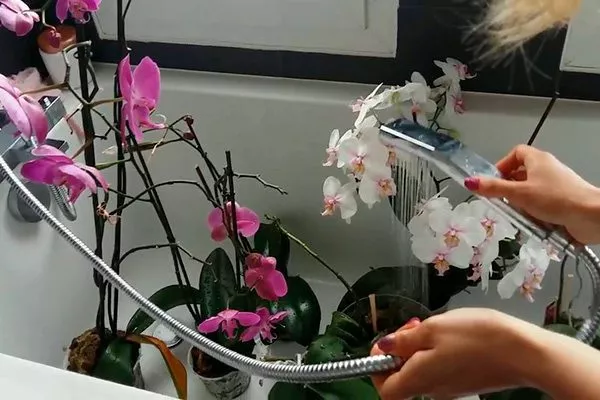
Hot shower
This method promotes high-quality flowering and foliage growth. This watering method mimics natural humidification in tropical environments, making it extremely beneficial for orchids.
How to water a flower with a hot shower:
- Place the potted plants in the bathtub and water them using the shower head. The water temperature should be around 38°C.
- Water until the substrate is completely saturated.
- Leave the flowers in the bath for half an hour to allow excess water to drain.
- Dry the leaves and young ones peduncles with dry wipes.
Some orchid species also require wiping the core after a shower to prevent rot. This applies especially to the popular Phalaenopsis orchid.
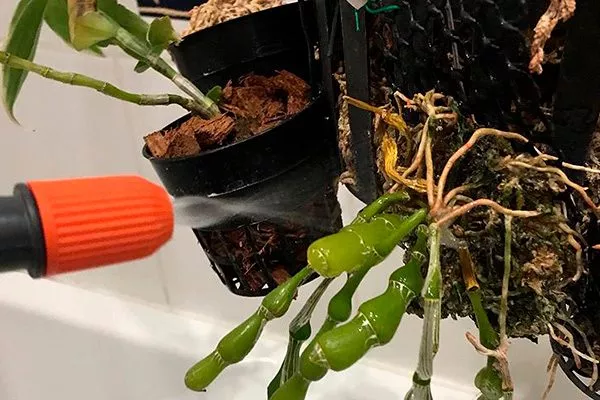
Spraying the roots
This watering method is considered the best for orchids grown without a substrate. It can also be used for potted plants, but only in combination with other methods that ensure adequate root hydration.
How to spray orchid roots:
- Take a spray bottle with a fine dripper. Use the "mist" setting for watering. Fill the container with the prepared water.
- Spray the roots until they turn green.
This method is advantageous because it prevents water from getting on the leaves and other plant parts, and prevents overwatering. The downside is the need for daily watering, as without a substrate, orchid roots dry out quickly.
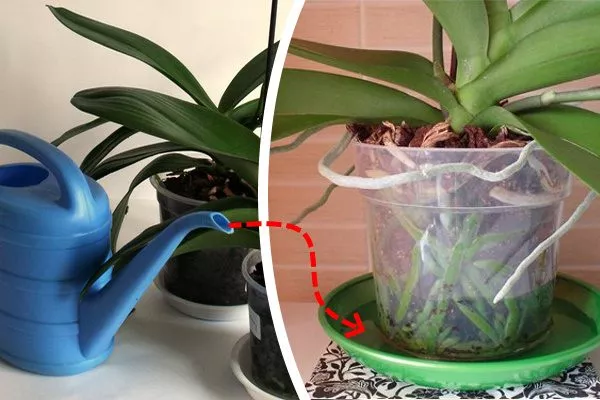
Watering into a tray
This method is used primarily by gardeners who value their time. The watering process is simple and quick.
How to water orchids in a tray:
- Take a large, deep tray and pour the prepared water into it.
- Place the flower pots in the tray—they will absorb as much water as they need. However, they should be left there for 10 to 20 minutes.
With this method of watering, the substrate is gradually saturated, and as a result, it is possible to maintain the optimal humidity for the flower in the pot.
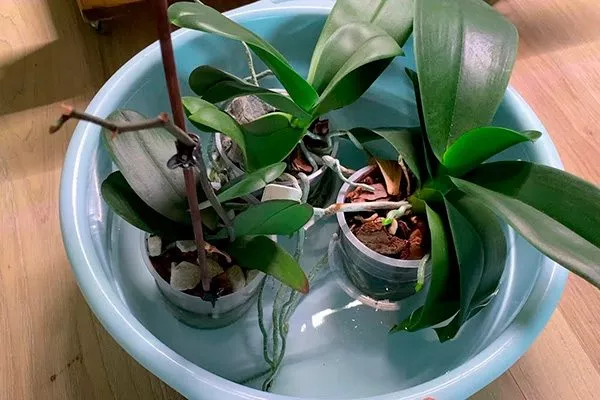
Immersion
Immersion is used not only to saturate orchids with moisture, but also to apply fertilizers, which are diluted in water beforehand.
How to water an orchid by immersion:
- Fill a deep container with water and place the flower pot in it so that its edges are slightly below the water level.
- Leave the pot in the water for 10-15 minutes, no more. This is enough time for the roots to soak. The duration of soaking depends on the size of the pot—the larger it is, the longer it should soak.
- Remove the orchid pot from the water and let it drain – excess water should drain away.
This is the most economical and safest watering method, as it prevents the leaves and stems from getting wet. However, before immersing the pot in water, make sure the plant is completely healthy, as the immersion method is contraindicated for sick or damaged orchids.
You can immerse several flower pots in a single large basin. However, this is risky—all it takes is one sick plant to infect all the others through the shared water.
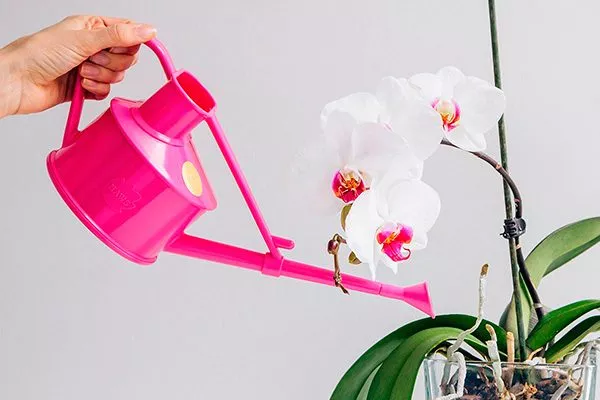
Surface irrigation
This is a classic method of watering houseplants: water is poured from the spout of a small watering can, carefully spreading it over the entire surface of the substrate.
The order of watering with a watering can:
- Fill a watering can with prepared water and water the substrate until water flows out of the drainage holes.
- Repeat the process 2 or 3 times, pouring out excess water from the tray each time.
This watering method prevents moisture from getting into the axils, which can cause leaf and stem rot. Surface watering is only done early in the morning.
Watering with a watering can is effective against fungi and bacteria that accumulate in the substrate over time. To do this, add a few crystals of potassium permanganate to the water.
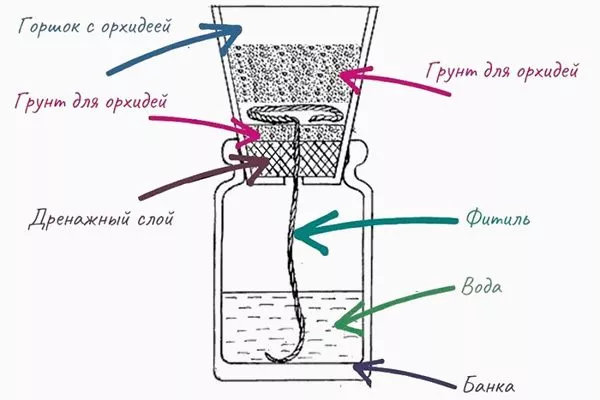
Wick method
This irrigation system allows the plant to take as much water as it needs at any given time.
Watering procedure:
- At the bottom of the pot, make a hole.
- Thread a synthetic thread through it and through the substrate.
- Place the end of the thread in a tray filled with prepared water.
This method allows maintaining the required substrate humidity without human intervention.
Heel method for a double potty
For heel watering, double pots are used. The inner pot has small protrusions on the bottom called "heels" (1-1.5 cm), which serve as support for the pot. The main pot is placed inside the larger pot.
How to water orchids using the "wet heel" method:
- Water the flower from above so that the water level in the second pot is 1.5 cm - this will allow the plant roots to receive moisture through the holes.
- Once the water has completely evaporated, water again. This method of watering completely prevents over-watering of the substrate.
Watch a video about watering orchids using the "wet heel" method:
How to water at different times?
Orchids are among those plants whose water requirements vary depending on the season (growing season). Specifically, the frequency and other nuances of watering vary.
In winter
During this period, orchids generally rest and don't require much water. To ensure normal growth and development, the plant only needs to be watered once every two weeks. It's also important to monitor humidity. Central heating radiators, for example, can lower it.
In summer
In summer, orchids require a lot of water, watering them every 3-4 days. The plant also benefits from hot showers and misting. To maintain the required humidity level, place a saucer of moistened pebbles, moss, or water near the orchid pot.
In spring and autumn
In spring, orchids are watered more frequently than in winter. Watering gradually increases, transitioning to a summer schedule. In autumn, watering is reduced compared to summer. However, sanitary spraying is still performed to remove dust and dirt from the leaves.
Features of irrigation taking into account the growing season
When watering orchids, it's important to consider the growing season, making any necessary adjustments to irrigation. When choosing a watering schedule, three plant states are typically distinguished: flowering, dormancy, and post-repotting.
During flowering
When the flower stalk is actively forming, the orchid's need for watering increases. However, water should be applied very carefully to avoid splashing the flowers. If it's warm outside, water the orchid approximately once every four days; if it's cold, water it once a week.
When watering, it's important not to overwater. Moisture in the substrate shouldn't stagnate, so avoid overwatering. Allow the substrate to dry between waterings. Overwatering can cause the orchid to drop flowers and increases the risk of root rot.
During the dormant period
When the orchid finishes blooming, the substrate should dry completely. After waiting another two days, water it. During the dormant period, water the plants twice a month, no more often. Water less during this period than during flowering.
After transplantation
Orchids are usually repotted after purchase or in the spring, after the plant emerges from dormancy. Besides repotting, the plant often requires fertilizing and root trimming. Immediately after repotting, water the orchid, but only generously mist the leaves. Wait a week and then water as usual.
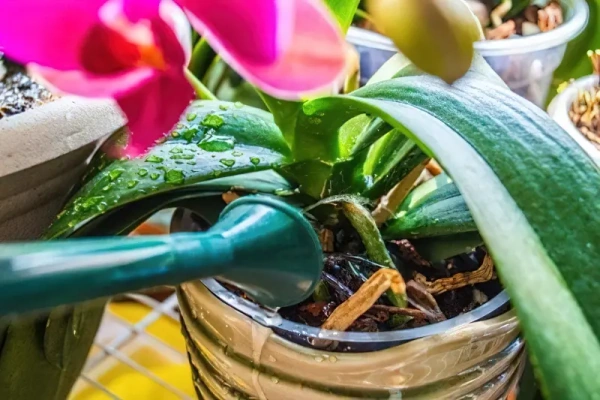
Repotted orchids are recommended to be watered using the immersion method, submerging the pot in warm water. After watering, the plant should be moved to a shaded area to help it cope with the stress of the move. Water again after two weeks, not sooner.
How to apply fertilizer during watering?
It is recommended to feed orchids with special fertilizers. fertilizers and only after watering. They contain minerals that prevent salt accumulation in the substrate and maintain the necessary acidity, as well as vitamins, amino acids, and succinic acid. All components are used in reduced dosages to avoid burning the roots.
Fertilizer isn't added to the water every time you water. In summer, it's added during the next, third watering. If you're watering by immersion, simply add the fertilizer to the water.
Watering orchids depending on the variety and type
Each type of orchid has its own characteristics and requires watering at a certain frequency and volume.
Types of orchids and their watering features - table:
| Variety | Recommendations for watering |
| Dendrobium | The best watering method is immersion. Keep the pot in water for 1 hour. |
| Wanda | Prefers a hot shower. Water the substrate only when it is completely dry. |
| Cambria | Spraying is contraindicated for it, and watering can only be done when the substrate is completely dry. |
| Phalaenopsis | During the budding and flowering period, watering is done every 3 days, during the dormant period - every 10 days. |
| Oncidium | It is watered generously until pseudobulbs appear. Watering is then stopped until flowering begins. |
What do you need to know about special cases?
There are times in an orchid's life when they require a special approach to watering. This is usually due to the flower's growing methods or its developmental stage. Let's look at the most common cases.
In expanded clay or polystyrene foam
If your plant is growing in polystyrene foam or expanded clay, determine its watering needs by the color of its roots. As soon as they turn silvery, they're dry and it's time to water. Gentle watering through the tray is recommended. Water will penetrate the holes in the substrate and be evenly distributed across the entire root area.
In sphagnum moss
Growing orchids in moss creates conditions close to natural. Sphagnum moss retains moisture for long periods of time, distributing it evenly throughout the plant's roots. Flowers grown on sphagnum moss don't require frequent watering; it's best to mist them once every two weeks.
For more information on growing orchids in moss and watering tips to prevent root rot, watch the video:
In a pot without holes
If the pot doesn't have drainage holes, the substrate can retain moisture longer than usual. Frequent watering is avoided in this case, as it leads to water stagnation and root rot. Watering in closed pots should be done once every two weeks.
After transplanting into dry bark
The timing of watering after planting in dry bark depends on the season. In summer, water the plant 24 hours after transplanting, and in winter, every 2-3 days.
In a flowerpot
Watering orchids in pots is considered the safest method—it doesn't cause either overwatering or drought. Add 1-2 cm of water to the bottom of the pot and immerse the orchid's roots in it.
Important questions
Growing orchids is an art form, requiring not only diligence but also knowledge. It's no surprise that beginners have many questions, including about watering.
Frequently asked questions and answers:
- How to water for the first time after purchase? The new plant is quarantined, away from other flowers, and watered no sooner than a week later. After that, water the plant 1-2 times every two weeks—the frequency depends on the ambient temperature.
- What to do in case of overflow? If the flower is overwatered, its roots darken and wrinkle, and the leaves are turning yellow and fall off. As a result, the plant dies. The flower can be saved if it is repotted in time.
- What to do if the orchid has dried out? As soon as the first signs of drying appear, water the plant immediately. The main symptoms are wilting flowers and yellowed, limp leaves.
- What is the best way to water an orchid? In this matter, you need to focus on the orchid's needs—their demands vary depending on the orchid species. Some prefer a shower, while others tolerate immersion better.
- Watering, lighting and temperature: how are they related? All three of these factors are closely interconnected. The more intense the lighting, the warmer the room, and the faster the substrate and plant roots dry out. In winter, with short daylight hours and a pot next to a cold window, moisture is retained for a long time.
Basic mistakes
Beginner gardeners often make mistakes when growing orchids. These can be avoided by understanding the flower's growing techniques in advance. Below are some common beginner mistakes and how to avoid them.
The most common of all are:
- Iridescence. These occur with frequent, excessive, or untimely watering. To prevent root rot due to stagnant moisture, it is recommended to install a 4-cm-thick foam drainage layer in the pot. Expanded clay and gravel are not recommended, as they can harbor pests.
- The leaf axils are flooded. If the plant is watered superficially (from a watering can), it is important not to allow moisture to remain in the axils - it will cause rotting and death of the plant.
- Close spraying. When watering, keep a distance of 20 cm or more from the plant. Spray gently to avoid damaging the leaves. Over-spraying can cause dents and other damage.
- Poor quality water. If it contains impurities or is hard, salt deposits may form in the substrate. This leads to yellowing of the leaves and root death.
- Spraying deadlines were violated. Avoid spraying the plant during winter, as the leaves may freeze. Watering is also prohibited if the plant is exposed to direct sunlight, as this may cause burns.
- Watering at night. Watering should be done in the morning. Otherwise, the orchid won't have time to dry out by nightfall, which can lead to disease and rot.
- The water does not change when watering several indoor flowers at the same time by immersion. If you don't do this, the flowers will infect each other - if there is even one sick plant.
Watering plays a crucial role in growing orchids; their beauty and health depend on it. Create conditions for these beautiful flowers that are as close to natural as possible, and they will respond with long and lush blooms.
Thanks for the article. I'm used to watering my orchids once a week, and they're growing without a problem. However, if I pay attention to the roots, they don't dry out completely at the bottom, and they're still dark green a week later. Now I need to think about whether I should water them less often and pay attention to their color. I'm at a loss now.
I'm simply shocked by the sheer number of nuances about watering orchids. I used to water them like regular flowers and kept wondering why they weren't blooming well, why the leaves were sometimes wilting, and so on. It turns out I was making so many mistakes! Thank you again for finding all the information, down to the smallest detail, in one place and in accessible, simple language.