
The peduncle is the orchid's "heart," responsible for the beauty of this magnificent yet capricious flower. The development of peduncles is a process that depends on the plant's condition and growing conditions. The stronger and healthier the orchid, the faster its stalks grow, and the more flowers they bear.
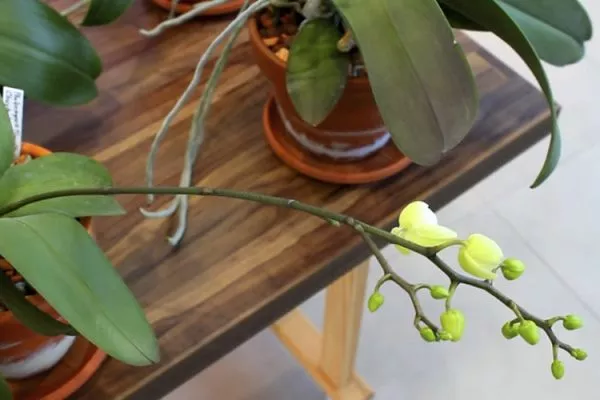
Orchid flower stalk
What is a peduncle?
The peduncle (or stalk) is the part of the orchid where buds form. It's essentially the section of the stem that extends upward from the base. It's where the most beautiful part of the orchid—the flowers—forms. The stalk always appears above the point of the previous bloom. It always has irregularities—the buds.
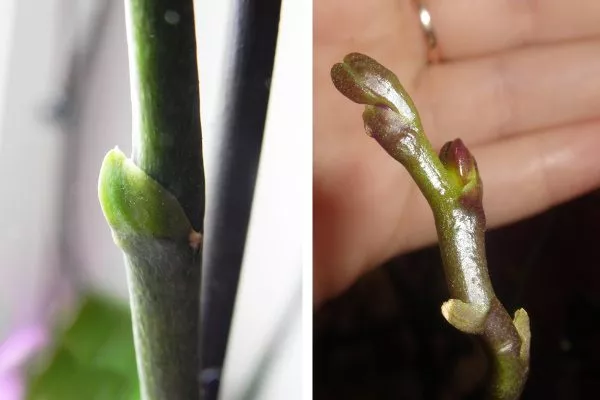
A bud on an orchid peduncle
The appearance of a peduncle indicates the active phase of plant development. During this period, the flower requires fertilizing. Special fertilizers for orchids are applied to orchids. The peduncle grows from the leaf axils, as well as from the growing point (rarely). At the rudimentary stage, the peduncle is often confused with an aerial root.
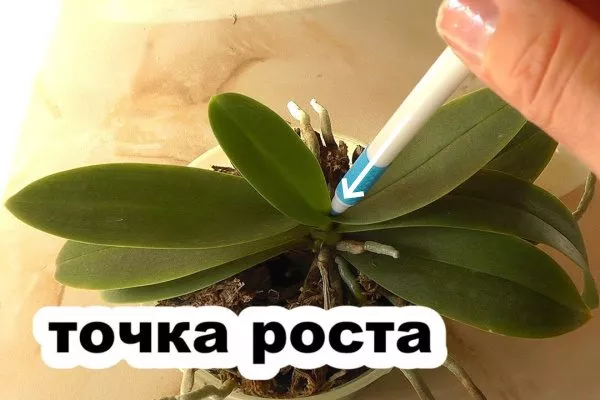
What does an orchid's flower stalk look like?
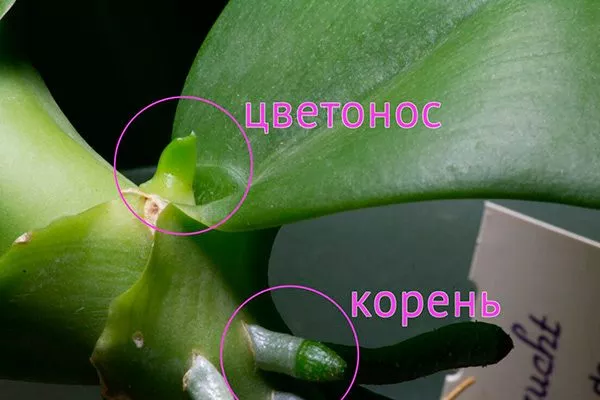
When a flower stalk first begins to grow, inexperienced gardeners often confuse it with a root or a baby plant, but there are differences between these parts of the plant:
- the flower stalks have pointed ends, while the shoots and roots are blunt;
- the flower stalks are covered with scales, and the roots of orchids are smooth;
- the flower stalks are uniformly colored, but the root has an uneven color (it is bluish at the base and green at the top);
- the roots, even in the initial phase of growth, are directed downwards.
Peculiarities of peduncle growth
Orchids typically produce flower stalks in the fall, when daytime and nighttime temperatures fluctuate significantly—from 25°C to 15°C. Flower stalk formation takes approximately 2-3 months, from the emergence of the shoot to the full development of the flower stalk.
The more favorable the growing conditions, the faster the orchid stalk grows. The flower stalks produce not only flowers but also offspring, which can be rooted to propagate the plant.
Peculiarities of orchid peduncle growth:
- During reblooming, a flower stalk may grow from a bud of the old stem. In this case, the additional stem produces fewer flowers than the main one. Furthermore, the new flower stalk grows sideways rather than straight.
- If the flower stalk is growing rapidly, it means the plant is receiving everything it needs for growth and development. Conversely, slow growth of the flower stalk indicates unfavorable growing conditions—perhaps the orchid is experiencing a nutritional or lighting deficiency.
- If the flower stalk began developing more than three months ago, the process is not going well. By this time, the plant should have formed a stalk and buds.
The video below explains what to do during the orchid's flower stalk growth period:
Conditions for peduncle growth
If there's no flower stalk or it's frozen and not growing, you first need to find the cause. If you've confirmed the plant is healthy, look for the cause in the growing conditions.
- ✓ Optimal air humidity should be 60-80% for most orchid species.
- ✓ Temperature regime: daytime temperature +25°C, nighttime temperature +15°C with a difference of 10°C to stimulate flowering.
In order for orchid flower stalks to grow and produce flowers, they must be provided with the following growing conditions:
- Temperature. Heat-loving orchids thrive at +25°C. However, nighttime temperatures should be significantly lower—by approximately 5-8°C.
- Lighting. Orchids prefer filtered light, with a day length of 12 hours. Otherwise, flower stalk growth will stop. Orchids thrive in southeast- and southwest-facing windows.
- Watering. Flowers are watered as the substrate dries out. Orchids react equally poorly to both under-watering and over-watering.
- Humidity. The plant requires regular misting with warm, settled water. To prevent damage, it's recommended to mist the plant with water—surrounding the orchid with other flowers and misting them.
- Top dressing. During the flowering period, the plant requires potassium and phosphorus. It is recommended to feed orchids with special fertilizers, such as Agricola (1-2 times a month, before flowering).
Peduncle and types of orchids
If an orchid doesn't produce a flower stalk, this is a serious cause for concern. But before taking any measures, it's important to consider the species of the orchid.
| Name | Temperature conditions | Lighting | Watering |
|---|---|---|---|
| Phalaenopsis | +25°C during the day, +15°C at night | Diffused light, 12 hours | Once a week |
| Wanda | +25°C during the day, +15°C at night | Bright light, avoid direct rays | Daily |
| Cattleya | +25°C during the day, +15°C at night | Diffused light, 10-12 hours | Reduce after growth |
| Cymbidium | +25°C during the day, +10°C at night | Bright sunlight | Reduce in June |
| Cambria | +25°C during the day, +15°C at night | Diffused light | Almost stop |
| Orchid species | Fertilizer type | Frequency of feeding |
|---|---|---|
| Phalaenopsis | Balanced (NPK 20-20-20) | Every 2 weeks |
| Wanda | High phosphorus content | Weekly |
| Cattleya | With increased potassium content | Once a month |
Phalaenopsis
This is the most popular type of indoor orchid. To stimulate flower stalk growth in a plant that has reached the appropriate age and has not been overfed, simply adjust its growing conditions slightly.
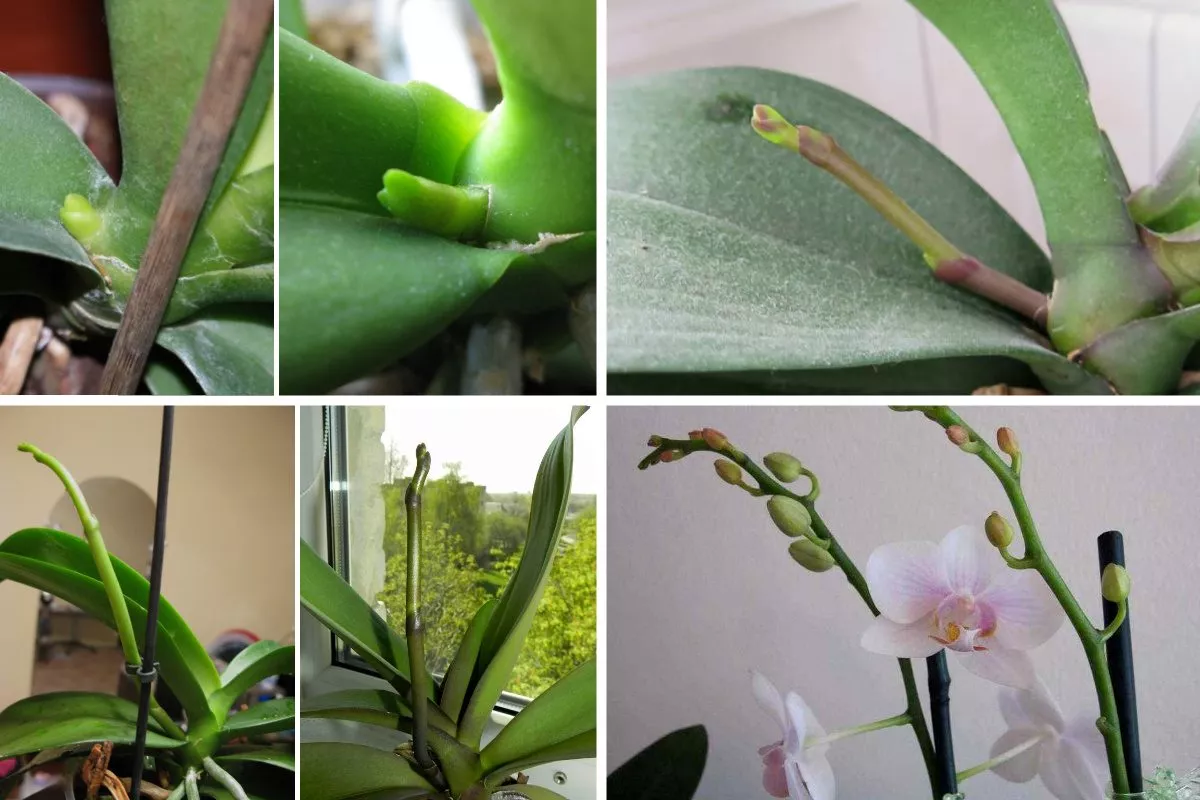
Phalaenopsis flower stalk at different stages
How to make phalaenopsis bloom:
- move the flower to the eastern or southeastern windowsill;
- achieve a difference between day and night temperatures of 6-8°C;
- Water once a week.
If the flower does not respond to stimulation, you need to create a little stress for it.
What else can you do to make your phalaenopsis bloom?
- do not water for 2 weeks;
- put it in a dark place;
- After a week, take it out into the light, water it, add potassium-phosphorus fertilizer and place it in moderate sun.
Wanda
Many gardeners consider this orchid too fussy. Some even believe it doesn't bloom indoors. In fact, Vanda is one of the most docile orchids, requiring no special conditions for flower production. The main thing is that the flower receives enough water and light.
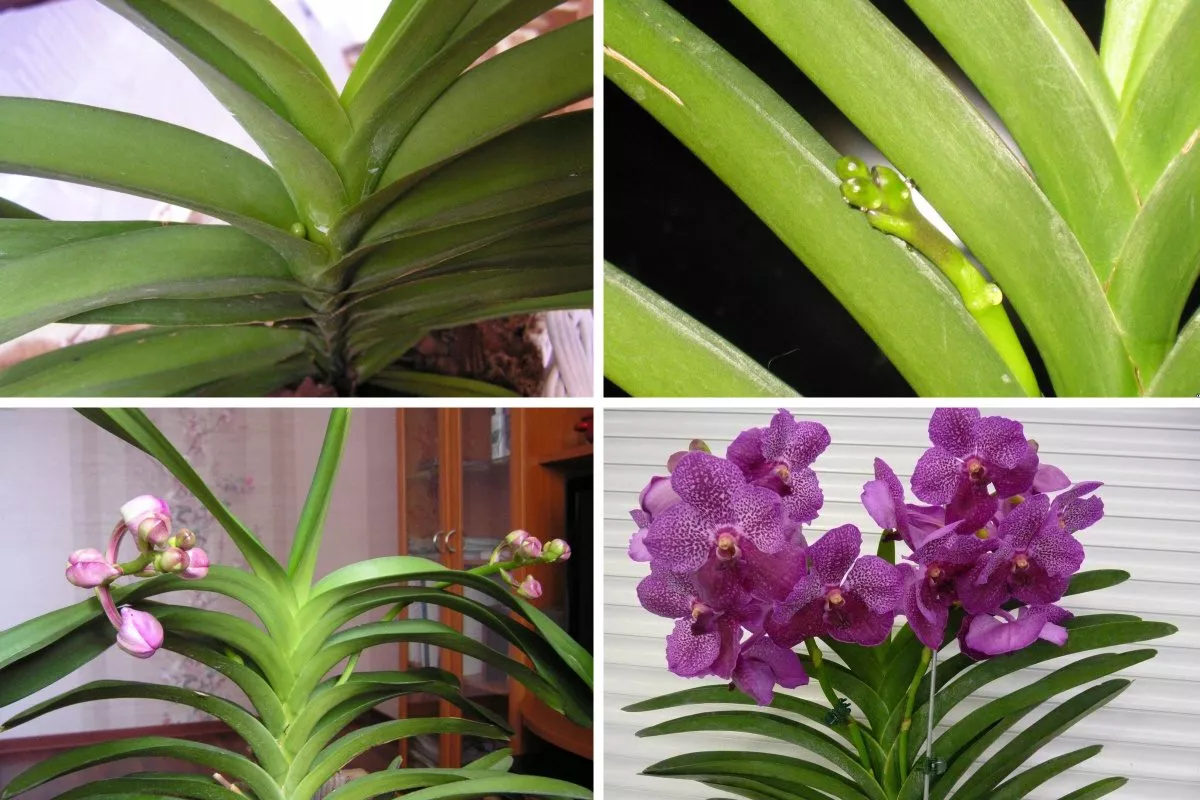
Development of the peduncle in the Vanda orchid
Vanda is extremely light-loving, but does not tolerate direct sunlight well—it can get burned. The plant requires daily watering if it is kept bare-root. This intensive regimen continues until the roots turn green.
Cattleya
These flowers are rightly called the queens of orchids. However, getting this graceful plant to bloom isn't easy. It's been noted that hybrid orchids are more difficult to stimulate than their natural counterparts. It's difficult to determine which orchid species were used to create the hybrids, so it's not always clear exactly how to stimulate them to bloom.
However, there are a few secrets that help to initiate the growth of the flower stalk:
- After the shoot grows to 2/3 the size of the pseudobulb, reduce watering - take breaks so that the substrate remains dry for 5-7 days.
- Increase the difference between day and night temperatures to 10-12°C.
- Maintain daylight hours at 10-12 hours.
- Provide cattleyas with sunbathing between 12 and 15 hours.
The above measures should be taken until buds appear. Then, gradually reduce the frequency of watering to the standard frequency. If this is not successful, reduce the daylight hours by 2-4 hours.
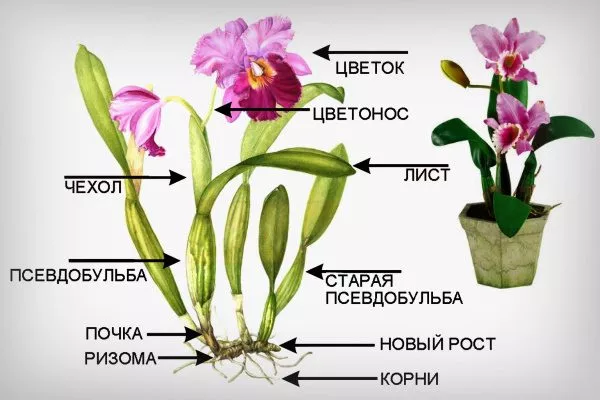
Cattleya orchid structure: peduncle and other flower parts
Cymbidium
Cymbidium has several fairly reliable signs by which one can identify the flower stalk:
- it is located on the side of the bulb (and does not grow from under it);
- it breaks through the bract (the flower stalk grows from under the leaf, but NOT from under the lowest one, called the stipule);
- its base is narrower than the center; its cross-section is round; and the tip is very sharp (that is why the rudiment of the peduncle is often compared to a bullet);
- If the length is more than 5 cm, the center of the peduncle is soft and seems hollow inside if you press on it lightly with your fingers.
To make a cymbidium produce an arrow, you need to:
- from the end of June, place the flower on a window with bright sunlight;
- create a period of “long daylight hours and cool nights,” where the temperature difference should be 10-15 degrees (to achieve this, place the cymbidium on the coldest window at night or repeatedly moisten the floor in the afternoon);
- If in spring the cymbidium is watered abundantly, not allowing the soil to dry out, then from the end of June watering should be reduced to 25-30%;
- Around the 20th of July, it is recommended to water the flower with slightly acidified water (this creates pH stress for it to stimulate the mass formation of flower stalks).
Also watch a video about the development of a cymbidium flower stalk:
Cambria
This orchid species requires at least two pseudobulbs to successfully grow and bloom. Cambria orchids, like phalaenopsis, don't require any special conditions other than high humidity. However, keep in mind that these orchids do not rebloom from old pseudobulbs.
To stimulate the formation of a peduncle in cambria, it is necessary:
- maintain a significant difference between day and night temperatures;
- almost stop watering (the plant is watered if the pseudobulb wrinkles).
If, after the measures taken, not a flower stalk but a new shoot has grown, it means the plant needs additional green mass or it is growing in unfavorable conditions.
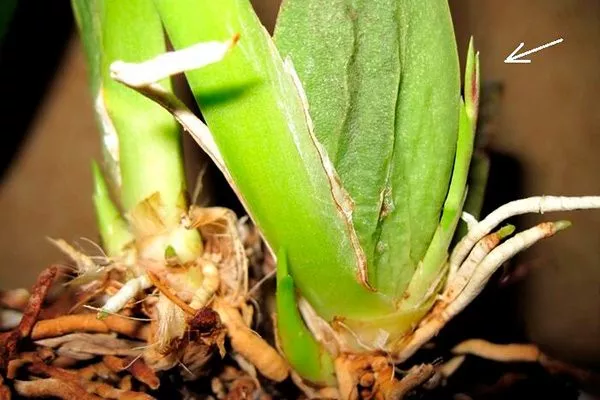
Flower stalk of the Cambria orchid
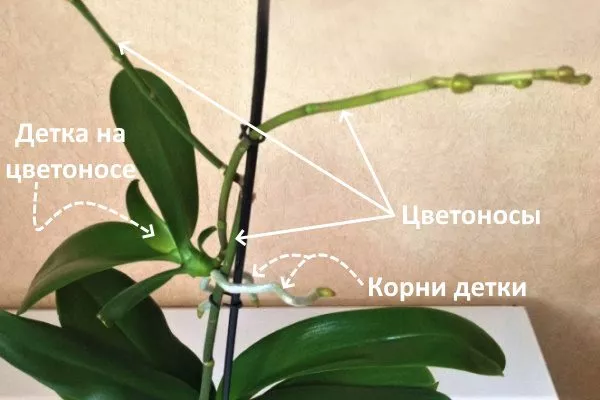
Orchid baby on a peduncle
When the first signs of growth appear on a bud, it's difficult to immediately determine what will emerge from the flower stalk—a baby flower stalk or a lateral flower stalk. Some things become clear only on the fifth day: the growing flower stalk has a pointed tip, while the baby flower stalk has a rounded tip.
But it will only be possible to determine exactly what is growing from the waiting bud after 10-15 days. The baby plant will first develop a rosette of leaves, and then roots will emerge.
For a baby to appear on a peduncle, special conditions are required:
- high humidity;
- diffused sunlight;
- temperature at +25…+27°C.
If all the above conditions are met, babies may appear on the peduncle soon after flowering ends.
How to transplant a baby?
Once a baby plant has emerged from the flower stalk and its roots have reached 5-6 cm in length, it's ready for transplanting. But before that, the baby plant must be properly separated from the adult plant.
To separate and transplant the baby eggs, you will need the following tools and materials:
- substrate based on coniferous tree bark, sphagnum moss, expanded clay;
- plastic pot;
- pruning shears (disinfected);
- cinnamon or activated charcoal.
Procedure:
- Cut the baby plant so that it captures part of the flower stalk on which it grew (about 1.5 cm).
- Dry the cut area for 30 minutes, then sprinkle it with cinnamon or crushed charcoal.
- Place the plant in the center of the pot. The planting container must have drainage holes. Add a layer of drainage material to the bottom of the pot.
- Fill the pot with moistened substrate, holding the baby plant by the root collar.
- Don't compact the top layer. To remove any air pockets between the roots, simply shake the pot and tap its sides.
- Sprinkle the top of the substrate with sphagnum moss.
Many gardeners believe it's best to place the pot containing the baby plant in a makeshift greenhouse. To do this, cover the container with transparent film. The mini greenhouse should be ventilated daily.
How to separate a baby plant from a flower stalk is also shown in the video below:
How to plant a baby plant is shown in the following video:
How to trim an orchid's flower stalk?
Orchids don't require special pruning, but the flower stalk should be trimmed after flowering. This procedure not only prolongs the flowering period but also the life of the flower.
Recommendations for pruning the flower stalk:
- It's recommended to trim the flower stalk in October-November (the exact timing depends on the orchid species). When the flower stalk turns brown, flowering is nearing its end.
- Flowering typically lasts 2-6 months. Some orchids bloom several times a year.
- During reblooming, buds often form on the bud of the old stem. Because of this, pruning is not done immediately after flowering, but rather when the flower stalk has completely dried out.
For pruning, use sharp pruning shears or scissors. The former is preferable, as pruning with pruning shears allows the cuts to heal faster. Scissors damage the edges of the flower stalk, and the cut takes a long time to dry. Always disinfect the tool before use with a cotton swab soaked in alcohol.
After flowering, the grower's actions will depend on the condition of the peduncle:
- dry and brown - pruning;
- not completely dry - pruning is postponed;
- There are buds on the peduncle, and the tip is green - pruning is postponed, since the stalk may bloom again;
- withers, but at the same time the dormant buds swell - the flower stalk is shortened above the buds or to green tissue.
Recommendations for determining the cut point:
- If the flower stalk has grown too long and buds remain only at the top of the shoot after the buds fade, pruning may not be necessary. However, it's preferable to select a well-developed bud and trim the flower stalk 1-2 cm above it.
- The cutting point is usually set above the second and third buds on the stem. The closer the cutting bud is to the base of the rosette, the more profuse the flowering on the side stems will be.
The timing of pruning depends on external characteristics. Before deciding whether pruning is necessary, carefully inspect the flower stalk.
It's time to prune if the flower stalk:
- dried up;
- the green one turned yellow or brown, and the purple one acquired a dark pink color;
- green for six months, but no buds are observed.
Tips for pruning flower stalks:
- Remove only the faded portion so the plant can focus its energy on forming new shoots. Avoid pruning during flowering, as this could kill the plant.
- There are 2 types of pruning:
- partial shortening of the peduncle (above the dormant bud);
- at the base (with a 2.5-3 cm stump).
The cut flower stalk is treated with a disinfectant, such as iodine, crushed activated charcoal, brilliant green, or garden pitch. This will not only prevent infection but also speed up wound healing.
How to trim an orchid's flower stalk is shown in the video below:
How to grow an orchid from a flower stalk?
To successfully propagate a flower stalk, it's important to time the process correctly. The best time for propagation is at the end of the flowering cycle.
Peduncles are often used to propagate orchids. A single stem can produce several shoots at once. Peduncle propagation involves rooting the entire stem or parts of it.
How to propagate orchids:
- Choose a time for propagation. Ideally, after the flowering period has ended, preferably in early spring.
- Cut the stems and divide them into pieces so that each piece has a living bud.
- Place the trimmed flower stalk in greenhouse-like conditions. To awaken the dormant bud, you will need:
- ensure air humidity at a level of 60-80%;
- set the temperature to +28…..+30°C;
- reduce lighting intensity;
- application of nitrogen fertilizers.
- Replant the stem after its sections have taken root. The optimal length is 50 mm.
- Place the established orchid in a substrate made from pine bark chips, charcoal, and sphagnum moss. First, add a drainage layer to the pot. Then, care for the plant as you would a mature orchid.
If a dormant bud fails to awaken, you can use cytokinin paste (available at flower shops). This is a hormonal preparation that stimulates cell growth and division.
How to use cytokinin paste:
- Warm the product to room temperature.
- Select several healthy buds (maximum 3 pieces) on the peduncle and separate the upper scale with a scalpel/tweezers.
- Rinse the exposed area with water and apply the paste to it.
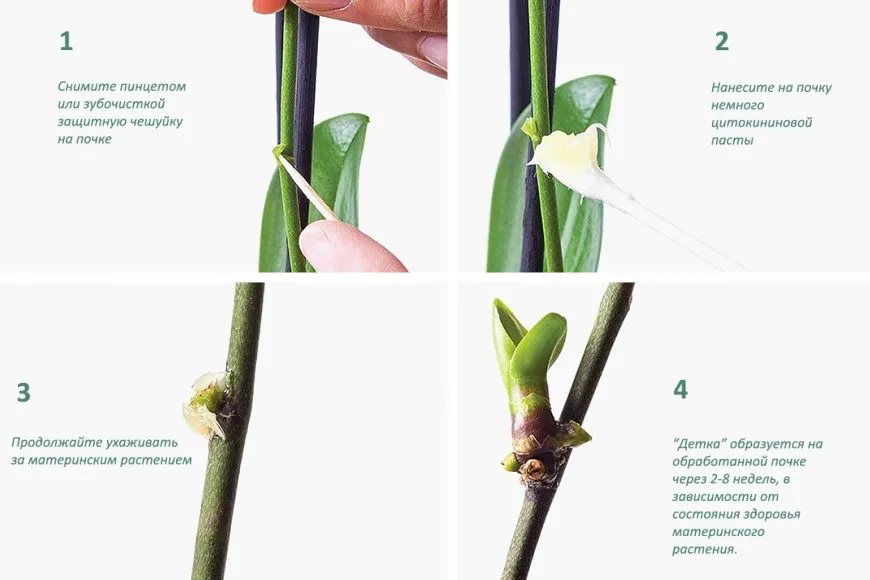
Contraindications to the use of cytokinin paste include recent flower transplantation, flowering period, weakened condition, hypothermia, illness, insufficient maturity and development.
Possible problems
It's not uncommon for a flower stalk to fail to grow, develop improperly, or be absent altogether. In each case, appropriate measures must be taken to correct the situation.
What are the problems with flower stalks and how to solve them:
- The flower stalk does not appear. Increase the lighting—move the pot to a new location and extend the daylight hours. Avoid watering for 10-12 days, then moisten the substrate in the shower. You can also feed the plant with Zircon or succinic acid.
- The flower stalk has stopped growing. If the plant's growing conditions aren't the cause, the plant may be experiencing root rot. The solution is immediate repotting into fresh soil, removing any rotted areas.
- The flower stalk dries up. The cause may lie in the plant's reaction to transplantation—as it adapts to its new location, it sheds excess material, usually the flower stalk and lower leaves. The condition can also be triggered by a lack of temperature fluctuation between day and night.
The solution is to cut the drying flower stalk down to living tissue. This will help slow down the drying process, and a new lateral shoot may emerge from the dormant bud. Otherwise, the stalk will have to be cut off, leaving a stump no more than 1.5 cm long. - The flower stalk has grown, but is short. A deviation is defined as a length that is inappropriate for the orchid species/variety. Causes include insufficient light and/or nutrition, short daylight hours, or improper watering. The solution is to identify and eliminate the cause of the problem.
- Sticky drops appeared on the peduncle. This could be a reaction to overwatering or a consequence of insect pests such as aphids, scale insects, or mealybugs. In the former case, watering should be reduced; in the latter, the plant should be moved to a quarantine area and treated with fungicides.
- The flower stalk broke. The top part should be placed in water—it will encourage flowering. Adding fertilizer to the water after flowering can encourage the appearance of offspring on the cut stem. If the remaining flower stalk doesn't dry out, there's no need to remove it.
By understanding the structure, growth, and development of orchids, you can not only ensure lush and long-lasting blooms but also productive propagation. If you follow proper orchid cultivation techniques, flower stalks can be successfully used to quickly and efficiently produce new plants.
Thank you! I also just got a new lateral flower stalk emerging from a bud.
I thought it might be a baby, but no, there will still be a flower stalk, judging by all the signs.
This is the kind of flower stalk I have growing.