
The orchid is considered one of the most beautiful flowers in the world, confidently rivaling the "queen of flowers" itself. This flower can come in a variety of colors, including yellow. There are many orchid varieties and hybrids with yellow flowers, all requiring specific growing conditions and care.
Description of yellow orchids
Most yellow orchids are herbaceous perennial epiphytes that, in nature, can cling to trees by means of aerial roots. Yellow coloration is found in various orchid hybrids and varieties, including Phalaenopsis, Cattleya, Cymbidium, Dendrobium, and other members of the family.
Brief description of yellow orchids:
- Stem cylindrical, green, usually up to 50 cm in height.
- Roots They have a spongy surface that can absorb moisture from the air. In hot weather, they serve as a source of moisture for the plant.
- Leaves Different orchid species vary in shape, color, and texture. They are usually oblong or elliptical.
- Flowers The flowers are located on peduncles and form racemes of inflorescences. Depending on the orchid species, the peduncles bear between 3 and 40 flowers. The petals are rounded, and in the center of the inflorescence is a sepal of varying shape. Many orchid species have flowers with a pleasant fragrance.
The life cycle of yellow orchids is linked to the climatic conditions of their natural environment. The monsoon season alternates with a dry period. Because of this, indoor orchids also undergo a dormant period.
Yellow orchids range in color from pale yellow tones to vibrant, sunny hues. The center of the flower is almost always brighter than the petal edges. Many varieties have a lip that contrasts with the base color—white, red, purple, speckled, or spotted.
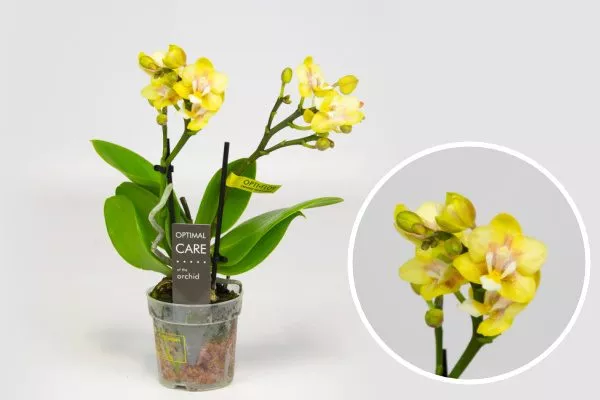
Yellow mini orchid
Distribution area
Yellow orchids grow primarily in warm climates—tropical latitudes. Most species are native to the humid forests of South America, India, Australia, Indonesia, Central America, and Southwest Asia.
Varieties of yellow Phalaenopsis orchids
Orchids aren't typically associated with yellow by flower lovers. However, there are quite a few varieties with flowers in shades of yellow. Below are the most popular among gardeners.
| Name | Plant height (cm) | Flower diameter (cm) | Aroma |
|---|---|---|---|
| Pulsation | 80-100 | 8-9 | Vanilla |
| Kaleidoscope | 70 | 8-9 | No data |
| Yellow chocolate | No data | 4-5 | Chocolate, lemon geranium |
| Phalaenopsis stuartiana yellow | 70 | No data | No data |
| Antura Gold | No data | 5 | No |
| Leopard | 70 | 9 | No data |
| Amadeus | 25-30 | 6 | Fragrant |
| Autumn sun | No data | 5 | No data |
| Shiny Girl | 25 | 3-3.5 | No data |
Pulsation
This is a hybrid orchid with yellow-variegated flowers reaching 8-9 cm in diameter. The petals are lemon-pistachio colored, speckled with coral. The leaves are leathery, glossy, and light green. The flower stalks reach 80-100 cm in height.
This variety holds its buds on its flowering shoots for a long time. The flowers have a vanilla-like scent. There is virtually no dormancy period. The plant blooms two or three times a year. A single plant can produce up to 25 flowers.
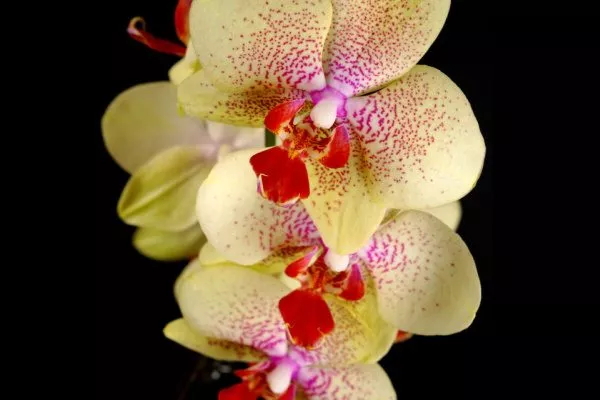
Phalaenopsis Pulsation
Kaleidoscope
A spectacular orchid, reaching a height of 70 cm. It blooms twice a year, but if given the most favorable conditions, it will bloom year-round. The flowers, with yellow-orange petals, are gathered in inflorescences. The yellow background is marked with crimson streaks, and the lips are crimson-yellow.
The flower diameter is 8-9 cm. The petals are velvety, reminiscent of tropical butterfly wings. The leaves are smooth, dark green, fleshy, and have a presentable texture, reaching 25 cm in length. The leaves grow fan-shaped. This variety is distinguished by its rapid development of aerial roots.
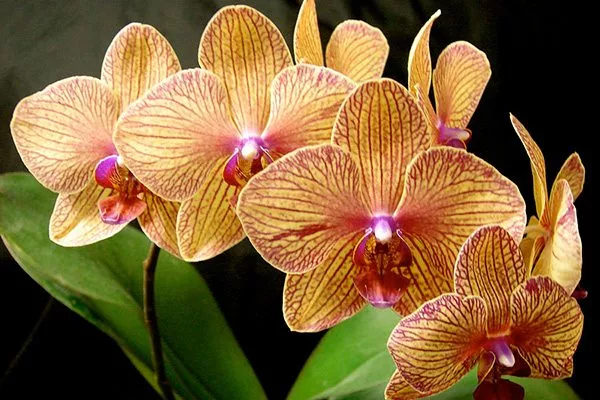
Phalaenopsis CY Kaleidoscope
Yellow chocolate
This variety is distinguished by its rich aroma. It's reminiscent of chocolate and lemon geranium. It can be smelled even from 2-3 meters away. The flower is especially fragrant in the morning. The plant is branched, with numerous flower stalks. This variety is considered easy to grow.
The petals are bright yellow and speckled. The speckles are burgundy-brown, reminiscent of chocolate sprinkles. The leaves are also speckled, with a purple line down the center and edges. Buds form almost year-round. The flowers are 4-5 cm in diameter.
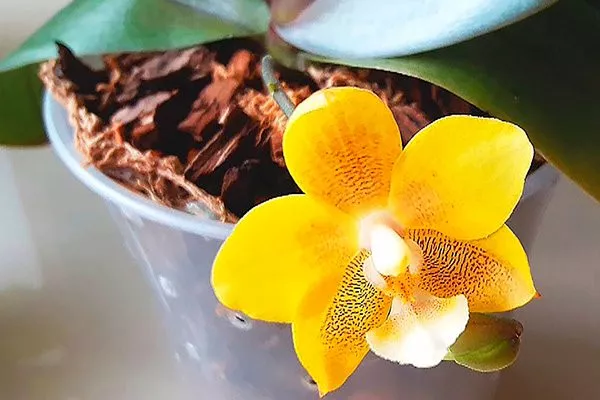
Phalaenopsis KS Balm “Yellow Chocolate”
Phalaenopsis stuartiana yellow
This orchid species comes in a variety of colors—there are subspecies with greenish and white flowers, and there's also a yellow variety, Phalaenopsis stuartiana var. nobilis. The petals are yellow, deep gold, and the center is variegated, scattered with red spots.
A single peduncle can hold up to 50 flowers. The stem is very short, hidden under thick leaves (20-30 cm long). The peduncle is drooping, up to 70 cm long.
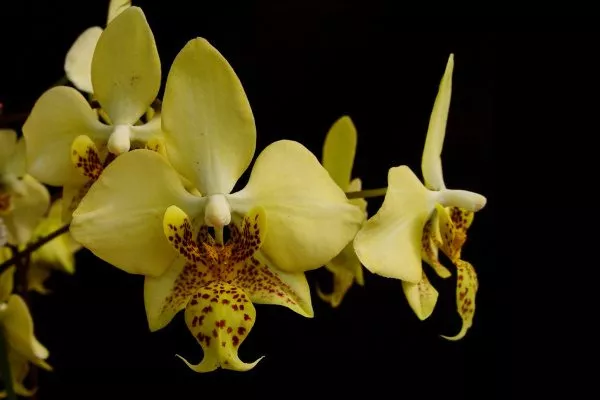
Phalaenopsis Yellow Strain
Antura Gold
An orchid with light yellow flowers and a darker ligula. The flowers are small, reaching 5 cm in diameter. There is no fragrance. The leaves are elongated and pointed.
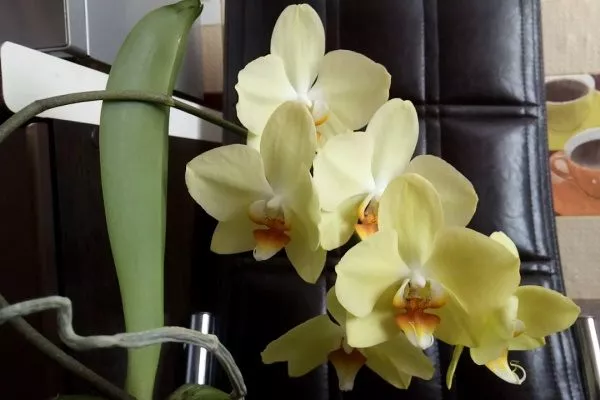
Phalaenopsis Anthura Gold
Leopard
A striking hybrid of Asian origin. The leopard-print flowers are densely speckled with a brownish-burgundy hue on a yellow background. This flower boasts a long lifespan, blooming indoors for up to 15 years.
The flower diameter is up to 9 cm. The plant height is 70 cm. The petals are dense, with a waxy coating.
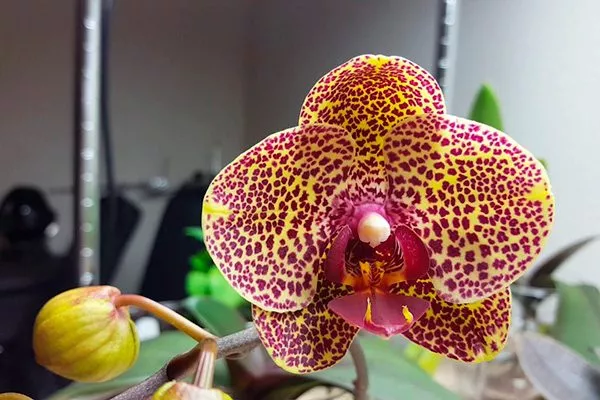
Phalaenopsis I-Hsin Yellow Leopard
Amadeus
A variety with waxy, canary-yellow petals. The flowers are only 25-30 cm tall. The fragrant flowers have branched stems. The diameter of the flowers is 6 cm. The leaves are dark green and elongated.
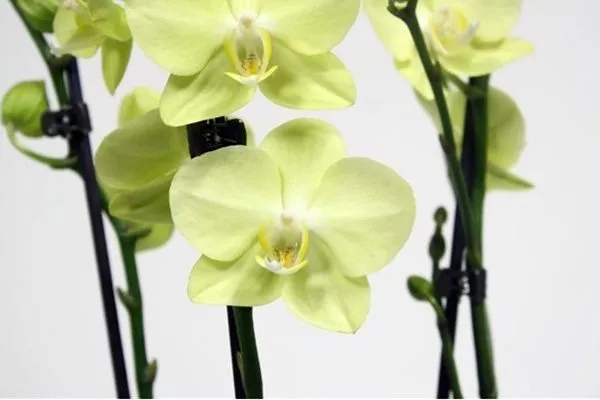
Phalaenopsis Amadeus
Autumn sun
This striking orchid features bright yellow flowers with purple and pink highlights concentrated in the center. The closer to the center, the more intense the color. The flowers are 5 cm in diameter.
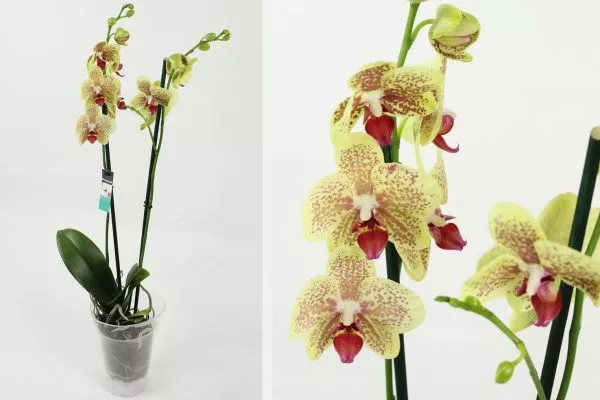
Autumn Sun
Shiny Girl
A beautiful hybrid from the mini-phalaenopsis group with delicately colored flowers. The petals are light green and yellow, with a white-pink center. The plant grows up to 25 cm tall, with flowers measuring 3-3.5 cm in diameter. The leaves are dark emerald.
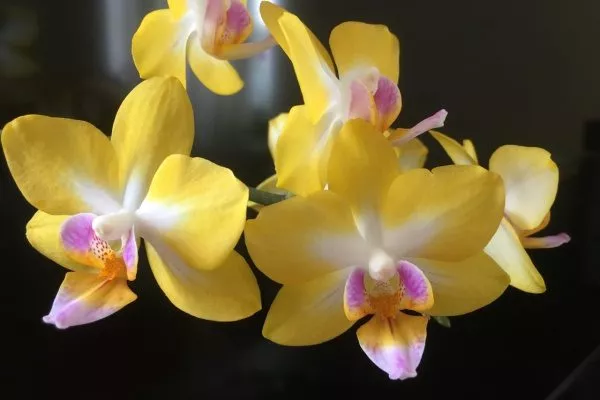
Phalaenopsis Yen Shuai Sweet Girl 'Shiny Girl'
Growing yellow orchids
Yellow orchids are grown using the same technology as other orchids. The yellow color does not affect the cultivation or care of these orchids in any way.
- ✓ The optimal temperature for most yellow orchids is +22…+24°C during the day and +16…+18°C at night.
- ✓ Air humidity should be maintained at 60-70%, especially during the period of active growth.
Lighting
Most orchids prefer bright, indirect light. Direct sunlight is equally dangerous for all species, as it can cause leaf burn. In winter, including during the dormant period, orchids require artificial lighting.
In winter, you can, for example, turn on phytolamps to extend daylight hours to 12-14 hours. This mode ensures timely and high-quality flower stalk formation.
Temperature
Yellow orchid varieties can have very different temperature requirements. These include those from the tropics and those from the cooler foothills. Therefore, when setting the room temperature, an individual approach is needed for each species/variety.
Air humidity
Orchids don't tolerate drafts well, but they respond well to ventilation. These flowers require good air circulation for healthy growth and flowering.
Air humidity, like temperature, is selected based on the natural habitat of a particular orchid species. The generally recommended humidity level for orchids is 60-70%.
Features of flowering
Each orchid hybrid or variety has its own flowering characteristics, but they also have some things in common. Orchid blooms last from several weeks to several months.
Yellow orchid flowering period:
- Vanda — 3-4 times a year. Flowering time does not depend on the time of year.
- Cattleya — 1-2 times a year. Flowering mainly occurs in winter.
- Phalaenopsis and Dendrobiums — 2-3 times a year. There is a pronounced dormant period.
If the fading flower stalks remain green, orchids can rebloom. To encourage blooming, they are trimmed back with a disinfected tool. The stalks are typically cut back by two-thirds of their length. The plant needs the remaining stalks to bloom again.
Cut off the flower stalks above the dormant buds, leaving a gap of 2-2.5 cm. Otherwise, the bud may dry out.
After a dormant period, the plant may not bloom for a long time. In this case, it is necessary to stimulate flowering by creating special growing conditions.
How to stimulate an orchid to bloom:
- watering is reduced as much as possible, and if necessary, stopped altogether;
- create temperature differences from +22…..+24°C during the day to +16…+18°C at night;
- In autumn, the length of daylight hours is increased to 12 hours (due to the inclusion of artificial lighting).
Maintenance and care
For an orchid to grow and thrive, it requires favorable conditions—temperature, light, and humidity. It also requires regular watering and fertilizing—only then will the flower thrive and bloom for a long time.
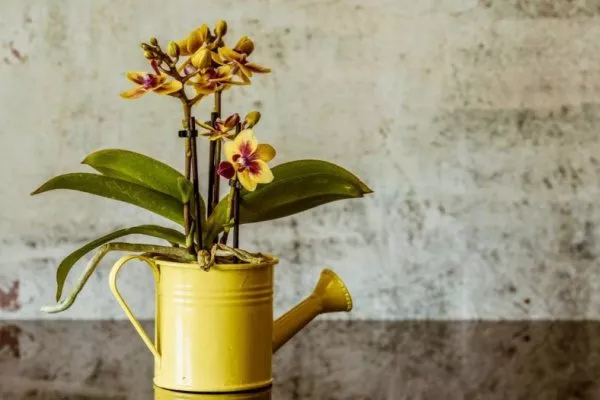
After purchasing a flower
Orchids purchased from flower shops generally don't need immediate repotting. However, there are situations in which repotting is recommended.
Reasons for replanting purchased orchids:
- If the flower grows on sphagnum moss, it is too moisture-absorbing.
- If the soil mixture contains peat, orchids do not tolerate an excess of nutrients well.
The new flower is kept in quarantine for two weeks. It is placed in a separate room, away from other houseplants. During this period, the orchid is not watered or fertilized—this allows it to adapt more easily to the new conditions.
After flowering
Flower stalks may remain green for a long time after flowering. To achieve this, it's necessary to take a number of measures aimed at normalizing the plant's life cycle.
What to do after flowering:
- Shorten the flower stalk by 2 or 3 buds. After this, the plant will bloom in about 2-3 months.
- Cut off the flower stalk at the base of the rosette - this will delay the formation of the arrow for a long time.
- Remove dried and yellowed flower stalks completely.
Watering and fertilizing
Orchids require intensive watering only during periods of active growth and flowering. During the dormant period, watering should be minimal.
Recommendations for watering and fertilizing:
- Orchids are watered with soft water with a low concentration of salts.
- In summer, plants are watered every 2-3 days, in winter - every 10 days.
- Fertilize orchids immediately after watering to prevent root burn. During active growth, feed every two weeks, and once a month in winter.
Increasing humidity
To ensure the plant maintains the required humidity, it's necessary to increase the humidity. This can be done by misting. This isn't recommended for white orchids, as it can cause gray mold. Yellow varieties, however, tolerate misting very well. A fine-mist sprayer is best for this purpose.
Landing
The planting technique for indoor orchids depends on the species, moisture requirements, and other factors. In any case, the flower should be planted in a properly selected pot and substrate.
Priming
Most indoor orchids are epiphytes, so they don't grow in regular peat soils. They require a special environment where their aerial roots can be well-ventilated and dry out after watering.
- ✓ The substrate should contain at least 70% pine bark to ensure good root aeration.
- ✓ Adding 10% charcoal will help prevent the development of putrefactive processes.
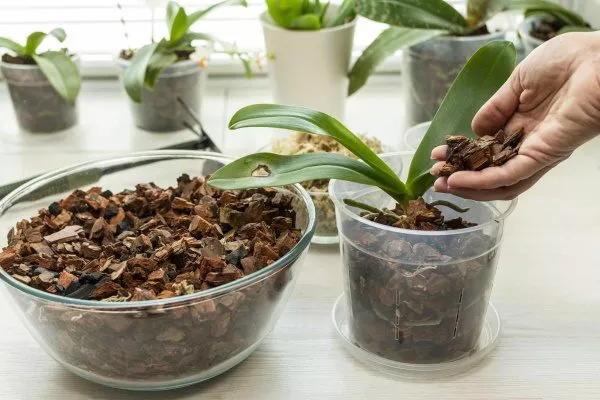
Ready-made orchid substrates are available in stores. In addition to pine bark, they typically contain various additives, such as sphagnum moss, charcoal, perlite, and coconut fiber/chips.
Sometimes the substrate contains peat; such mixtures should be avoided. Peat mixtures are too dense and are not suitable for aerial roots. Alternatively, you should remove the large elements from the mixture and discard the peat.
- You can make the substrate yourself - by cutting pine bark into pieces and adding one or more additives to it:
- Sphagnum moss — increases the substrate's water retention capacity. Recommended for growing orchids in hot and dry conditions. Moss doesn't necessarily need to be added to the substrate; it can be placed on top to help retain root moisture.
- Styrofoam. It doesn't absorb water at all, so it can be placed under the orchid's crown to prevent rot. Foam balls can also be used as drainage material or a rooting agent.
- Charcoal — it helps disinfect the substrate. It's added in very small amounts—no more than 10% of the total volume.
- Expanded clay — a moisture-absorbing and breathable material. It can be used as a base material—as an alternative to pine bark.
Foam glass, zeolite, clay granules, etc. are also often added to the orchid substrate.
Pot
Orchids can be grown in pots made of various materials. However, transparent plastic containers are typically used to allow the plant's roots to participate in photosynthesis.
Tips for choosing a pot:
- When repotting a flower, use a pot one size larger than the previous one. This will allow the roots to spread more freely in the new container.
- If you discover a lot of rotted roots during repotting, trim them off. The root mass will decrease, so you'll need to move to a smaller pot. Orchids don't like overly spacious pots; they grow better in tighter ones.
- The pot must have drainage holes.
Orchids can also be grown in plastic pots, glass vases, jars and flasks.
Deadlines
The timing of orchid repotting depends on their species and life cycle. Most often, gardeners grow Phalaenopsis orchids—orchids with a single flower stalk bearing several flowers. These orchids are typically repotted in March or April.
When planting, you also need to consider the type of planting material. For example, bulbs ordered from a nursery should be planted immediately upon receipt, otherwise they will dry out.
Planting technology
The technique for planting (repotting) orchids depends on their growing conditions. Most often, gardeners grow epiphytes, which require transparent pots.
To complete the work, you will need a sharp tool - scissors, a knife or pruning shears, as well as a substrate, a pot and one tablet of activated carbon.
Transplantation procedure:
Step 1. Inspect the flower and trim off any dried or damaged leaves. Sprinkle the cuts with crushed charcoal. If the flower has recently finished blooming, trim off its stem. Water the roots to make them more pliable and easier to remove from the pot.
Step 2. Carefully remove the plant's roots and the potting medium. Be careful not to damage any of the roots. Don't pull the plant by the leaves; instead, crumple the plastic container to loosen the potting medium and make it easier to remove the roots. Alternatively, turn the pot upside down, holding the plant by the base—it will slide out under its own weight.
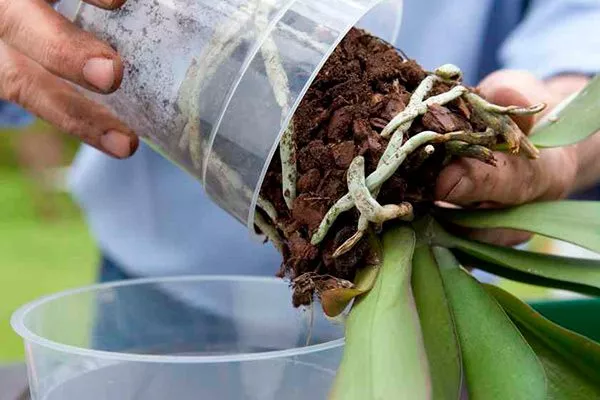
If all else fails, cut the plastic pot open. Ceramic pots can be gently smashed with a hammer.
Step 3. Remove any old soil from the roots. Use your hands to remove any remaining moss and bark. Then rinse the roots in a basin filled with room-temperature water. Inspect the plant and trim off any rotted roots or empty bulbs.
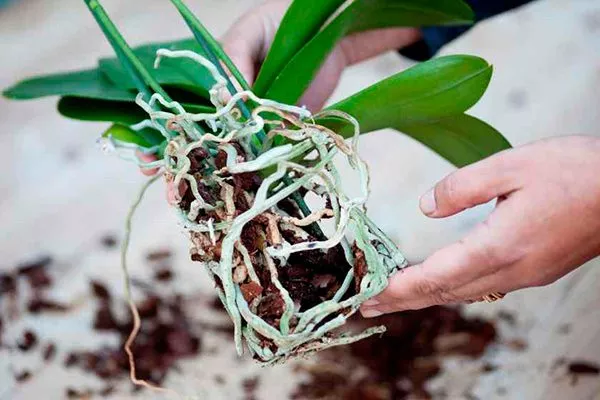
Orchid roots become brown and hollow as they rot. Sprinkle the cut ends with activated charcoal. Repot when the roots are dry, which usually takes 6-8 hours.
Step 4. Prepare a new pot. Soak it in a potassium permanganate solution for a few minutes to disinfect it. Add a 2 cm layer of expanded clay or fine gravel to the bottom of the pot. If the plant is large, place larger stones on the bottom to act as weights to prevent the pot from falling.
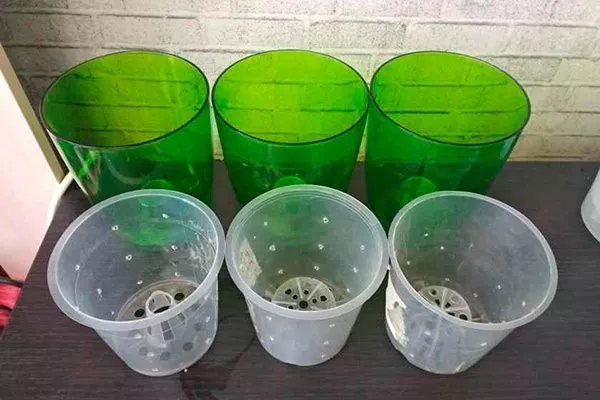
Step 5. Add a small amount of potting soil to the pot, leaving enough room for the plant's roots. Place the plant in the container and fill any empty spaces with potting soil, ensuring there are no air pockets between the roots. Don't compact the soil; it will settle on its own over time. The plant should sit firmly in the pot, not wobble.
The base of the plant should be 1-1.5 cm below the edge of the pot. Secure long flower stalks immediately during repotting to avoid damaging the roots later.
Methods of reproduction
Orchid propagation methods depend on the species and the grower's preferences. Orchid propagation is typically done in one of three ways: cuttings, division, or propagation by cuttings. Seed propagation is not commonly practiced by ordinary gardeners, as it is very time-consuming and labor-intensive.
By dividing the bush
Dendrobiums, Cymbidiums, Miltonias, Cattleyas, and Oncidiums are propagated by division. This method is suitable for mature plants. Each division should produce four or more pseudobulbs.
Division order:
- Moisten the substrate to make it easier to remove the plant from the pot.
- Pull the plant by the base of the stem to remove it. Remove any soil from the roots.
- Using a sharp knife, divide the onion into several pieces.
- Dust the cuts with crushed charcoal or cinnamon and air dry.
- Plant the cuttings in separate pots filled with moss and nutrient substrate.
Children
Flowering stems produce offspring randomly during flowering. High temperatures (above 28°C) and increased humidity are required for their emergence.
The order of reproduction by babies:
- Carefully separate the shoot from the stem. Ideally, the offshoot should already have a root system, then it can be safely repotted.
- Dry the cut area and sprinkle with charcoal.
- Make holes in the sides of a clear plastic container.
- Fill the pot with substrate and plant the baby plant so that its roots are completely covered. Place the plant near a window.
- Do not water the plant for the first two days. On the third day, water it with a solution of Kornevin, Epin, or another rooting stimulant. Ventilate the plantings for 5-7 minutes every day.
- When the plant roots reach a length of 4-5 cm, transplant the plant into a substrate for adult orchids.
Also watch a video about propagating orchids using babies:
Cuttings
Phalaenopsis is usually propagated by cuttings. This is the simplest and most effective method, and the one chosen by most gardeners.
Reproduction order:
- After flowering, the flower stalk is cut into 3-4 cm pieces so that each cutting has one dormant bud.
- Treat the cuts with crushed charcoal.
- Place the cuttings in damp sphagnum moss and cover with plastic wrap. Keep them in a warm place (25°C to 28°C) and moisten the moss regularly.
When the cuttings take root and the first leaves appear, plant them in separate pots.
Diseases and pests of yellow orchids
Indoor orchids are typically grown not with wild orchid species, but with hybrids and cultivars. These are highly resistant and adapted to transport and repotting. Yellow orchids, like all flowers, are not immune to diseases and pests.
The main enemies of orchids are various types of rot—black, bacterial, gray, and brown. These rots appear under unfavorable conditions, such as overly wet substrate or high air humidity.
Orchid pests also appear primarily due to care errors. Attacks most often occur in winter, when flowers lack natural light and the heating system disrupts their normal microclimate. The most common orchid pests are scale insects and mites.
How to combat diseases and pests:
- Viral diseases typically change the appearance of the flower and leaves. These diseases are not treatable. Fungal diseases typically affect the leaves, causing them to turn black. Spraying with fungicides can help solve the problem.
- Scale insects hide in plant scales. They can be easily removed with toothbrushes. If there are numerous pests, spray the plant with an insecticide.
- Aphids typically attack young flower buds. Pest colonies can be washed off with a shower. If the buds have already opened, use effective insecticides.
Yellow orchids are spectacular plants, united by the color of their flowers. However, each variety or hybrid has its own growing conditions. Each flower requires an individual approach to planting, care, and propagation, tailored to the specific characteristics of the variety.
Incredibly beautiful yellow orchids.
I already have a snow-white one, a lilac one, and for March 8th my dad gave me a white one with lilac spots.
But now I really want a new one – a yellow one 🤗