
Dendrobium orchids are not a cultivar, but a genus of perennial herbaceous plants in the Orchidaceae family. The Dendrobium group includes many different cultivars, including greenhouse, garden, and indoor varieties. The species was first described by Swedish botanist Svarts Peter Olof back in 1799.
Description of the flower
The culture is a sympodial epiphyte or lithophyte, which differs from other orchid genera by its tubular base of flowers, lanceolate leaves and large inflorescences.
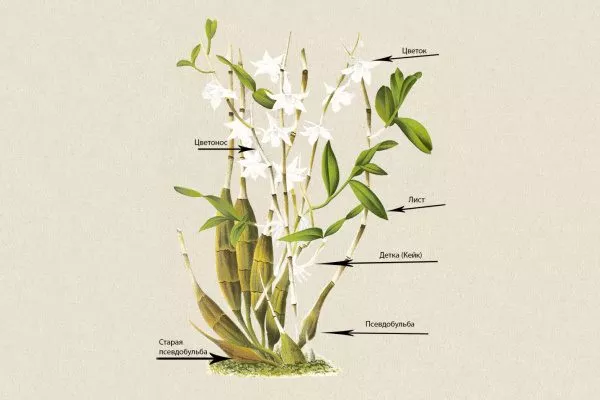
Dendrobium can also be recognized by the following characteristics:
- Escapes. They can be either drooping or upright, ranging in length from 20 cm to 1-5 m. They are most often thickened and ribbed or cylindrical in shape. Pseudobulbs are present.
- Root system. Vigorous, developed, with a velamen covering, preventing complete drying out. Aerial roots are present.
- Inflorescences/peduncles. They have a racemose shape and can contain one or more flowers. Type: drooping, erect, terminal, or lateral. Peduncles are formed in the leaf axils.
- Foliage. Depending on the variety, the shape is ovoid, oblong, lanceolate, or elliptical. Many Dendrobium subspecies have thickened and fleshy leaves (like those of succulents).
- Flowers. They often have a pleasant, distinct aroma. The base of the lip is tubular and coiled, and the shape is highly variable. The sepals have a sac-like growth, similar to a blunt spur.
- Coloring – white, pink, red, lilac, purple, yellow, light blue, blue, etc. Moreover, not always monochromatic.
Popular varieties
There are many species of orchids in the genus Dendrobium. But there are some very popular ones that are grown by our compatriots on windowsills.
| Name | Height of shoots | Flower color | Flowering period |
|---|---|---|---|
| Dendrobium Nobile | 70-90 cm | Lemon yellow, lilac, coral, lilac, orange, purple | 1-1.5 months |
| Dendrobium phalaenopsis | Up to 60 cm | Different palettes | 2 months |
| Dendrobium Parisha | 30 cm | Purple Amethyst | June-July |
| Dendrobium King | Up to 30 cm | Pink or lilac | February-March |
| Dendrobium densiflorum | Up to 30 cm | Bright yellow | Not specified |
| Dendrobium moniliforme | 15 cm | Not specified | Not specified |
| Dendrobium magnificum | 7-8 cm | Snow-white | Spring and August |
| Dendrobium reina Victoria | Not specified | Violet | Not specified |
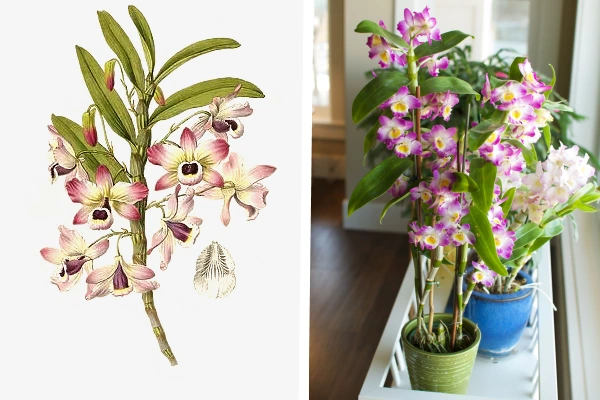
Dendrobium nobile (or noble)
Dendrobium nobile — This is the most popular variety of the polymorphic sympodial type. It is characterized by upright shoots at the beginning of growth and drooping shoots in maturity. They reach a length of 70-90 cm and a thickness of about 2 cm. When the pseudobulbs mature, the foliage falls, and offspring form at the top, suitable for reproduction.
Other features:
- the leaves have a leather-like surface and are arranged in two rows;
- petals ovoid;
- the floral lip is pubescent with dark spots at the base;
- shortened inflorescences with up to 4 flowers;
- flower diameter is about 7 cm;
- flowering time – 1-1.5 months;
- prefers to grow in rocky areas.
The shades are varied – lemon yellow, lilac, coral, purple, orange, violet.
Dendrobium phalaenopsis
Dendrobium phalaenopsis (or Dendrobium bigibbum) is a hemiepiphyte with fleshy tuberidia for water storage. The plant is asympodial, so vegetative shoots form in axillary buds at the base of the stem. The leaves are leathery and glossy, and the bush is lush, with more than 8-10 flowers forming on a single peduncle.
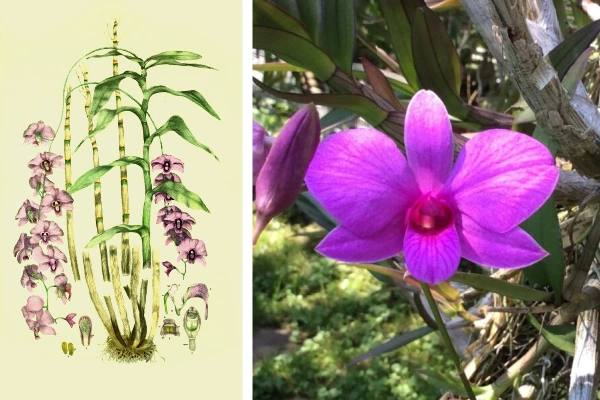
There's also a third name—butterfly. This stems from the fact that this Dendrobium species was discovered by three people at different times and in different locations. It grows on both rocks and trees. Numerous hybrids of various shapes and sizes have been bred from this species.
Dendrobium Parisha
Dendrobium parishii is an epiphyte with drooping shoots about 30 cm long, while the oblong and pointed leaves reach almost 10-12 cm. The flowers have a purple-amethyst sheen and a very pubescent lip with brownish-purple spots. It blooms from June to July.
Dendrobium King
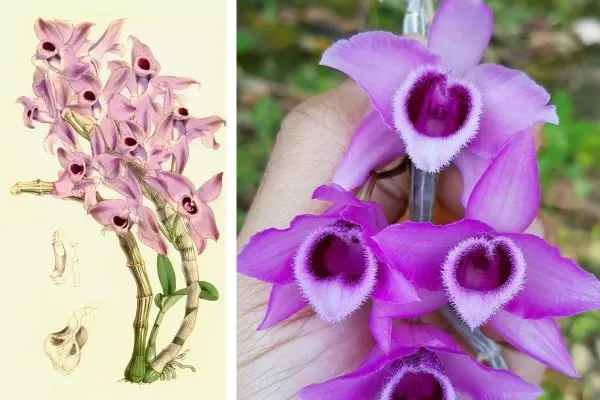
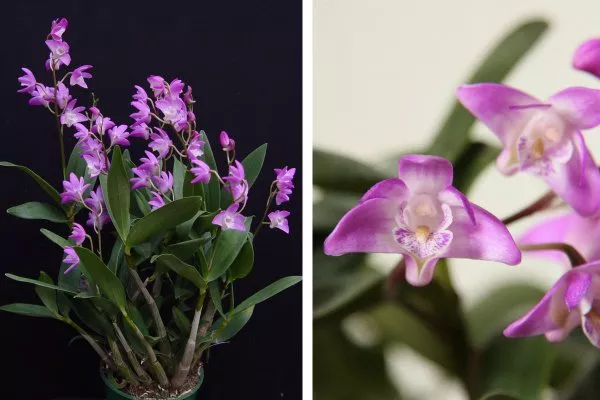
An interesting Australian cultivar with the Latin name Dendrobium kingianum. The stems are cylindrical, and the leaf blades are very wide. The petals are pink or lilac, but the lip is spotted. Flowering is short-lived, lasting about a month (February to March).
Dendrobium densiflorum
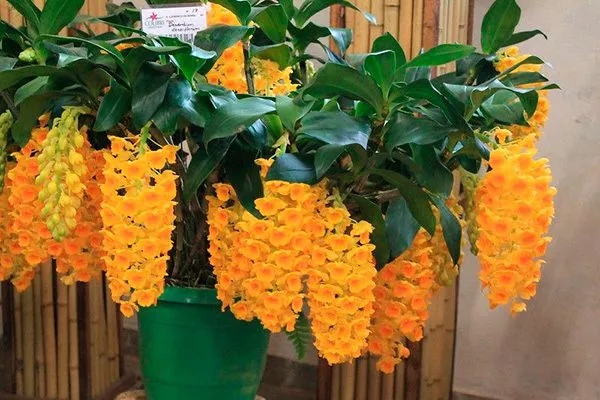
Dendrobium densiflorum is distinguished by its tetrahedral stems and a huge number of flowers per inflorescence (almost 50). The racemes reach 30 cm in height and are bright yellow, with an orange-edged lip.
Dendrobium moniliforme
Dendrobium moniliforme is a Japanese endemic, closely resembling Dendrobium nobilis, but is significantly smaller—only 15 cm. It is considered the most low-maintenance, making it recommended for beginners.
Dendrobium magnificum
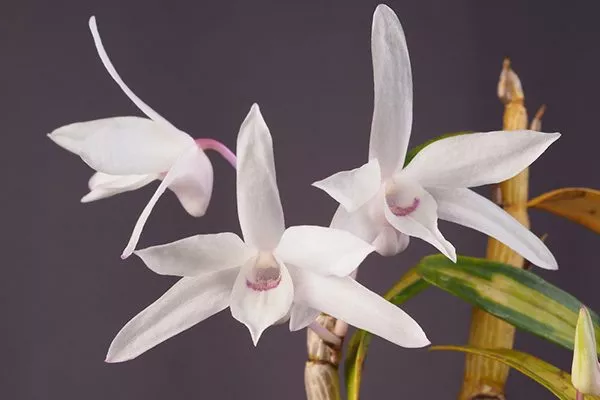
Dendrobium bellatulum is a miniature house orchid, reaching a height of 7-8 cm. Its flowers are only 2-3 cm in diameter, and its apical leaves are fleshy. It blooms twice a year – in spring and in August. The flowers are pure white with a bright yellow lip.
Dendrobium reina Victoria
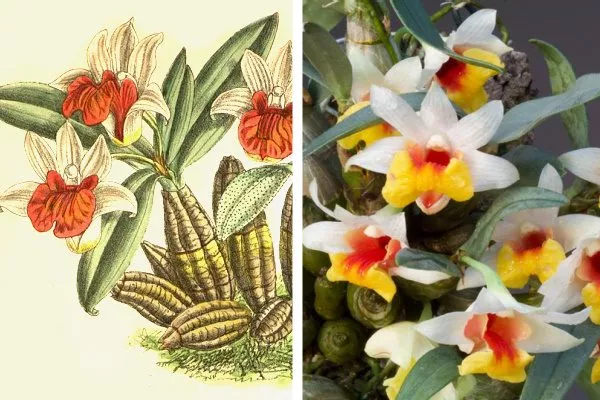
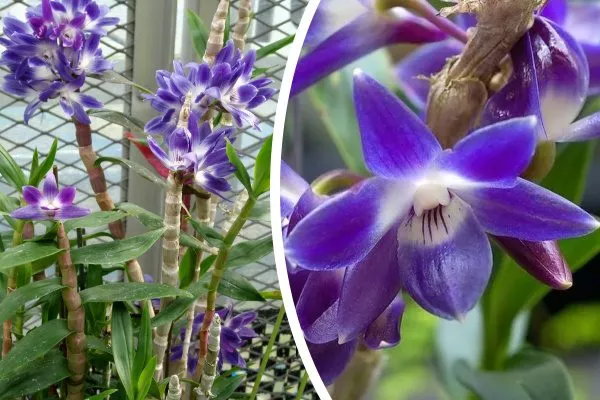
This member of the genus, called Dendrobium victoriae-reginae, has purple flowers, which is exactly how Victoria blooms in the wild.
Conditions of detention
Dendrobium orchids are excellent for indoor growing, but beginners are better off choosing hybrid varieties rather than the originals – they are less demanding and undemanding. Even in natural conditions, they grow more successfully. Care instructions are the same for them, regardless of the hybrid variety.
- ✓ Optimal lighting level: 10-16 hours per day, depending on the variety.
- ✓ The need for night and day temperature differences to stimulate flowering.
- ✓ The air humidity level should be 50-80% to avoid rotting or drying out of the plant.
Location
Orchids, and especially Dendrobiums, love light and heat, so pot placement is crucial. A west-facing window is ideal, but not all apartments have access to one. Therefore, when choosing, consider the following:
- South side. A good alternative, but not for summer, as during hot weather, the sun's rays and heat from the glass can harm the plant, causing burns, wilting, yellowing, etc. If there is no other option, hang curtains on the windows or install blinds before the onset of hot weather.
You can use light-colored paper (don’t use black paper, it attracts heat). - North side. The worst solution. Natural light won't be enough in both summer and winter, so you'll have to install phyto- or fluorescent lamps. It's especially important to move the pots at least 50 cm away from the glass immediately after the weather turns cold.
Remember, glass materials accumulate both heat and cold, and therefore transfer these properties to objects located nearby. - East side. An excellent option, but not suitable for regions with cold climates in winter – the glass will be too cold and there will be insufficient light.
Lighting
There should be plenty of light, but the length of daylight depends on the specific Dendrobium variety. The minimum is 10 hours, and the maximum is 16 hours per day. The exception is the dormant period—during dormancy, daylight hours are reduced by 2-3 hours per day.
Temperature conditions
Dendrobiums belong to the temperate orchid group. The only difference is that they require night/day temperature fluctuations. Based on this, there are three main seasons for transitioning to cooler temperatures:
| Time of year | Daytime temperature | Night-time temperature |
| Spring, summer | From +20 to +25 degrees | From +15 to +18 degrees |
| Autumn | From +15 to +20 degrees | From +7 to +12 degrees |
| Winter | From +10 to +18 degrees | From +10 to +18 degrees |
Humidity
The humidity level in the room where Dendrobiums are kept should range from 50 to 80%, depending on the variety. Higher humidity levels will cause plants to rot, while lower humidity will prevent flower stalks from forming, and the plant itself will develop too slowly.
Watering during the growing period
Dendrobiums typically undergo long periods of rest (up to almost six months). During this time, the flowers are rarely watered, as this stimulates growth, which is undesirable for proper rest.
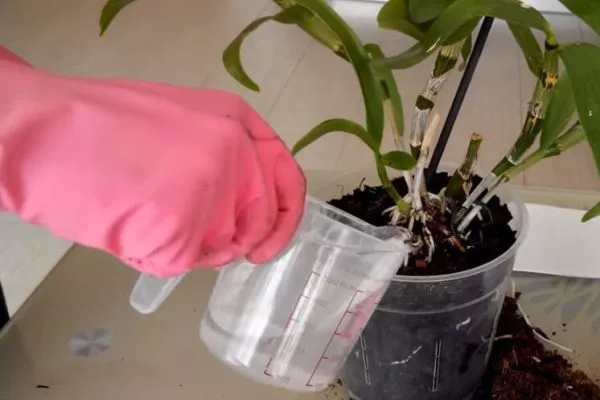
As the plant grows, watering becomes more intensive, but its frequency and amount depend on many factors—the age and size of the plant, the variety, the composition of the substrate, the temperature and humidity, and the season. For beginners, it can be challenging to determine all these parameters simultaneously, so consider the following recommendations:
- flowers with narrow and oblong leaves evaporate moisture more slowly than those with wide leaves, so they are watered less often;
- humidification is required when there are no condensation drops on the walls of the transparent pot;
- it is too early to water if the roots are still wet;
- the water temperature in warm weather is a couple of degrees cooler than the room temperature, in cold weather – the same amount cooler;
- Avoid letting drops fall on the green parts of the plant, but if water gets into the axils, wipe it off with a napkin;
- use a combined method - once immerse in a tray with water, the other time moisten from a watering can;
- Use settled and boiled or filtered water.
Spraying
Dendrobiums thrive on room humidity, so misting them isn't recommended. The only thing you can do is give them a hygienic shower once every couple of months. To do this:
- Place the pot in a basin.
- Fill a watering can with filtered water.
- Water the bush from above so that the water stands in the pot.
- Let the liquid drain immediately, and wipe the leaves, stem and axils with a soft cloth until completely dry.
Top dressing
Dendrobiums don't need fertilizing during the dormant period, but if the soil isn't nutritious enough, do it once every 30-50 days. During active growth and flowering, fertilizers need to be applied Once a week, immediately after watering. However, keep in mind that the concentration should be 2-4 times lower than indicated in the instructions (due to frequency).
Preparing for landing
Preparatory measures play a significant role in the viability of orchids. They determine the incidence of disease, adaptation, and survival, so don't ignore these rules. This is especially true if you're a novice orchid grower, as you won't be able to correct your mistakes later.
Selecting soil
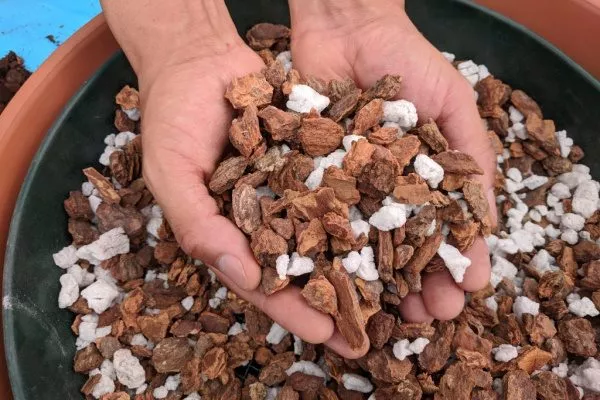
The main requirements for a substrate are looseness, moisture absorption, and neutral pH. Experienced orchid growers prefer to make their own soil, but beginners can purchase a special soil mix for epiphytes. If you prefer to do the job yourself, prepare the following materials:
- pine or spruce bark;
- charcoal;
- sphagnum moss;
- expanded clay, perlite, polystyrene foam or vermiculite for the drainage layer.
Manufacturing process:
- Soak the bark in water for 3 days. Be sure to place a weight on top to ensure the wood is completely saturated. Remove the bark and air dry for about 10 hours. Now cut it into pieces approximately 2 cm long.
- Prepare the moss. Soak it for 90 minutes and let it dry for 5 hours.
- Separately, grind the charcoal into fractions of about 1 cm.
- Mix all ingredients in equal proportions, but you can add twice as much bark (depending on the variety).
- Place drainage at the bottom of the pot first, then the substrate.
Pot
Dendrobiums are typically planted in specialized basket pots, regular containers, or on blocks. The latter can be pieces of coconut, pine bark, driftwood, any piece of wood, etc. In this case, the roots will naturally cling to the material and grow open. No substrate is required.
If you are buying a regular pot, then follow the requirements:
- size - 2-3 cm wider than the root system of the flower, since the roots do not like a lot of space (they will not cope with the absorption of water, and will put all their energy into the growth of roots, and not greenery and flowers);
- the pot is high because a drainage layer of at least 10 cm is laid;
- material – ceramics, clay, glass, plastic;
- The presence of holes is mandatory, and not only at the bottom of the container, but also on the sides.
How to identify a healthy plant?
As with other ornamental flowers, Dendrobium orchids have their own selection criteria, which, if followed, will ensure successful planting and subsequent cultivation. Important factors to consider include:
- First, inspect the substrate the plant is in. If it's infected with diseases or pests, the plant is unlikely to be healthy.
- Inspect the stems and leaves. They should match the variety's hue, be rich and intact. The texture should be firm, and the surface is usually glossy. Be sure to check the underside as well. If you notice wrinkled, wilted, spotted, yellowed, or disproportionate foliage, discard the plant.
- Roots aren't always fully visible, but pay attention to the exposed parts. Good indicators include integrity, the presence of branches, density, and uniformity. The color should be white or creamy in areas without soil; in the substrate (damp), it should be exclusively green.
- Dendrobiums have pseudobulbs, so inspect the thickening area – it should not be wrinkled or wilted.
How to transplant a dendrobium?
Immediately after purchase, repotting a Dendrobium is strictly prohibited, as transportation and changes in growing conditions can cause stress. Therefore, give it 2-4 weeks to acclimate. If the plant is doing well after this period, proceed with the repotting process.
Transplantation is also required in other cases:
- cramped space for roots (the pot is too small);
- root breakage;
- the presence of a disease in which it is important to renew the substrate;
- capacity split;
- soil salinization.
It's best to repot a Dendrobium in the spring, when the plant has emerged from dormancy—this will help it root more quickly. Follow these steps:
- Moisten the soil mixture.
- Remove the Dendrobium from the pot along with the substrate. Discard the soil immediately—it's no longer suitable for reuse.
- Clean the root system with your hands and rinse under water.
- Inspect. If you find any damage, rot, mold, or other defects, trim them off with sharp pruning shears and immediately dust with crushed wood or activated charcoal.
- Place the flower on any surface and keep it there for 30-50 minutes.
- Prepare a new pot and substrate.
- Place drainage on the bottom, then fill 2/3 with soil.
- Place the orchid and sprinkle with the remaining substrate. Do not bury the pseudobulbs too deeply.
- Install the support. If the plant has tall shoots, leave it in the pot; otherwise, remove the support stakes after rooting.
For the first couple of weeks, place the transplanted plant in a dark place at a temperature of 18 to 22 degrees Celsius. Watering is possible on the fourth day.
Watch the following video to see how experienced orchid growers repot Dendrobiums:
Bloom
When a Dendrobium blooms, orchid growers try to pay as much attention to it as possible. This is essential to prolonging the blooming process. Each variety has its own flowering characteristics, but there are some general ones:
- When and how does it bloom? Dendrobiums most often begin budding in the spring, but the timing depends entirely on the cultivar. Flowering lasts from 3 weeks to 6 months, but some specimens produce flower stalks for 8-11 months.
Flower stalks do not form on one-year-old pseudobulbs, only on flowers that are two or more years old. - Dendrobiums after flowering. Don't prune bulbs that were blooming, as they dry out on their own, which transfers all the nutrients to the new plant parts. Once they dry out, cut them off.
Be sure to apply nitrogen fertilizers at this time.
Reproduction
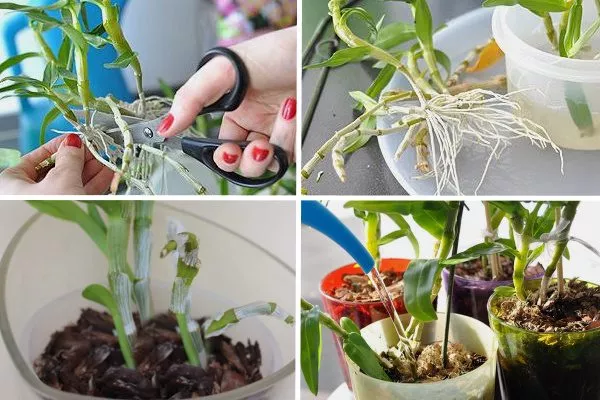
In the wild, Dendrobium orchids reproduce by seeds or fragments of elements with a growing point. At home, this species is usually propagated vegetatively. There are only three methods for this.
Be sure to consider the following factors:
- Do not replant during active flowering; it is better to choose a time when the flower has just awakened.
- Propagate at room temperature from +26 to +30 degrees.
- The mother bush must be at least 2 years old.
- The orchid must be completely healthy.
Methods:
- Children. The best option for Dendrobium. The offspring are located in buds at the base of the stem or in the area of the shoot where the flower stalk is forming. The procedure is simple:
- Carefully cut off the baby plant that has already developed aerial roots.
- Plant in substrate and cover with polyethylene or a transparent plastic cup for a while.
- Remove the cover after active growth begins and transplant in a permanent pot.

- By dividing the bush. The plant is divided only if it has a sympodial variety with pseudobulbs. Here's how to do it correctly:
- Remove the flower from the container as if replanting.
- Wash the roots.
- Place the plant vertically and determine the location of the division.
- Cut the flower so that each new bush has 2-3 pseudobulbs and roots.
- Dust the cut areas with activated charcoal or wood carbon.
- Transplant into pots.
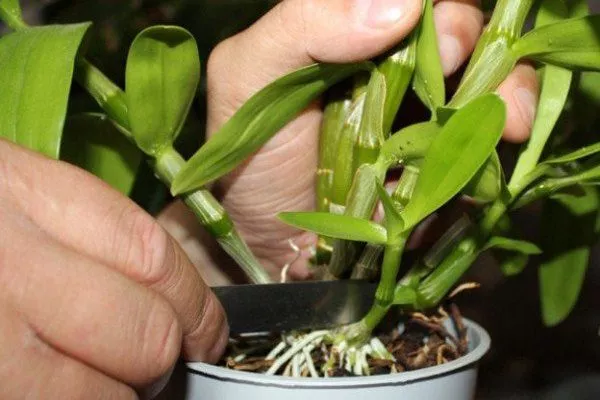
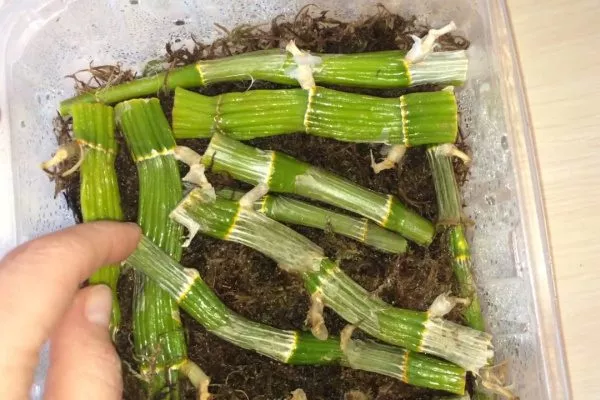
- Cuttings. For cuttings, either the stem or the flower stalk and stem can be used. A brief description of the propagation process:
- Use a sharp, thin knife for the cut, but a scalpel or razor blade is better. Disinfect the area.
- Make a cut of the stem.
- Divide the shoot into several parts so that each is about 10 cm.
- Place sphagnum moss substrate in a plastic container and moisten it.
- Place the cuttings horizontally on top of the substrate.
- Cover with a lid. Keep the mini greenhouse at a temperature of +25 degrees Celsius.
Diseases and pests
With proper care and proper conditions, Dendrobium orchids are virtually disease-free and pest-resistant. Therefore, such problems are most common among beginners. What can happen to this genus:
- Fungal infection. The main symptoms are yellowing of green matter and rotting of various plant parts. Regardless of the fungal strain, universal remedies can be used, such as Horus.
- Root rot. It manifests itself as root rot. The first thing to do is immediately repot the plant in a new pot and substrate, after cutting off all the affected areas and dusting the cut areas with ash. Then, treat with Bayleton.
- Brown rot. Green foliage is susceptible to damage and should be cut off immediately. Be sure to spray the rest of the plant with a product such as Baikal-EM or another fungicide.
- Aphids and thrips. These are the most frequent "visitors" of the Dendrobium orchid. Fury helps against both pests, but other insecticides can be used if desired.
To prevent diseases and insects, keep orchids away from other indoor plants, carry out preventative treatments promptly, and strictly follow agricultural practices.
Problems of growing
Besides pests and diseases, newbie orchid growers face other problems. It's important to know how to fix the situation:
- The leaves are turning yellow. Yellowing of the foliage is considered normal, indicating the orchid needs to renew itself. This happens every 2-3 years for Dendrobiums. However, if other accompanying symptoms are present, it indicates a disease.
Sometimes the leaves are turning yellow, if the humidity level in the room or substrate is excessive, especially when water stagnates in the leaf axils. - Flowers and buds fall off. This happens when the air temperature is high, especially if the pot is located directly next to the glass in summer, and next to heating devices in winter.
- It doesn't bloom for a long time. There are several reasons for this: an excess of nitrogen-containing fertilizers (in this case, only foliage and stems grow), conditions that are too hot, or improper maintenance of orchids in a dormant state.
- Shriveling of stems. The plant needs water.
Each Dendrobium orchid variety requires unique growing conditions, so pay attention to the varietal characteristics when growing this flower. If you're a beginner, learn how to properly select seedlings and replant them, and consider the specific plant structure when propagating.