
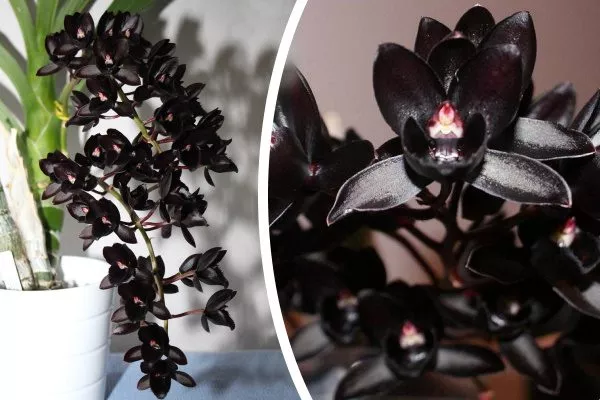
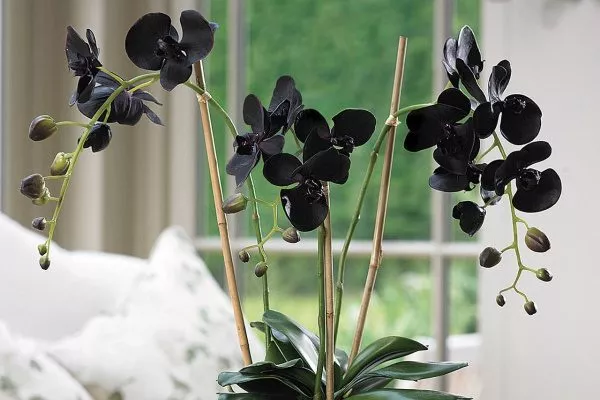
The black orchid is a mysterious and unusual flower, the existence of which is constantly debated. While flower lovers debate, breeders are persistently developing new varieties whose coloring closely resembles that elusive dream—the black orchid.
Do pure black orchids exist in nature?
It's believed that black orchids don't exist in nature, but are the result of crossbreeding between different species. Scientists claim there's no black orchid gene or pure black pigment. Therefore, perfectly black orchids don't exist. This idea is promoted by flower merchants, who market varieties with dark purple, burgundy, and blue flowers as "black orchids."
There are many orchids available commercially with colors close to black. The darkest colors are found in hybrids. Black orchids are much more expensive than varieties with other colors. These flowers are profitable to sell—they command high prices and are in demand. Therefore, breeders are actively working to create new, darker hybrids.
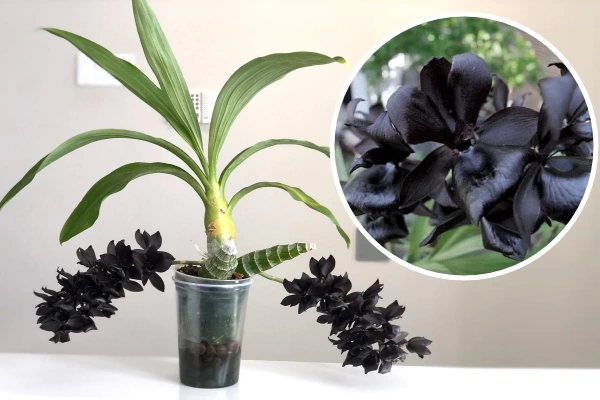
In nature, orchis species typically have light spots or streaks on their dark petals to attract insects. Dark orchids are most abundant in the dense jungles of Thailand, the Philippines, and Australia.
How do you dye petals black?
Flower growers often make no secret of the fact that black isn't natural, and the orchids will be a different color the next time they bloom. Most often, they're white, as it's easier to dye white flowers—it's easier to achieve a uniform color.
But many sellers, looking to make a buck, dye orchids themselves. They then pass off their work as "real black orchids." They then offer these flowers for sale at triple the price. Unlike dark-flowered hybrids, artificially dyed flowers are distinguished by their uniform, even black color.
- ✓ Uniform and uniform black color of petals, not typical for natural hybrids.
- ✓ Presence of injection marks on the peduncle or roots.
What to do if you bought (or were given) a “black orchid”:
- Inspect the plant—there may be a puncture mark on the flower stalk. In this case, the flower has a chance of survival. However, if the paint was injected into the root, the plant is unlikely to survive for long.
- Don't rush into repotting a dyed orchid—the already weakened plant doesn't need extra stress.
- If your orchid has dropped its buds, it's likely the dye has stressed it. To prevent the toxic dye from spreading to other parts of the plant, you should cut off the flower stalk.
- Rinse the roots with warm water and trim away any rotten areas. Sprinkle the cuts with cinnamon and ash and dry thoroughly. Then repot the plant in fresh orchid soil.
Any gardener can dye an orchid black. If done correctly, the damage to the flower will be minimal, and you won't have to overpay unscrupulous sellers who ruin the plant for profit.
- ✓ Use only special plant dyes that are safe for orchids.
- ✓ The concentration of dye in water should not exceed 0.5%, so as not to harm the plant.
How to dye an orchid black:
- Watering. Dilute the dye in water (the higher the concentration, the brighter the flowers' color will be, but the more harmful it is to the orchid). Water the orchid with the resulting solution as often as usual.
The downside of this method is that the stem will also be stained, not just the petals. This coloring is unstable—if you stop using the dye, the flower will quickly return to its original color. - Blue pigment. This is a more dangerous option for the plant, so it's recommended to choose the gentlest method of introducing the pigment—into the flower stalk. Injecting it into the roots and stems is not recommended, as this harms the plant and weakens it. Visible defects, similar to ulcers, remain on the flower.
Black orchids of the genus Phalaenopsis
Phalaenopsis orchids are considered one of the most popular and sought-after orchid species. They come in a wide variety of colors, including "black" orchids. Most phalaenopsis orchids in this group have dark burgundy or dark purple flowers.
| Name | Petal color | Plant height | Number of peduncles |
|---|---|---|---|
| Black Pearl | dark burgundy | up to 60 cm | up to 4 |
| Black Trezor | deep burgundy | up to 50 cm | 1 |
| Blackjack | dark burgundy | up to 60 cm | up to 4 |
| The Black Prince | inky (dark purple) | 40-50 cm | 1 |
| Black butterfly | dark purple | up to 40 cm | 1 |
| Black bird | deep purple-violet | up to 50 cm | 1 |
| Black swan | deep purple | up to 50 cm | 1 |
| Black mamba | dark wine | up to 50 cm | 1 |
| Black Widow | rich dark purple | up to 40 cm | 1 |
| Mickey Black Angel | dark purple | 25 cm | 1 |
| Kaoda Twinkle | dark purple | up to 50 cm | 1 |
Black Pearl
This orchid is the result of extensive selection. Its flowers are dark burgundy and striking. During flowering, the plant looks incredibly beautiful. The corollas are large. The plant can produce up to four flower stalks simultaneously.
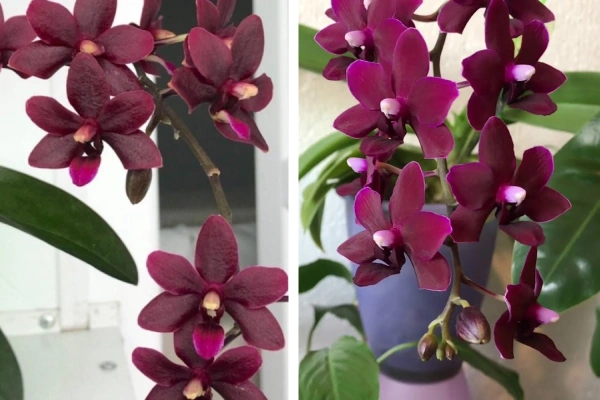
Phalaenopsis 'Black Pearl
Black Trezor
This orchid has deep burgundy petals. The dense wax coating gives the flowers a fake, almost artificial appearance. However, this doesn't detract from the plant's beauty; it's quite striking when in bloom. This variety is easy to grow, making it accessible even for beginners.
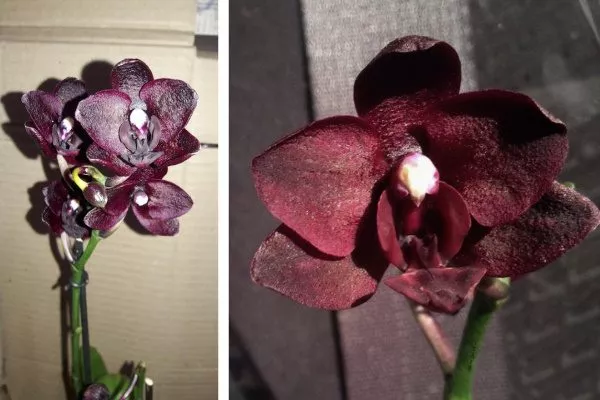
Phalaenopsis 'Black Tresor'
Blackjack
This variety is distinguished by its tall growth—the flower reaches 60 cm in height. The petals are dark burgundy, and the lip has a yellow border (wide or thin). The plant can produce up to four flower stalks at a time, each bearing a different number of flowers. It requires standard care.
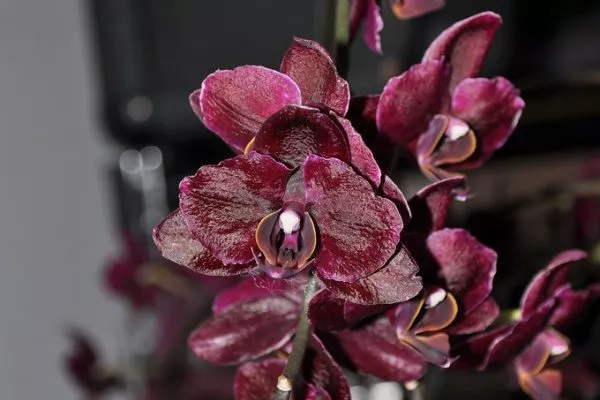
Phalaenopsis 'Black Jack'
The Black Prince
A fairly tall flower, reaching 40-50 cm in height. It was created by crossing two orchid species, Phalaenopsis and Doritaenopsis. The flowers are inky (dark purple), punctuated by lighter spots on the petals.
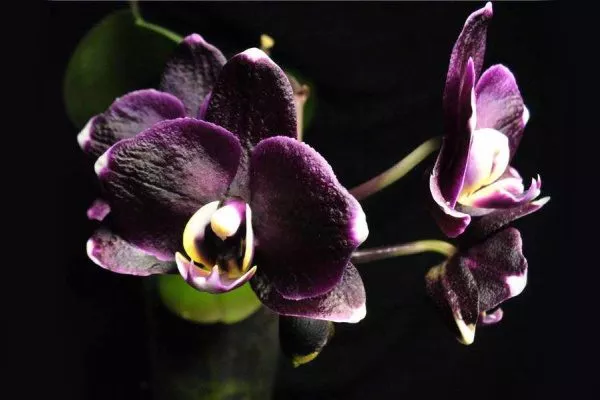
Phalaenopsis 'Black Prince'
Black butterfly
This orchid has dark purple petals sprinkled with a light scattering of speckles. The flowers, with their speckled petals, resemble the outstretched wings of butterflies. This orchid has only a single flower stalk, studded with numerous small but striking flowers.
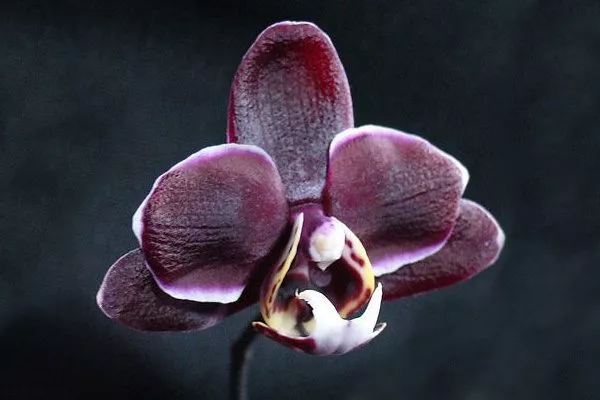
Phalaenopsis 'Black Butterfly'
Black bird
An orchid with large flowers of a rich purple-violet or dark wine color. The Black Bird has only one flower stalk. This variety is distinguished by its long and spectacular blooming period. The flowers of this orchid are large, with a beautiful waxy sheen.
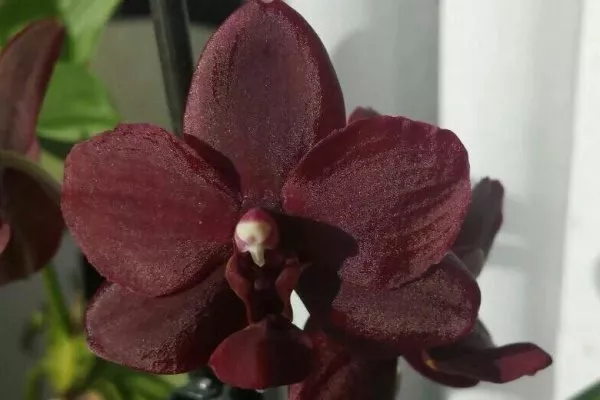
Phalaenopsis 'Black Bird'
Black swan
This variety has a rich, deep purple petal color. Its distinctive feature is a clearly defined yellow center. The plant looks extremely elegant and presentable.
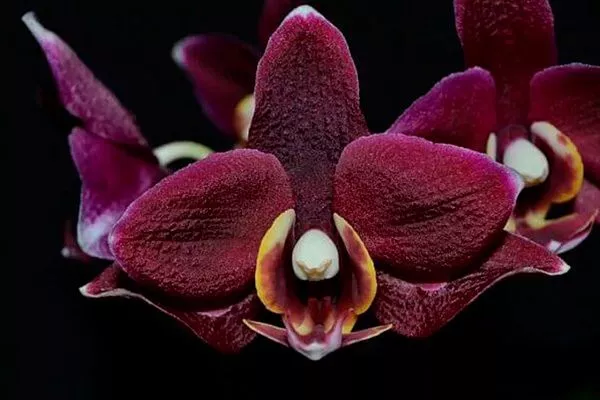
Phalaenopsis 'Black Swan'
Black mamba
A variety with dark wine-colored petals and a single stem that can hold up to a dozen buds. The flower's lip is white with a yellow tint.
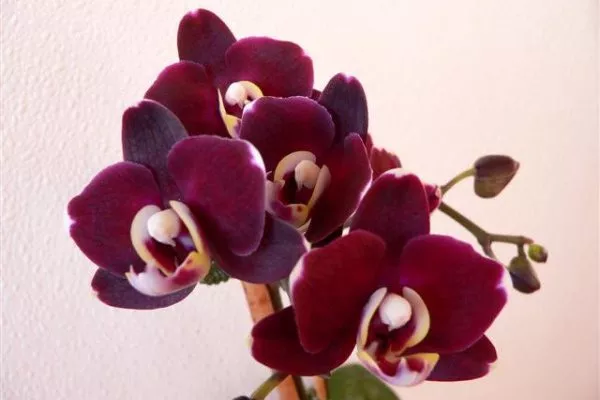
Phalaenopsis 'Black Mambo'
Black Widow
A flower with small flowers, several of which are gathered on a stem. The petals are a rich, dark purple (almost black in appearance). They also have a white border. The lip is snow-white.
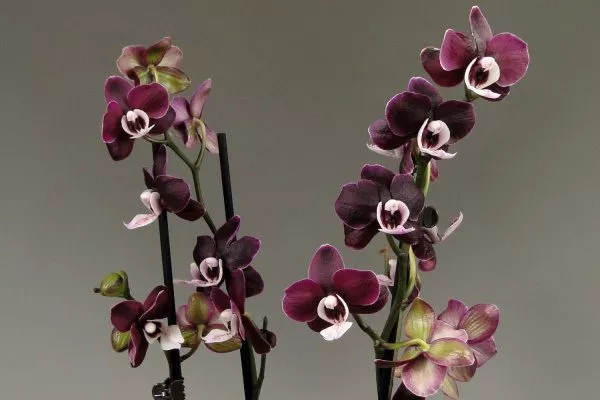
Phalaenopsis 'Black Widow'
Mickey Black Angel
This Asian Phalaenopsis is a mini orchid. It looks wonderful and is a favorite among lovers of unusual orchids. Bred by Taiwanese breeders, it reaches 25 cm in height. The flowers are 4 cm in diameter. The petals are dense, velvety, and dark purple.
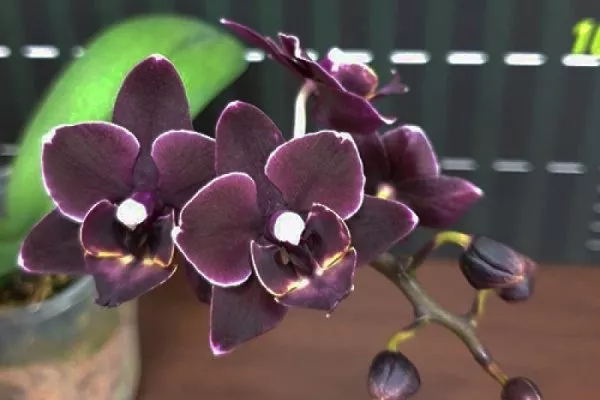
Phalaenopsis Miki Black Angel
Kaoda Twinkle
This is one of the many varieties of the Kaoda orchid. This hybrid features dark purple petals surrounded by a white border and a snow-white-pink lip that contrasts beautifully with the dark flowers. The petals are waxy and medium-sized.
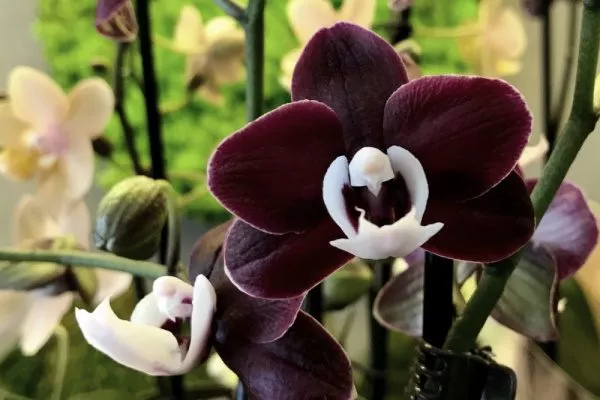
Phalaenopsis 'Kaoda Twinkle'
Family Dracula
Orchids of the Dracula genus are very rare in the wild and grow in a limited range. These flowers can be found in mountainous areas—in Colombia, Peru, and Ecuador. They grow only at altitudes of 1,000–2,000 meters above sea level. However, some orchid enthusiasts manage to grow this unusual flower at home.
| Name | Petal color | Plant height | Number of peduncles |
|---|---|---|---|
| Dracula Rosley | black-brown | up to 20 cm | 1 |
| Dracula the Vampire | greenish with dark purple veins | 20-35 cm | 1-3 |
| Dracula Raven | dark brown | up to 30 cm | 1 |
| Dracula Phantom | greenish-yellow with dark brown veins | up to 25 cm | 1 |
| Dracula Benedicta | purple-black to brown | 15-20 cm | some |
Dracula Rosley
This orchid has densely spaced black-brown spots, which is why it's called a black orchid. The plant is short and has an attractive, exotic appearance. The flowers resemble animal faces, which is why it's also known as the Monkey Face orchid.
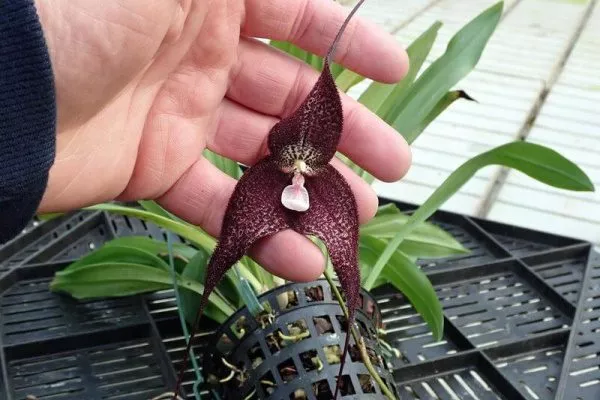
Dracula roezlii
Dracula the Vampire
This epiphyte is native to Ecuador. It grows to 20-35 cm in height. One to three flowers are per stalk. The base color is greenish, but the densely spaced dark purple veins make the flowers appear black. The lip is white with yellowish or pinkish veins.
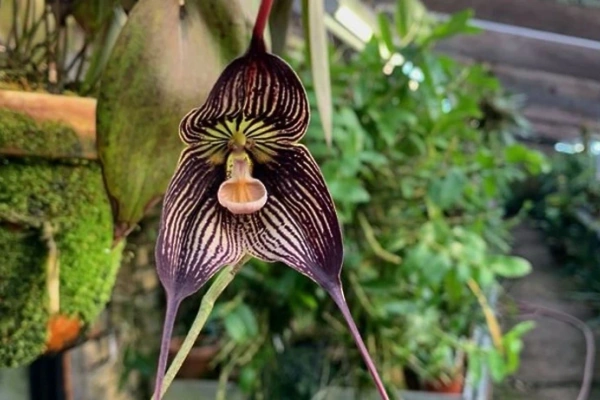
Dracula the vampire
Dracula Raven
An exotic and extremely rare hybrid orchid, created by crossing cultivars from the genus Dracula—Roezlii 'San Francisco' and Vampira 'Walter'. This award-winning orchid was bred by John Leathers. The flower is dark brown, almost black, with yellow markings and a light-colored ligula.
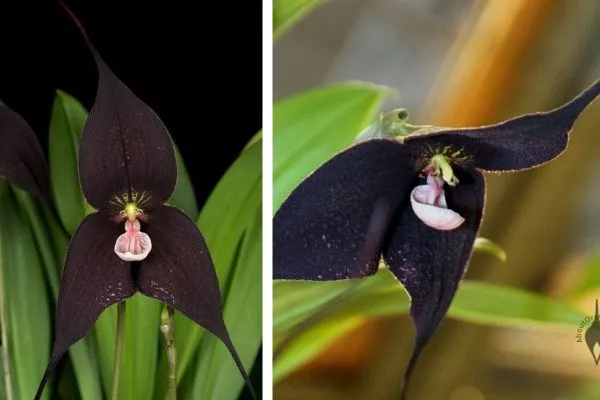
Dracula Raven
Dracula Phantom
A spectacular hybrid obtained by crossing orchids of the genus Dracula—Vampira and Tubeana. The base color is greenish-yellow, but numerous parallel veins make it appear dark brown. The ligule is light.
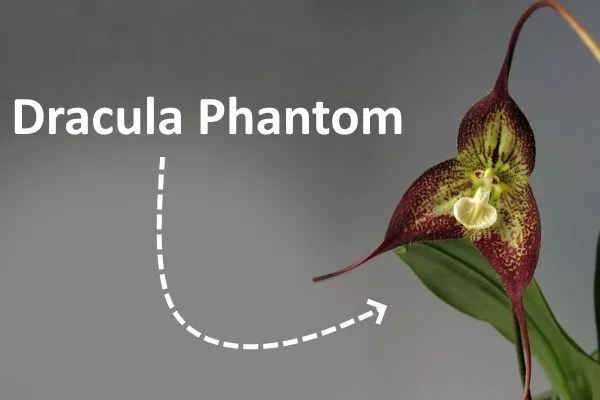
Dracula Benedicta
The orchid is named after the Czech horticulturist and botanist Benedikt Roezl. It grows in the Western and Central Cordilleras. It reaches a height of 15-20 cm. Several flowers bloom on each stem, one after another. The sepals are white, with the interiors ranging from purple-black to brown. The lip is white and pinkish-white.
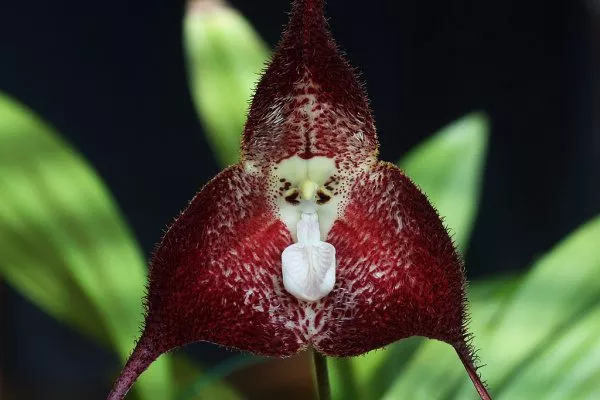
Dracula benedictii
Genus Paphiopedilum
Paphiopedilum (or Lady's Slipper) is a very popular orchid variety in Eurasia. In nature, these flowers grow in moist, but not swampy, areas. The flowers are shaped like a lady's slipper and are distinguished by their vibrant colors. Among them, there are also hybrid forms in dark shades, which can safely be classified as black orchids.
| Name | Petal color | Plant height | Number of peduncles |
|---|---|---|---|
| The Night Watch (De Nachtwacht) | dark burgundy with a brown tint | up to 30 cm | 2 |
| Midnight (Pisgah Midnight) | dark burgundy | up to 25 cm | 1 |
| Black Dragon | dark burgundy, almost black | up to 35 cm | 1 |
The Night Watch (De Nachtwacht)
A hybrid orchid created by crossing Paphiopedilum 'Voodoo McNay' and Paphiopedilum 'Rothschildianum'. This orchid produces only two flowers, a striking dark burgundy color with a brown tint. The leaves are small and vibrant. In low light, the flowers appear completely black.
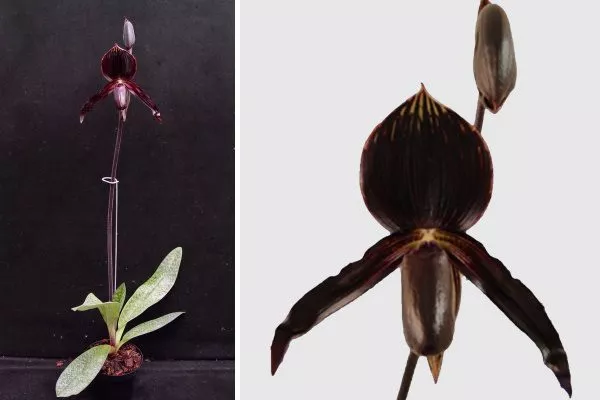
Paphiopedilum De Nachtwacht
Midnight (Pisgah Midnight)
A charming orchid with dark burgundy petals. The throat is lighter than the petal tips. The slipper, which consists of three petals, is also lighter. Whether this hybrid qualifies as a black orchid is debatable, but that doesn't make the flower any less charming.
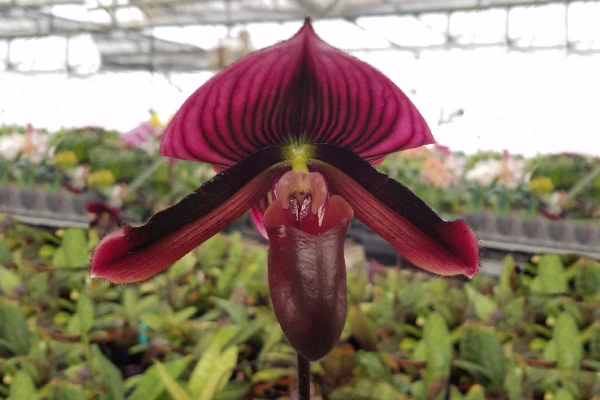
Paphiopedilum 'Pisgah Midnight'
Black Dragon
This hybrid was created by crossing Paphiopedilum Rothschildianum and Hsinying Maru. The flower was first shown to the public in 2010 at an exhibition in Tokyo. The petals and lip are dark burgundy, almost black. Designed by Hajime Sakurai.
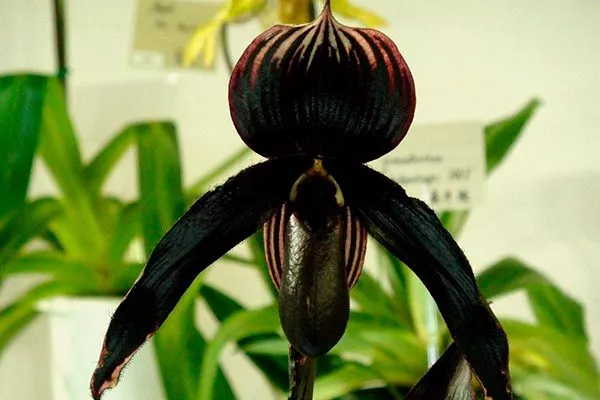
Paphiopedilum Stealth 'Black Dragon'
Genus Catasetum
Catasetums are herbaceous plants in the Orchidaceae family. They grow in the Western Hemisphere, in the equatorial regions of America. These orchids are epiphytes—they grow by attaching themselves to other plants, using them as support.
| Name | Petal color | Plant height | Number of peduncles |
|---|---|---|---|
| Dark Tale | dark burgundy | up to 20 cm | 1 |
| Rio Claro | deep burgundy, almost black | up to 25 cm | 1 |
| Hat Trick 'Oh Yeah' | dark burgundy, almost black | up to 30 cm | 1 |
Dark Tale
This orchid was bred in 2015 by Donna Wise. Its flowers are so dark that they're difficult to spot among the leaves. The base color is dark burgundy, with a lighter center.
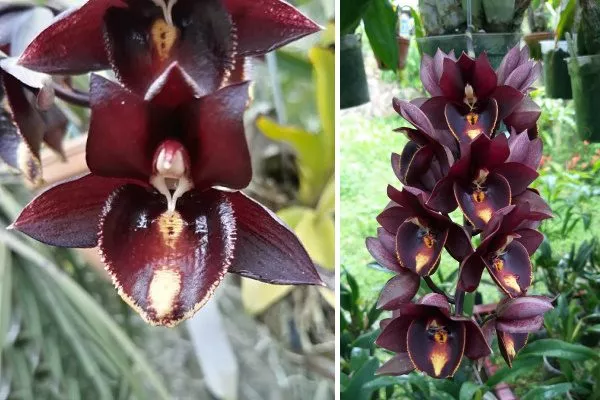
Catasetum Dark Tale
Rio Claro
This orchid was bred in 2003 by E. Perazolli. The hybrid was created by crossing João Stivalli and Egel orchids. The flowers are a rich burgundy, sometimes black. The petals have pointed tips and lighter centers.
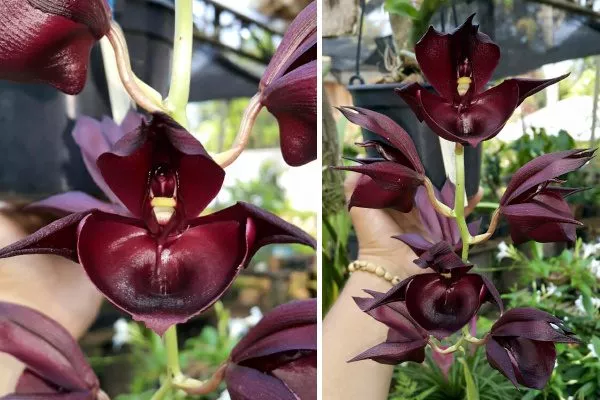
Catasetum Rio Claro
Hat Trick 'Oh Yeah'
This orchid was created by crossing Catasetum 'Jose Abalo' and 'Fimbriatum'. Its color is dark burgundy, almost black. It was bred in 2015.
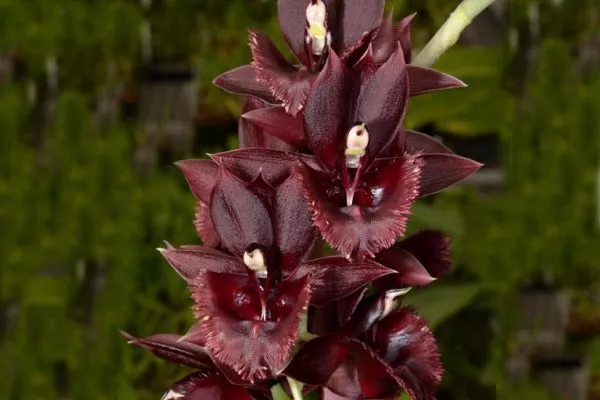
Catasetum Hat Trick 'Oh Yeah'
Intergeneric hybrids
Intergeneric hybrids are orchids created by crossing two or three closely related species. This method allows for the creation of new, completely unexpected hybrids distinguished by their spectacular and extraordinary beauty.
| Name | Petal color | Plant height | Number of peduncles |
|---|---|---|---|
| Orchid Monnierara Millennium Magic 'Witchcraft' | almost dark blue, almost black | 10 cm | 1 |
| Orchid Fredclarkeara after Dark 'SVO Black Pearl' | almost black | up to 15 cm | 2-4 |
Orchid Monnierara Millennium Magic 'Witchcraft'
An intergeneric hybrid obtained by crossing Cycnoches and Mormodes catasetums. The plant height is 10 cm, the flower diameter is 5 cm. This is a spectacular orchid with an exotic beauty. It has dense waxy flowers growing in large, fragrant clusters. The color is almost dark blue, almost black.
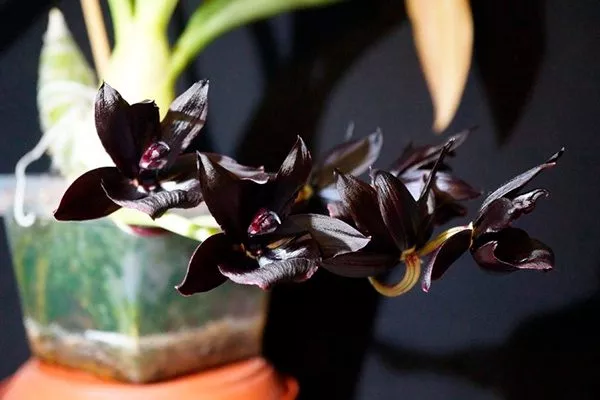
Orchid Fredclarkeara after Dark 'SVO Black Pearl'
This intergeneric hybrid is a cross between three orchid genera—Clowesia, Catasetum, and Mormodes. It is considered one of the most unusual orchids. A mature plant produces 2-4 flower stalks, each bearing up to 25 flowers 4-5 cm in diameter. They have dark, almost black petals and a honey-like aroma.
Other species
Black orchids are also found among other orchid species. All of them are black, whether natural or artificial. Below are several other orchid species popular with gardeners.
| Name | Petal color | Plant height | Number of peduncles |
|---|---|---|---|
| Rod Wanda – Black Magic | dark purple with white specks | up to 50 cm | 1 |
| Genus Cymbidium – Kiwi Midnight | dark burgundy with a violet-lilac tint | 30-40 cm | 1 |
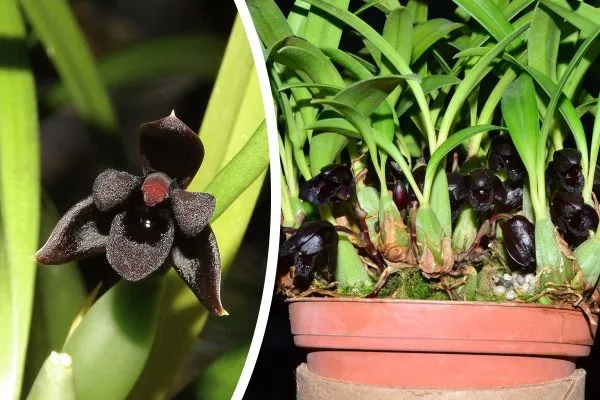
| Genus Brasiliorchis – Brasiliorchis schunkeana | dark purple | up to 20 cm | 1 |
Rod Wanda – Black Magic
This orchid is not only striking but also mysterious. The flowers are captivating, seeming to possess some kind of magical attraction. The large blooms resemble the wings of a moth—scattered across a dark purple background are tiny white specks resembling stars.
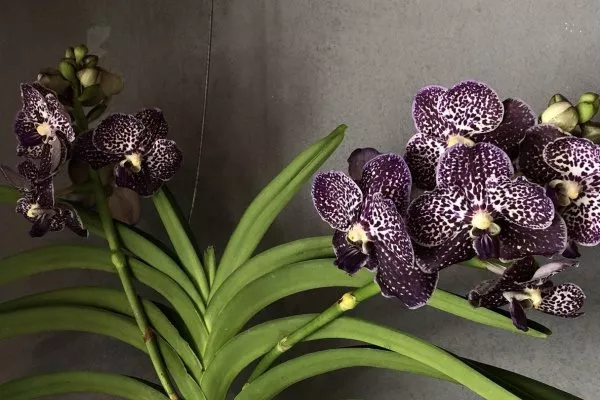
Vanda orchid Black Magic
Genus Cymbidium – Kiwi Midnight
The first Cymbidiums were discovered back in 1800. The flowers of these orchids resemble a boat. In the wild, these orchids grow in Australia, the Himalayas, and India.
The Midnight kiwi is distinguished by its narrow, leathery leaves and multi-flowered inflorescences. The flowers are dark burgundy with a violet-lilac hue, gathered in clusters. The plant grows to a height of 30-40 cm.
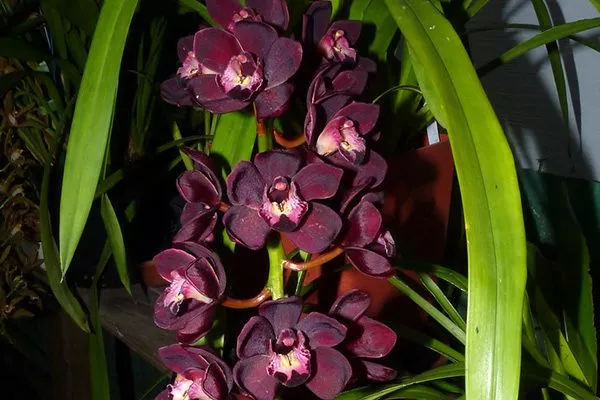
Cymbidium Kiwi Midnight
Genus Brasiliorchis – Brasiliorchis schunkeana
This orchid was formerly known as Maxillaria shunkeana. It grows in the tropical forests of Brazil at altitudes of 600-700 meters. Its color is dark purple, almost black.
Features of flowering
The most anticipated moment for any orchid lover or collector is the blooming period. Orchids in bloom are exceptionally spectacular. It is precisely because of the beauty of their flowers that orchids compete for the title of the most beautiful flower in the world.
Frequency and duration
Orchids bloom for a relatively long time compared to most houseplants. The duration and frequency of blooming vary from orchid to orchid. However, if the plant isn't given the proper attention, it may refuse to bloom. If an orchid doesn't produce a flower stalk on time, it's necessary to review and adjust its growing conditions.
The duration of orchid flowering depends on the species:
- Cattleyas bloom for 1.5-2 months.
- Cumbria - up to 7 weeks.
- Vanda - up to 8 weeks.
- Slipper - 2-3 months.
- Mini orchids - 6 months (at any time of the year).
- Cymbidiums – 2-3 months.
- Dendrobium nobile - 3-4 months.
It takes one to two months from the beginning of flower stalk growth to flowering. The duration of flowering largely depends on favorable conditions. Orchids typically bloom once a year, ranging from a few weeks to six months. However, if they are well cared for, repeat blooming is possible.
Stimulation
Sometimes a gardener buys an orchid covered in blooms. Then the plant refuses to bloom, and the wait drags on for years. This indicates unfavorable growing conditions.
Why orchids refuse to bloom:
- problems with roots (mechanical damage, rotting, etc.);
- the irrigation regime is violated;
- unfavorable temperature (above or below normal);
- lack of light or an opaque pot (the roots must participate in photosynthesis).
If an orchid does not bloom, its flowering can be stimulated in various ways:
- Move the orchid to a dark room for a couple of weeks. For example, you can place it in a basement. The plant, being in the dark and cool, will become stressed and will bloom.
- Turn on grow lights for illumination. Orchids love light, and indoors they often lack it, especially in winter when daylight hours are short.
- Use succinic acid for stimulation—this compound nourishes both the roots and the above-ground parts of the plant. You can also use the growth stimulant Epin. It helps the plant survive transplanting or moving to a new location.
- Water the plant with a warm shower until the moisture is completely absorbed—this usually takes half an hour. The recommended water temperature is 30–35°C. The procedure should last no more than 1 minute. Repeat weekly until the orchid blooms.
Maintenance and care
Orchids are considered capricious and fragile plants. In fact, they are hardy and strong plants, simply adapted to a specific habitat. The gardener's job is to provide orchids with growing conditions as close to natural as possible.
Recommendations for maintenance and care:
- Optimal conditionsOrchids thrive in moderate temperatures, ranging from 20°C to 25°C during the day and 18°C at night. Drafts, sudden temperature fluctuations, and dry air are undesirable for plants (a humidity level of 60-75% is recommended).
- Watering. The best way to water the plant is by placing it in a tray of water. Water the orchid based on the appearance of the roots—as soon as they turn white, the plant needs watering. The recommended water temperature is 20–22°C. Allow the water to settle for two days before watering.
- Top dressing. They can be root-based or foliar. The former is applied with watering (by diluting the fertilizer in water), while the latter is applied by spraying. The latter option is recommended if the roots are damaged.
- Seasonal features. When an orchid enters its active growing season, it requires plenty of light and abundant watering. When buds are forming, the plant requires micronutrients to maintain its strength. Once the last flower fades, stop feeding and reduce watering to a minimum.
- Trimming. After flowering, remove spent orchid buds with a sharp, disinfected knife, 2 cm above the bud located above the bud; this is where a new flower stalk will later grow.
Landing
Planting orchids isn't difficult, even for inexperienced gardeners. The main thing to focus on is choosing the right soil and pot.
Features of orchid planting:
- Priming. Orchids require a loose, breathable substrate that retains moisture well. Typical substrates include tree bark, coconut fiber, sphagnum moss, and charcoal. The ratio of ingredients in substrates may vary between manufacturers.
Preparing your own mixture is not recommended, as it can introduce infections or parasite eggs. It's better to use a ready-made product, which can be purchased at any flower shop. - Pot. It's recommended to plant orchids in clear plastic pots with drainage holes. These pots allow light to reach the orchid's roots, which need it just as much as the leaves and flowers.
The pot size should be chosen to accommodate the root ball and still leave room for the growing medium. The pot's height should be the same as the diameter of its neck. - Technology. The gardener's primary task is to replant the flower without damaging its roots. Planting is done in the following order:
- disinfect the pot;
- pour a drainage layer on the bottom;
- place the substrate on top;
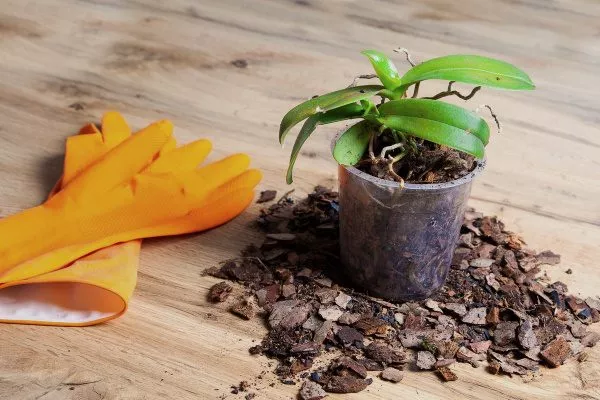
- Place the plant in the pot and carefully straighten the roots;
- Fill the free space with substrate.
- Transfer. It is carried out if pests have appeared in the substrate, the roots have rotted or do not fit in the pot, and also when the soil has decomposed into dust.
The plant is typically repotted once every 3-4 years. The main reason for repotting is when the roots grow to a size that exceeds the pot's capacity. Repotting is best done 10-14 days after flowering.
Methods of reproduction
Orchids are propagated primarily vegetatively, which allows for quick and easy production of flowers that are exact copies of the parent plant.
Vegetative propagation methods:
- Daughter sockets. They can appear in mature, overgrown plants. When the rosette develops 2-3 leaves of its own and roots approximately 5 cm long, it can be separated from the mother plant and repotted in a separate pot filled with potting soil. This rosette will bloom in approximately 2-3 years.
- Children. They form from dormant buds on the flower stalk. They rarely form in healthy plants, due to stress or unfavorable factors. However, in many hybrids, offspring form actively and even bloom while attached to the adult plant. Offspring formation can be stimulated with cytokinin paste.
When the baby plant has several leaves and 2-3 roots, it is separated from the adult plant along with a piece of the peduncle and transplanted into a separate container. - By dividing the bush. This method is applicable to mature plants. It's quite traumatic and is used to rejuvenate older orchids. First, some of the plant's lower leaves are removed, leaving only the tip. Soon, the beginnings of new roots begin to appear on the exposed stem.
The top and roots are trimmed off, the cuts are sprinkled with charcoal, and the plant is planted in moistened soil. Alternatively, the plant is laid on sphagnum moss until strong roots form, regularly misted and fertilized with foliar fertilizer. - Cuttings. For propagation, parts of the peduncle with a bud are used - they are placed in a container with a moistened substrate.
Growing orchids from seeds is rarely done at home. Firstly, it's a very time-consuming method of propagation, and secondly, the resulting plants can differ significantly from the parent plants. Seed propagation is primarily done in the laboratory for breeding purposes.
Common diseases and pests
Even with the most meticulous care, orchids can become diseased or infested with parasites. It's important to spot the problem early and begin treating it as soon as possible.
The main pests of black orchids:
- Spider miteA small sucking insect that becomes active in high humidity. Identifiable by its fine webbing. Spraying with Fitoverm or other acaricides is recommended.
- Aphid. These are small green insects. A soap solution helps control them; for severe infestations, spray the plant with a soap solution (100 g of laundry soap per 1 liter of water).
Orchids can be affected by various bacterial rots, fungal, and viral infections. The latter are incurable, requiring the plants to be disposed of. Other diseases are treated with fungicides such as Fundazol, Topsin, and others.
The black orchid doesn't bloom, what should I do?
If a plant refuses to bloom, it is necessary to determine the cause of this phenomenon and eliminate it.
Why doesn't the black orchid bloom?
- Too much green mass due to overfeeding with nitrogen fertilizers. Temporarily refusing to use nitrogen and adding phosphorus fertilizers can help correct the situation.
- Too little light. Increasing daylight hours to 10-12 hours, including through backlighting, helps solve the problem.
- Plant fatigue. In this case, it is better not to stimulate it, but to provide ideal conditions for keeping it.
Reviews of black orchids
Orchid enthusiasts are actively discussing black orchids on forums. Many are leaving reviews of these unusual flowers:
Black orchids, like all other orchids, require special attention from the grower. Growing conditions are especially important; if they don't meet the stated requirements, orchids will fail to bloom and even die. When purchasing a black orchid, be sure to inquire about its species—this will determine the specific care and maintenance requirements.
Cool orchids!