
It's important to learn how to properly water your Kalanchoe in advance to avoid any problems in the near future after purchasing the plant. The quality and method of watering the plant determines not only the overall health of the Kalanchoe but also its risk of disease.
Basic rules of watering
Many gardeners recommend watering indoor plants when the top layer of the potting soil dries out. However, this isn't entirely correct, as the frequency, amount, and method of watering depend on the type of plant and its root system. This is also influenced by the time of year and the Kalanchoe's active or dormant period.
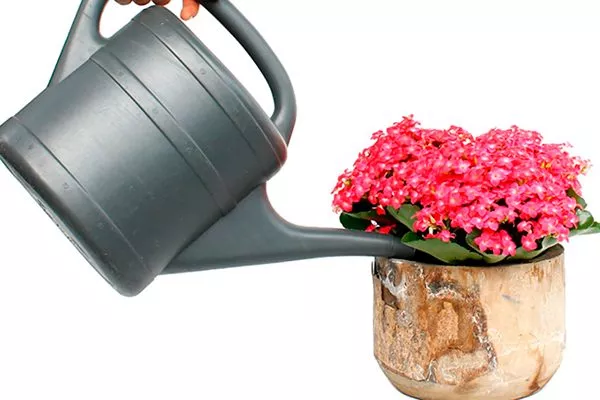
Since Kalanchoe belongs to the Crassulaceae family, its root system is fibrous and superficial. The roots are located close to the soil surface and spread across the entire width of the shallow pot.
It is important to take into account other rules of hydration:
- watering is done rarely and in small quantities;
- the water must be settled;
- It is acceptable to use filtered, rain or melted water; some gardeners also use boiled water;
- It is forbidden to use liquid with sediment after settling; it is necessary to drain the clean upper layers of liquid, since the sediment indicates magnesium and calcium salts;
- the temperature of the water for irrigation should be room temperature only, otherwise the plant is susceptible to diseases;
- It is forbidden to let even drops of water fall on the leaves and trunk, otherwise yellow or brownish spots will form on the green mass;
- About half an hour after moistening, all the liquid must be drained from the tray, and the bottom of the pot must be wiped with a dry cloth;
- It is advisable to add fertilizer when watering;
- When adding water, distribute it throughout the entire pot so that there are no dry areas;
- To prevent water from stagnating in the pot, be sure to add drainage material when replanting.
- ✓ Use water at room temperature, left to stand for at least 24 hours.
- ✓ Check the soil moisture at a depth of 2-3 cm before watering.
How often should I water Kalanchoe?
Kalanchoe is a plant that stores moisture in its leaves and stems in case of drought, but if too much moisture accumulates, the green mass may crack. Therefore, it is not recommended to water this plant frequently.
The main requirement for frequency is to allow time for the top layer of the substrate to dry out so that moisture from the leaves can be redistributed throughout all parts of the plant.
In summer and spring
Starting in early spring, Kalanchoe, like any other plant, enters a period of awakening, followed by the active growth phase. This continues until the autumn months. During this time, the plant requires frequent watering, but it should still be moderate.
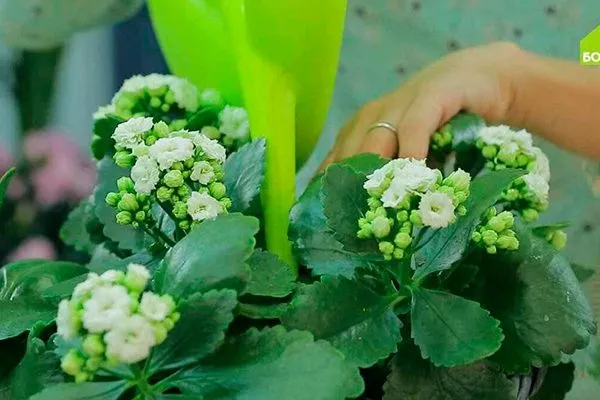
The optimal frequency is once a week, regardless of the Kalanchoe species and variety (even if the plant is in bloom). If the air temperature exceeds 30-32 degrees Celsius, it's acceptable to water the soil twice a week. However, it's important to ensure the soil dries out between waterings.
In autumn and winter
In autumn, the plant prepares for a dormant period, and in winter, it enters hibernation, so watering is significantly reduced. This is especially true if it's located away from heating devices. Watering frequency is twice a month. However, if the room is as warm as summer, watering should be done once a week in autumn and once every 10 days in winter.
High air humidity
Kalanchoe does not tolerate high humidity in the room for the same reason: its own moisture accumulates in the green mass.
But periodically, the bushes are washed in the shower, followed by wiping each part of the plant with a dry, soft cloth. This is important to remove dust.
Methods of watering Kalanchoe
The most successful method for watering Kalanchoe is root watering, but other techniques are also acceptable. Each method has its own characteristics:
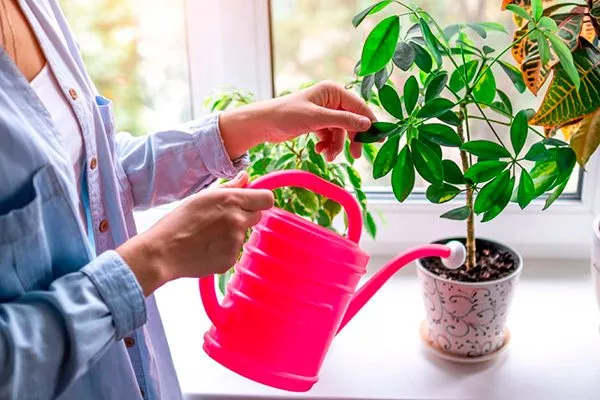
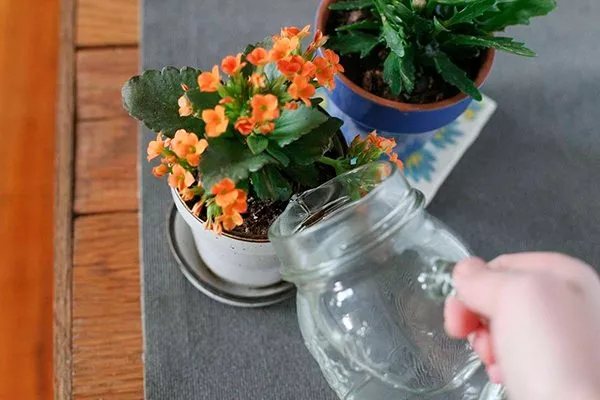
- Top irrigation. A watering can without a spray nozzle (only with a spout) is used, thanks to which the water will fall directly under the roots and on the soil, and not on the trunk and leaves.

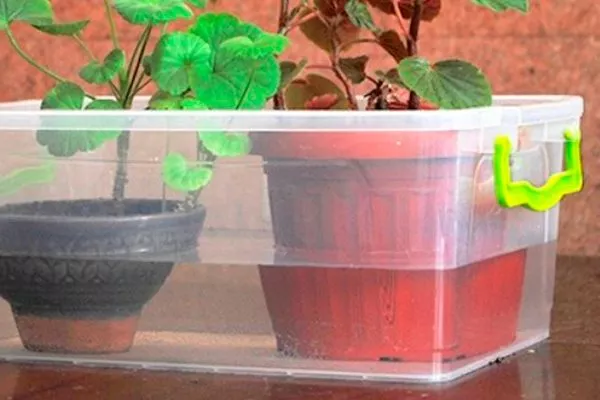
- Bottom irrigation. Place the Kalanchoe pot in a basin of water. Keep the container submerged until no bubbles remain. After this, remove the pot and allow the remaining water to drain completely. Best used in summer.
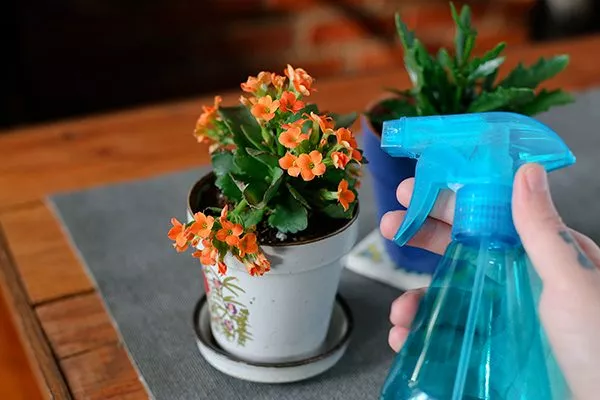
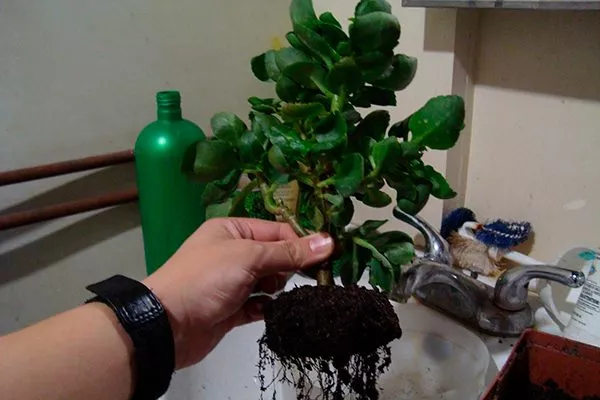
- Spraying the root system. This method is used only for replanting. It requires a spray bottle, which is used to completely saturate the roots until they soften. This method prevents breakage of the root shoots.
Questions and Answers
Kalanchoe watering requirements are simple, yet beginners still have many questions, answers to which are almost impossible to find anywhere. We offer the most common ones.
Should you choose boiled water?
Some gardeners prefer boiled water. This is due to the absence of pathogenic microorganisms, which are killed by high-temperature heat treatment. Few consider the disadvantages of boiled water for irrigating indoor plants.
The negative side is based on the decrease in water hardness, which causes the following problems:
- beneficial minerals disappear;
- oxygen levels decrease.
But these problems are easily solved. In the first case, it's enough to add complex fertilizer with boiled water every time you water. In the second case, you'll need to loosen the potting soil every two days. Therefore, whether to water with boiled water or not is entirely up to the grower.
Which water is better – settled, filtered or rainwater?
Each aquatic environment has its own characteristics, advantages and disadvantages that you need to be aware of when choosing:
- Settled tap water. The best option is well water, which is not suitable for residential use (only for private homes). Centralized water supplies contain many impurities, most importantly chlorine, which is strictly contraindicated for Kalanchoe.
Water should be left to stand in an open container for at least 3-4 days. Well water can be left to stand overnight. - Rainy. This water is considered optimal because it comes from nature itself, and therefore most closely resembles the liquid added to the soil where Kalanchoe grows in the wild. However, there is a small drawback: rainwater doesn't always run clean, so it needs to be additionally filtered or allowed to settle.
- Filtered. This is tap water that has undergone multiple purification stages. It's perfectly acceptable, but it still needs to settle for at least two days before use.
What is the best thing to add to water?
Most often, complex mineral fertilizers are sometimes added to the water for watering Kalanchoe, but many gardeners also use other substances:
- Iodine. It's essential for plant strengthening. The concentration must be strictly controlled to prevent overdosing. Only 1 mg of iodine is needed per 1 kg of substrate.
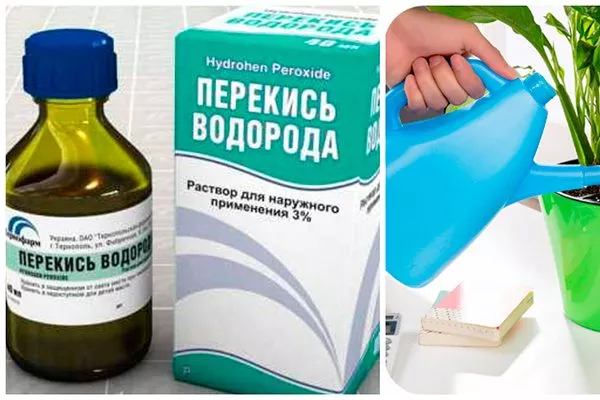
- Hydrogen peroxide. It helps destroy all pathogens and strengthen the immune system. For 1 liter of water, you need 2 tablespoons of the solution. Water the plant no more than once a week.
How to soften water?
Excessively hard water is contraindicated for indoor Kalanchoe, so it should be softened. This can be done in several ways:
- freeze 2/3 of the volume - leave the frozen water for garnishing, and pour out the rest;
- dissolve 100 g of peat in 10 liters of water, let stand for 12-14 hours, strain;
- For 1 liter of water take 0.5 g of citric acid.
How do you know if your Kalanchoe has dried out?
You can determine whether a plant has dried out by the following signs:
- if the drought was minor, then the turgor weakens, causing the surface of the leaves to become covered with micro-wrinkles;
- the edges of the leaves become dark and dry;
- leaf blades fall off without reason;
- It becomes impossible to wet the soil mixture - the water is absorbed too slowly.
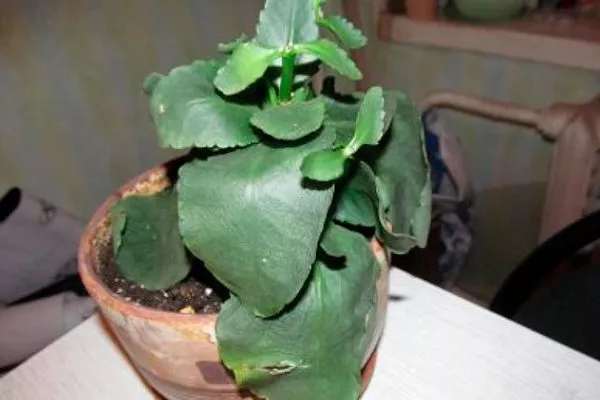
It's easy to revive a dried-out Kalanchoe by keeping the pot with the flower in a basin of water for several hours (the exact time depends on how dry the soil is).
How do you know if your Kalanchoe has been overwatered?
If the soil is overwatered, the roots begin to rot, which also affects the above-ground part:
- the stems become soft and thin;
- the leaf blades become covered with black spots, but do not dry out;
- a wet rot develops on the surface of the foliage;
- wet leaves fall off.
To quickly remedy the situation, you need to immediately inspect the root ball. Most often, it's wet and damp. What to do:
- at the initial stages, when the roots still have elasticity and a natural color, you can simply dry the soil after removing the bush from the pot;
- If the root shoots have already rotted and there is an unpleasant odor from the substrate, you will have to remove the plant and cut off all the damaged areas, then treat the cut areas with activated carbon and replace the soil with new;
In the second case, it's important to disinfect the pot, as it already contains fungal spores. Another important point: after trimming the soft, blackened roots, leave the bush in the open air to allow the root system to dry. Then, avoid watering for a couple of weeks.
Should I water Kalanchoe after replanting?
If the Kalanchoe looks healthy before replanting, and its soil was moistened with water to facilitate the process of removing it from the pot, then after deepening the bush into the new substrate, moistening is not required.
If the repotting medium is too dry, mist it with a spray bottle beforehand. This is quite sufficient.
Should Kalanchoe be sprayed in addition to watering?
Kalanchoe, regardless of variety or species, doesn't require frequent misting, but it may be necessary to remove dust or during hot weather. This rule only applies to varieties with smooth leaf surfaces. If the leaf surface is fuzzy or velvety, misting is not recommended. Wipe each leaf with a dry cloth after hygienic cleaning.
Irrigation rules:
- the optimal time for spraying is evening;
- the worst period is winter;
- What to wipe the leaves with after the procedure - a microfiber cloth or a cotton pad;
- what to use – a regular spray bottle;
- During flowering, it is forbidden to water the foliage.
How to combine watering with fertilizing?
There are two ways to do this: you can add fertilizer directly to the water for irrigation or do the following:
- Moisten the soil.
- Dilute the fertilizer to the required concentration.
- Fertilize the bushes 30-40 minutes after watering.
If you use fertilizers in the form of a solution, then you need to moisten the substrate with a smaller amount of water (taking into account how much liquid will come with the fertilizer).
Is automatic watering suitable for Kalanchoe?
This watering method is strictly contraindicated for Kalanchoe, because automatic watering requires a constant supply of water to the substrate, and overwatering promotes root rot.
To learn how to properly water Kalanchoe, simply familiarize yourself with the basic requirements and nuances. By following the recommended watering methods, you'll ensure healthy growth and lush flowering, if appropriate for the variety.