
Mammillaria is a large genus of cacti, particularly popular among cactus growers and houseplant enthusiasts. These striking and easy-to-grow plants blend seamlessly into modern interiors and pair easily with a wide variety of succulents.
General information about mammillaria
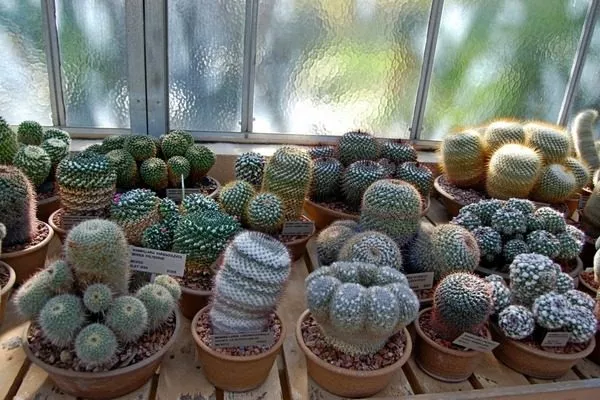
Mammillaria (Latin: Mammillaria) is one of the largest genera in the Cactaceae family. A distinctive feature of these cacti is the papillary stems. Hence the name: the Latin word mamilla translates as "nipple."
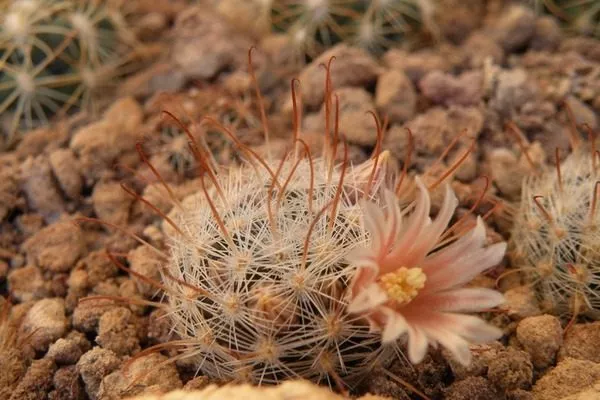
Most Mammillaria species grow in Mexico, while some varieties are found in the southern United States and several Latin American countries. In fact, these cacti are found in an area stretching from Argentina to southern Canada.
Mammillaria can be found in a wide variety of places, growing on rocky hills and arid plains. These cacti typically thrive at altitudes of 1,500–2,000 meters above sea level. They are not only a constant feature of desert landscapes but also true oases for a wide variety of animal species.
You can get acquainted with other unusual and beautiful plants that are part of the prickly cactus family. here.
Botanical description
Mammillaria species vary not only in size but also in shape. In the wild, these cacti can reach several meters in height. However, when grown indoors, they tend to be small. Despite their diversity, Mammillaria species share a number of characteristics common to all species.
Botanical features of mammillaria:
- Appearance. Mammillarias are typically small, may or may not branch, grow alone, or form spreading cushions reaching 1 m in diameter. The stems are compact, with distinct ribbing.
- Stem. Depending on the species, the stem may be spherical, cylindrical, short-cylindrical, or columnar. Stem height varies from 5 to 40 cm, and diameter from 5 to 20-30 cm. The entire stem is covered with papillae arranged in a spiral. The shape of the papillae may be cylindrical, conical, pyramidal, or ovoid.

- Thorns. They can vary in number, color, thickness, and structure among different Mammillaria species. Most cacti have two types of spines. The central spines are thicker and longer, and can be straight or curved, while the radial spines are thinner and shorter.
- Flowers. Small, white, whitish-green, brownish, and various shades of yellow and pink. The flowers are bell-shaped or funnel-shaped. The diameter is 1-2 cm, and in some species, 3-4 cm. The petals are narrow and glossy.
- Fruit. They resemble berries in appearance, elongated or club-shaped. They are usually red, but can also be whitish, yellowish, greenish, or brownish. The fruit is 5-50 mm long and 2-10 mm in diameter.
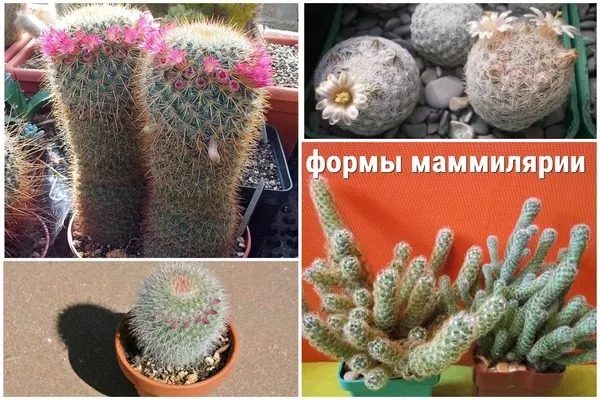
Among the mammillarias, there are species that are both absolutely unpretentious and those that are extremely demanding in terms of growing conditions.
Features of flowering
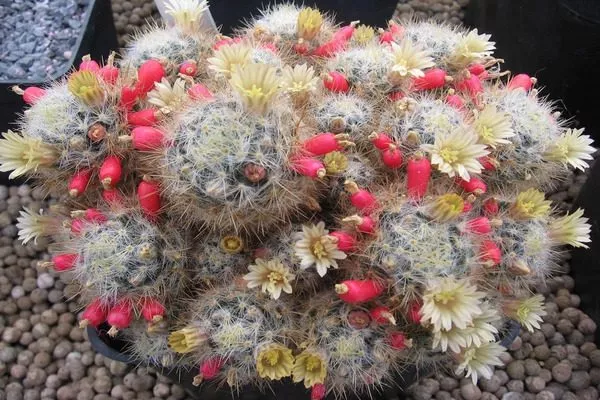
Mammillarias usually bloom in spring, less frequently in summer. Small flowers are often gathered in dense inflorescences that contrast beautifully with the green stems. Cylindrical mammillarias typically develop a crown of flowers at the top, while spherical cacti can be completely covered in buds. Pollination occurs by wind or insects.
The flowering period itself can last several weeks or months. The duration is affected by lighting conditions and care. The timing and frequency of flowering also depends on the mammillaria species. Some bloom only in summer, while others bloom from early spring to fall.
You will find more useful information on how to achieve luxurious flowering of mammillaria at home. Here.
Popular types of mammillaria
Mammillarias amaze even seasoned cactus growers with their diversity of shapes and colors. There are approximately two hundred species of Mammillaria in the wild, many of which are successfully grown indoors. Below are the most popular Mammillaria varieties with brief descriptions and photos.
Elongated
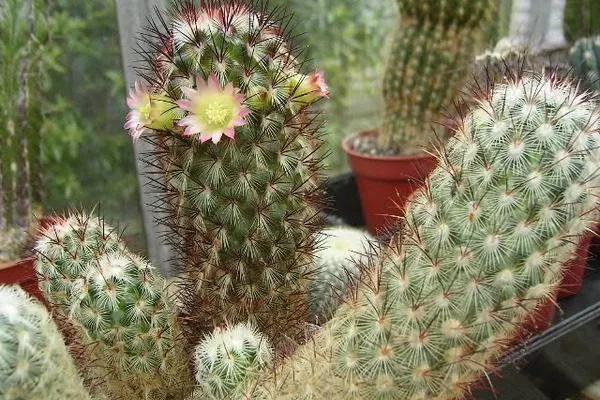
This Mexican mammillaria is deservedly considered one of the most popular indoor plants. It has a branching, elongated cylindrical stem covered in sharp spines. The plant grows up to 15 cm tall, with a stem diameter of up to 3 cm. The spines are radial, golden, and reach 1 cm in length, with typically 15-25 in each tubercle. This mammillaria has no or very few central spines.
The flowers are pale yellow or pink, bell-shaped, reaching 1.5 cm in diameter, and appear at the apex or slightly below. Blooming occurs from April to June. Mammillaria elongata propagates by pupae and seeds. Its golden needles, elegant appearance, and ease of care make this cactus ideal for succulent arrangements. Latin name: Mammillaria elongata.
The most prickly
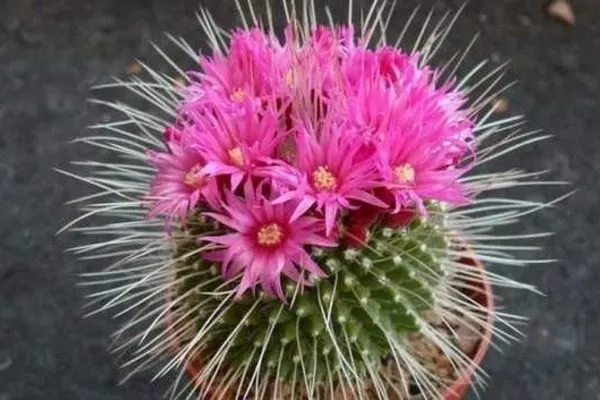
This mammillaria has a spherical or oblong stem, covered with long, thin white or brown spines. Between the conical papillae is a pubescence that resembles cotton balls. The matte green stem becomes columnar with age, growing up to 25 cm in height. The stem diameter is up to 10 cm.
Up to 15 needles grow from each papilla. They are straight and flexible, with one of the central spines tipped with a hook. There are even more radial needles, white and bristly, about 1 cm long. In the wild, this cactus grows in dry deserts and is endemic to two Mexican states: Guerrero and Morelos.
The spiny mammillaria blooms from late winter to early spring. Its flowers are pale or bright pink, or purple. The plant requires plenty of light and warmth to grow and bloom. This cactus is ideal for indoor decoration, easily blending into any interior. It propagates by seeds or by offshoots, which root easily. Its Latin name is Mammillaria spinosissima.
Wilda
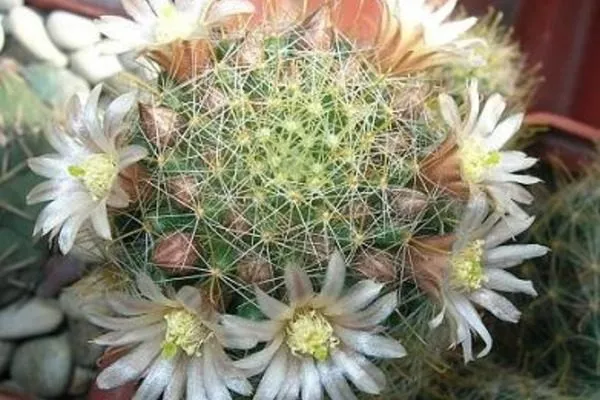
This Mammillaria is considered not only one of the most common cacti, but also one that tolerates care errors. It has a thick, cylindrical stem with thin, elongated papillae, from which grow thin, golden, hair-like spines. Unlike many Mammillarias, this species branches extensively and has central spines that are curved into a hook.
The flowers of the Wilda cactus are straw-yellow and quite large. Fruits form after flowering. Flowering occurs in spring and summer. The flowers are located near the top of the cactus, forming a striking ring. The flowers reach 2 cm in diameter. In the wild, this wonderful cactus is found in the deserts of Mexico, the southern United States, and the Caribbean islands.
The plant can be propagated by pups and seeds. This species produces quite a few pups, which do not fall off on their own, resulting in extensive branching. The cactus, with its unusually fluffy surface, easily becomes an important accent in any room. Latin name: Mammillaria wildii.
Zeilman
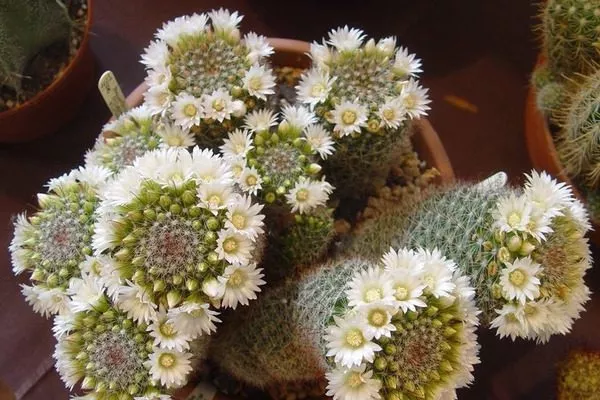
Mammillaria Zeilmannii, a Mexican endemic (found only in Guanajuato), is beloved by gardeners for its attractive appearance, spectacular blooms, and hardiness—it easily tolerates temperatures as low as -7°C. The plant has a relatively short, dark-green cylindrical stem and dense, slightly curved spines.
The plant typically blooms from late winter to early summer. Blooming lasts up to six months, provided the cactus is well cared for. The flowers are deep pink, bell-shaped, and up to 2 cm in diameter. They appear at the top of the cactus and can form a crown, each bloom lasting almost a week.
Zeilmann's cactus tends to form shoots, which can be used for propagation—a good alternative to seeds. Dense spines, impeccable form, and spectacular blooms make this mammillaria an excellent decorative element for modern interiors. Latin name: Mammillaria zeilmanniana.
Excellent
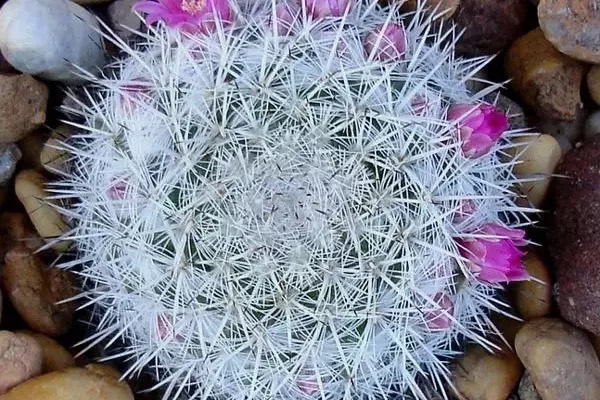
This Mexican endemic, growing naturally on limestone slopes, earned its impressive name for a reason—the cactus truly is a stunning sight. Its charm is enhanced by its flowering period. This cactus is a small sphere, measuring 6-7 cm in diameter.
The entire stem is covered with small white spines, so numerous that they resemble a blanket of snow. The plant begins to bloom at 3-4 years. The flowers are pink or purple. Flowering time is late fall or late spring. The cactus produces numerous offspring, so it can be propagated not only by seeds but also by cuttings.
To stimulate flowering, the cactus is stimulated by simulating the changing growth cycles, and during flowering, lighting is turned on—at least 16 hours of daylight per day is required. The plant is highly prized by collectors and is widely used as an ornamental plant. Latin name: Mammillaria perbella.
Ghana
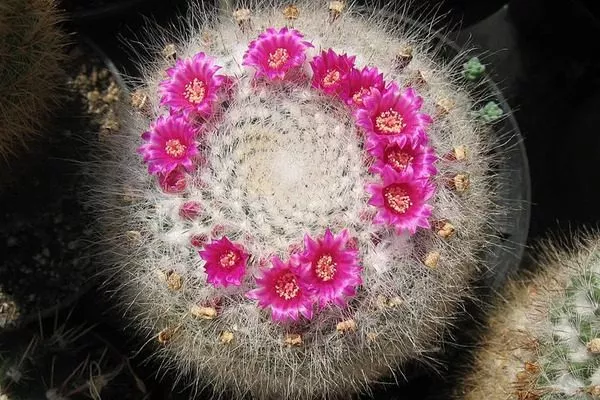
Mammillaria hana (or Mammillaria hana) is very beautiful and popular in indoor gardening. This spherical cactus is particularly attractive due to its regular geometric shape—the rounded stem is covered in conical papillae, from which grow white hair-like spines that resemble fine bristles.
The spherical stem becomes cylindrical over time, light green or grayish-green, and the white spines covering it reach 4 cm in length. They have reddish tips, adding a touch of glamour to this striking plant. This mammillaria blooms from late winter until spring.
The flowers are small, reaching 1.5 cm in diameter. Their color ranges from pink to purple-red. The plant prefers bright light but does not like direct sunlight, although it naturally grows in the dry deserts of Mexico. It reproduces by seeds and offshoots. It is ideal for creating succulent arrangements. Latin name: Mammillaria hahniana.
Bokasanskaya
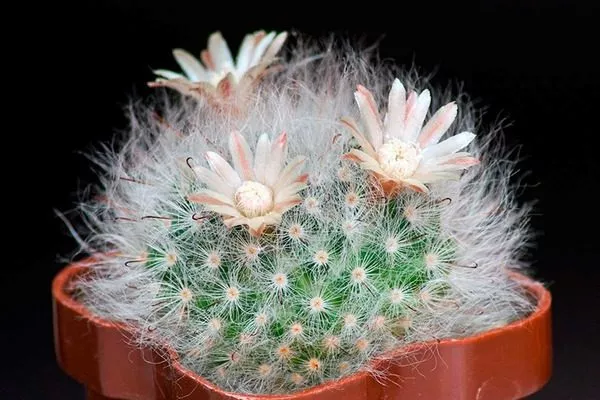
The distinctive feature of this Mexican endemic is its spines. They are so numerous that the spherical stem appears fuzzy, covered in light hair. And each spine is unique—there's a central, hooked spine, several thin, needle-like spines, and many long, hair-like spines. The stem grows up to 10 cm tall. As it grows, it transforms from a sphere into a cylinder. The stem is bluish-green in color.
Bokasan mammillaria grows and blooms easily indoors. Flowering begins in spring and continues until late summer. The flowers are small, funnel-shaped, and range in color from creamy white to pinkish, up to 2 cm in diameter. After flowering, oval fruits, red or pink, form.
Young plants are solitary; they begin to bush out at 3-4 years of age, forming large mounds. Propagation is possible by seed and vegetative means. Thanks to its hairy pubescence, the Bocasan mammillaria literally glows in the sun, creating a radiant effect. Latin name: Mammillaria bocasana.
Shoot-bearing (growing)
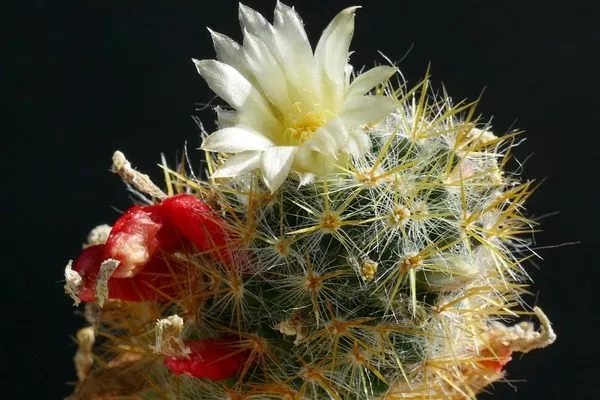
The name of this mammillaria comes from the Latin words proles ("offspring") and fero ("I bear"), and refers to the large number of offspring this plant produces. The cactus has a spherical or elongated stem up to 6 cm tall and 4 cm in diameter. It branches extensively at the base and laterally, with adjacent shoots literally clinging to each other.
The papillae covering the stem are soft and rounded, their axils sparsely covered with white bristles. The central spines are yellow and shiny, up to 1 cm long. The radial spines are many times more numerous, thin and white. Flowering lasts 2-3 months, usually in spring. The flowers are creamy yellow, with a pinkish-brown stripe in the center.
After flowering, edible orange-red fruits form. The plant is very easy to grow and compact, easily placed in a container with succulents without overpowering neighboring plants. This mammillaria reproduces well by seed and cuttings. Latin name: Mammillaria prolifera.
What is necessary for comfortable growth?
Mammillaria is one of those cacti that can be successfully grown indoors. However, for successful cultivation, it must be provided with certain conditions. Improper care and errors in maintenance quickly lead to disease and death.
Conditions for comfortable growth of mammillaria:
- TemperatureMammillaria thrives best in daytime temperatures ranging from +20°C to +25°C. Nighttime temperatures should not drop below +10°C.
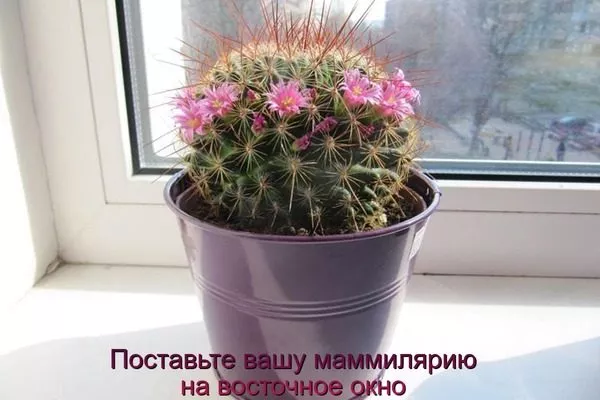
- LightingThe plant requires plenty of bright light. It is recommended to place it on east- and south-facing windows. If the light is insufficient, the cacti can be illuminated with phytolamps or other artificial lighting.
- HumidityIn nature, Mammillaria grows primarily in arid areas, so it's undemanding of air humidity and can easily grow in ordinary living spaces. Moreover, these plants, like most cacti, do not tolerate overwatering.
However, in summer, a light rain shower is recommended for plants. Large drops should not fall onto the stems.
Growing and care
Caring for mammillarias isn't difficult, but there are a few things to be aware of. If you treat them like regular houseplants, they'll quickly wither and die.
Soil requirements
You can use a commercial (ready-made) substrate for growing mammillaria, but make sure it's labeled "for cacti." You can also make your own, but follow the instructions and be sure to disinfect the mixture.
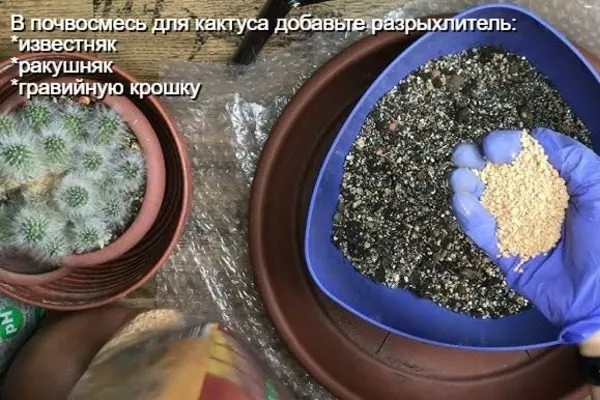
For young plants, a mixture of equal parts leaf mold and turf soil is suitable. Add one part each of peat and sand. Brick or gravel chips can also be added for loosening the soil. Shell rock or limestone can also be added, and charcoal is a must.
The composition of the substrate is influenced by the type of mammillaria, or rather the type of its roots:
- For cacti growing on plains and having fibrous roots, light and fertile soils are suitable, preferably with leaf soil.
- For species with tuberous roots, heavier mixtures with a predominance of turf soil are needed.
- Mammillaria growing in mountainous regions will grow well in a substrate with the addition of lime, finely crushed shell rock or marble (brick) chips.
Choosing a pot
Since mammillarias tend to spread out, it's recommended to plant them in wide pots. The diameter should be 2 cm larger than the cactus's. An unglazed clay or ceramic pot is best. Glazed pots are less suitable, as the glaze makes them less breathable.
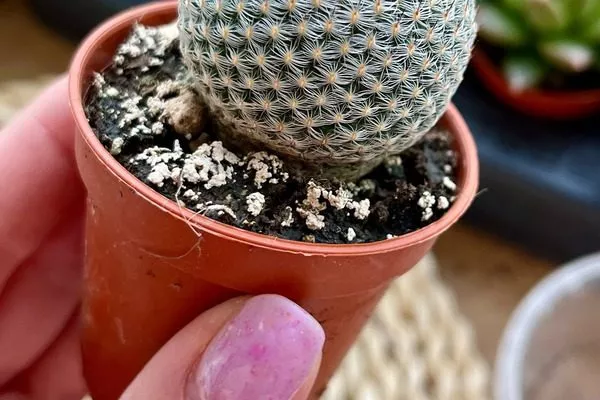
You can also use plastic pots. They're impermeable, so moisture evaporates more slowly from the soil—it's important to avoid overwatering. The optimal shape is a trapezoid, with a narrow bottom and a wide neck. This allows for more even distribution of roots. Tall pots aren't suitable, as they will cause permanent waterlogging.
Watering
When grown indoors, mammillarias should be watered moderately, paying attention to the condition of the substrate. These plants are very sensitive to overwatering and do not tolerate stagnant water, which leads to root and stem rot.
Watering frequency depends on the season. Mammillaria needs moisture in spring and summer. During this period, water the cacti when the top layer of soil dries out. In autumn, watering is reduced, and in winter, when the dormant period begins, it is practically stopped.
Features of watering mammillaria:
- It is better to water plants in the morning so that the soil dries well by evening.
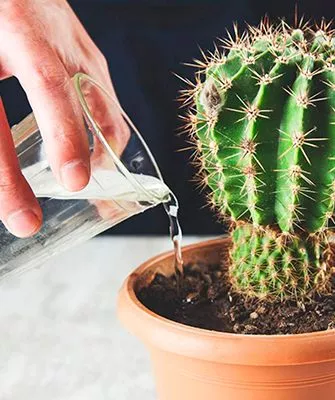
- Watering should be abundant, the water should pass through the root ball and flow through the drainage holes - this will provide the roots with the required amount of moisture.
- Water should not get on the stem, otherwise the risk of rot increases.
- For watering, you should use distilled or rainwater, as tap water may contain chemicals that are harmful to cacti.
You can find maximum useful information about the correct watering of a home cactus by following this link link.
Top dressing
Mammillaria cacti need nutrients to grow and bloom. They can survive without fertilizing, but they're unlikely to delight their owners with profuse blooms. Fertilize about once a month or less frequently; there's no need to feed cacti in the fall or winter.
Mammillarias are fed with special cactus fertilizers, which are high in potassium and phosphorus and significantly lower in nitrogen. Suitable fertilizers include Florise, Agricola, Flower Paradise, and Bona Forte. The packaging should be labeled "for cacti."

It's best to apply fertilizer as a liquid solution. It's important not to let the solution get on the stems, as it can cause burns in bright sunlight.
Trimming
Mammillarias don't require pruning; it's done only when necessary. For example, to give an overgrown plant a neat shape or to remove areas affected by fungal infections. The cactus is also pruned if the stems become deformed, which can occur due to improper care or excessive stem elongation.
Features of pruning mammillaria:
- The procedure is recommended from April to early September. During this period, the plant actively grows and recovers quickly. It is not advisable to prune cacti in winter, as their immunity is weakened and cuts heal slowly. During this time, pruning is only permissible in extreme cases.
- Pruning is performed with sharp, disinfected instruments. All damaged tissue must be removed, and the cuts must be sprinkled with crushed charcoal to prevent infection.
- Large cacti can be trimmed directly in the pot, but smaller ones are best removed from the container. Wear gloves when handling cacti to prevent punctures from the thorns.
After pruning, do not water the cactus; place it in a dry, warm spot, shaded from direct sunlight. After a week, the cut ends should dry out and shrink slightly.
Transfer
Adult mammillarias are repotted approximately every two years, in spring or summer; young mammillarias are repotted once a year. Repot into a pot that is 2-3 cm wider than the previous one.

Features of the transplant:
- Don't water the cactus before repotting. Remove it from the pot along with the dry soil.
- The cactus's roots are inspected for rotten areas. Any damaged or rotten roots are trimmed off with a disinfected tool.
- Add a small amount of fresh potting soil to the bottom of the new pot, then place the plant in the center of the container and fill the empty space with soil. The soil level should be slightly below the rim of the pot to allow for watering.
After repotting, shake the pot slightly to compact the soil, then water lightly. Keep the plant in bright but indirect light for several weeks; direct sunlight should be avoided.
Wintering
In winter, mammillaria enters a dormant period. Growing conditions change. Temperatures drop to 7–10°C. For pubescent varieties, the requirements are different: temperatures should not drop below 15°C.
Features of mammillaria wintering:
- Cacti should not be placed near radiators or ventilation openings, as sudden temperature fluctuations can cause stress to the plant.
- Humidity levels should be low, ideally 30-40%. Humidifiers are not recommended. Plants require ventilation, but drafts are avoided.
- In winter, watering is significantly reduced, and fertilizing is stopped completely.
Reproduction
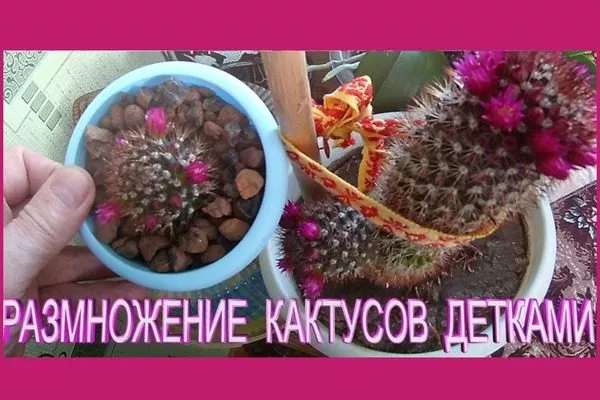
The Mammillaria cactus reproduces easily by both seeds and offshoots (lateral shoots). The choice of propagation method depends primarily on the growing objectives. Seeds are used to prevent degeneration and to obtain many young plants at once.
But Mammillaria is most often propagated by offshoots. Firstly, this plant produces many lateral shoots, and secondly, this allows for faster production of a mature plant. However, vegetative propagation cannot be used permanently—if you constantly replace mature plants with young shoots taken from the same plants, the quality of the cacti will deteriorate over time.
Diseases and pests
Mammillaria, like other cacti, can be affected by various pathogens. Most often, they are affected by rot, which is a result of improper care. Fungicides such as Hom, Topaz, and Fundazol are used to combat these diseases.
The plant can be affected by red spider mites, cactus scale insects, and nematodes. Insect pests are controlled with systemic insecticides, such as Aktara, Actellic, Fitoverm, and Vertimek.
Use in interior design
Mammillarias, often called snow cacti, are used in interiors as striking accents. These plants add a fresh and exotic touch to interiors. They are compact, beautiful, and fit seamlessly into city apartments.
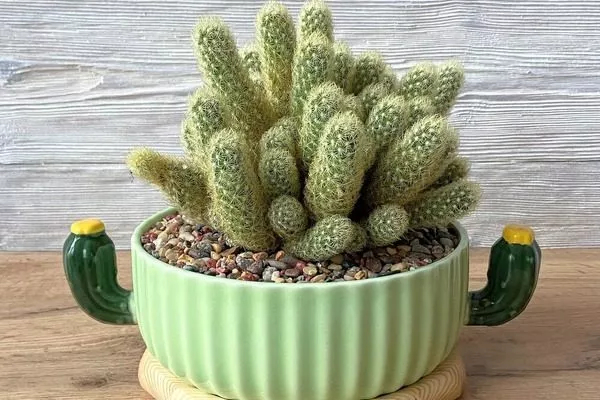
Mammillarias, with their abundant needles and fluffy texture, pair harmoniously with other houseplants. However, it's recommended to space them 30-40 cm apart from other cacti.
Interesting facts
Mammillaria flowers are very popular worldwide. Many interesting events and facts are associated with them. Most of them are related to the American continent and its indigenous peoples. Native Americans collected mammillaria fruits, ate them, and used them for other purposes.
Native Americans used baked Mammillaria stems for medicinal purposes. Shamans used certain Mammillaria species in their rituals. It was believed that eating this cactus (its pulp) could cause madness.
Mammillarias occupy a worthy place among cacti grown indoors. They are extremely striking in appearance, delighting their owners with regular blooms, and are also low-maintenance. These cacti are truly versatile, fitting beautifully into both residential and office interiors.