
Ferocactus is a large genus of American cacti, featuring a variety of shapes, sizes, flower colors, and needles. They don't bloom often, but this doesn't diminish their popularity among gardeners—the ribbed cacti with their long needles look beautiful in interiors and flower arrangements. They can range from very small to giants, up to 1 meter tall, depending on the species.
General information about the genus Ferocactus
Ferocactus (Ferocactus) belongs to the Cactaceae family and is native to North America. They are true giants among cacti, reaching 3-4 meters in height and 1 meter or more in diameter.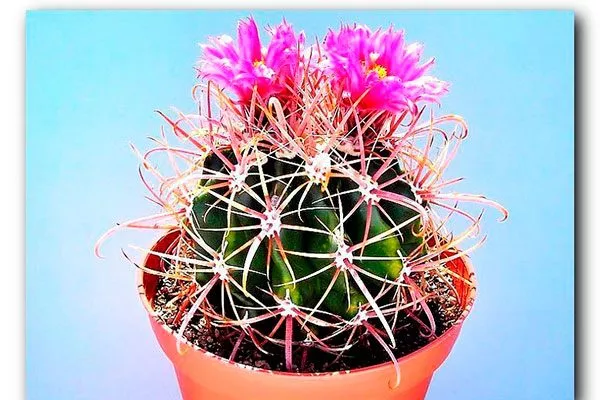
Some species of Ferocactus can be grown in greenhouses and living spaces. The key factors for them are intense sunlight and a completely dry winter.
Origin of the name and brief history
Ferocactus gets its name from its enormous needles, which befit its gigantic size—they can reach up to 20 cm in length. It derives from the Latin word "ferus," which translates as wild or cruel.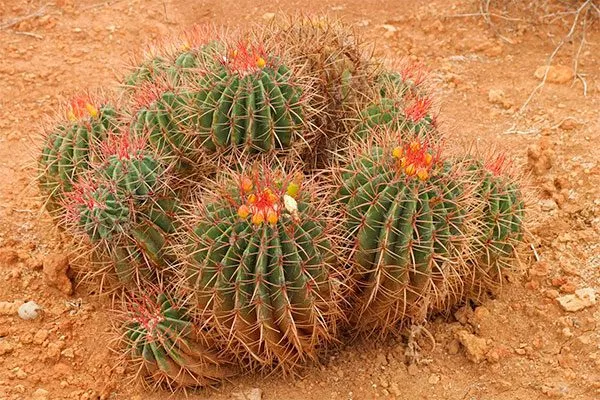
The first representative of the genus was Ferocactus recurvus, which was discovered and described in 1773 as Cactus recurvus Mill. In 1922, the American botanists N. Britton and J. Rose first introduced the name Ferocactus into botanical nomenclature.
Biological characteristics
Ferocactus species vary in size, flower color, rib configuration, and other characteristics. However, all Ferocactus species share common features.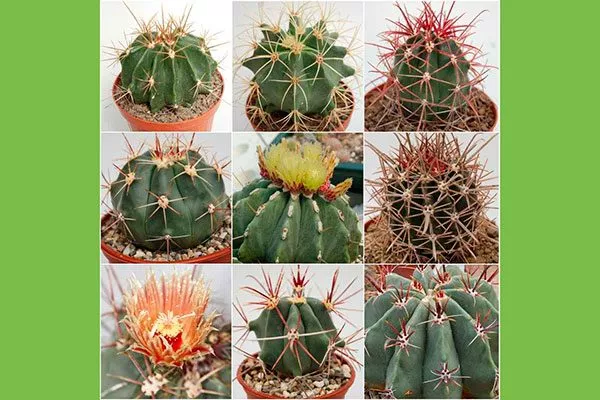
Growth forms and sizes
The shape of Ferocactus depends on the species. Plants can be round, laterally flattened, or cylindrical. Shoots can be single or have multiple branches. Sizes vary: height from 0.2 to 4 m, diameter up to 1 m.
Stem and rib structure
Ferocactus stems are fleshy, with thick, shiny skin, dark green or bluish in color. Ribs are vertical, clearly defined, triangular in cross-section, and can be quite thick.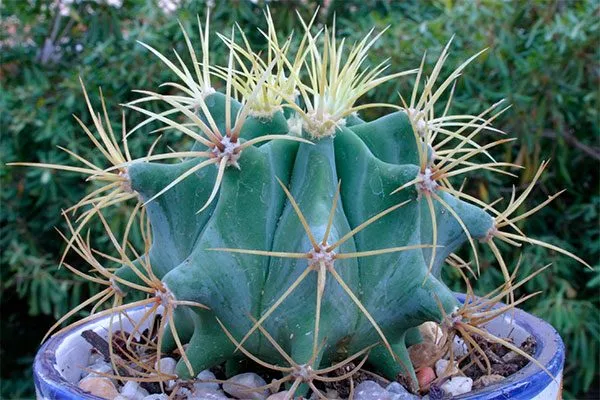
Flat areoles with light pubescence and a tuft of sharp spines are evenly distributed along each rib. Depending on the Ferocactus species, the ribs can be straight or sinuous.
Roots
Most Ferocactus have roots that grow in width, penetrating approximately 3 cm deep. This is due to the soil conditions in which these plants grow.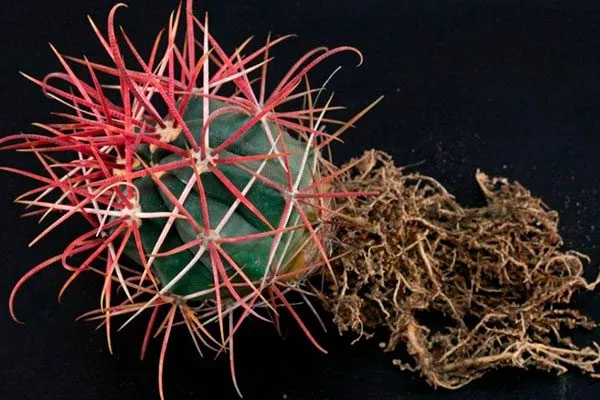
At the same time, there are varieties of Ferocakuts whose roots go into the ground to a depth of 15-20 cm.
Thorns
Ferocactus spines are long and powerful, looking truly menacing. The longest spines are found on the erect-spined Ferocactus, which can reach 25 cm. Some species have hooked and/or brightly colored spines. They can be flat or awl-shaped.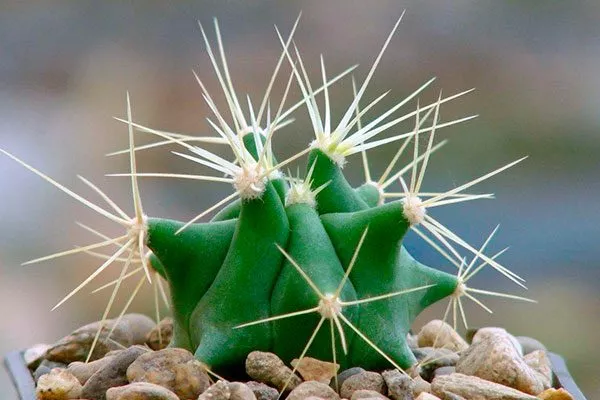
Flowering and fruit characteristics
In the wild, Ferocactus bloom in summer. Flowering is rarely observed indoors. Cacti typically bloom when they reach at least 25 cm in height. Flowers most often form at the top of the plant, less commonly on the sides of the stem.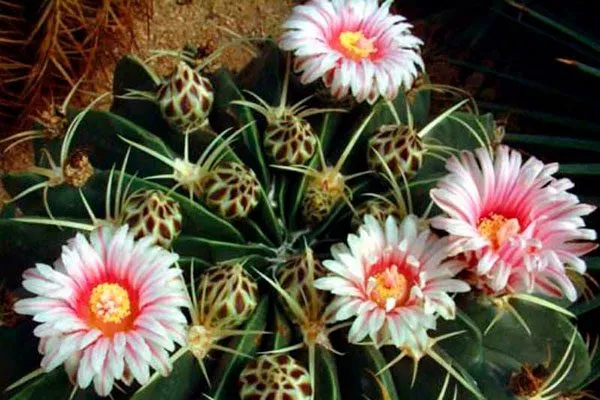
Ferocactus flowers resemble bells or elongated tubes. They can range in color from pink to deep yellow. The flowers reach 3-6 cm in diameter. The duration of flowering depends on the Ferocactus species and can last from a few days to several weeks.
When ferocactus flowers fade, fruits form in the place of the flowers. They are oblong and covered with a thick, smooth skin. Inside is a juicy pulp containing several shiny black seeds. The fruits are most often yellow, with the remains of a dried flower at their tip.
Habitat and ecological conditions
Ferocactus are heat-loving and thrive in specific climates. They are found in areas with sparse vegetation and challenging climates.
Natural habitat
Ferocactus cacti naturally grow on rocky and calcareous soils. They thrive in hot and arid environments. These cacti can be found in the southern United States and desert regions of Mexico.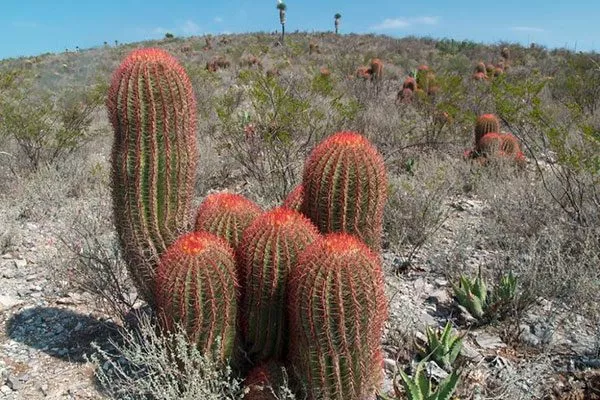
Ferocactus cacti typically grow singly. However, some species grow in groups and even form entire colonies or thickets consisting of hundreds of cacti.
Climate preferences
Ferocactus grows in the subtropical climate zone. Favorable temperatures are considered to be +20…+35°C in summer and +10…+15°C in winter.
If the thermometer drops below +10°C, cacti are very likely to die - this depends on the duration of the temperature drop, the landscape, and the age of the plant.
Typical habitats
Ferocactus grows in deserts, foothills, open mountain slopes, and flat semi-desert areas. They can be found at altitudes of 500–3,000 meters above sea level. Some species of Ferocactus grow at the bottom of the Grand Canyon in the United States.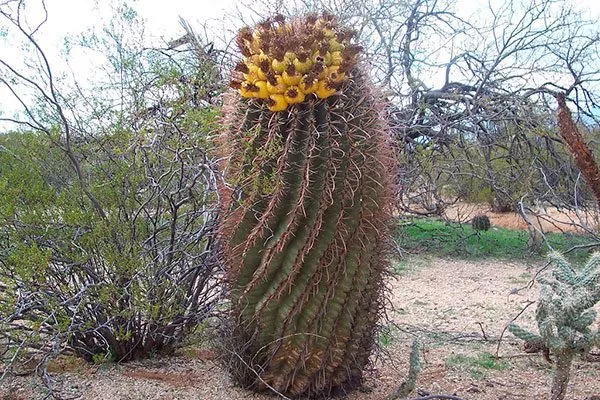
Features of the habitat:
- Abundant bright sunlight year-round. However, some varieties of Ferocactus grow better in areas with some midday shade.
- An irregular flow of water or depression where water can accumulate in a short period of time.
- Ridges where depressions form, as well as areas near gullies, are where cactus seeds undergo natural scarification due to water movement.
Peculiarities of home cultivation
Ferocactus are considered easy-to-grow plants, especially those grown from seed. However, as they mature, these cacti become more demanding in terms of care and growing conditions.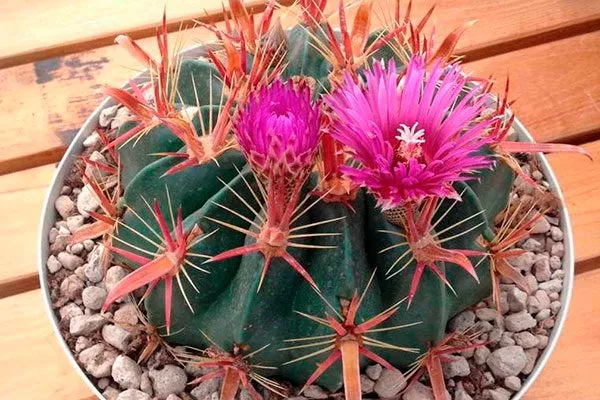
Most ferocactus grown indoors do not flower. However, gardeners appreciate them for their striking ribbing and long spines.
As the central spines grow, a sweetish syrup oozes from the center of the areole, which hardens to form sugar crystals. This sweet liquid should be washed off, for example, with a brush dipped in alcohol. This procedure prevents the growth of sooty mold, which not only spoils the cactus's appearance but often leads to its death.
Main types and varieties
The genus Ferocactus comprises approximately 35 species. While sharing a number of common features, Ferocactus varieties differ in shape, size, color, and spine length. Below are the most popular Ferocactus species that thrive in indoor settings.
Wide-spined
This ferocactus is also known as "devil's tongue." It is considered one of the most attractive of its genus. Its stem is spherical and flattened, and its color is greenish-blue. Its surface is ribbed, with 15-25 fairly high ribs on a single stem.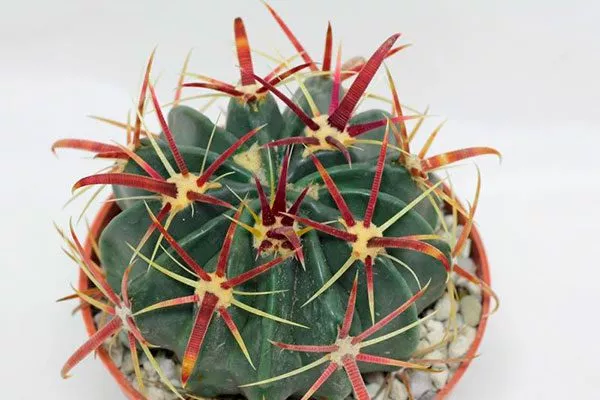
This ferocactus has large areoles with 2-4 ruby-colored spines reaching 5-8 cm in length and 6-12 radial spines of a white-pink hue, approximately 2 cm long. The largest spine curves downward, resembling a protruding tongue—hence the unusual name.
The flowers are red and bell-shaped, reaching 5 cm in length. This ferocactus is one of the smallest, reaching a height and diameter of about 40 cm. It grows in dry and desert regions of northern and central Mexico. Latin name: Ferocactus latispinus.
Ferocactus fordii
This endemic plant of Mexico's Baja California Peninsula is also known as the barrel cactus. It typically grows to a height of no more than 40 cm. Its stem is spherical, flattened, and grayish-green. Its flowers range from yellowish-red to purple and pale pink, reaching 6 cm in diameter and 4 cm in length.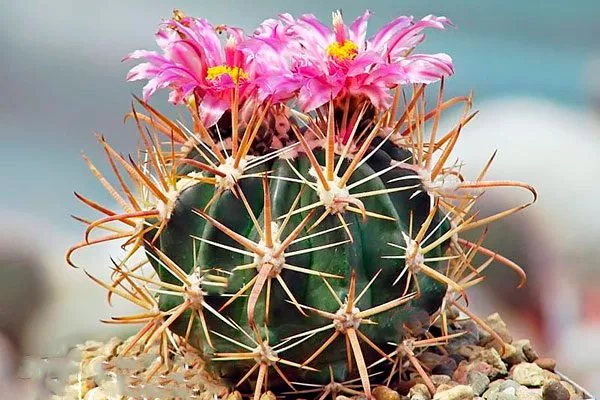
Each areole has four central spines, 2-4 cm long. They are flat and curved downwards, and range in color from gray-red to brown. The fruits are oval; their color depends on the species and can be pink, yellow, or other colors. Latin name: (Ferocactus fordii).
Powerful
This species is distinguished by its striking spherical or cylindrical stems, studded with numerous large spines, pale or bright, depending on the species. The stems are small, dark green, often with a reddish-gray tint. This cactus produces numerous offshoots, which create enormous cushions reaching 1 m in height and 5 m in width.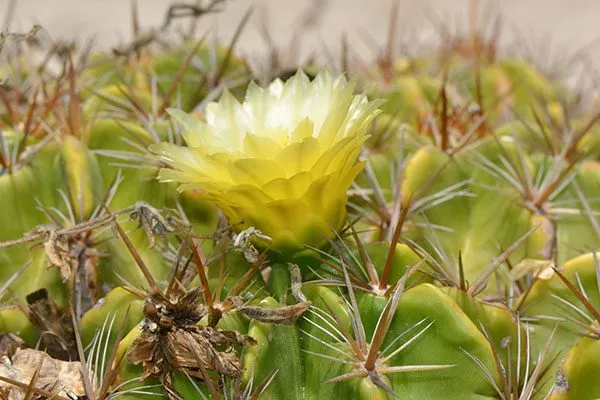
The surface is ribbed, the areoles are large, initially white, later gray. There are 4-6 central spines, and 10-14 radial spines. The flowers are yellow-orange, approximately 4 cm in diameter. In the wild, Ferocactus robustus is common in the Mexican states of Puebla and Veracruz at altitudes of 700-1000 m. Latin name: (Ferocactus robustus).
Straight-spined
This cactus has a spherical or slightly elongated stem with distinct ribs and strong spines. The central spines reach 25 cm in length. They are bright red or yellow-orange, becoming lighter with age. The plant reaches a height of 40-60 cm.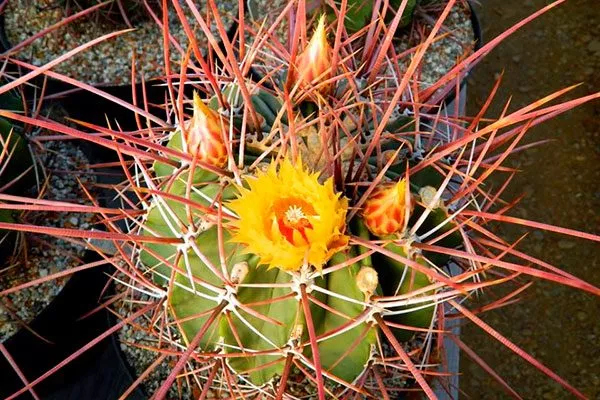
The flowers of this cactus are yellow and broadly funnel-shaped. They are located at the apex. The petals are reddish at the base. Ferocactus rectispinus is found in arid regions of North and Central America. Its Latin name is Ferocactus rectispinus.
Cylindrical
The stem is cylindrical, with thick, high ribs. The spines are well developed, can be straight or hooked, and are often brightly colored—red or yellow. Lateral offshoots often grow on the stem, forming small colonies.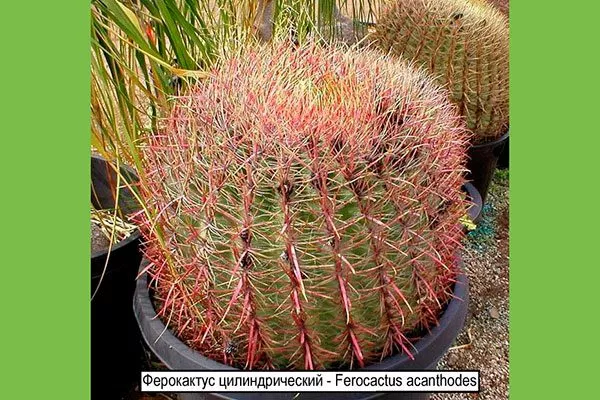
The flowers are orange-yellow and reach 5 cm in diameter. Ferocactus cylindrica grows in southwestern North America and in arid and desert regions of Mexico. Latin name: (Ferocactus acanthodes).
Agricultural technology and cultivation
Growing Ferocactus doesn't require much effort—these hardy succulents don't require frequent watering or fertilizing. The key is understanding the care requirements, as cacti, unlike regular houseplants, require specific growing conditions.
Selecting soil and container
In nature, Ferocactus grows in poor soils—rocky or calcareous. When growing these cacti indoors, it's necessary to use substrates with similar properties. The soil should be porous, loose, well-drained, and reasonably acidic (pH 7-8).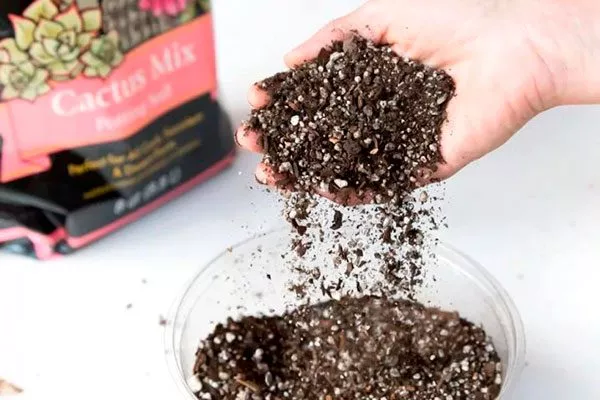
To grow Ferocactus, you can use ready-made mixtures—they are sold in flower shops—but it is recommended to additionally add fine gravel or coarse sand.
You can make your own potting soil using equal parts of turf, leaf mold, fine gravel (or brick chips), and sand. It's also recommended to add some wood soil to the mixture.
Features of choosing a planting container for Ferocactus:
- The planting container for Ferocactus should be wide and not too deep, since these plants have a superficial root system.
- The pot must have drainage holes at the bottom, otherwise the accumulated moisture will cause the roots to rot.
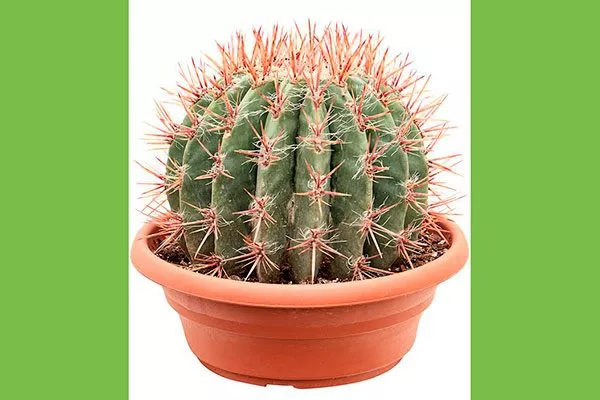
- It is recommended to give preference to ceramic pots; plastic ones are used only for young plants.
- Ceramics are highly breathable. If they don't have a glossy finish, the cactus roots will be able to "breathe."
- The pot should be larger than the volume of the cactus, but not more than 20%.

Watering rules
Ferocactus plants are watered when the entire soil ball is dry. No water should remain in the tray, as this can cause root rot. In summer, watering depends on soil conditions and can be quite frequent—up to once a week. In winter, when the plants are dormant, watering is significantly reduced.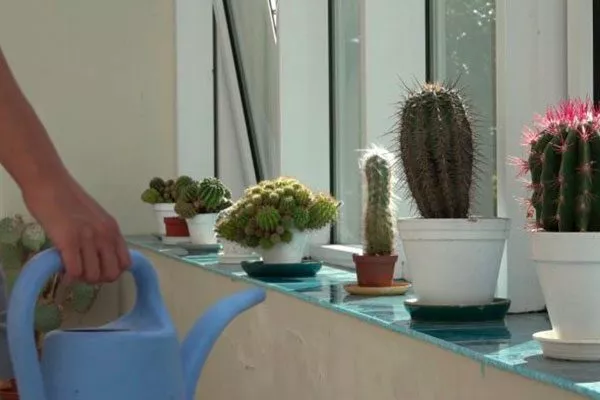
For watering, use settled water at room temperature. Water should not remain on the surface of the substrate during watering, so the base of the cactus should be surrounded by drainage material such as small stones or gravel.
From November to March, cacti don't need to be watered at all, as long as the room is cool. However, if the plant can't be given a comfortable winter, it will need to be watered. Moreover, the larger the cacti and the pots, the less frequently they need to be watered.
Lighting mode
Ferocactuses require plenty of sun, so a south-facing window is the best location for them. If they don't get enough light, their needles will turn pale, become smaller, and some will fall off. In summer, it's recommended to move them outdoors—to the garden or onto an open balcony.
The plant should receive at least 12-14 hours of light. In summer, young cacti on south-facing windowsills may need some shade. In winter, if there's insufficient light, artificial lighting should be turned on. If the Ferocactus has been in partial shade for a while, it should be gradually acclimated to full sun to prevent sunburn.
Air temperature and humidity
Ferocactus thrives in warmth. In summer, they thrive in temperatures ranging from +20°C to +35°C, and in winter, from +10°C to +15°C. Temperatures should not drop below +10°C, otherwise the plant will suffer from hypothermia and may even die. Ferocactus are more resilient in dry soil, surviving temperatures as low as +5°C.
Ferocactus thrive in dry air, so they thrive in city apartments. They don't require high humidity. They don't require special watering, but a shower from time to time is fine to remove dust. A brush or toothbrush can be used to thoroughly clean the cactus's surface.
Top dressing
Ferocactus naturally grows in very poor soils, so they need to be fertilized with extreme caution. Fertilize during the active growth period—from spring to early fall. It's important not to overdo it with fertilizer to avoid burning the roots.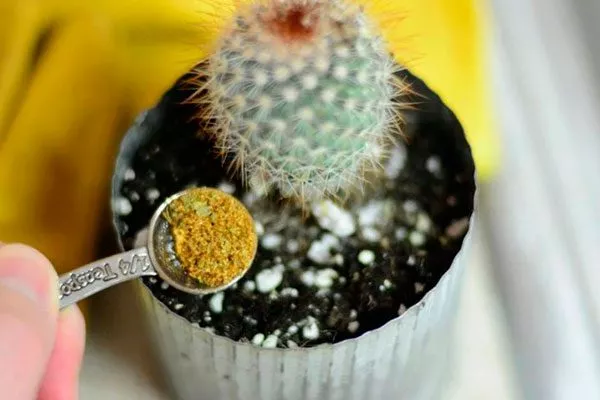
For fertilizing, use special liquid formulations for succulents or cacti, as well as slow-release fertilizers. Nitrogen-containing fertilizers are not used. Fertilizers are poured or scattered around the base of the plant, avoiding direct contact with the stem.
Methods of reproduction
Ferocactus can be propagated by seeds, cuttings, or offshoots (lateral shoots). The latter option is only suitable for those Ferocactus species that produce offshoots.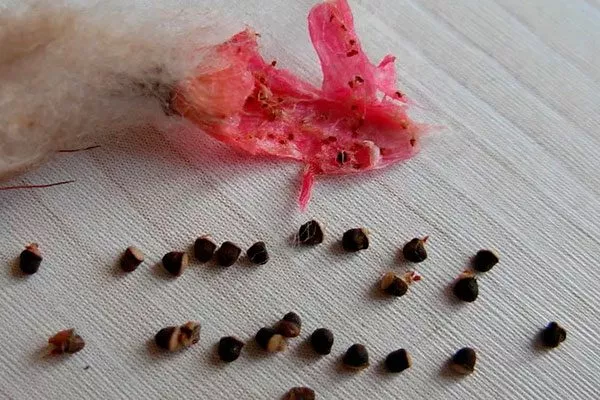
Features of propagation of Ferocactus by seeds:
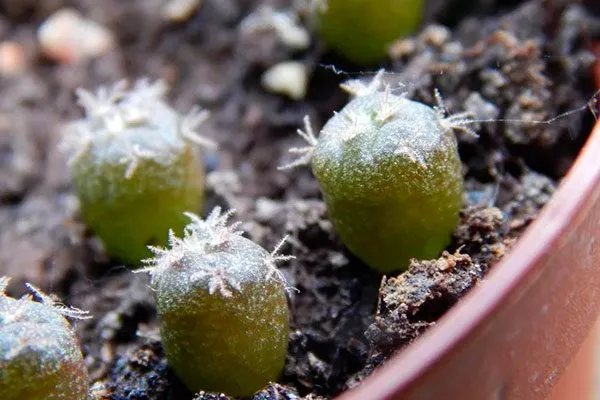
- The seeds are pre-soaked in warm water for 24 hours.
- Prepared planting material is sown into a moistened substrate.
- Cover the container with transparent film and place it in a bright, warm room. Until the seedlings emerge, moisten the substrate occasionally to prevent it from drying out. The mini-greenhouse is also ventilated daily.
- Seedlings usually appear within a month of sowing. Once this happens, the film is removed.
- When the cacti grow up, they are transplanted into individual pots.
If the cactus does not have children, it is propagated using cuttings.
Features of Ferocactus cuttings:
- Using a sharp, disinfected knife, cut a section of the cactus stem. Dust the cut with wood ash.
- Place the cut off portion in a well-lit area to dry for 2 days. However, it should not be exposed to direct sunlight.
- The dried part is planted in a pre-prepared substrate. Water it moderately. After 2-3 weeks, roots will appear on the cutting.
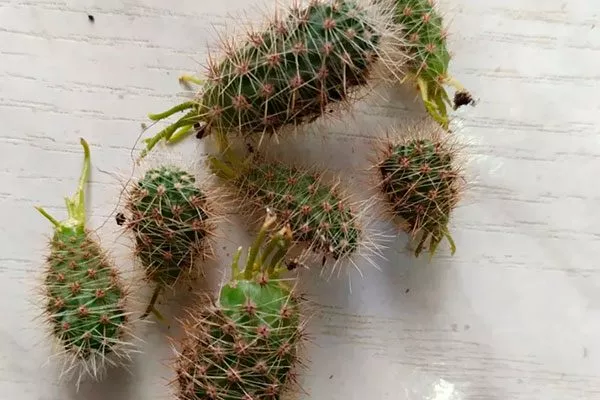
The simplest and most effective method of propagation is by using offshoots. They are simply broken off from the stem and air-dried for a couple of days. They are then immediately planted in a small pot filled with dry, loose soil.
Features of reproduction by babies:
- The babies are separated from the cactus very carefully so as not to damage the mother cactus.
- To prevent the young plant from collapsing in the substrate, it is surrounded with small stones.
- The first time the planted baby is watered 2-3 weeks after planting.
Transfer
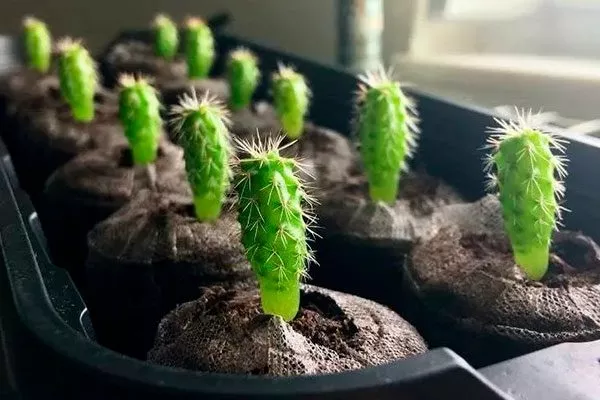
Young Ferocactus plants should be repotted annually, while older plants should be repotted every few years. It's time to repot the cactus into a larger pot when the roots begin to grow through the drainage holes. After repotting, do not water the cactus for 7-9 days.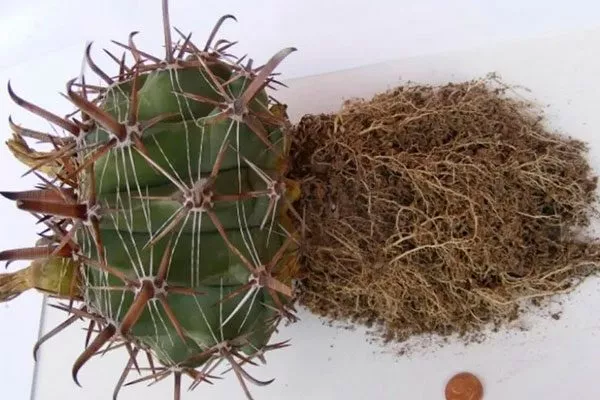
Diseases and pests
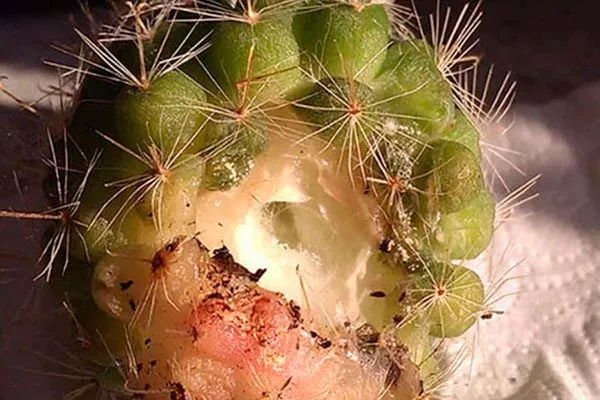
Ferocactus are rarely affected by diseases and pests; this usually occurs due to gross violations of agricultural practices—excessive watering, insufficient light, overdosing on fertilizers, and other errors.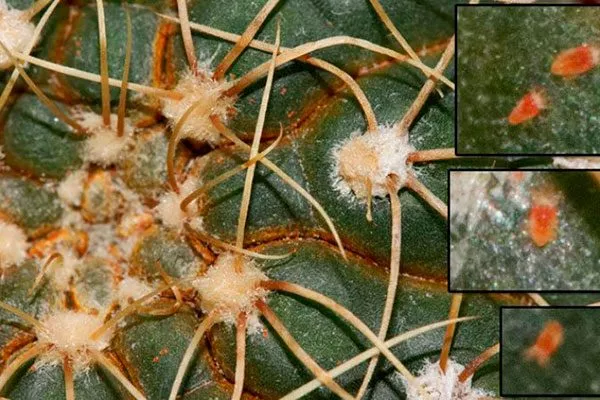
Ferocactus are usually affected by:
- Rotten — they appear due to excessive moisture. If signs of rot appear, spray the cacti with Bordeaux mixture or Fundazol. It's also important to establish a regular watering schedule, ensure air circulation, and avoid overcrowding.
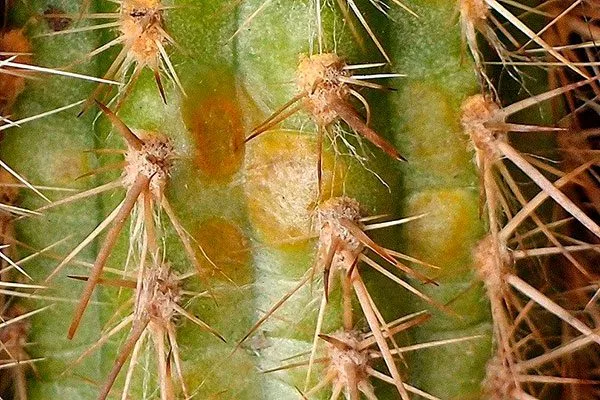
If necessary, remove the plant from the pot, wash the roots and transplant into fresh substrate. - Brown spot (rust)This is accompanied by the appearance of rusty spots. Affected areas are treated with fungicides, and then the plant should be provided with good ventilation and avoided overwatering.
Among the pests that attack Ferocactus, the most dangerous are spider mites and mealybugs, which feed on plant sap. Acaricides and insecticides, such as Fufanon, Aktara, Fitoverm, or similar products, are used against these pests.
Practical application
Thanks to their distinctive ornamental qualities—their unusual shapes and varied spine colors—ferocactuses find wide practical uses, including in interior decoration. These plants are also part of the cultural heritage of North American peoples.
Decorative use in gardens and interiors
Ferocactus plants integrate harmoniously into landscape design and can be used as decorative elements in a wide variety of interiors.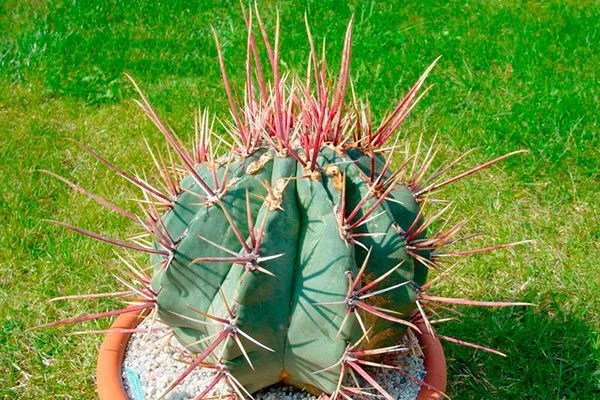
Features of using Ferocactus in gardens:
- As an accent. Large, spherical cacti can be placed in the center of a round flowerbed or along a garden path.
- As part of a desert-style mini garden. Ferocactus plants harmoniously combine with a wide variety of drought-resistant plants growing in sandy and gravelly soils. Large natural stones and boulders typically complete the picture.
- In combination with different plants. Ferocactus look spectacular next to wildflowers, lawns and ornamental grasses.
The beauty of Ferocactus is appreciated by lovers of beautiful interiors. These large cacti with long spines fit perfectly into both work and living spaces.
Ferocactus are suitable for different interior styles:
- Loft. Cactus arrangements look beautiful against brick walls and on open shelving, typical of loft and industrial styles.
- Minimalism. Ferocactus cacti look spectacular as stand-alone plants. They are ideal for various geometric pots. These cacti also fit well in reception area arrangements.
- Scandinavian style. Ferocactus fit beautifully into pastel interiors if planted in matching pots or placed on wooden stands.
Traditional significance and cultural heritage
Among Mexican peoples, ferocacti are a symbol of protection and security, so they are widely used to decorate gardens and homes. North American peoples also associate these robust cacti with strength and resilience.
In their native land, Ferocactus silago is used for economic purposes: the pulp is fed to livestock, the hollow stems are used to make containers for storing bulk products, and the needles are used as awls or fishhooks.
Ferocacti are often found in various local legends. For example, one legend claims that large cacti have repeatedly saved travelers from thirst and death. And although the ferocacti's sap is bitter, the legend remains popular in America and Mexico.
If you need a cactus to decorate your interior or create a flower arrangement, the Ferocactus is just what you need. Its visual appeal, beautiful geometric shapes, luxurious needles, and sometimes even flowers—all of this looks wonderful in modern interiors, gardens, balconies, and terraces.