
Ariocarpus is a small succulent plant that, although related to cacti, is virtually spineless. Most Ariocarpus species are rare in the wild today. Some are critically endangered. However, they thrive, bloom, and reproduce indoors.
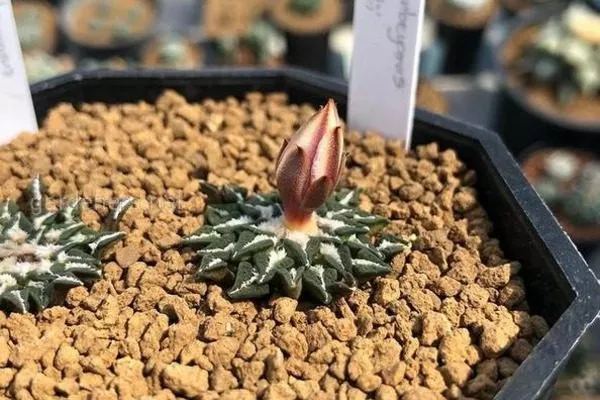
General information about Ariocarpus
Ariocarpus is a small genus of succulents in the Cactaceae family, comprising no more than a dozen species. Ariocarpus grows on rocks, stony, and calcareous soils. These plants are popular among cactus growers due to their unique appearance, slow growth, and easy care.
Ariocarpus are very unusual succulent plants that resemble cacti but have virtually no spines (or only rudomantarous).
You can get acquainted with other, no less interesting, representatives of the prickly family Cacti by clicking on link.
Origin and biology of Ariocarpus
The genus was first described in 1838 by Belgian botanist Michel Scheidweiler. The name of these plants comes from the Greek words aria ("oak tree") and carpos ("fruit"). Different species of Ariocarpus differ in appearance, but they share the same basic biological characteristics.
Desert plant species tolerate water shortages well; in fact, they've evolved to thrive on small amounts and will simply die if overwatered. Ariocarpus, like all other succulents, are very tolerant of moisture, but they're also demanding of warmth, air, and other growing conditions—their unique botanical structure helps them survive in these harsh conditions.
How Ariocarpus are structured:
- Stem. It is spherical or slightly flattened, gray-green or gray-brown in color, and reaches 12 cm in diameter. The stem is covered with flattened, thick papillae—deltoid, prismatic, or triangular—that are 3-5 cm long.
At the ends of the papillae are areoles with residual spines. They are virtually invisible to the naked eye. The plant's body contains specialized mucus canals that help it conserve water during periods of drought.

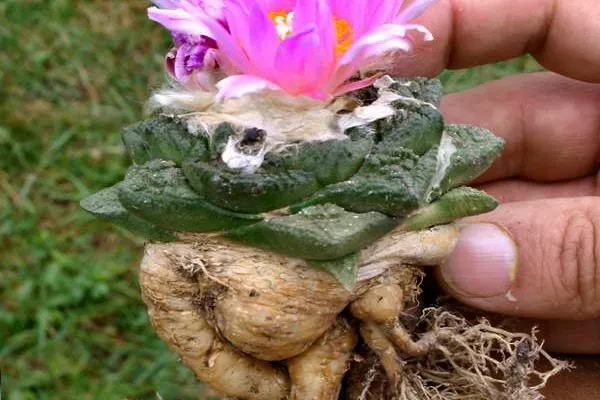
- RootsAriocarpus plants are well adapted to harsh desert conditions and can withstand long periods of drought. This is aided by their large underground roots, which make up a significant portion of the plant. Because water is unavailable from deep within the desert soil, Ariocarpus plants have a superficial root system. The roots grow directly beneath the topsoil.
- FlowersThey are bell-shaped and come in a variety of colors—white, yellow, and red. The flowers are 3-5 cm in diameter and form near the growing point.
- Fruit Ariocarpus fruits resemble acorns in shape. They are fleshy, filled with small seeds, and oblong. The fruits are white with a reddish or greenish tint. They are 1.5-2.5 cm long.
Habitat
Ariocarpus are native to North and South America. They are common, in particular, in Texas (USA) and Mexico, in the states of Coahuila, Tamaulipas, Nuevo León, and San Luis Potosi. In the wild, Ariocarpus can be found both in open, sunny locations and under the shelter of plants such as shrubs and dry grasses.
Types of Ariocarpus
The genus Ariocarpus comprises eight species. All are suitable for indoor growing and are distinguished by their decorative qualities and low maintenance. Below are descriptions and photos of all Ariocarpus species.
Agave-like
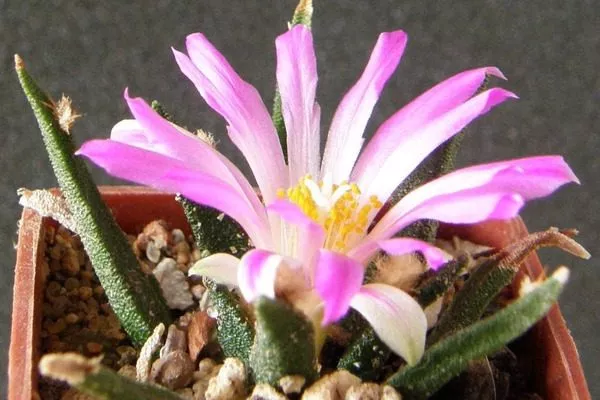
This Ariocarpus has a spherical stem, reaching 2-6 cm in height. It is dark green in color and lacks ribs. The papillae reach 4 cm in length; they are flat, hard, and large, with large areoles, radiating from the center in a rosette. Viewed from above, the plant resembles a star.
Flowers appear near the top of the plant. They are dark pink, silky-sheen, bell-shaped, and funnel-shaped, with a thin floral tube. They reach 3-4 cm in diameter. Ariocarpus agavoides blooms from July to November. The flowers remain open for only one day. Latin name: Ariocarpus agavoides.
Dulled
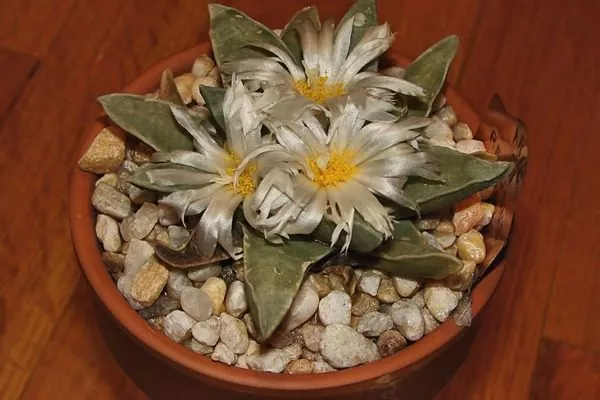
Compared to other Ariocarpus species, this species has a fairly large stem. It is bluish-olive or gray-green, reaching 10-12 cm in diameter. The upper part of the stem is covered with a tomentose pubescence—white or brownish. The stem is covered with triangular, pointed, and slightly convex papillae.
The obtuse ariocarpus blooms in late September to early October, lasting several days. The flowers are white, white-yellow, or pale pink. The diameter of the flowers is up to 4 cm. Latin name: Ariocarpus retusus.
Cracked
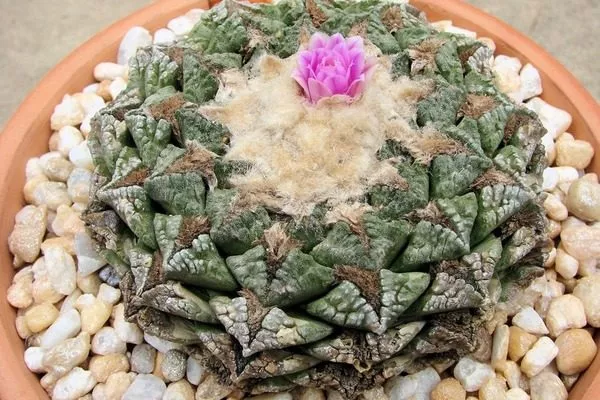
The succulent has a flattened, spherical shape, its grayish-green stem covered with fleshy deltoid tubercles growing from a large taproot. The plant is usually solitary, occasionally producing offshoots from old areoles, and grows extremely slowly.
The stem's surface resembles cracked stone. In nature, it literally blends into the rocks and becomes noticeable only during flowering. The plant blooms in October and early November, producing pinkish flowers. This Ariocarpus propagates by seeds, layering, and offspring. Latin name: Ariocarpus fissuratus.
Flaky
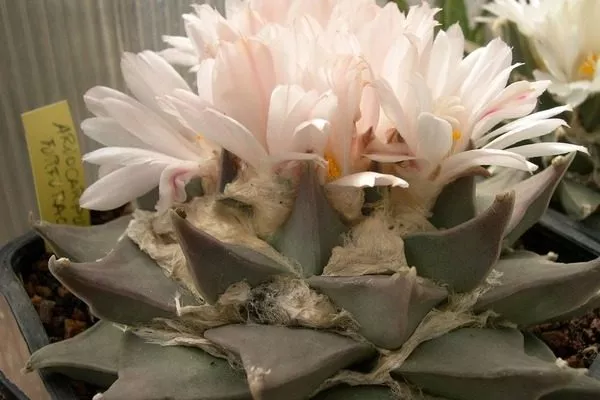
This species is significantly larger than other Ariocarpus species. It can reach a height of 10-13 cm and a diameter of 20 cm or more. It has triangular papillae pointing downward and a rough surface. The areoles are glabrous, with little or no spines.
The Ariocarpus furfuraceus blooms. Its bell-shaped flowers are cream or white-pink, 3 cm long and 5 cm in diameter. This succulent propagates by seeds and grafting. Its Latin name is Ariocarpus furfuraceus.
Ariocarpus Kochubey
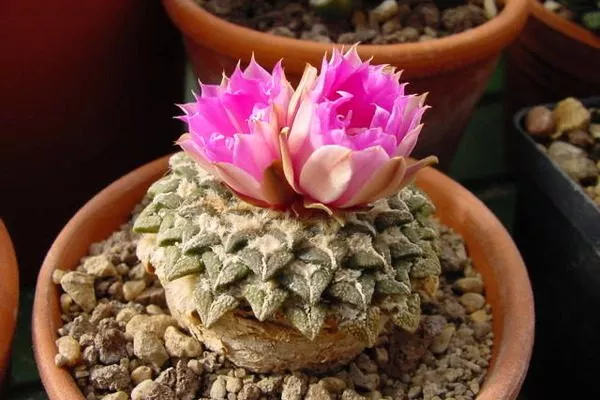
This miniature plant has a spherical, star-shaped, gray-green stem and large, pointed, triangular tubercles. It grows 4-10 cm tall and 10-20 cm in diameter. Spines are sparse or absent altogether.
The plant blooms in September and early October. The flowers are large, funnel-shaped, with a yellow center and glossy petals, white, purple, or pink. The flower diameter is 4-5 cm. Propagation is possible by grafting or seed. Latin name: Ariocarpus kotschoubeyanus.
Ariocarpus Bravo
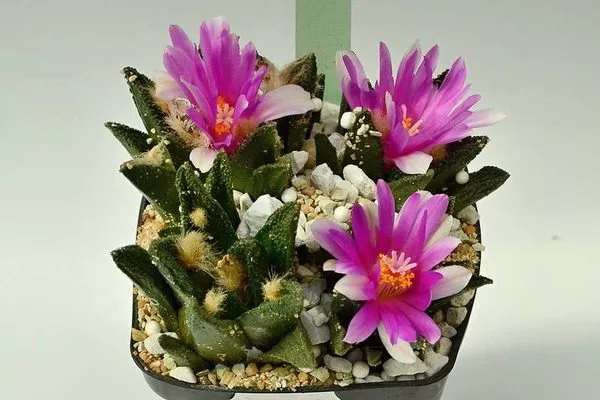
This succulent has a small gray-green stem that grows almost level with the ground, ranging in diameter from 3 to 9 cm. It has large, flat, dark-colored papillae with woolly areoles at the edges. The top of the plant is covered with a light-colored felt.
Ariocarpus bravo blooms in late September and early October, lasting several days. The flowers are purple, bell-shaped, and 4 cm in diameter. They have glossy petals and a dense center with a single pistil and a cluster of stamens. This succulent is propagated by seed or grafting. Latin name: Ariocarpus bravoanus.
Ariocarpus lloydii
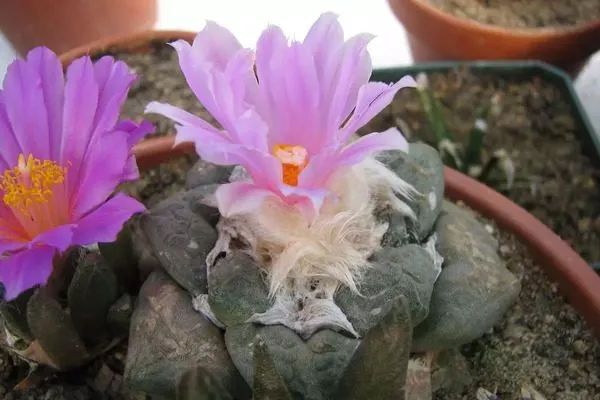
This slightly flattened succulent grows up to 10 cm in height and can reach 10-20 cm in diameter. It has a gray-green stem with tubercles radiating laterally and rounded tips. White hairs grow in the axils of the tubercles.
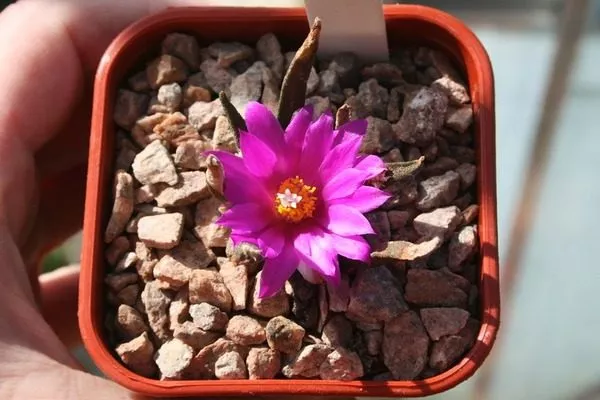
Ariocarpus lloydii blooms from July to November. The bell-shaped flowers, with a short floral tube, are purple-pink in color. The bloom period lasts for several days. Latin name: Ariocarpus lloydii.
Ariocarpus triangularis
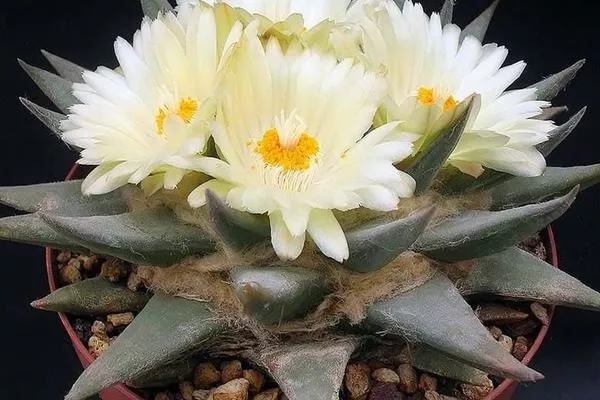
The gray-green, spherical stem reaches 10 cm in diameter. It has pointed, fleshy, triangular papillae. They curve upward and reach 5 cm in length.
The flowers are pale yellow, up to 5 cm in diameter. Ariocarpus trigonus blooms in late fall or early winter. It can be propagated by seed or grafting. Latin name: Ariocarpus trigonus.
Indoor maintenance of Ariocarpus
The conditions in which a succulent grows directly affect its growth, flowering, and even lifespan. Any imperfections can cause the plant to wither, rot, become diseased, and ultimately die.
Soil and drainage
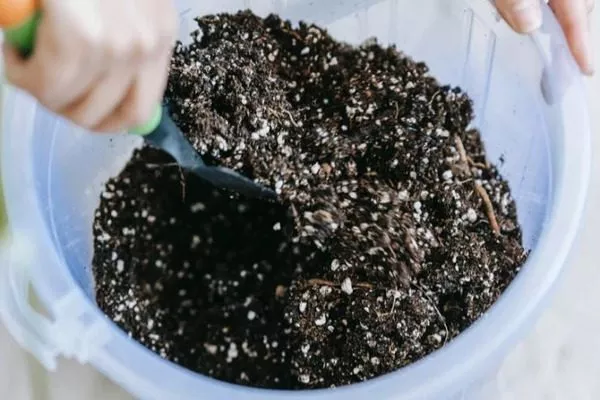
Ariocarpus requires a light, well-drained substrate that doesn't retain water—overwatering can be fatal to succulents. You can buy a ready-made substrate or make your own, for example, from coarse sand (50%), clay loam (30%), and limestone chips (20%).
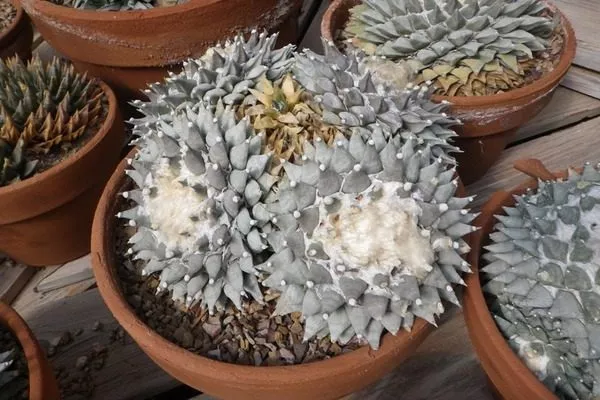
It's recommended to use a ceramic or plastic pot, and make sure it has plenty of drainage holes. Add a thick layer of drainage material to the bottom of the container—1/6 to 1/3 of its volume. Expanded clay, polystyrene foam, fine crushed rock, or crushed wine cork can all be used as drainage material.
Watering and humidity
Ariocarpus should be watered sparingly to prevent root rot. Before watering, make sure the substrate is completely dry. In spring and summer, water the plant more frequently, but stop watering in winter and during cool weather, otherwise the plant will die from root rot.
Ariocarpus are watered with warm, settled water at room temperature. When watering, it's important to avoid dripping onto the leaves. Humidity isn't particularly important for Ariocarpus. However, these plants should not be misted. Dust should be brushed off with a brush.
You will find maximum useful information and recommendations from experienced gardeners regarding the correct watering of cacti. Here.
Lighting and temperature
Ariocarpus grows well in bright and indirect light. Daylight hours should be at least 12 hours. The best location for this succulent is an east- or west-facing window. It is recommended to shade the plants from direct sunlight. In winter, fluorescent lamps should be used.
Too much light can cause sunburn on the leaves, causing them to develop brown spots and a sun-bleached appearance. Too little light can cause equally serious problems, causing the plant to become thinner, stretchier, slower in growth, and weakened in immunity.
You will find more details about the conditions that a cactus needs to create for luxurious flowering. Here.
Fertilizers and dressings
Fertilizers are applied to Ariocarpus in spring and summer, strictly observing the dosage. Overfeeding is contraindicated for succulents that have adapted to surviving in conditions of nutritional deficiency.
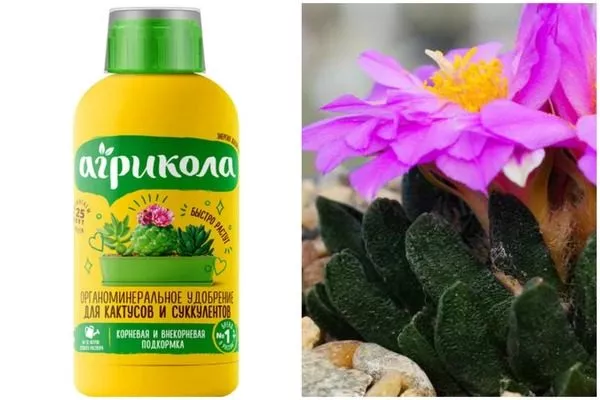
Features of fertilizing Ariocarpus:
- During the period of active growth, apply a universal liquid fertilizer for succulents.
- Fertilize the plant a few hours after watering. Do not pour fertilizer into dry soil.
- Fertilizing immediately after repotting is prohibited. Wait 2-3 weeks.
- The fertilizer should contain all essential elements—nitrogen, potassium, and phosphorus. During budding and seed ripening, Ariocarpus also requires calcium.
Transfer
Ariocarpus are repotted only when necessary—if the succulent becomes overcrowded in its pot. Generally, young plants are repotted once a year, while mature plants are repotted every 2-3 years. Repotting is done in the spring, as soon as the plant begins active growth—this is the period when it most readily adapts to its new conditions.
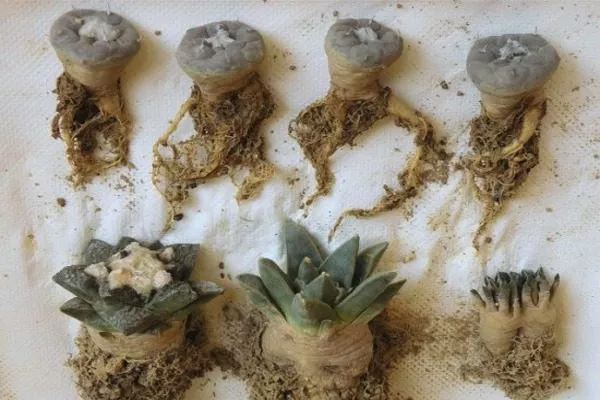
Features of the transplant:
- Ariocarpus must be moved very carefully, as it has fragile roots.
- The potting soil should be completely dry. Unlike regular plants, succulents and cacti are not watered before repotting.
- The plant is transplanted using the transshipment method - into a new pot together with a lump of soil.
- The free space is filled with soil (it should have the same composition as the old substrate).
- The transplanted plant is watered. Once the soil has settled, add a little more soil and sprinkle it with pebbles to create top drainage.
The next watering should be done no sooner than 5-7 days later. The plant should be closely monitored during the first few weeks, as stress from the change in location can cause it to turn yellow and wilt.
Protection from diseases
Ariocarpus rarely get sick in the wild, but indoor problems can arise mainly due to improper cultivation practices. Most often, the plant is affected by rot, which is caused by overwatering.
If dark spots (rot) appear on the stem, they must be removed:
- The affected tissue is removed with a sharp and disinfected instrument.
- The cuts are sprinkled with crushed charcoal.
- After the procedure, the plant is not watered for a whole month so that the fungus completely dies.
For the treatment and prevention of bacterial diseases, the biofungicide Fitolavin is used; fungal diseases can be controlled using the preparations Bayleton, Alirin-B, and Fitosporin-M.
Pest control
Ariocarpus can be affected by the same pests as other houseplants, including spider mites, scale insects, and others. The presence of pests can be identified by holes, pits on leaves and stems, sooty mold, or a white coating—signs of infestation vary from one pest to another.

Features of pest control for Ariocarpus:
- During the first spring watering, a systemic insecticide is applied as a preventative measure.
- To combat pests, use biological products, such as Fitoverm, which kills virtually all pests, including spider mites. Insecticides such as Aktara and Actellic are also very effective against all pests of Ariocarpus. The acaricide Neoron can also be used against spider mites.
If pests appear, it's recommended to immediately use a strong pest control product, as insects quickly develop resistance to the active ingredients of poisons. It's advisable to treat the plant with different insecticides at weekly intervals.
The process of reproduction
Ariocarpus reproduces well by seed and vegetatively—by cuttings or grafting. Both methods are quite labor-intensive and require specific knowledge and experience. The best time for propagation by any method is spring.
Seeds
Sow seeds in a well-drained mixture of sand, perlite (or pumice) and compost mixed in equal parts.
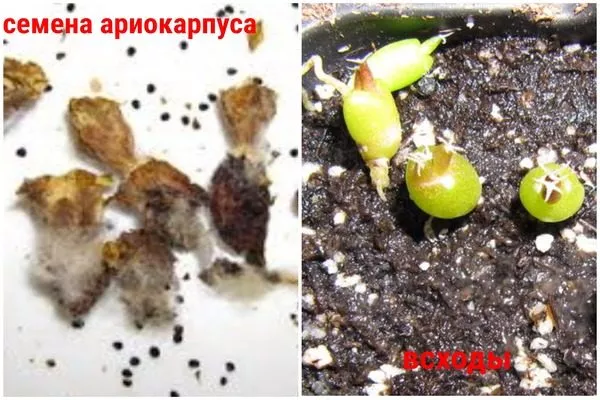
Features of propagation by seeds:
- The substrate is leveled and the seeds are evenly distributed across it. Cover with a thin layer of soil, but avoid burying the seeds too deeply—they need light to germinate.
- The crops are sprayed with warm, settled water and a constant level of humidity is maintained, but without over-wetting the substrate, so as not to provoke seed rotting.
- Cover the container with the seeds with transparent film. It's important to ensure adequate ventilation in the mini-greenhouse, otherwise mold may develop.
- Optimum temperature for seed development: +20…+25°C.
Ariocarpus seedlings may take several weeks or even months to emerge.
By cuttings
To propagate by cuttings, use healthy shoots, cut and slightly dried, which are rooted in moist soil. The cuttings are regularly sprayed with water, and the soil is kept slightly moist. Rooting is slow and will take several weeks.
By vaccination
A young Ariocarpus can be grafted onto a cactus, such as an Eriocereus or Myrtillocactus. This is done using the standard technique: the top of the rootstock is cut off, and the scion is cut from the mother plant.
Features of grafting Ariocarpus:
- The best time for this procedure is late spring or summer. During this period, the plants are in a state of active sap flow, so the scion and rootstock fuse quickly.
- Three to four days before grafting, water the succulents generously with water and a weak solution of mineral fertilizer. The stems should remain dry during this time.
- It's best to make the cut on the rootstock at the beginning of the current year's growth. Cut off the top of the cactus so that it doesn't touch the woody part.
- The scion is obtained by cutting off a part of the Ariocarpus with a dry, disinfected knife, then pressing it against the rootstock so that there are no air bubbles or contaminants in the medium.
- If the scion is smaller than the rootstock, it's best to place it off to the side of the rootstock rather than in the center—this allows for at least partial alignment of the vascular vessels. However, the best option is to have the same size cuts on both the rootstock and scion.
Improving plant stability and quality
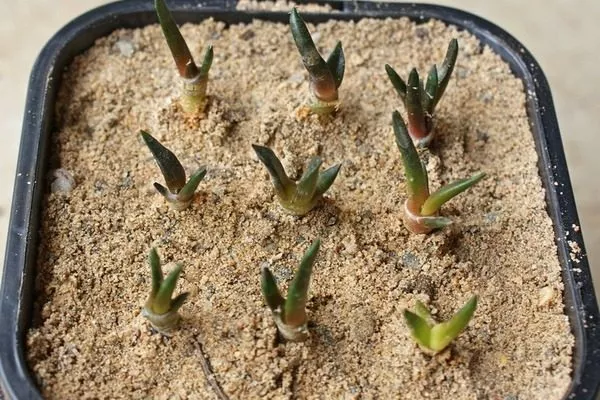
The quality and stability of Ariocarpus, their decorative qualities and ability to reproduce are achieved through proper care.
What to pay attention to when growing Ariocarpus:
- Growth rate. Ariocarpus grow extremely slowly. This is their characteristic and their advantage, especially for collection creators. There's neither need nor opportunity to try to speed up the growth process.
- Substrate composition. The more similar the soil mix is to the soil in which Ariocarpus grows in deserts, the better. Ideally, it should consist of sand, gravel, and light cactus soil. This mixture ensures good root aeration and prevents overwatering—this is crucial for root rot.
To prevent fungal rot, charcoal, brick chips or small pebbles are added to the substrate. - Nutrition. It's best to use a balanced cactus fertilizer with slow-release elements and low nitrogen content. Just be sure not to overfeed the plant, strictly following the package directions. Ariocarpus requires nothing else, including mineral or, especially, organic fertilizers.
Recommendations for care of individual species
When growing Ariocarpus, care adjustments must be made depending on the species. These succulents thrive in different conditions and locations, so their requirements for watering, lighting, nutrition, temperature, and humidity may vary.
Features of caring for some types of Ariocarpus:
- Agave-like. Prefers bright sunlight, at least 8 hours daily, including in winter. However, direct sunlight is not recommended. The best location is an east- or west-facing window. Water sparingly and infrequently.
- DulledIt requires at least 6 hours of direct sunlight per day. Shade is only required on the hottest days, around midday. The best location for a blunted Ariocarpus is a south-facing window.
If light levels are insufficient, supplemental lighting is essential. Water this plant infrequently but deeply. During the growing season, watering frequency is increased slightly, but avoiding stagnant water in the substrate. During the dormant period, watering is reduced to a minimum. - Flaky. Unlike most Ariocarpus, this species requires little or no watering in the summer. In the fall, during flowering, the succulent receives moderate watering. This characteristic is due to its natural habitat—where the scaly Ariocarpus grows, tropical rainfalls occur in the summer, after which the plant begins to bloom.
Mistakes and useful tips
Ariocarpus, while hardy, is a very sensitive plant that requires a specific approach. Any deviation from proper cultivation practices can lead to disease and even death.
The most common mistakes:
- Unsuitable substrate. Planting Ariocarpus in regular potting soil isn't ideal. It's not aerated enough and doesn't provide adequate drainage for this succulent. As a result, the plant will end up in waterlogged soil, rot, wither, and, if not addressed promptly, die.
The solution is to change the substrate and repot the plant. In severe cases, graft the healthy part onto the rootstock. - Overflow. When you have a lot of plants in your home, it's easy to overwater your succulents—along with everyone else. This isn't ideal. If you forget when you last watered your plant, check the substrate. If it's not completely dry, postpone watering.
- Shower. Indoor plant enthusiasts often mist their plants with warm water from a spray bottle or water them from above with a watering can. This is unacceptable for Ariocarpus. Even in extreme heat, avoid pouring water on this succulent. Otherwise, the risk of fungal infections and various types of rot increases dramatically.
- Transfer. It shouldn't be done unless absolutely necessary. Ariocarpus plants don't tolerate this procedure well due to the brittleness and fragility of their roots. This should only be done as a last resort, not because you want to move the plant to a more attractive pot. Read on to learn how to repot properly so your green pet doesn't suffer. here.
- Moving. If you move your Ariocarpus outdoors without gradually acclimating it, there's a risk of sunburn. Sun exposure should be increased slowly over several weeks. Avoid sudden changes in conditions, such as from dry to humid air or vice versa.
Ariocarpus are truly unusual and unique plants, easily overlooked in the wild due to their ability to camouflage, but captivating indoors. These succulents are quite rare, and many are endangered, making them all the more reason to have such amazing plants in your home. They're also quite easy to care for, making them suitable for even novice cactus growers and casual indoor plant enthusiasts.