
Hibiscus comes in a vast array of cultivars, each belonging to a specific species, but some varieties are suitable for indoor growing. It's important for beginning gardeners to learn how to distinguish indoor hibiscus from garden hibiscus, as it's forbidden to plant indoor hibiscus in the garden, or garden hibiscus in small pots.
Features of a houseplant
Hibiscus, also known as Hibiscus in Latin, belongs to the Malvaceae family and can be either annual or perennial. The latter varieties are grown indoors.
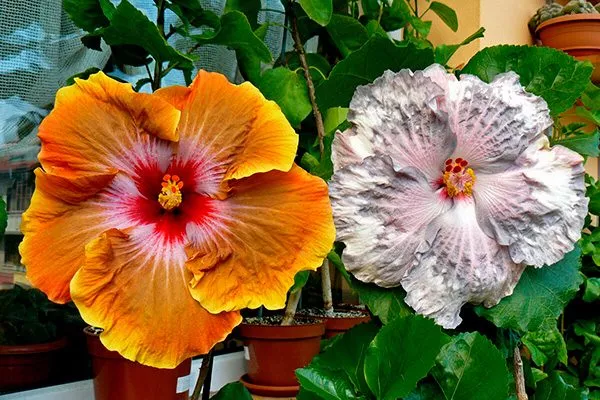
Regardless of the species, hibiscus have some common characteristics:
- leaves are incised and petiolate, decorative;
- flowers are usually large in size, but have a rather elegant structure;
- corollas usually have a contrasting bright shade;
- the fruits (seed pods) are leguminous, have 5 valves, which easily disintegrate when fully ripe;
- seeds can have a smooth, fibrous or pubescent surface;
- taproot system;
- crowns – quite dense;
- the bark has a greyish tint;
- leaf color – dark green;
- the color of the petals is very diverse - from snow-white to deep red, purple, etc.;
- plant type – tree, shrub or herbaceous;
- shoot length – from 30 to 300 cm;
- flowers in diameter – 5-30 cm;
- the number of petals in a bud is almost always 5 pieces;
- inflorescences - either simple or double;
- The color of the petals can be single-color or multi-color.
A single bud blooms for 2 to 3 days, after which it fades, but a new flower quickly forms on it. Therefore, the total flowering period varies from 3 to 9 months.
Herbalists use the plant to prepare medicinal infusions, as the flower petals contain a wealth of beneficial substances for the body, particularly those affecting the gastrointestinal tract, circulatory and immune systems, skin, and more.
The main types of indoor hibiscus
Many varieties of hibiscus are grown at home, but only a few have truly gained popularity among domestic gardeners.
| Name | Plant type | Plant height | Flower color | Flowering period |
|---|---|---|---|---|
| Syrian | Deciduous shrub | Up to 6 m | From snow-white to bright crimson | From April to October-November |
| Chinese | Bush | Maximum 2 m | White, red or pink | From April to October-November |
| Ternary | Herbaceous | From 5 to 80 cm | Pale yellow or lemon-colored | A few hours |
| Hemp | Bush | From 1 to 4 m | White, pale lilac, cream | From early July to mid-September |
| Sudanese | Bush | Maximum 2 m | Very bright and big | Not specified |
| Swamp | Herbaceous | Maximum 2.5-2.7 m | From lilac and scarlet to violet | From the beginning of March to the end of October |
| Sour | Bush | From 90 to 150 cm | A wide variety of shades | Not specified |
Syrian
The Latin name is Hibíscus syríacus. It is native to China, Western Asia, and Korea, but is cultivated throughout the country, including Russia. It is a deciduous shrub that grows up to 6 meters in the wild.
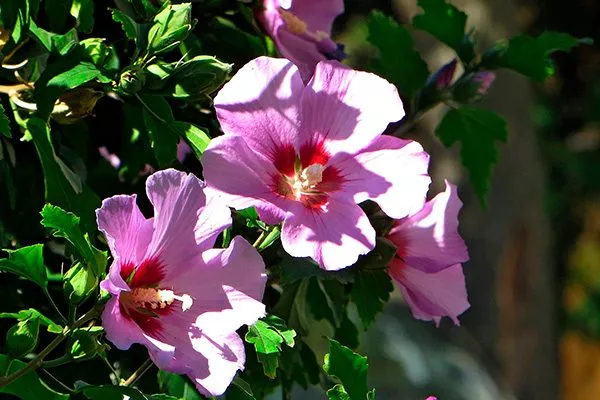
In a potted plant, the grower controls the height of the shoots, but the stem length should not exceed 2 m. For this reason, the plant is usually planted in large ceramic pots.
Other characteristics:
- the stem is tree-like, therefore thickened, its shape is conical;
- sympodial branching, crown heavily foliated;
- leaf blades reach up to 8-10 cm, slightly corrugated, palmately divided, compacted;
- filaments of stamens and anthers are light yellow;
- petal color – single-color or two-color;
- colors – from snow-white to bright crimson;
- the seeds are always smooth, their number in one nest is about 3 units;
- The shoot is equipped with a green nerve node.
Syrian hibiscus is commonly grown both indoors and outdoors for landscaping, as the plant easily tolerates temperatures down to -35-40°C. This early-maturing group produces very profuse blooms.
Chinese
The Latin name is Hibiscus rosa-sinensis, also known as the Chinese rose. It is considered the most popular species among Russian gardeners. It is native to southern China and northern Indochina. It is a symbol of Malaysia, where it is also known as the Bungaraya, and is featured on the national coin.
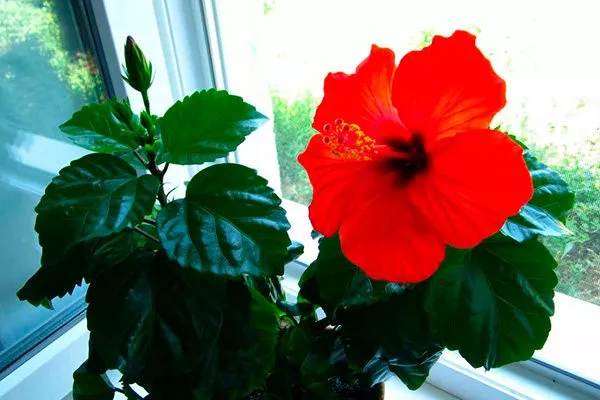
Flowers can grow both in the garden and indoors, and are characterized by the following features:
- remains viable in the temperature range from +12 to +25 degrees;
- the height of the bush in a pot is maximum 2 m;
- leaves - very similar to birch leaves, rounded at the base, glossy and smooth surface, serrated edge;
- flowers are single, very narrow when buds are formed, but after flowering they can be simple or double;
- In full bloom, the flowers resemble a cup, the diameter varies from 8 to 14 cm;
- petal color – white, red or pink;
- the flowering of buds lasts from 1 to 2 days;
- flowering period: from April to October-November;
- It can be grown as a standard tree.
Chinese hibiscus is considered edible – its young leaves and shoots are used in cooking for salads, tea, compote, etc. A natural dye is extracted from the flower, used in hair dyes and food colorings.
Ternary
In Latin, it's called Hibiscus trionum. The species has a wide variety of origins, including Iran, Africa, Japan, America, and more. Description of the Trifoliate Hibiscus:
- Seed part. It can be round or triangular, with a rough matte surface.
- Foliage. Petiolate, tripartite, and alternate. The surface is pubescent, with a coarsely toothed margin. The leaf blade on the lower part of the bush is rounded-lobed, while on the upper part it is dissected and palmate. Leaf length varies from 3 to 6 cm.
- Stem. It is erect but branched, often spreading, requiring support. It reaches a height of 5 to 80 cm. Its surface is covered with forked, stellate, or bristly hairs.
- Flowers. They are borne on 2-2.5 cm long peduncles. The flowers are pale yellow or lemon-tinged. The center is either purple or purple-brown. A distinctive feature is that the buds open for only a few hours.
- Root system. Exclusively rod-shaped, with very large penetration depth.
- Temperature conditions. The range is small – from +18 to +22 degrees.
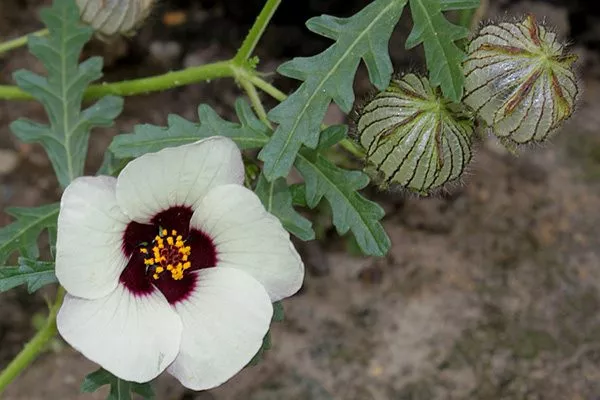
The ternate hibiscus species has one unusual feature: the plant cells are uneven, giving the surface an iridescent, blue halo. This causes the blue tint to dissipate.
Hemp
The Latin name is Hibiscus cannabinus, but other names include Kenaf, Gamb Hemp, Canap, Java Jute, Bombay Hemp, and Deccan Hemp. Its primary country of origin is India. The Cannabis hemp species first appeared in Russia in 1914 (it was imported from Persia).
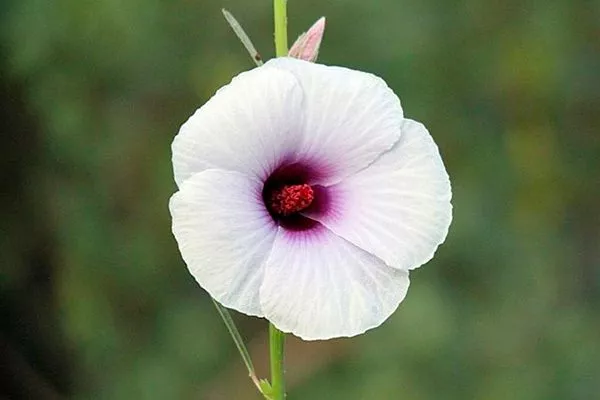
The woody trunks are used to make various types of paper, the seeds are essential for oils, soap, and leather, and the cake and shoots are used to feed cattle and other livestock. The material is used to make fertilizer. Herbalists use it for medicinal purposes.
There are five subspecies, each with minor differences. However, they all have the following in common:
- the root system is taproot and widely branched;
- the stem is straight and completely bare, but there are also ribbed and rounded, simple and branched varieties;
- the height of the bush varies from 1 to 4 m;
- The color of the bark differs from other types of hibiscus, as it is initially light green and then becomes covered with a red or purple tint;
- petals are white, pale lilac, cream, the core is cherry red;
- leaves lanceolate or heart-shaped with elongated spiny petioles, entire or lobed;
- flowering lasts from early July to mid-September;
- the buds are large and after opening they are similar in shape to mallow;
- The flowering of one bud lasts only one day.
Sudanese
In Latin, it's called Hibiscus sabdariffa, and is commonly known as Sudanese rose, Rosella, Karkade, Sabdariffa, and other names. The plant is believed to have originated in India. It's a shrub, growing 5-6 m tall in the wild and up to 2 m tall in a pot.
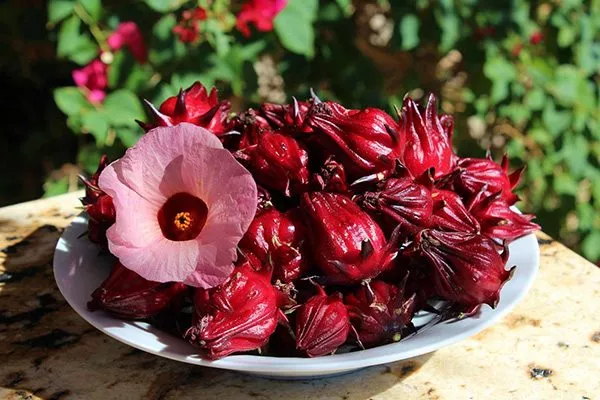
Features of Sudanese Rose:
- Roots. They are considered mixed because they are both taproots and highly branched. Furthermore, the root system contains primary and secondary taproots, as well as viable buds.
- Foliage. The leaf blade is trifoliate, serrate, glabrous, and glossy. The petioles are alternate and long. The main varieties of Sudanese hibiscus have standard dark green leaves, but there are also specimens with variegated green foliage.
- Flowers. Very bright and large, with a prominent stamen tube above the petals. The main characteristic of this species is the jagged, ragged edge. The petal surface can be double or smooth.
- Escapes. Completely smooth and very durable. The color ranges from gray to brownish. Sometimes black bark is also found.
- ✓ The presence of a jagged-ragged marginal structure in the flowers of Sudanese hibiscus.
- ✓ The scent of Swamp Hibiscus seeds is reminiscent of wine and wood.
The flower contains numerous beneficial elements, making it widely used by herbalists and pharmacists to make medicinal products. Hibiscus is also popular in cooking—the petals are used to make tea, compote, jam, and jelly, while the shoots and leaves are used to prepare main courses and green borscht (as it is also known, or red sorrel).
Swamp
In Latin, Hibiscus moscheutos, also known as Exotic, Musk, or Herbaceous Hibiscus, is also known as Marsh Mallow or Pink Hibiscus. It prefers to grow in marshy areas, so it's important to ensure high humidity levels in both the substrate and the air. Its origins are believed to be Mississippi and Eastern America.
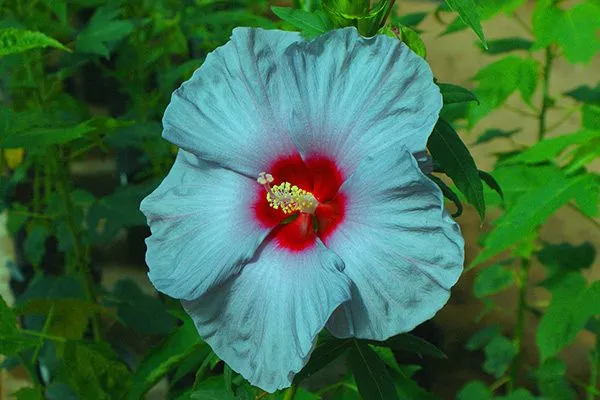
Characteristics of Swamp Hibiscus:
- the root system is very powerful and strong, with well-branched shoots;
- the leaves are heart-shaped with serrated edges, glossy on top and pubescent on the back;
- flowering is long-lasting – from the beginning of March to the end of October;
- the petals are richly bright, the color varies from lilac and scarlet to violet;
- flower diameter – 12-15 cm;
- the core of the inflorescence is always speckled, dark burgundy;
- the bud blooms for 12 hours (only during daylight hours);
- The peculiarity of the seeds is that their smell is reminiscent of wine and wood;
- trunk – erect;
- bark color – dark brown;
- The height of the bush is a maximum of 2.5-2.7 m, so it is grown in large pots.
Sour
In Latin, it's called Hibiscus acetosella, commonly known as African mallow, and in scientific literature, it's known as Hibiscus arugula or Hibiscus cranberry. The species originates from southern Africa. The plant tastes like sorrel or spinach (depending on the variety), and its leaves resemble maple leaf blades.
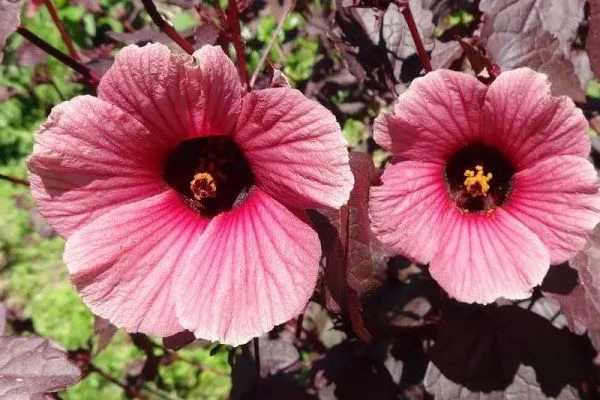
Features of the culture:
- Sour hibiscus is sometimes called red-leaved hibiscus, as its foliage is not the classic dark green, but purple-red.
- The bush grows from 90 to 150 cm in height, and branches up to 60-75 cm in width. The stems are erect, sometimes bare or slightly pubescent.
- The leaves are alternate and simple, reaching up to 6-10 cm in diameter. There are 5 radial veins on the leaf blades.
- Flowers range from 5 to 10 cm in diameter. They are borne solitarily and come in a wide variety of shades. The center is most often a vibrant purple, but other shades are also found.
- Sour hibiscus is edible. It's used in borscht, shchi, salads, and as an additive to sauces and gravies. The petals are used to make drinks, but only to enhance the color, as the buds have no flavor.
Hibiscus care instructions
When growing any kind indoor hibiscus Usually, there are no problems. The most important thing is to create the right conditions and follow the care instructions. They all boil down to the following:
- The location for hibiscus should not be too dark or too bright, so it is optimal to place the pot on the eastern and western windowsills.
- Daylight hours should be at least 12 hours, maximum 15-16.
- Temperature requirements vary by species and even cultivar, but generally range from 20 to 26 degrees Celsius. Many cultivars can be grown at temperatures as low as 12 to 15 degrees Celsius.
- Hibiscus plants should be watered sparingly—only after the top layer of the substrate has dried out. Humidity should be maintained at 80-90%. Therefore, it's important to shower once a month. Humidifiers or other devices (a container of water, etc.) should be placed near the pots.
- The most important thing for indoor hibiscus of any kind is regular fertilization. This is done twice a month during the growing season (spring, summer, and early fall).
After the plants emerge from dormancy, apply nitrogen, then use a mineral complex fertilizer rich in phosphorus, potassium, and magnesium. Try to incorporate organic fertilizers in addition to store-bought fertilizers. - Hibiscus must be pruned. If you neglect this procedure, the shoots will grow too large and grow out of shape. But the most important thing is to perform a sanitary pruning at least once a year, removing dried or rotted branches, old shoots, and damaged stems.
During flowering, be sure to remove spent flower buds. Otherwise, you won't see any new buds form.
Hibiscus comes in a large number of varieties, including some suitable for indoor growing. Each variety has numerous cultivars, so before purchasing a houseplant, carefully familiarize yourself with all the different types and cultivars.