
Hyacinths are popular garden flowers that grow beautifully indoors. They're ideal as houseplants—compact, easy to maintain, and attractive. To ensure they stay healthy and bloom on time, proper care is essential.
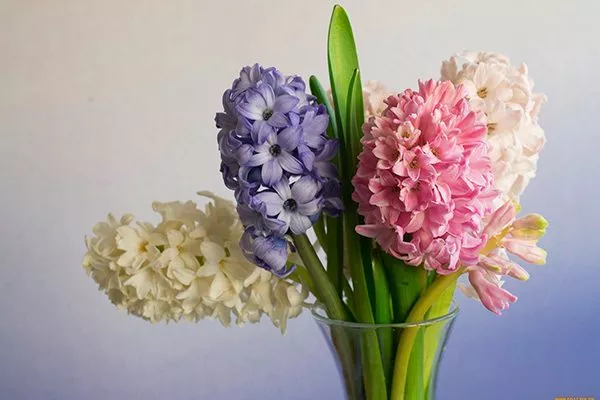
Why are hyacinths grown in pots?
Hyacinths — spring flowers that bloom once a year. The bulbs, entering a "dormant" state, accumulate energy to delight you with a lush bloom the following season. By growing them indoors in pots, you can ensure blooms by a specific date—March 8th, Valentine's Day, or another.
Growing hyacinths at home allows you to produce a beautiful flowering plant that can be given as a holiday gift. Also, through forcing—a process that forces the plant's rhythms to change—commercial hyacinth cultivation is possible.
- ✓ The optimal temperature for storing bulbs during the dormant period is +5…+10°C.
- ✓ Minimum pot size for one bulb: diameter 12 cm, depth 15 cm.
Caring for hyacinth after purchase
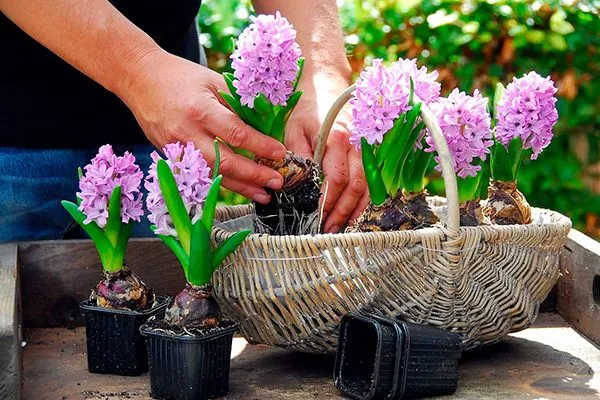
If you bought a hyacinth from a store, the first thing you need to do is repot it. The containers they come in are usually unsuitable for growing—they're too small for the plant's growth and development. In addition to the pot, you'll also need a tray and drainage material.
Procedure:
- Carefully remove the bulb from the soil and transfer it, along with the soil ball, to a new pot. Then add the required amount of soil to the container.
- Spray the soil with a solution of Fitosporin - this is necessary for disinfection.
- Once the plant has taken root in its new location, increase watering and the frequency of fertilizing, and do not stop until flowering is complete.
- When the hyacinth has finished blooming and the leaves have dried out, dig the bulb out of the ground and store it until next season.
Caring for hyacinths at home
Hyacinths are quite demanding plants, and their flowering depends largely on their growing conditions. To ensure beautiful, strong, and healthy blooms, they require watering, loosening, fertilizing, light, and the right temperature and humidity.
Location and lighting
Hyacinths love light, but its quantity is adjusted depending on the stage of vegetation.
Features of lighting for potted hyacinths:
- Containers with planted bulbs are placed in a dark place for 1.5-2 months - this is an important condition for the development of tubers and plant roots.
- Once the first shoots appear, gradually increase the lighting. After 2.5-3 months, the flower reaches 2.5 cm in height and is moved to partial shade.
- When buds appear, move the pots with hyacinths to the windowsills.
- Avoid exposing hyacinths to direct sunlight. Only expose mature plants to sunlight for 2-3 hours, in the morning or evening.
Hyacinth pots are recommended to be placed on south- or southeast-facing windows, as close to natural light as possible. If the windows face north, it's best to center the plant in the room.
Air temperature and humidity
Hyacinths don't like heat, preferring moderate temperatures of 20 to 22°C. They don't tolerate sudden temperature changes, extreme cold, or overheating. They also shouldn't be exposed to drafts or placed near heating devices.
Hyacinths don't like high humidity. They thrive in dry rooms. Misting these flowers is not recommended, and it's completely contraindicated during flowering.
At the beginning of the hyacinth's growing season, the room temperature should be around 15°C. Once the plant has formed and buds have appeared, the pot is moved to a warmer room.
Watering
Once buds appear on hyacinths, water them frequently and sparingly. These flowers prefer moist soil.
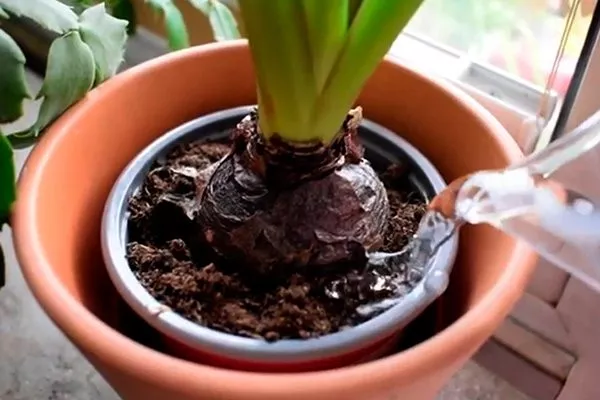
Rules for watering hyacinths in pots:
- water should not get on leaves, stems, buds;
- Stagnant water in the pot is contraindicated - it can lead to root rot;
- the optimal method of watering is through a tray;
- Only settled warm water is used for irrigation.
The pots must have drainage holes and a drainage layer of small pebbles at the bottom.
Top dressing
Hyacinths, like other indoor plants, require fertilizing. When applying fertilizer, it's important to consider the season and growing season.
Recommendations regarding feeding:
- When the plant enters a dormant state, the amount of fertilizer applied is significantly reduced.
- The optimal frequency of fertilization is once every 10-15 days.
- After applying fertilizer, it is recommended to loosen the soil to allow nutrients to penetrate more effectively.
Hyacinths require fertilizing during the active growing season. The composition and amount of fertilizer depend on the plant's condition and stage of development.
Fertilizing regime for hyacinths:
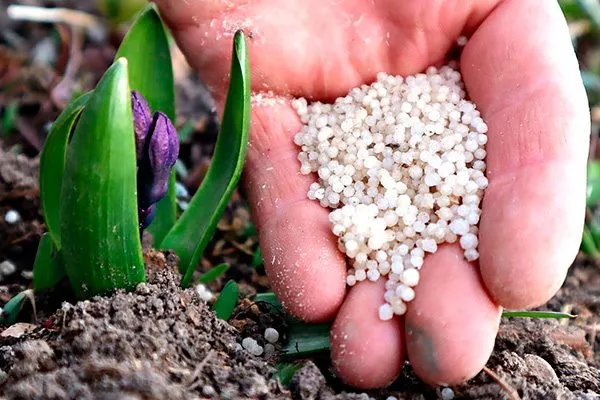
- First feeding This is done when moving the plant pot from a dark place to a bright room. Phosphorus is essential for the growth and flowering of hyacinths.
- Second feeding Fertilizing is done at the beginning of flower stalk growth. Its purpose is to maintain lush blooms and vibrant colors. The fertilizer should contain nitrogen and phosphorus. Hyacinths expend a lot of energy during flowering and therefore desperately need additional nutrition.
- Third feeding After flowering has finished, superphosphate and potassium-containing fertilizers are applied.
Diseases and pests
The most common causes of disease are drafts and temperature disturbances (sudden changes, too high or too low temperatures).
Causes and symptoms of diseases:
- violation of growing conditions - leaves turn yellow and dry out;
- poor lighting - wilting of foliage;
- overmoistening - flowers fall off.
If slime or black spots appear on plants, it is best to destroy them, as these signs indicate the presence of serious bacterial diseases.
Hyacinths grown in pots can be attacked by insects. The underground parts of the plant can be damaged by onion root mites or flower flies. If these or other insects appear on the plants, it is recommended to treat them with Aktara, Tabazol, or Mukhoed.
Care features depending on the season
Caring for potted hyacinths is almost the same as caring for them in the ground. Care for potted plants depends on the season.
How to care for hyacinths at different times of the year:
- Autumn. This period is considered ideal for planting bulbs. They are transplanted into individual pots and placed in a dark place to await the emergence of sprouts.
- Winter. If everything was done correctly, seedlings will appear in December. Daylight hours should be gradually increased. Early-blooming varieties should be placed on windowsills—they will bloom by March 8th.
- Spring. When warmer days arrive, hyacinths begin to bloom. During this period, the plants are generously watered and fertilized.
- Summer. When the weather gets hot, the plant goes into hibernation. The bulbs are moved to a cool place, such as a refrigerator. There, they can remain until autumn.
If you do not provide the bulbs with cold during the dormant period, hyacinths will not produce lush and dense flowering.
Care during flowering
Hyacinths bloom for a short time—1-2 weeks. The flowering period occurs in the spring; potted hyacinths may bloom at a specific time (during March-May). Experienced gardeners can extend the blooming period for up to four weeks.
Blue hyacinths are the first to bloom, followed by pink, white, red, and lilac varieties. Yellow and orange varieties bloom last.
During flowering, hyacinths require increased attention from gardeners. The duration and profuseness of their blooms, as well as the richness and vibrancy of their flowers, depend on the quality of care, its correctness, and consistency.
How to care for hyacinths during flowering:
- Water and loosen the soil regularly.
- Maintain the temperature at +20…+22°C.
- The air in the room should be sufficiently dry.
- Provide flowers with a full daylight period – at least 15 hours.
- Feed the plant regularly.
Post-flowering care and bulb storage
After the hyacinth has finished blooming, it should not be left unattended. During this period, the flower requires special care to begin preparing the bulbs for the next season.
Features of caring for hyacinths after flowering:
- Prune the plants with a disinfected and sharpened tool. Prune lightly, leaving shoots approximately 15 cm tall.
- Reduce the frequency of watering. Moisten the soil only after it has completely dried out.
- As soon as the leaves turn yellow, stop watering completely.
- Wait until the leaves dry out and fall off. Then dig the bulbs out of the ground.
Extracted bulbs must be stored properly. If incorrectly stored, the plant may not bloom next season.
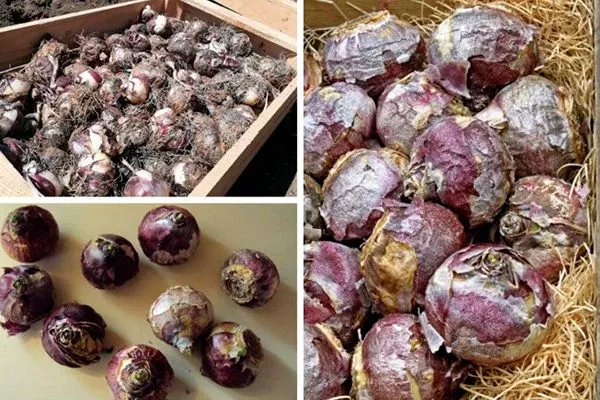
The procedure for preparing the bulbs:
- Clean the onion and its roots from soil.
- Treat the tuber with a solution of potassium permanganate for disinfection purposes.
- Place the bulbs outside or in a well-ventilated room to dry. The recommended temperature is 20°C. Keep in mind that the bulbs should not be exposed to direct sunlight.
- After digging up the bulbs, clean them from soil and rinse them under running water.
- Dry the bulbs for 5-7 days in a ventilated room at a temperature of +20°C.
- Before storing, treat the bulbs with a solution of potassium permanganate for disinfection.
Place the bulbs prepared for planting in ventilated boxes or paper bags. You can also sprinkle the bulbs with sawdust.
How to propagate hyacinths at home?
Bulbs that bloom for 2-3 years don't always form offspring. In this case, growers resort to other methods of propagating hyacinths—seeds, base cuttings, scales, and leaf cuttings.
Seeds
Seed propagation is rarely used by ordinary gardeners and indoor gardeners. This method is popular among those who breed hyacinths.
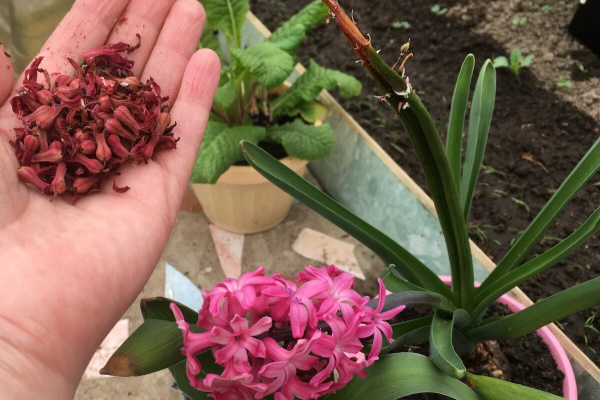
The order of propagation by seeds:
- Prepare a substrate from humus, leaf mold, and sand (2:1:1). Fill the box with it.
- Sow seeds at the end of September.
- Grow seedlings for two years in cold greenhouses.
Children
This propagation method is considered the most productive and is used by most gardeners and indoor gardening enthusiasts. Propagation by pups allows for flowers to be produced three years after planting.
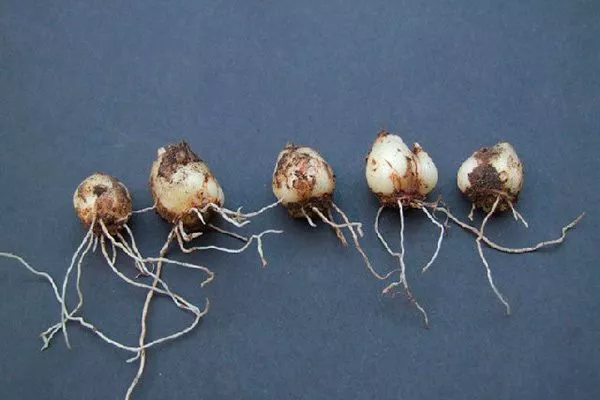
Reproduction order:
- Dry the bulblets, which are easily separated from the bulb.
- Plant the dried babies in pots at intervals of 2.5 cm. They should be completely hidden under the soil.
- Cover the plantings with plastic film, in which you first make holes for watering.
- Place the planted babies in a room with a temperature of +10°C.
If the babies do not separate from the parent tuber, transplant them into new pots along with the bulb.
See also a video about propagating hyacinths using baby plants:
Cutting out the bottom
For this propagation method, select the largest bulbs. You'll also need a sharp knife, a ventilated box, and a container for storing the tubers.
How to propagate hyacinths by cutting out the bottom:
- Plant the bulbs in the ground in the spring.
- When the flower's leaves turn yellow, remove the tubers from the ground.
- Immediately after digging, without letting the bulbs dry out, rinse them under running water. The pressure should be strong enough to remove any old scales.
- Place the washed bulbs in a single layer in a box. Place the box in a semi-dark area and let the tubers dry there for a week.
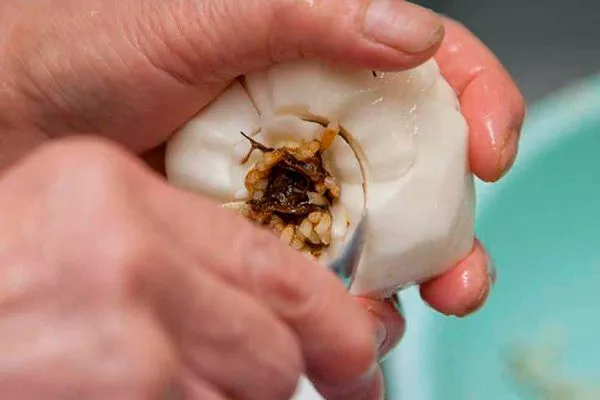
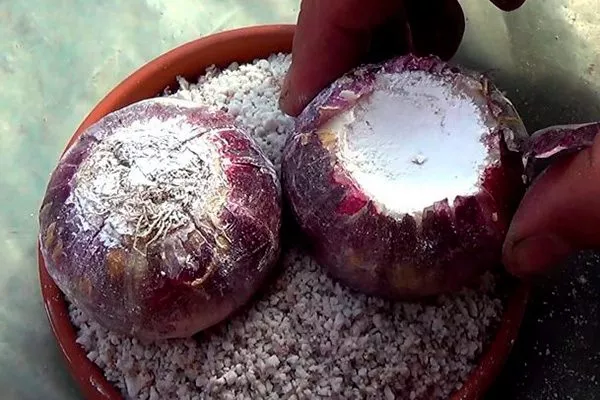
- Take a sharp, disinfected knife and make a wedge-shaped cut in the base. Remove the bud and base completely.

- Sprinkle the cut area with crushed activated carbon.
- Place the tubers in a container on a layer of perlite, with the cut ends facing up.
- Place the container with the bulbs in a plastic bag (a garbage bag will do) to ensure the planting material is in a favorable microclimate. If the temperature is around 30°C and the humidity is high, the tubers will soon produce shoots. In a couple of months, they will reach 1 cm in diameter. The shoots will develop roots and shoots.
- Plant the tubers with their baby bulbs in pots filled with substrate and sprinkle with sawdust or peat. If planting early, turn the bulbs upside down and place them in a container with soil. Store the planting material in a cool place, such as a basement or refrigerator. When the time is right, transplant the bulbs into pots.
We also recommend watching a video about propagating hyacinths by cutting out the bottom:
Onion scales
This propagation method uses large bulbs—about 5-6 cm in diameter. You'll also need a container and a clear plastic bag.
Reproduction order:
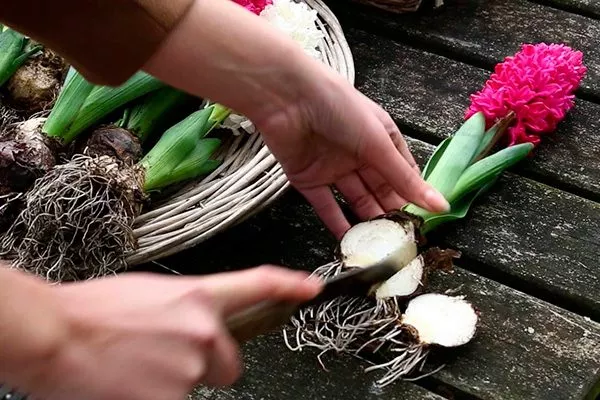
- Cut the onion into 4 equal parts, separate a few scales from the bottom.
- Sprinkle the cut surfaces with crushed activated carbon.
- Fill the bottom of the container with sand, perlite, crushed charcoal, and ash. Place the broken scales on top and place the container in a bag. Tie the bag and place it in a semi-dark room. The recommended temperature for the first two weeks is 19 to 23°C, and for the remaining six weeks, 16 to 19°C.
- After two months, bulblets will form on the scales. Until planting, the planting material is stored in a cool place, as in the previous method.
Leaf cuttings
This method of propagation is applicable at the stage of formation of peduncle ovaries.
Reproduction order:
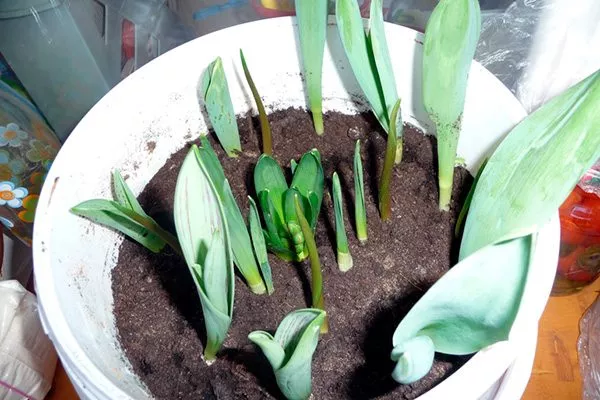
- Cut off a couple of leaves from the hyacinths, as close to the base as possible.
- Treat the cut leaves in a solution that stimulates root formation (for example, you can use Heteroauxin).
- Place the leaves in a pot filled with perlite or sand.
- Place the container with the leaves in a plastic bag, tie it, and place it in a semi-dark room. The optimal temperature is 10 to 17°C, with a humidity of 80-90%.
- After 1-1.5 months, bulb buds will appear on the cuttings. Roots and leaves should appear within 50-60 days.
- Plant the rooted plants in the ground - you can get 6-10 babies from each cutting.
By cutting the bottom
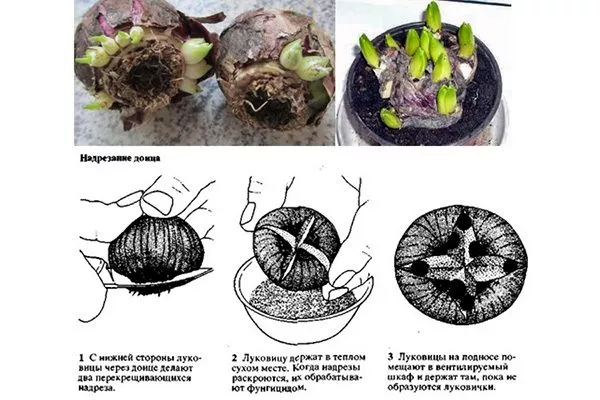
Unlike the procedure that involves cutting out the bottoms, in this case they are simply cut. Two cuts are made, one crosswise. The largest bulbs are used for propagation.
Reproduction order:
- Make cuts on the tubers, one on small ones and two on large ones.
- Sprinkle the cut areas with crushed activated carbon.
- Place the bulbs in a warm room where the "crosses" should open. The recommended temperature is 20 to 24°C.
The rest of the process is the same as in the previous method. This procedure yields 10 to 16 bulblets.
Forcing hyacinths
Forcing is the artificially induced germination of a bulb. Unlike regular planting, this process is performed without regard for the plant's natural rhythms. Hyacinth flowering is artificially stimulated by creating favorable conditions.
In the ground
This is the most common method for forcing hyacinths. The process begins 2-2.5 months before the scheduled flowering date.
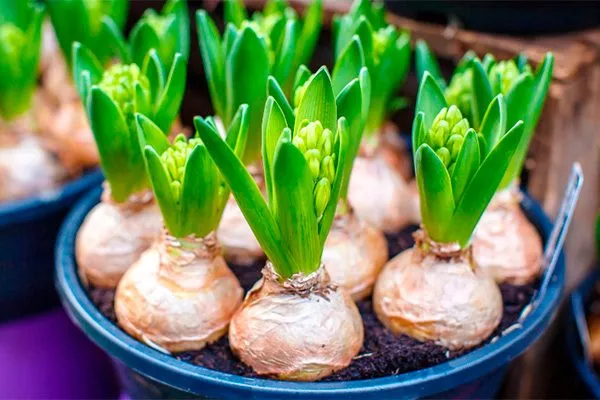
The procedure for forcing into pots with soil:
- Place a drainage layer on the bottom of a small pot and a suitable substrate on top.
- Plant the bulbs, with the bulblets removed, 2/3 of the way into the soil, leaving only the tops above the surface. The soil should be moderately moist to prevent the bulbs from rotting due to dampness.
- Place the plantings in a cool (+4…+9°C) and dark room, for example, a basement, cellar, or refrigerator.
- Once the bulbs have rooted and produced their first flower stalks, move them to a windowsill. However, be sure to shade them from excessive sunlight.
The soil in pots with hyacinths can be mulched with lichen or moss - this prevents it from drying out quickly.
In the water
The technique for forcing in water is almost the same as forcing in soil, but instead of a pot, a glass container is used. It should have a fairly wide neck and be of the appropriate size.
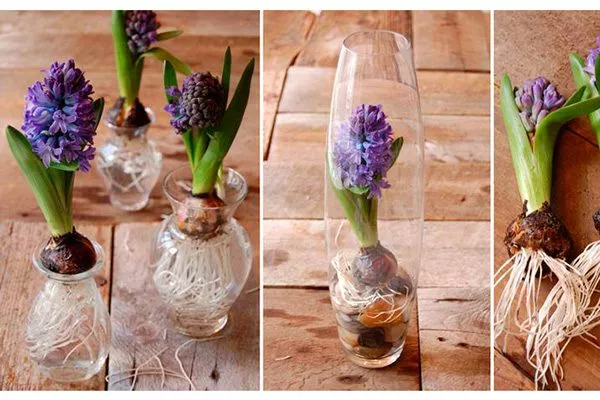
The order of distillation in water:
- Pour water into the container – at least 300 ml.
- Place the bulb in the pot so that there's about 2 cm of space between the base and the water—this will prevent rotting. The bulb will root and reach the water on its own.
- Place the container with the bulb in a cool, dark place. Add water periodically.
- Once the flower stalk and leaves appear, move the plant to a warm, bright room. Cover the flower stalk with an opaque material until it reaches 10 cm in height. You can add a complete fertilizer to the water.
Hyacinths bloom quickly when exposed to warmth. However, this method has a drawback: flowering is shorter when forced by water, and the bulb is more depleted than when forced by soil.
In hydrogel
This is a relatively new method for forcing hyacinths. Instead of the usual medium—soil or water—hydrogel is used. This is a polymer that can absorb a huge amount of moisture—much more than its own weight.
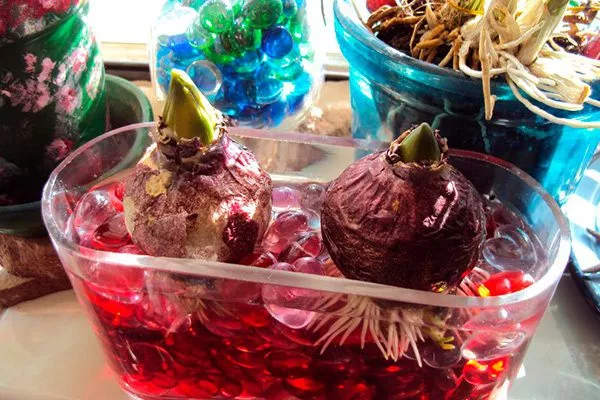
Forcing order:
- Fill the hydrogel with water.
- Add complex fertilizer according to the instructions.
- Place hyacinth bulbs in a container filled with water.
- Place the plantings in a dark place, and then in the light - just like in the two previous forcing methods.
Watch a video about forcing hyacinths at home:
Caring for potted hyacinths isn't difficult, but it does require precision and strict adherence to proper gardening practices. Even when the plant is on vacation, it requires some care. The time and effort will be well-rewarded—by the appointed time, the hyacinths will delight you with luxurious and long-lasting blooms.