
Watering a ficus is an essential part of its care. Furthermore, the plant's viability depends on the level of humidity in the substrate and air. This is especially true for the most popular species in indoor gardening: Ficus benjamina and Ficus elastica. To properly care for this plant, familiarize yourself with the basic requirements and rules for watering.
What does the intensity of irrigation depend on?
The frequency and amount of water added to a pot are influenced by various factors. The most important are the following:
- period - in a dormant state, the flower requires less moisture than in its active form;
- type of ficus – each variety and species has individual requirements;
- age - for example, cuttings are watered less often and in smaller quantities;
- the quality of the soil mixture – compacted substrate dries out more slowly, therefore watering is carried out less frequently;
- the temperature in the room - the warmer it is, the more often you need to humidify;
- pot material – plastic retains water, clay does not;
- container size – the wider the pot, the more intense the evaporation of moisture.
General features of the procedure in cold and warm seasons
Ficus trees have a rather succulent, fleshy foliage, so they require high humidity. The root system is very sensitive to moisture, so the soil shouldn't be too wet. Otherwise, the plant will begin to rot, lose its leaves, and become diseased.
There are general rules for moisturizing ficus plants, regardless of the growing season and plant type:
- First, the condition of the soil mixture is checked;
- then loosening is carried out to saturate the root system with oxygen;
- then watering is carried out;
- then, after 30-40 minutes, drain the water from the stand;
- Loosening is carried out again, but more lightly.
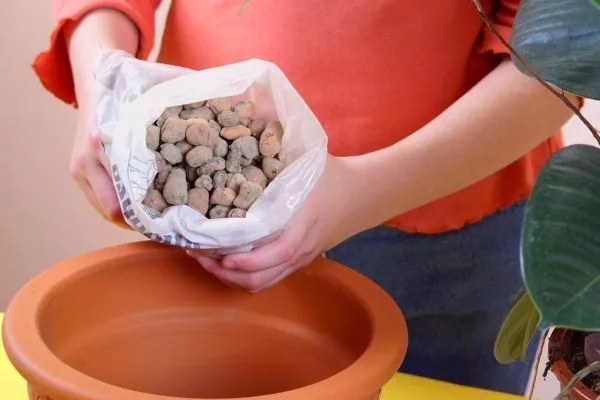
A drainage layer is always placed at the bottom of the pot to remove excess moisture.
There is a watering scheme depending on the time of year:
- In spring and summer, when the plant's growth is at its peak, water once every 5 days. If the summer is very hot, water once every 3 days.
- In autumn, it is enough to water once every 7-10 days, depending on the type of ficus.
- In winter, watering is done approximately every two weeks. However, much depends on the room temperature:
- if it varies from +16 to +18 degrees, then it is necessary to moisten once every ten days;
- when the temperature is moderate (from +18 to +21 degrees), water once every 7-9 days;
- If the heating devices are on or the central heating is hot, water is added every 4 days (as in summer).
During the cold season, high temperatures are undesirable, as the ficus needs to rest. This is only possible with a moderate regime.
How often should you water a ficus depending on the type?
Each ficus variety has specific substrate moisture requirements. There are a huge number of them, but it's best to consider the species most commonly used in indoor gardening.
| Name | Leaf type | Period of active growth | Air humidity requirements |
|---|---|---|---|
| Benjamin | Narrow | Spring-summer | High |
| Rubber-bearing | Wide | Spring-summer | Very high |
| Lyre-shaped | Wide | Spring-summer | High |
| Bonsai | Various | All year round | Moderate |
Benjamin
This is the most popular variety, along with varieties such as Natasha, Anastasia, Daniel, and others. It is drought-resistant and tolerates temporary overwatering. This allows the plant to recover quickly. However, if the soil is constantly overwatered and then dries out, this can lead to unpleasant consequences. Watering instructions:
- If the variety has narrow leaves, be careful not to overdry or overwater the flower - varieties are very sensitive to this;
- water any variety in summer once every 3 days;
- the soil should always be kept slightly moist;
- if there is a lack of moisture, growth slows down;
- Spray once every 3-4 days.
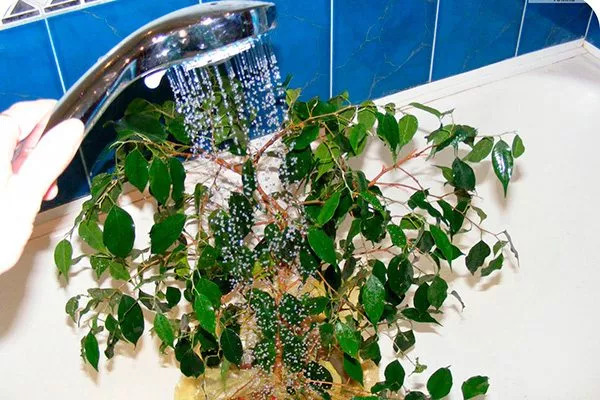
Be sure to take a warm shower once a month.
Rubber-bearing
This variety does not tolerate overwatering, as its roots quickly begin to rot, so overwatering is strictly contraindicated. If drought occurs, the leaves will fall off.
Rules:
- water moderately but often - in summer about every 2 days;
- spray daily, and in summer twice a day;
- Take a warm shower twice a month.
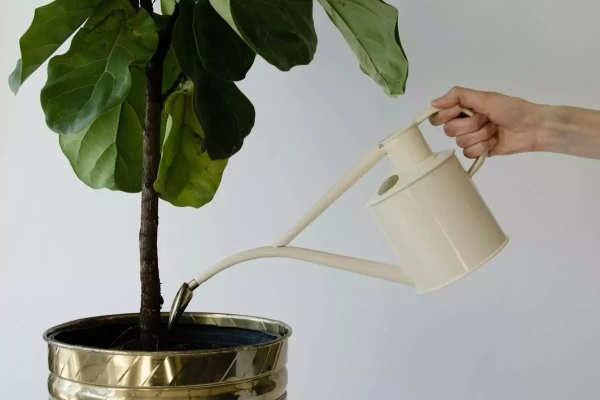
Lyre-shaped
Like the rubber plant, it quickly rots when overwatered. This variety requires a strict watering schedule; otherwise, the foliage will either shrink or grow excessively. The watering schedule depends on the specific variety of lyrate ficus.
Bonsai
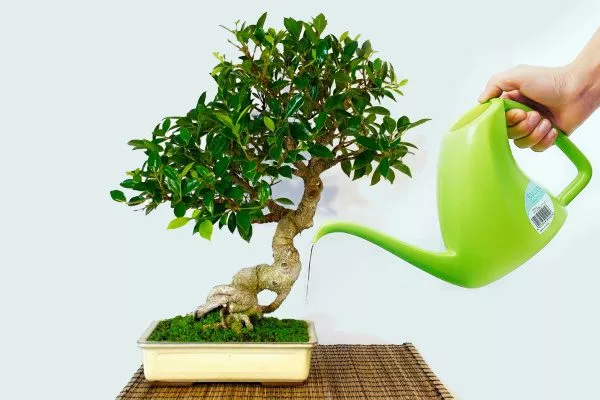
This ficus has pruned roots. It's planted in a low, wide pot with a small amount of substrate. Therefore, moisture evaporates very quickly. Consequently, this bonsai will need to be watered more frequently than other varieties.
Watering methods
Ficus plants are watered using various methods. Each has its own characteristics, advantages, and disadvantages.
Top watering
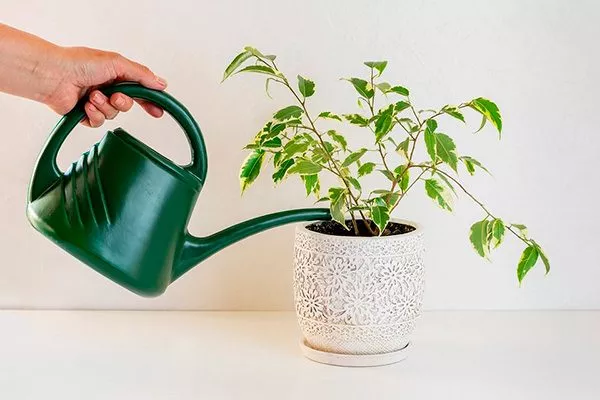
This is the most common method, where water penetrates from the top to the very depths of the pot and then flows into the base. It has several advantages:
- the top layer of the substrate remains moist for a longer period of time;
- all the nutrients reach the tips of the roots, and through evaporation they rise back up to the top layer of the soil mixture;
- convenience and speed – takes a minimum of time and effort;
- reduction of salt deposits - as they are washed out;
- thorough absorption of moisture - with the correct watering technique, every root and piece of substrate is watered.
There are also disadvantages:
- there is a risk of water getting on the stems and leaves, which leads to their rotting;
- the development of fungal diseases is possible, since the upper part of the pot is always wet, insects fly in;
- the soil becomes compacted from water - this is undesirable for ficuses.
If you choose overhead watering, carefully study the rules for watering ficus:
- Prepare a watering can. Large flowers require a long spout; small ones require a short spout (a syringe can be substituted).
- Pour in water.
- Start watering around the perimeter of the pot, avoiding the growing point (if it's exposed). Continue watering until the liquid begins to seep over the edges of the pot.
Leave the pot like this for half an hour, then carefully drain the pan to ensure it stays dry. Avoid pouring water in just one area; distribute the water evenly over the entire surface.
How to water a ficus in a tray?
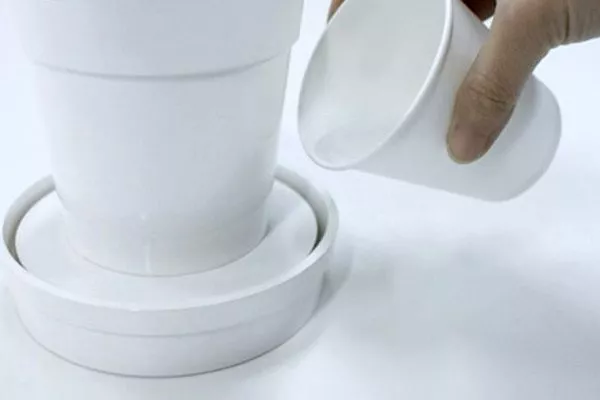
This method is called bottom watering. Its main purpose is to gradually introduce moisture through the lower layers of the substrate. This is especially important for ficus plants grown in shallow containers. If the pot is tall, bottom watering can be combined with overhead watering to ensure the entire soil is moistened.
Advantages of this method:
- this way, the plant cannot be over-watered, which eliminates the risk of root rot;
- no water gets on the stems and leaves;
- the top layer of the substrate always remains dry, so fungal diseases do not occur and pests are not attracted to the wet environment;
- the root system develops faster.
Disadvantages noted by ficus growers:
- not all of the substrate gets wet;
- salt minerals are deposited, which is why a salty crust appears (the substrate must be changed more often);
- Nutrients are transported upwards and do not return downwards.
How to humidify in a tray:
- Place the pot in a tall, wide tray.
- Fill the last one with water to the very top.
- When all the water is absorbed, add more liquid.
- As soon as the water stops being absorbed, stop the topping up procedure.
- Leave for 40-50 minutes.
- Drain the water from the tray completely.
Immersion irrigation
This is a type of bottom watering that thoroughly saturates the substrate with moisture. The liquid isn't retained by the soil, but rather slips through. This method requires less frequent watering. Disadvantages include the time and effort required.
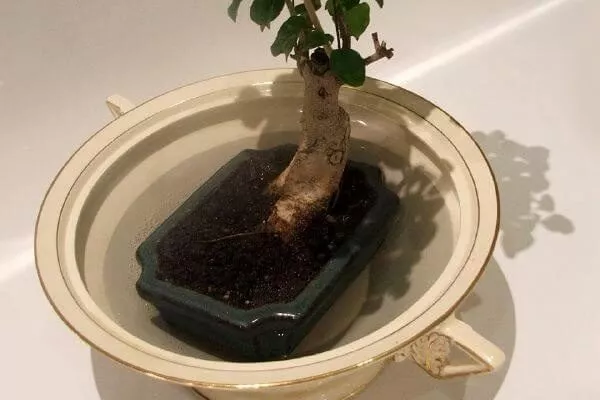
How to moisturize using the immersion technique:
- Fill a wide bucket or a large basin with water (you can do it directly in the bathtub) until it’s half full.
- Place the pot with the ficus without a tray.
- Add water. The level should be 2 cm below the edge of the pot.
- Leave it for long enough for liquid to appear on the surface of the soil mixture.
- Pull out the flower.
- Let it sit until all the liquid has drained out.
You can also water the ficus from above. However, in this case, be sure to cover the surface of the substrate with plastic or cling film to prevent the soil from getting too wet. Otherwise, it will completely wash away through the large drainage holes.
Watering after transplanting
Immediately after repotting, lightly water the plant. Full watering should be given no sooner than 3-4 days later. Continue moderate watering for a month.
Water quality requirements
Ficus, like most other houseplants, are very demanding when it comes to the quality of the water they're given. Remember the most important rule: never moisten the substrate with tap water. This will completely destroy the plant, as it contains chlorine, various salts, lime, and other substances.
Therefore, please follow a number of requirements:
- Let the water settle. To do this, fill a wide container and leave it at room temperature for at least 2 days. Don't close the lid, as the liquid contains substances that don't settle, but only evaporate.
- Be sure to carefully pour the settled water into a clean container so that the sediment remains at the bottom.
- The temperature should be room temperature or a couple of degrees higher. Cold water is strictly prohibited, as it will rot the roots.
- ✓ The water temperature should be 2-3 degrees higher than room temperature to prevent stress on the root system.
- ✓ Water hardness should not exceed 8°dH, otherwise salts may accumulate in the substrate.
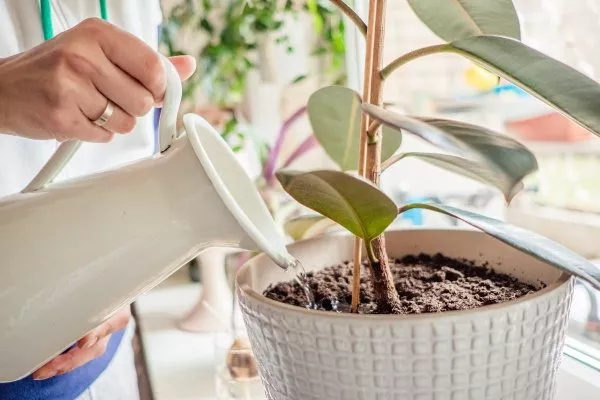
Keep in mind that the water should be soft. If the hardness level is high, soften it. There are several universal methods for this:
- freezing - put the water in the freezer, let it freeze 2/3 of the way, defrost the ice and water the flower, and drain the remaining water with hardness salts;
- add auxiliary substances - citric acid, a little peat, etc.
There are other types of water that can or cannot be used for watering ficuses:
- boiled - not suitable, as it does not contain any useful substances;
- Artesian water is a great option, but only if the water is soft;
- Melt and rainwater are the best options, but only if the liquid is not taken from an urban area where water contains many harmful elements.
Combining fertilizing and watering
Starting in March or April, ficuses are fertilized every two weeks until the end of the growing season. It's also important to combine these fertilizers with watering. This will prevent the risk of burning the root system. The following can be added to the watering water:
- organic matter;
- mineral complexes;
- growth biostimulants.
Do you need to spray ficus plants?
Ficus plants don't like stagnant soil but prefer higher humidity levels. The average humidity level is 60%.
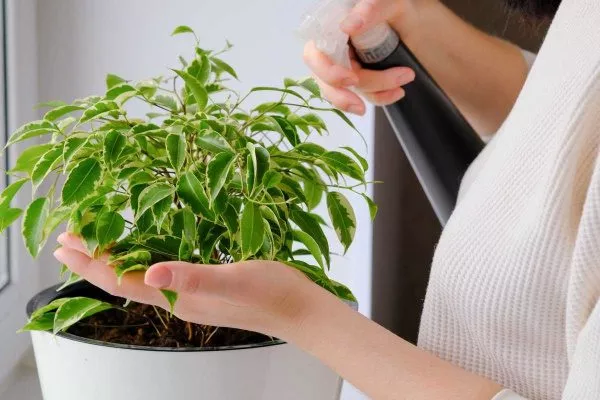
If your apartment is hot, which can happen in summer and winter (due to radiators located under the windowsill), misting is important. The frequency depends on the specific ficus species and cultivar. For example:
- Ampelous flowers need to be watered every two days;
- ficuses with thin leaves (Benjamin) are sprayed every day during hot weather;
- If the flowers have leathery leaves (rubber, etc.), then watering is required less often.
For many varieties, wiping them daily with a damp cloth is sufficient. All varieties require a warm shower once a month. Just remember to cover the substrate with plastic wrap to prevent soil erosion.
How do you know if there is a water overflow?
Overwatering the substrate can lead to unpleasant consequences, sometimes even the complete death of the plant. What are the signs of overwatering?
- Regular loss of leaves, especially from the lower tiers. But during overflow the intensity is not too high.
- The edges of the leaves turn yellow. Yellowing occurs gradually.
- Rotting. The root system is susceptible to this. If the roots are completely hidden under the substrate, carefully inspect the area of the trunk where it touches the soil – you may notice a white, powdery coating.
- Formation of wet brown spots on the edges of leaves or drops on the underside. The drops are formed from the juice that splashes out when the cells, filled with liquid, crack.
- ✓ Ficus Benjamina: yellowing and leaf fall begins from the upper tiers.
- ✓ Rubber plant: appearance of dark, water-soaked spots on the leaves.
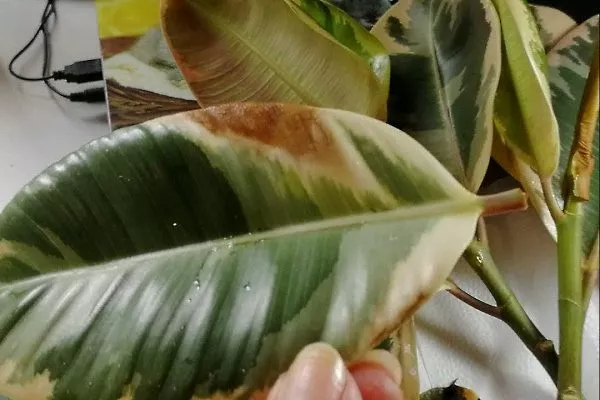
To correct the situation and prevent the flower from dying, you can do the following:
- If overwatering is a one-time occurrence (accidental), simply remove the plant from the pot, leave it in the open air for 3-4 hours, and when the soil dries out, put it back into the container.
- Alternatively, you can replace the soil mixture. To do this, remove the plant, remove the root ball, and treat the roots with a light pink solution of potassium permanganate. This will prevent rot. Then replant in new, completely dry soil, and sprinkle wood ash or activated charcoal on the surface. Water every 2-3 days.
- If there's no time to correct the situation, simply avoid watering the soil for a couple of weeks. However, this should only be done if the soil is overwatered once.
- If the root system is rotting, clean it out. To do this, after removing the flower and removing the root ball, trim off the damaged roots, treat them with boiled water, then dust them with activated charcoal, leave them to dry for several hours, and then replant as usual.
Be sure to disinfect the pot, tools and substrate.
Signs of underfilling
Adding too little water can also, in rare cases, lead to problems. What are the signs of underwatering and the consequences?
- young leaves grow small, and before they have time to fully form, they fall off;
- old leaves suddenly turn yellow;
- the growth of shoots stops or slows down significantly;
- the bush becomes highly susceptible to diseases;
- leaves turn yellow in the center and brown at the edges;
- the green mass becomes dry;
- the foliage and crown take on a drooping appearance.
The main consequence is the plant drying out, which leads to its death. At the very least, the trunk and branches may become bald.

How to save a ficus:
- Water the substrate generously, preferably by immersion;
- Be sure to take a warm shower or at least spray;
- Establish a hydration regime.
If the bush has already lost its decorative appeal, be sure to add regenerating agents to the water for watering and spraying. These include Epin-Extra (1 ampoule per 5 liters of water), Megafol (3 ml of liquid per 1 liter of water), and similar products.
Helpful Tips
Experienced ficus growers know how, with what, and when to water ficuses to avoid problems. However, beginners find this difficult to navigate, as each species and cultivar has its own specific requirements and rules.
Please pay attention to some tips from flower growers:
- Carefully study all the care requirements for a specific ficus variety;
- do not ignore fertilizers, which are best added along with water;
- Don't forget to thoroughly loosen the substrate after the moistening procedure (but if you did this before watering, then only lightly) - this will saturate the roots with oxygen, and the moisture will be retained longer;
- If you don’t have the opportunity to water your ficus frequently, place mulch on the soil surface (peat is excellent).
Watering a ficus is not difficult. The main rule is to water as the substrate surface dries, and avoid overwatering (avoid stagnant water). Water quality and temperature should be the same as for all houseplants.