
The indoor ficus is an evergreen or deciduous plant from the Mulberry family. It is native to the African, Asian, and subtropical regions. Considered low-maintenance and highly decorative, it is popular with gardeners worldwide. Many superstitions, both positive and negative, are associated with this flower.
What is a ficus?
The Latin name for ficus is Ficus, which translates as "fig" or "sycamore." The ficus family also includes plants such as the fig tree and the fig. Ficus trees have two types of roots: underground roots that spread extensively, and aerial roots (typical of epiphytes) that tightly envelop the tree trunks.
If a ficus tree completely twines around itself, it will die from strangulation, as the weaving is very dense. Therefore, "dead" trunks are used for indoor cultivation.
Brief description of ficus:
- leaves are a rich green shade, can be alternate, opposite, lobed, entire or serrated;
- the surface of the leaves is glossy, semi-glossy or with a waxy coating;
- milky juice – present;
- flowers – can be single or in groups;
- inflorescences are axillary type;
- shoots - flexible when young, strong when mature;
- fruits - consist of a nut and a fleshy receptacle.
The ficus tree looks stunning in interiors and fits easily into any design style. It has numerous beneficial properties, so traditional healers recommend using the plant's leaves as a remedy. However, traditional medicine should be used with caution, as the plant also contains toxic substances.
Classification of ficuses
Conventionally, all domestic ficuses are divided into three groups:
- Arborescent. These are tall bushes (from 2 to 5 m) with a woody trunk, which is distinguished by its increased strength.

- Ampelous. They are characterized by flexible stems that are easy to weave. They grow very quickly and can be compact or dwarfed.
Ficus pumila
- Shrubby. They don't grow taller than 70 cm indoors, but dwarf varieties are most often chosen by gardeners. The shoots are quite dense, making braiding impossible.
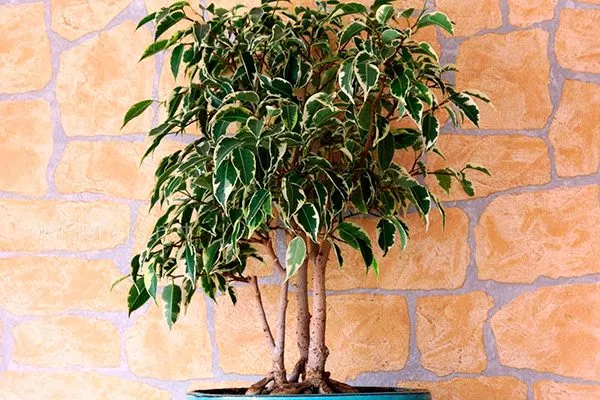
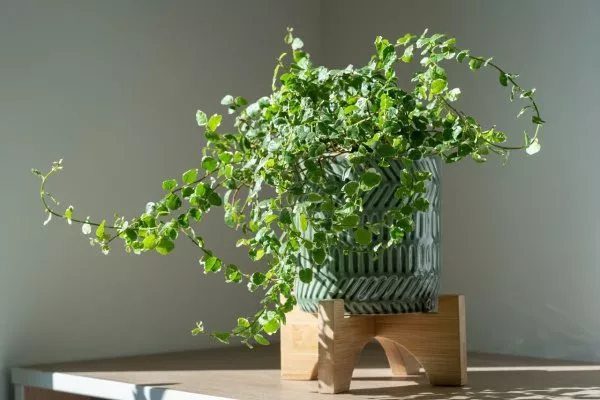
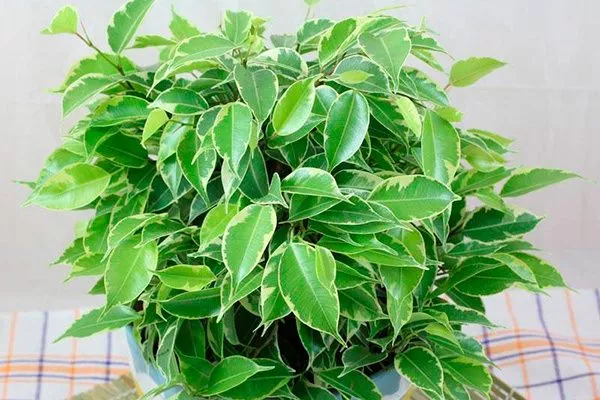
The most popular species for indoor growing
There are so many varieties of ficus that there are over 840 species alone. They grow not only in apartments and gardens, but also in the wild.
Only two species of ficus are most commonly used as houseplants: the rubber plant and the benjamina, and, less commonly, the lyrate and dwarf ficus. Each species has a vast number of cultivars.
| Name | Growth type | Leaf size | Care Features |
|---|---|---|---|
| Benjamin | Tree-like | Small ones | Requires diffused light |
| Rubber-bearing | Tree-like | Large | Does not tolerate drafts |
| Lyre-shaped | Tree-like | Large | Rapid growth |
| Dwarf | Ampelous | Small ones | Requires frequent replanting |
Benjamin
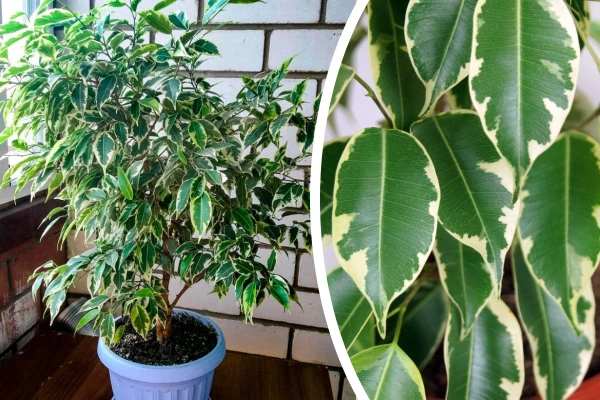
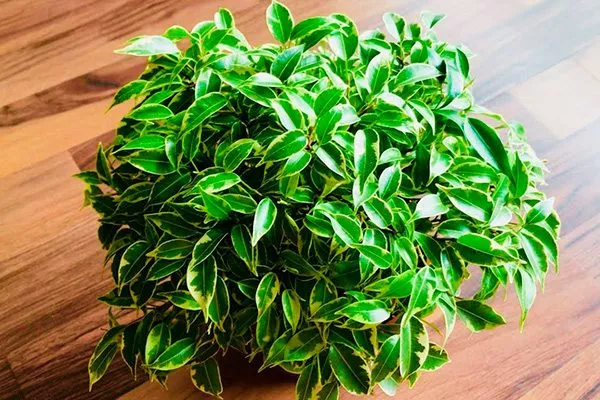
The most popular variety in indoor gardening. This plant resembles a small tree, with a slender trunk and small leaves. They can be solid-colored or have light veins. This depends on the specific variety. A key feature is that plants with green leaves should be placed in partial shade, while those with veins should be placed closer to the light.
Rubber-bearing
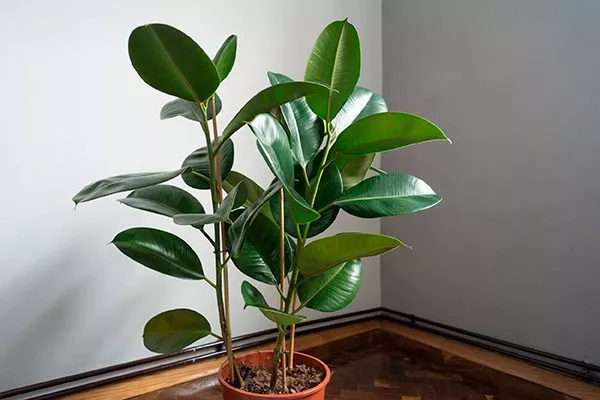
A distinctive feature of this species is that the bush consists of a single trunk that does not divide into side shoots. The leaves are always large and grow upward. They can be dark green or veined. This variety does not tolerate drafts and heat, so in winter, pots should be moved away from radiators.
Lyre-shaped
This is a large ficus tree, reaching up to 2 m in height. It is characterized by a trunk that is completely covered in foliage. The leaves, regardless of variety, are always light green, large, and have wavy edges. A distinctive feature of this species is its very rapid growth (in the first few years, it grows approximately 25 cm during the growing season).

Dwarf
It differs from other varieties in its compact trunk, but the growing stems can droop and creep along surfaces. The leaves are small and rounded.
To ensure shoot growth, special conditions must be created, including annual repotting into a larger pot. This is due to the plant's powerful root system, and if its growth stops, the development of the aboveground part is also inhibited.
Rules for growing and propagating ficus trees
Each species, and especially each variety, requires specific growing conditions. However, there are also general requirements. This applies to absolutely everything—air humidity, soil type, watering, fertilizing, pruning, etc.
Choosing soil and pot
The optimal container material for any ficus is clay, ceramic, or thick, high-quality plastic. The pot can be any shape, but a modest height is preferable. The main criterion is that the reservoir should be 30% larger than the volume of the plant's root system. If the container is too small, the plant will become diseased; if it's too large, it will stunt its growth.
- ✓ The pot must have drainage holes to prevent water stagnation.
- ✓ The pot material affects the temperature regime of the root system: ceramics retain coolness, plastic heats up quickly.
Gardeners are especially sensitive to soil composition, as all ficus prefer very loose soil with high water and air permeability. The optimal pH is between 5.5 and 7.5, depending on the variety.
The substrate can be purchased at a flower shop or made yourself from:
- leaf soil;
- river sand;
- peat.
Most often, gardeners plant ficuses in the following compositions:
- leaf soil – 2 parts, humus and peat – 1 part each;
- river sand – 1 part, leaf and turf soil – 2 parts each.
If the ficus is grown using the "bottle" method, then brick chips, gravel, pebbles, expanded clay, perlite, and the like are used as a substrate.
Lighting and air humidity
Light levels depend on the leaf type. Variegated plants (those with light veins) require a lot of light, as without it, the foliage will turn a uniform green. They should be placed on sunny windowsills, but during the hottest periods, it's advisable to provide some shade (not because of direct sunlight, but because of the high temperature).
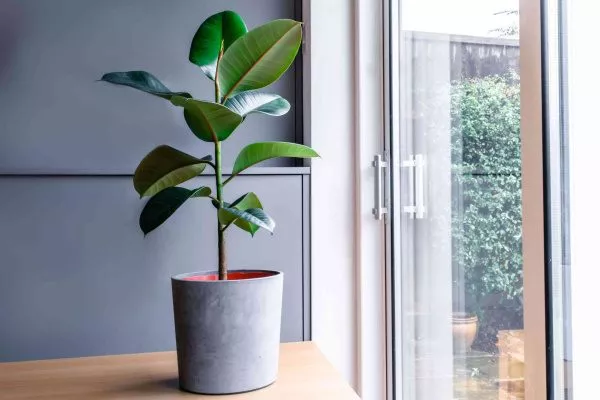
Varieties with solid-colored leaves are best placed 2-5 meters from the windowsill, as direct sunlight will cause the color to fade. However, constant partial shade is also harmful. Diffused light is optimal.
Other features:
- From spring to autumn, turn the pot in different directions, which will help the crown form beautifully and geometrically correctly;
- In winter, turn on artificial lighting, as the average daylight hours are 12-13 hours;
- the distance from the lamp to the flower is at least 50 cm.
All ficus prefer high humidity (not soil humidity), but only if the air temperature is at least 16 degrees Celsius. Humidity can be maintained by misting and wiping. Features:
- spray the crown with warm, settled water using a spray bottle;
- Wipe broadleaf varieties daily or every other day with a damp cloth to remove settling dust that prevents nutrients from passing through;
- Place a container of water next to the pot and add liquid constantly.
About once a month (some varieties less often, others more often), perform a shower. To do this, place the pot in a bathtub or large basin and slowly water the plant with a watering can equipped with a spray nozzle. Be sure to cover the soil surface with a plastic bag or thick cloth to prevent the soil from washing out of the container.
Temperature conditions
Ficus plants thrive in warmth and don't tolerate drafts. Each species and variety requires specific conditions. For example:
- for ficus benjamina the optimal temperature is +10 degrees;
- for dwarf Pumila – +8 degrees;
- for the rubber-bearing species, a temperature of +16 degrees and above is required;
- for lyrate ficus – +20…+25 degrees.
It is forbidden to place pots with ficuses on the floor or a cold windowsill - it is better to lay down foam plastic.
Methods of reproduction
Ficus trees reproduce in different ways:
- seeds – rarely used due to the length of the process and the impossibility of achieving maternal characteristics;
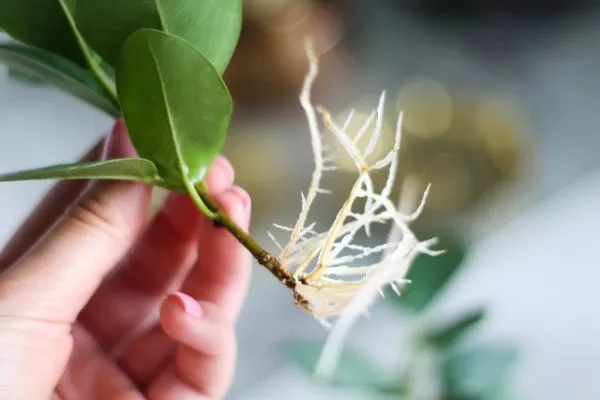
- cuttings are the best option;
- a leaf with a shoot is another alternative;
- air layering – used for epiphytes with aerial roots.
Landing and transplanting
To prevent the ficus from becoming wild and to ensure it continues to grow, it needs to be periodically repotted into a new, larger pot. However, if you don't want the plant to grow too large, skip the procedure.
Rules:
- repot annually until the plant reaches 5 years of age;
- at an older age, once every 2-3 years;
- after 10 years, you can simply replace the top layer of the soil mixture;
- transplant time - early spring.
How to plant/replant a ficus:
- Place drainage material (expanded clay, etc.) at the bottom of the pot. The layer should be 2-4 cm.
- On top are a few pieces of wood ash.
- Fill the container halfway with substrate.
- Place the seedling/flower and add the remaining soil.
- Moisten slightly.
Caring for flowers at home
The viability of a ficus depends on how well it's cared for. Each species and variety has its own specific parameters, but there are also general guidelines.
How to water a ficus?
Ficus trees thrive in high humidity, but they don't tolerate it in the soil, as it can cause rotting in the root system. Therefore, pay special attention to this parameter.
Other requirements:
- pour in enough liquid so that the water does not stagnate, but immediately penetrates into the pot;
- if the pot is wide and small, the soil dries out faster, so you will have to water it more often;
- in the cold season, water less often than in the warm season;
- The water must be at room temperature and left to stand for 2-3 days.

How to feed a ficus?
Ficus plants should be fed only during the growing season; this is not allowed during winter dormancy. Fertilizers should be rich in nitrogen, potassium, and phosphorus. Other minerals are also needed, so it's best to use a general-purpose commercial fertilizer. The plant also responds well to organic matter.
What can you feed it with:
- organic fertilizers – animal or plant humus, wood ash;
- superphosphate;
- ammonium nitrate and potassium nitrate;
- "Beauty for ficuses";
- succinic acid;
- "Gumisol";
- "Ideal";
- Ficus
- herbal infusions (nettle, etc.).
Fertilizer should be applied twice a month, but not more frequently. Be sure to alternate between applications.
Pruning and crown shaping
Ficus trees need pruning for good health and rapid growth, and shaping for beauty. The first trimming is done between early spring and early summer, but the earlier the better. By the time the active growing season begins, the cuts should have healed.
Types of pruning:
- sanitary - old stems are cut off, damaged and dried shoots are removed, wilted or too old leaves are torn off;
- rejuvenating - the oldest shoots are cut off at the base;
- pinching - the apical shoots are removed, thanks to which the crown will become lush.
The type of shaping depends on the ficus species: if it has a strong trunk, a lush crown is created; if it has flexible shoots, they are trained to grow in a specific direction. Intertwined options are particularly attractive. This is most often achieved by planting several ficus trees in a single pot, intertwining them, or shaping them in a specific direction.
How to braid a ficus?
Ficus benjamina are most often braided, as they are the easiest to braid and look unique. However, keep in mind that once braided, it's impossible to return the plant to its natural state.
Briefly about the rules:
- You can only braid young flowers while their shoots are still bendable;
- A day before the procedure, water the soil generously, which will make the stems more pliable.
Main methods:
- Spiral. To create a spiral shape, install a support post in the center and plant one or two ficus benjamina trees around it. If there's only one plant, the stem should curl around the support. If there are two, the vines should curl in opposite directions.
To ensure that the turns are at the same distance along the entire height, first mark the pole.
How to do this and the final result, see the video below:
- Lattice. Another name for this type of weaving is flat weaving. It requires at least eight cuttings, which are planted in a single row and interwoven like a trellis. They can be secured with soft wire or rope, clamps, etc. A trellis is considered a type of hedge.
To learn how to create a flat weave and the results, watch the video below:
- Circular weaving. The composition is similar to the previous one, but the technique is much more complex. There are two versions: simple and three-dimensional.
The video below shows how a circular hedge is woven and what the resulting plant looks like:
- Eight. The technique involves planting two seedlings side by side. The vines need to be crossed to form figure-eights. To learn how to do this, watch the following video:
- Pigtail. This is the most popular type of ficus weaving, but it's very difficult to achieve, as even the slightest mistake can result in a sloppy appearance. For example, if you weave tightly, you'll end up with a solid column; inserting sticks between the strands will add volume.
To learn how to braid a ficus tree correctly, watch this video:
How to choose a ficus?
The vast selection of not only species but also varieties of indoor ficus can make it difficult for a novice gardener to choose the right plant. Therefore, consider a few criteria:
- Decide what height you want your ficus to grow – in a large pot on the floor or in a small pot on a windowsill.
- Decide what look you want the bush to look like a tree or a flat houseplant with hanging stems.
It's also important to buy a healthy flower that will quickly take root and adapt to new conditions, so pay attention to the following criteria:
- the best time to purchase is spring and summer, since after purchase the flower will need to be transplanted into a new pot, and this is prohibited in autumn and winter;
- the optimal age is up to 3 years, since the older the ficus, the more difficult it is for it to adapt to a new place;
- the bush must be healthy, this can be easily checked - stroke it against the foliage, and if the leaves begin to fall off, discard this specimen;
- the roots should be exclusively light, not black or dark brown;
- The green mass should be glossy, without any diseased spots.
- ✓ Roots should be visible through the drainage holes, indicating good root system development.
- ✓ No white coating on the soil surface or pot walls, which may indicate overwatering or fungal diseases.
Can you keep a ficus tree at home? Signs and superstitions
There are many superstitious beliefs associated with ficuses, but no scientific evidence has been found. Nevertheless, some gardeners believe in them, and wonder if it's safe to keep these flowers indoors. Here are some legends associated with this exotic plant:
- Some people consider the ficus to be a husband-killer, meaning that men will not thrive in a house where the plant is present.
- If the leaves are waxy, they can bring not only discord into the family, but also envy and gossip around the owner of the ficus.
- Asians and Africans, on the contrary, believe that having a ficus tree in the home brings happiness, especially to women, good luck, wealth, and other blessings. Many believe that the appearance of the flowers increases financial well-being, while others believe it heralds an addition to the family (the birth of a child).
- Researchers claim that having a ficus tree in your home helps purify the air of substances such as xylene, formaldehyde, acetone, etc.
- According to Feng Shui, a flower should be placed in a specific room. If it's in the kitchen, there will always be money in the house; if it's in the bedroom, there will be children; if it's in the living room, there will be happiness; if it's in the hallway, there will be continued productivity; and if it's in the study, there will be improved productivity.
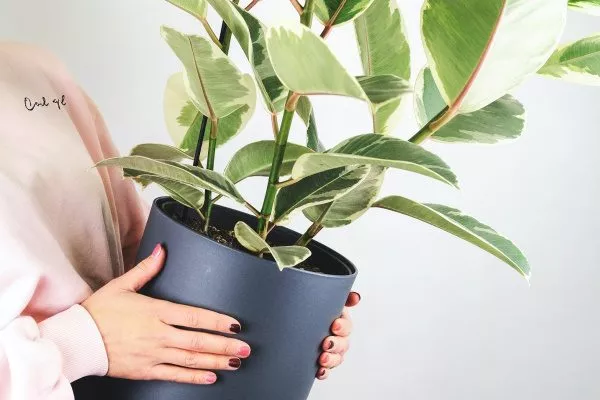
Pregnant women are very wary of having a ficus in their home, mistakenly believing the flower will cause harm. In fact, it should not be grown if a woman suffers from bronchial asthma or has an allergic reaction to these flowers.
Some people believe that ficus promotes conception, but for this to happen, a special ritual must be performed:
- Buy a ficus, but it's better to steal it from a house where there are children.
- Place the pot in your bedroom in the most visible place and closer to the marital bed.
- Care for the plant as if it were a child.
All that remains is to wait for the ficus to begin actively growing and developing. Supposedly, conception can be expected at this point.
As for pets—cats, dogs, canaries, etc.—who might accidentally feast on the juicy, fleshy leaves, you need to be careful. The milky sap contains toxic substances. These poisons are often fatal. Therefore, try to keep the pots away from animals, and especially small children.
What problems arise?
Ficus isn't considered a particularly fussy houseplant, but if planting and care guidelines aren't followed, some problems can arise. The most common ones are:
- The leaves are falling. If the plant is old or deciduous, the leaves will fall in autumn, which is completely normal. If the bush is younger and not deciduous, look for the following causes:
- the flower is cold or hot;
- dry air or soil.
- The leaves are turning yellow. There are many possible causes for this, including exposure to direct sunlight and insufficient watering. However, the most common causes are pests or diseases. These include cercospora leaf spot, anthracnose, and root rot.
- Spots and plaque on the above-ground part. They can be brown or black, and sometimes a white coating appears. This indicates a fungal infection of the ficus. The problem is compounded by leaf curling.
- Slow growth along with yellowing and leaf drop. This most often occurs in winter due to insufficient lighting. Read more about growing ficus in winter. here.
- The plant is withering. There is one reason – incorrect temperature conditions.
- Drying of the stem. This occurs due to drafts. The second stage is the sudden drop of leaves.
- Top dieback. The cause is overwatering of the substrate. Along with this, other symptoms appear, such as rot and leaf discoloration.
- Drying of foliage. This occurs when there's a lack of moisture. First, the leaves dry out, then curl up and fall off.
- Sudden death of a flower. The main negative factor is overfertilization. This causes severe root burn. This can occur when applying too much fertilizer, for example, 300-400 ml instead of 200 ml. Or when the concentration of the product is too high. For example, if the instructions say 20 g of product per 1 liter of water, but you applied 30 g.
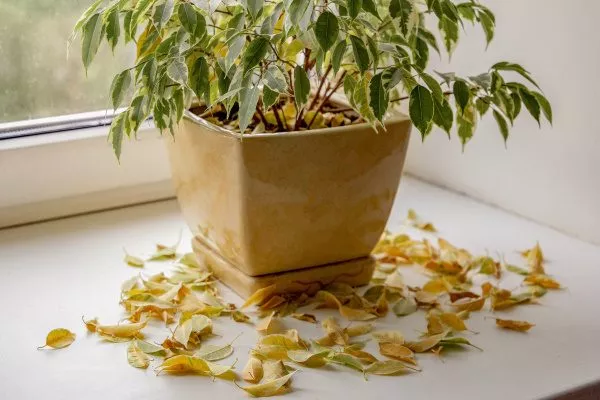
If a problem arises, act immediately, but first analyze the cause. If disease or pests are the cause, treat the plant, fertilize, and create the most favorable conditions.
Reviews
Growing a ficus indoors is a simple process. Moreover, the plant responds very well to good care, resulting in rapid growth. To add variety to your windowsill plantings, braid the ficus, create a trellis, or create a hedge, and wow your guests.